Kirjahaku
Etsi kirjoja tekijän nimen, kirjan nimen tai ISBN:n perusteella.
1000 tulosta hakusanalla JAMES JOYCE

Irish writer James Joyce's first novel, A Portrait of the Artist as a Young Man, was published in 1916. It is a K nstlerroman written in a modernist style that follows the religious and intellectual awakening of young Stephen Dedalus, Joyce's fictional alter ego whose surname alludes to Daedalus, the consummate craftsman in Greek mythology. Stephen questions and rebels against the Catholic and Irish conventions that shaped his upbringing, culminating in his self-exile from Ireland to Europe. The work employs techniques that Joyce expanded on in Ulysses (1922) and Finnegan's Wake (1939).Joyce began A Portrait in 1904 as Stephen Hero, a 63-chapter autobiographical novel written in a realistic style. In 1907, Joyce abandoned Stephen Hero after 25 chapters and began reworking its themes and protagonist into a condensed five-chapter novel, eschewing strict realism and making extensive use of free indirect speech that allows the reader to peer into Stephen's evolving consciousness. Ezra Pound, an American modernist poet, serialized the novel in the English literary magazine The Egoist in 1914 and 1915, and B. W. Huebsch of New York published it as a book in 1916. The publication of A Portrait and the short story collection Dubliners (1914) propelled Joyce to the forefront of literary modernism.

Publicado en 1914, Dublineses es uno de los libros de relatos m s unitarios y perfectos alumbrados por un autor. Pese a gravitar en su totalidad en torno a Dubl n y sus personajes enmarcados en un periodo hist rico muy concreto (el que habr a de anteceder en breve a la independencia de la cat lica Irlanda respecto al protestante Reino Unido, y sobre todo Inglaterra), James Joyce (1882-1941) muestra en los quince cuentos que integran la obra una sensibilidad y penetraci n dif cilmente igualables a la hora de captar la naturaleza humana en sus distintas edades y condiciones, as como en el laberinto de las relaciones personales y sociales. La impecable estructura del libro, que parte de las primeras experiencias infantiles para ir recorriendo el arco de la existencia humana, culmina en esa obra maestra que es el relato titulado Los muertos sin duda alguna una de las cumbres del g nero.

Dubliners is a collection of 15 short stories by James Joyce, first published in 1914. The fifteen stories were meant to be a naturalistic depiction of the Irish middle class life in and around Dublin in the early years of the 20th century. The stories were written at the time when Irish nationalism was at its peak, and a search for a national identity and purpose was raging; at a crossroads of history and culture, Ireland was jolted by various converging ideas and influences. They center on Joyce's idea of an epiphany: a moment where a character has a special moment of self-understanding or illumination. Many of the characters in Dubliners later appear in minor roles in Joyce's novel Ulysses. The initial stories in the collection are narrated by children as protagonists, and as the stories continue, they deal with the lives and concerns of progressively older people. This is in line with Joyce's tripartite division of the collection into childhood, adolescence and maturity.
Dubliners is a collection of 15 short stories by James Joyce, first published in 1914. The fifteen stories were meant to be a naturalistic depiction of the Irish middle class life in and around Dublin in the early years of the 20th century. The stories were written at the time when Irish nationalism was at its peak, and a search for a national identity and purpose was raging; at a crossroads of history and culture, Ireland was jolted by various converging ideas and influences. They center on Joyce's idea of an epiphany: a moment where a character has a special moment of self-understanding or illumination. Many of the characters in Dubliners later appear in minor roles in Joyce's novel Ulysses. The initial stories in the collection are narrated by children as protagonists, and as the stories continue, they deal with the lives and concerns of progressively older people. This is in line with Joyce's tripartite division of the collection into childhood, adolescence and maturity.
Dubliners is a collection of 15 short stories by James Joyce, first published in 1914. The fifteen stories were meant to be a naturalistic depiction of the Irish middle class life in and around Dublin in the early years of the 20th century. The stories were written at the time when Irish nationalism was at its peak, and a search for a national identity and purpose was raging; at a crossroads of history and culture, Ireland was jolted by various converging ideas and influences. They center on Joyce's idea of an epiphany: a moment where a character has a special moment of self-understanding or illumination. Many of the characters in Dubliners later appear in minor roles in Joyce's novel Ulysses. The initial stories in the collection are narrated by children as protagonists, and as the stories continue, they deal with the lives and concerns of progressively older people. This is in line with Joyce's tripartite division of the collection into childhood, adolescence and maturity.
A Portrait of the Artist as a Young Man
James Joyce
Createspace Independent Publishing Platform
2017
nidottu
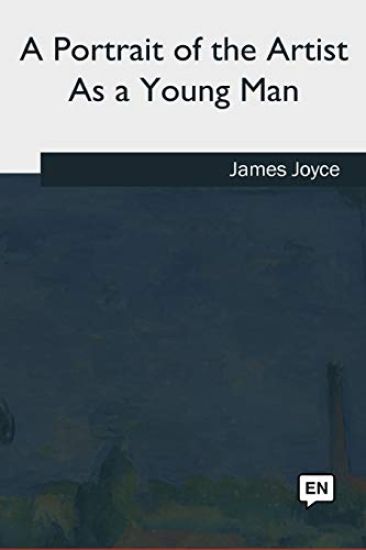
Perhaps Joyce's most personal work, A Portrait of the Artist as a Young Man depicts the intellectual awakening of one of literature's most memorable young heroes, Stephen Dedalus. Through a series of brilliant epiphanies that parallel the development of his own aesthetic consciousness, Joyce evokes Stephen's youth, from his impressionable years as the youngest student at the Clongowed Wood school to the deep religious conflict he experiences at a day school in Dublin, and finally to his college studies where he challenges the conventions of his upbringing and his understanding of faith and intellectual freedom. James Joyce's highly autobiographical novel was first published in the United States to immediate acclaim. Ezra Pound accurately predicted that Joyce's book would "remain a permanent part of English literature," while H.G. Wells dubbed it "by far the most important living and convincing picture that exists of an Irish Catholic upbringing." A remarkably rich study of a developing young mind, this work made an indelible mark on literature and confirmed Joyce's reputation as one of the world's greatest and lasting writers.

Ulysses is a modernist novel by Irish writer James Joyce. It was first serialised in parts in the American journal The Little Review from March 1918 to December 1920 and then published in its entirety in Paris by Sylvia Beach on 2 February 1922, Joyce's 40th birthday. It is considered to be one of the most important works of modernist literature and has been called "a demonstration and summation of the entire movement". According to Declan Kiberd, "Before Joyce, no writer of fiction had so foregrounded the process of thinking". Ulysses chronicles the peripatetic appointments and encounters of Leopold Bloom in Dublin in the course of an ordinary day, 16 June 1904. Ulysses is the Latinised name of Odysseus, the hero of Homer's epic poem Odyssey, and the novel establishes a series of parallels between the poem and the novel, with structural correspondences between the characters and experiences of Leopold Bloom and Odysseus, Molly Bloom and Penelope, and Stephen Dedalus and Telemachus, in addition to events and themes of the early 20th century context of modernism, Dublin, and Ireland's relationship to Britain. The novel is highly allusive and also imitates the styles of different periods of English literature. Since publication, the book has attracted controversy and scrutiny, ranging from the 1921 obscenity trial in America to protracted textual "Joyce Wars". Ulysses' stream-of-consciousness technique, careful structuring, and experimental prose-full of puns, parodies, and allusions-as well as its rich characterisation and broad humour, have led it to be regarded as one of the greatest literary works. Joyce fans worldwide now celebrate 16 June as Bloomsday. Ulysses is approximately 265,000 words in length and Joyce divided it into eighteen episodes.
Dubliners is a collection of 15 short stories by James Joyce, first published in 1914. The fifteen stories were meant to be a naturalistic depiction of the Irish middle class life in and around Dublin in the early years of the 20th century. The stories were written at the time when Irish nationalism was at its peak, and a search for a national identity and purpose was raging; at a crossroads of history and culture, Ireland was jolted by various converging ideas and influences. They center on Joyce's idea of an epiphany: a moment where a character has a special moment of self-understanding or illumination. Many of the characters in Dubliners later appear in minor roles in Joyce's novel Ulysses. The initial stories in the collection are narrated by children as protagonists, and as the stories continue, they deal with the lives and concerns of progressively older people. This is in line with Joyce's tripartite division of the collection into childhood, adolescence and maturity.
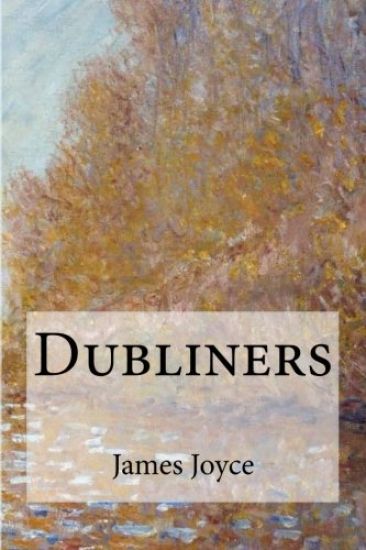
Dubliners is a collection of fifteen short stories by James Joyce. They form a naturalistic depiction of Irish middle class life in and around Dublin in the early years of the 20th century. The stories were written when Irish nationalism was at its peak, and a search for a national identity and purpose was raging; at a crossroads of history and culture, Ireland was jolted by various converging ideas and influences. They centre on Joyce's idea of an epiphany: a moment where a character experiences a life-changing self-understanding or illumination. Many of the characters in Dubliners later appear in minor roles in Joyce's novel Ulysses. The initial stories in the collection are narrated by child protagonists, and as the stories continue, they deal with the lives and concerns of progressively older people. This is in line with Joyce's tripartite division of the collection into childhood, adolescence and maturity.
A Portrait of the Artist As a Young Man
James Joyce
Createspace Independent Publishing Platform
2018
nidottu
Once upon a time and a very good time it was there was a moocow coming down along the road and this moocow that was coming down along the road met a nicens little boy named baby tuckoo.... His father told him that story: his father looked at him through a glass: he had a hairy face. He was baby tuckoo. The moocow came down the road where Betty Byrne lived: she sold lemon platt. O, the wild rose blossoms On the little green place. He sang that song. That was his song. O, the green wothe botheth. When you wet the bed, first it is warm then it gets cold. His mother put on the oilsheet. That had the queer smell. His mother had a nicer smell than his father. She played on the piano the sailor's hornpipe for him to dance. He danced: Tralala lala, Tralala tralaladdy, Tralala lala, Tralala lala.
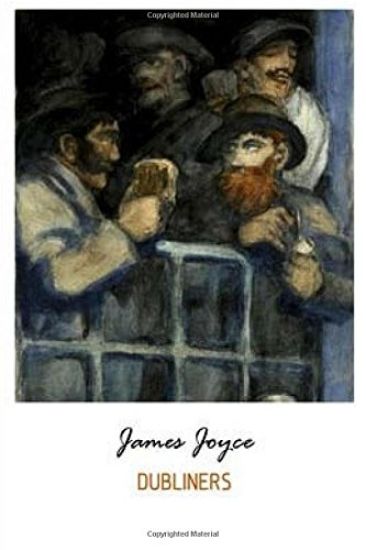
Dubliners is a collection of fifteen short stories by James Joyce, first published in 1914. They form a naturalistic depiction of Irish middle class life in and around Dublin in the early years of the 20th century. The stories were written when Irish nationalism was at its peak, and a search for a national identity and purpose was raging; at a crossroads of history and culture, Ireland was jolted by various converging ideas and influences. They centre on Joyce's idea of an epiphany: a moment where a character experiences a life-changing self-understanding or illumination. Many of the characters in Dubliners later appear in minor roles in Joyce's novel Ulysses. The initial stories in the collection are narrated by child protagonists, and as the stories continue, they deal with the lives and concerns of progressively older people. This is in line with Joyce's tripartite division of the collection into childhood, adolescence and maturity.