Kirjojen hintavertailu. Mukana 11 342 296 kirjaa ja 12 kauppaa.

Kirjahaku

Etsi kirjoja tekijän nimen, kirjan nimen tai ISBN:n perusteella.

1000 tulosta hakusanalla James Runciman

James Joseph Sylvester

James Joseph Sylvester

Karen Hunger Parshall

Johns Hopkins University Press
2006
sidottu
Here, in this first biographical study of James Joseph Sylvester, Karen Hunger Parshall makes a signal contribution to the history of mathematics, Victorian history, and the history of science. A brilliant Cambridge student at first denied a degree because of his faith, Sylvester came twice to America to teach mathematics, ultimately becoming one of Daniel Coit Gilman's faculty recruits at Johns Hopkins in 1876 and winning the coveted Savilian Professorship of Geometry at Oxford in 1883. He held professorships of natural philosophy, worked as an actuary, was called to the bar, and taught mathematics to cadets training for engineering and artillery posts in the British Army. During his long, distinguished career he also edited England's Quarterly Journal of Pure and Applied Mathematics and established the American Journal of Mathematics, the first sustained mathematics research journal in the United States. Situating Sylvester's life within the political, religious, mathematical, and social currents of nineteenth-century England, Parshall penetrates the myth of this venerated figure, revealing how he lived, the choices he made and why, how the world in which he lived affected him-and how he affected that world. The story of Sylvester's life sheds light on the evolution of mathematical thought. It also examines the ways in which mathematics may be done and what factors may shape a mathematician's ideas. Parshall explores the development of academic professionalization, nineteenth-century mathematical culture, and the emergence of modern algebra as a mathematical discipline. She highlights the human side of what many view as that most arcane and otherworldly of intellectual endeavors, mathematics, which indeed answers to such diverse factors as religion, ego, and depression.
James Joyce's Techno-Poetics

James Joyce's Techno-Poetics

Donald Theall

University of Toronto Press
1997
sidottu
James Joyce's Techno-Poetics is on the cutting edge of an original and exciting new trend in Joycean studies, as it combines the study of literature, technology, and communication to reveal James Joyce as 'a key figure in the history of cyberculture.' Donald Theall examines for the first time how Joyce conceived of the artist as an engineer and the artist's works as constructions, and reveals the importance of Joyce's understanding of the direction of a developing technoculture. Theall explores the interrelationships between the machinic and the processes of encoding, decoding, reading, writing, and interpreting in Joyce's self-reflexive treatment of the book in Finnegans Wake. By situating this project in relation to memory and cultural production, Theall argues that Joyce's radical paramodern poetic practice has important implications for a wide variety of subsequent cultural and theoretical movements: dramatism, poststructuralism, semiology, and hypertextuality. Theall places Joyce in the context of other modern thinkers, such as Benjamin and Bataille, and draws a direct line of influence from Joyce to Marshall McLuhan and Neuromancer author William Gibson. This is a remarkable and innovative work that makes an important contribution not only to Joycean studies, but to literary theory, modernism, cultural analysis, the history of ideas, and the relationship between literature, science, and technology.
St. James

St. James

James B. Adamson

William B Eerdmans Publishing Co
1989
pokkari
Ageless in its appeal, the Epistle of James, says James B. Adamson, is essentially a prophetic protest that is supremely relevant to the urgent ethical and social issues confronting the modern church. This book is an independent sequel, companion, and complement to the author's commentary on James in the New International Commentary on the New Testament series. Writing primarily for interested laypersons, students, and pastors, but also for scholars, Adamson thoroughly investigates the intriguing questions surrounding the epistle and its author and offers some fresh solutions.
James River Chiefdoms

James River Chiefdoms

Martin D. Gallivan

University of Nebraska Press
2003
sidottu
James River Chiefdoms explores puzzling discrepancies between the ethnohistoric and archaeological records of the Powhatan and Monacan societies Jamestown colonists met in 1607. The colonists described the coastal Powhatans and the Monacans of the James River interior in terms that evoke the anthropological notion of a chiefdom, but the Chesapeake region's archaeological record lacks elements typically associated with complex polities. In an effort to account for these apparent incongruities, Martin D. Gallivan synthesizes ethnohistoric accounts with the archaeology of thirty-five Native settlements dating from A.D. 1–1610 to identify and illuminate social changes largely undetected by previous research. A comparative, quantitative analysis of residential archaeology in the James River Valley highlights a rearrangement of daily practices within Native villages between 1200 and 1500. James River villagers reorganized their domestic production, settlements, and regional interactions to create new funds of power within social settings perched between communally oriented cultural practices and exclusionary political strategies. During the early-seventeenth-century colonial encounter, Native leaders were thus positioned to employ strategies that, for a time, eclipsed communal decision-making structures in the Chesapeake. James River Chiefdoms presents a novel perspective on an important chapter in the history of Native peoples in eastern North America and on early colonial America. It offers an innovative interpretive approach to Native American culture history and the emergence of hierarchical political organizations in the Americas.
The Life and Adventures of James P. Beckwourth

The Life and Adventures of James P. Beckwourth

James P. Beckwourth

University of Nebraska Press
1981
pokkari
Throughout his long and lusty life, James P. Beckwourth epitomized much of the best and the worst of a fabulous breed, the mountain men of the early West. Trapper, hunter, guide, horse thief, Indian fighter, and Indian chief, he also took part in the Seminole and Mexican wars and the California gold rush before he dictated his memoirs to an itinerant newspaperman, Thomas D. Bonner. Beckwourth was the only black mountain man to record his story; his autobiography, first published in 1856, is a classic of its kind, the western adventure story par excellence. But because it mixes fact and fiction it has long been regarded with suspicion. This edition reproduces the original 1856 printing, and adds notes and an epilogue by Professor Delmont R. Oswald to assist the reader in sifting Beckwourth's life from the legend Beckwourth preferred to create.
James T. Farrell and Baseball

James T. Farrell and Baseball

Charles DeMotte

University of Nebraska Press
2019
sidottu
James T. Farrell and Baseball is a social history of baseball on Chicago’s South Side, drawing on the writings of novelist James T. Farrell along with historical sources. Charles DeMotte shows how baseball in the early decades of the twentieth century developed on all levels and in all areas of Chicago, America’s second largest city at the time, and how that growth intertwined with Farrell’s development as a fan and a writer who used baseball as one of the major themes of his work. DeMotte goes beyond Farrell’s literary focus to tell a larger story about baseball on Chicago’s South Side during this time-when Charles Comiskey’s White Sox won two World Series and were part of a rich baseball culture that was widely played at the amateur, semipro, and black ball levels. DeMotte highlights the 1919–20 Black Sox fix and scandal, which traumatized not only Farrell and Chicago but also baseball and the broader culture. By tying Farrell’s fictional and nonfictional works to Chicago’s vibrant baseball history, this book fills an important gap in the history of baseball during the Deadball Era.
James B. Conant

James B. Conant

James G. Hershberg

Stanford University Press
1995
nidottu
James B. Conant (1893-1978) was one of the giants of the American establishment in the twentieth century. President of Harvard University from 1933 to 1953, he was also a scientist who led the US government's effort to develop weapons of mass destruction, and his story mirrors the transition of the United States from isolationism to global superpower at the dawn of the nuclear age. 'This splendid portrait of Conant ...illuminates the life of a pivotal figure in the making of US nuclear, scientific, educational, and foreign policy for almost half a century. But the book is much more: it is not only an insightful narration of Conant's life, it is also a brilliant and important account of the making of the nuclear age, a chronicle that contains much that is new.' TheWashington Post 'The bomb would be as much Conant's as it was anyone's in government. His inner response to that burden of responsibility has long been obscured, but it is illumined here ...This is a model of historiography that is evocative reading.' The New York Times Book Review 'Vibrantly written and compelling, it breaches Conant's shield of public discretion in masterly fashion ...It is a huge, ambitious work - a history of the Cold War as Conant encountered it as well as a study of the man.' The New Yorker 'Magnificent ...Any reader interested in nuclear weapons, Cold War history, or American politics from FDR to JFK will find this biography riveting.'
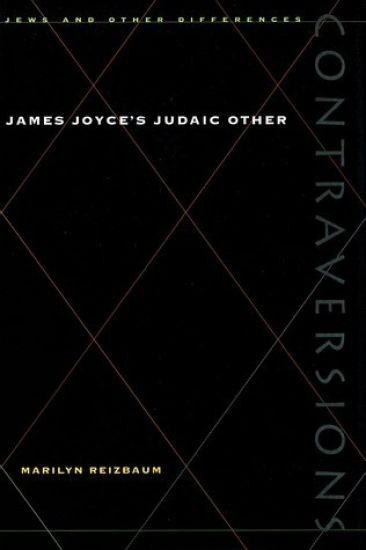
James Joyce's Judaic Other

James Joyce's Judaic Other

Marilyn Reizbaum

Stanford University Press
1999
sidottu
How does recent scholarship on ethnicity and race speak to the Jewish dimension of James Joyce's writing? What light has Joyce himself already cast on the complex question of their relationship? This book poses these questions in terms of models of the other drawn from psychoanalytic and cultural studies and from Jewish cultural studies, arguing that in Joyce the emblematic figure of otherness is "the Jew." The work of Emmanuel Levinas, Sander Gilman, Gillian Rose, Homi Bhabha, among others, is brought to bear on the literature, by Jews and non-Jews alike, that has forged the representation of Jews and Judaism in this century. Joyce was familiar with this literature, like that of Theodor Herzl. Joyce sholarship has largely neglected even these sources, however, including Max Nordau, who contributed significantly to the philosophy of Zionism, and the literature on the "psychobiology" of race—so prominent in the fin de siècle—all of which circulates around and through Joyce's depictions of Jews and Jewishness. Several Joyce scholars have shown the significance of the concept of the other for Joyce's work and, more recently, have employed a variety of approaches from within contemporary deliberations of the ideology of race, gender, and nationality to illuminate its impact. The author combines these approaches to demonstrate how any modern characterization of otherness must be informed by historical representations of "the Jew" and, consequently, by the history of anti-Semitism. She does so through a thematics and poetics of Jewishness that together form a discourse and method for Joyce's novel.
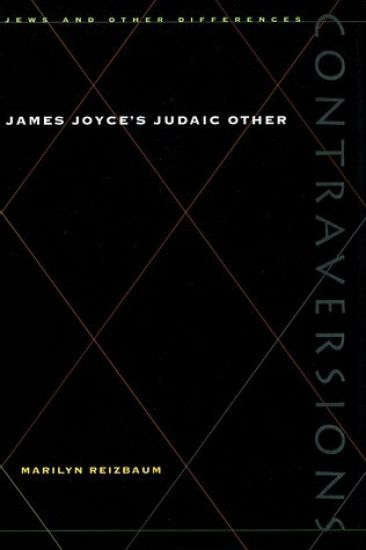
James Joyce’s Judaic Other

James Joyce’s Judaic Other

Marilyn Reizbaum

Stanford University Press
1999
pokkari
How does recent scholarship on ethnicity and race speak to the Jewish dimension of James Joyce’s writing? What light has Joyce himself already cast on the complex question of their relationship? This book poses these questions in terms of models of the other drawn from psychoanalytic and cultural studies and from Jewish cultural studies, arguing that in Joyce the emblematic figure of otherness is “the Jew.” The work of Emmanuel Levinas, Sander Gilman, Gillian Rose, Homi Bhabha, among others, is brought to bear on the literature, by Jews and non-Jews alike, that has forged the representation of Jews and Judaism in this century. Joyce was familiar with this literature, like that of Theodor Herzl. Joyce sholarship has largely neglected even these sources, however, including Max Nordau, who contributed significantly to the philosophy of Zionism, and the literature on the “psychobiology” of race—so prominent in the fin de siècle—all of which circulates around and through Joyce’s depictions of Jews and Jewishness. Several Joyce scholars have shown the significance of the concept of the other for Joyce’s work and, more recently, have employed a variety of approaches from within contemporary deliberations of the ideology of race, gender, and nationality to illuminate its impact. The author combines these approaches to demonstrate how any modern characterization of otherness must be informed by historical representations of “the Jew” and, consequently, by the history of anti-Semitism. She does so through a thematics and poetics of Jewishness that together form a discourse and method for Joyce’s novel.
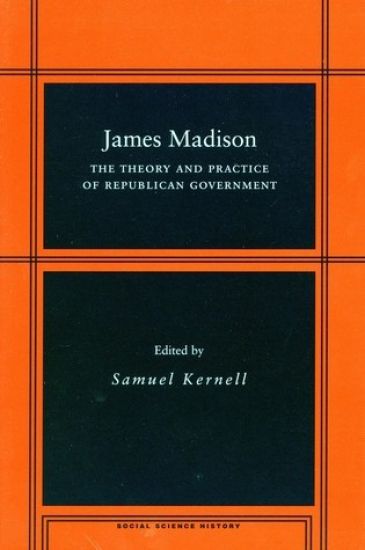
James Madison

James Madison

Stanford University Press
2003
sidottu
In recent years, the study of James Madison and his contributions to early American politics has enjoyed a growing audience among scholars and students of modern American politics. Not only did Madison establish the fundamental American concept of pluralism, his appreciation of the logic of institutional design as a key to successful democratic reform still influences modern theory and research. This book evaluates the legacy of James Madison as the product of a scholarly politician—a politician who thought carefully about institutions in the context of action. It brings together thoughtful responses to Madison and his theory from a broad cross-section of modern political science, and views Madison not as an icon or mouthpiece of an era, but as a "modern" political scientist who was able to implement many of his theoretical ideas in a practical forum.
James Madison

James Madison

Stanford University Press
2005
pokkari
In recent years, the study of James Madison and his contributions to early American politics has enjoyed a growing audience among scholars and students of modern American politics. Not only did Madison establish the fundamental American concept of pluralism, his appreciation of the logic of institutional design as a key to successful democratic reform still influences modern theory and research. This book evaluates the legacy of James Madison as the product of a scholarly politician—a politician who thought carefully about institutions in the context of action. It brings together thoughtful responses to Madison and his theory from a broad cross-section of modern political science, and views Madison not as an icon or mouthpiece of an era, but as a "modern" political scientist who was able to implement many of his theoretical ideas in a practical forum.
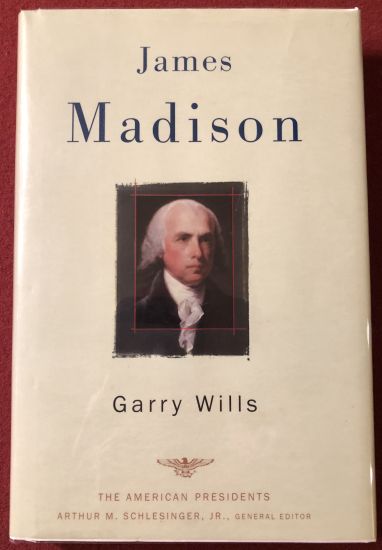
James Madison

James Madison

Garry Wills; Arthur M. Schlesinger

Henry Holt Company Inc
2003
sidottu
A bestselling historian examines the life of a Founding Father.Renowned historian and social commentator Garry Wills takes a fresh look at the life of James Madison, from his rise to prominence in the colonies through his role in the creation of the Articles of Confederation and the first Constitutional Congress. Madison oversaw the first foreign war under the constitution, and was forced to adjust some expectations he had formed while drafting that document. Not temperamentally suited to be a wartime President, Madison nonetheless confronted issues such as public morale, internal security, relations with Congress, and the independence of the military. Wills traces Madison's later life during which, like many recent Presidents, he enjoyed greater popularity than while in office. Garry Willis is a Pulitzer Prize-winning historian and cultural critic, and a professor of history at Northwestern University. A recipient of the National Book Award, his many books include Lincoln at Gettysburg, Reagon's America, Witches and Jesuits, and a Biography of Saint Augustine. He lives in Evanston, Illinois. Arthur M. Schlesinger, Jr., is arguably the preeminent political historian of our time. For more than half a century, he has been a cornerstone figure in the intellectual life of the nation and a fixture on the political scene. He served as a special assistant to John F. Kennedy; won two Pulitzer Prizes for The Age of Jackson (1946) and A Thousand Days (1966); and in 1998 received the National Humanities Medal. He published the first volume of his autobiography, A Life in the Twentieth Century, in 2000.
James Monroe

James Monroe

Gary Hart

Times Books
2005
sidottu
A thorough analysis of America's fifth president looks at the military and political accomplishments of James Monroe, describing his service during the Revolutionary War; his diverse roles as senator, governor, ambassador, secretary of state, secretary of war, and president; and his creation of the Monroe Doctrine as a policy to establish American national security.
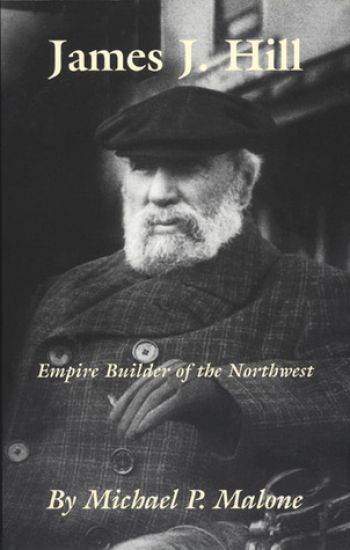
James J. Hill

James J. Hill

Michael P. Malone

University of Oklahoma Press
1997
nidottu
In this volume, Michael P. Malone provides a succinct interpretive biography of James J. Hill, the ""Empire Builder""-so called for his work in developing the region of the United States between the Great Lakes and the Pacific Northwest.Malone explores Hill's complex life and personality, his activities and interests, and recreates both the story of the railroad race to the Pacific and the complex interactions involved in the development of the region.""Michael Malone has written a model. . . .interpretative biography of James J. Hill. He has drawn on the research of others, published and unpublished, as he says, but also on his own knowledge of American economic development in Hill's time as a leading historian of mining and of a state in whose development Hill's railroads were major factors."" -Earl Pomeroy, Professor of History, Retired, University of Oregon and University of California, San Diego
James Henry Hammond and the Old South

James Henry Hammond and the Old South

Drew Gilpin Faust

Louisiana State University Press
1985
nidottu
From his birth in 1807 to his death in 1864 as Sherman's troops marched in triumph toward South Carolina, James Henry Hammond witnessed the rise and fall of the cotton kingdom of the Old South. Planter, politician, and partisan of slavery, Hammond built a career for himself that in its breadth and ambition provides a composite portrait of the civilisation in which he flourished.A long-awaited biography, Drew Gilpin Faust's James Henry Hammond and the Old South reveals the South Carolina planter who was at once characteristic of his age and unique among men of his time. Of humble origins, Hammond set out to conquer his society, to make himself a leader and a spokesman for the Old South. Through marriage he acquired a large plantation and many slaves, and then through shrewd management and progressive farming techniques he soon became one of the wealthiest men in South Carolina. He was elected to the United States House of Representatives and served as governor of his state. A scandal over his personal life forced him to retreat for many years to his plantation, but eventually he returned to public view, winning a seat in the United States Senate that he resigned when South Carolina seceded from the Union.James Henry Hammond's ambition was unquenchable. It consumed his life, directed almost his every move, and ultimately, in its titanic calculation and rigidity, destroyed the man confined within it. Like Faulkner's Thomas Sutpen, Faust suggests, Hammond had a ""design,"" a compulsion to direct every moment of his life toward self-aggrandizement and legitimation. Hammond envisioned himself as the benevolent, paternal, but absolute master of his family and his slaves. But in reality, neither his family, his slaves, nor even his own behavior was completely under his command. Hammond ardently wished to perfect and preserve the southern way of life. But these goals were also beyond his control. At the time of his death it had become clear to him that his world, the world of the Old South, had ended.
James Dickey and the Gentle Ecstasy of Earth

James Dickey and the Gentle Ecstasy of Earth

Robert Kirschten

Louisiana State University Press
1999
nidottu
Robert Kirschten maintains that most formal analyses of Jams Dickey's poetry have been unsatisfactory or at best only partially complete. Some critics have labeled Dickey an American romantic, while others have called him a mystic, a pantheist, a comic poet.In James Dickey and the Gentle Ecstasy of Earth, Kirschten provides a fuller understanding of Dickey's lyric vision by employing what Ronald Crane calls ""multiple working hypotheses."" The first three of these, mysticism, neoplatonism, and romanticism, serve primarily to align general traits in Dickey's poetry with familiar literary traditions. The fourth of Kirschten's hypotheses, primitivism, is drawn from the field of anthropology. Kirschten shows that such anthropological concepts as magic, rites of passage, and ritual violence are vital in describing Dickey's central methods.After synthesizing the four hypotheses to establish a critical base, Kirschten investigates three crucial elements in Dickey's poetry: his lyric speakers, central narrative devices, and poetic diction. The final chapter, in a culmination of the entire investigation, offers a reading of the long poem ""The Shark's Parlor.""Kirschten's study reveals a sure grasp of the philosophical principles of literary criticism as well as a wide range of reading, especially in the literature of romanticism. This lucid examination gives us genuine new insights into the work of one of the country's premier poets.