Kirjojen hintavertailu. Mukana 12 016 292 kirjaa ja 12 kauppaa.

Kirjahaku

Etsi kirjoja tekijän nimen, kirjan nimen tai ISBN:n perusteella.

1000 tulosta hakusanalla Justin Booth

Comprehensive Aural Skills

Comprehensive Aural Skills

Justin Merritt; David Castro

Routledge
2020
nidottu
Comprehensive Aural Skillsis a complete suite of material for both performance and dictation, covering the wide range of sight singing and ear training skills required for undergraduate courses of study. It provides a series of instructional modules on rhythm, melody, and harmony, and blends musical examples from the common-practice repertory with original examples composed to specifically address particular skills and concepts. Each module includes material for classroom performance, self-directed study, and homework assignments.FeaturesA complete suite of aural skills material: Comprehensive Aural Skillsis a combined sight singing and ear training textbook, audio, and companion website package. Fully modular, customizable organization: Instructors can choose freely from the set of exercises in the book and supplemental material on the companion website to appropriately tailor the curriculum based on their students’ needs. Engaging and idiomatic musical examples: Examples are selected and composed specifically for the didactic context of an aural skills classroom. Dictation exercises for practice and assignment: Practice exercises include an answer key so students can work independently and receive immediate feedback, while homework assignments are given without a key. Audio examples for dictation: The website hosts live recordings of acoustic instruments performed by professional musicians for each dictation exercise and homework assignment. Supplemental materials for instructors: A wealth of material for class use and assignment can be found on the companion website. Teachers’ guide: The guide includes answers for every homework assignment, brief commentary on each module’s content, tips for integrating written theory, and strategies on how to effectively teach new concepts and skills. This updated second edition includes the following:Revised rhythm and harmony module structure, now introducing foundational concepts more gradually.Additional examples from the repertory in the harmony and melody modules.New and improved recordings on the companion website.Please note: The paperback edition of this book (ISBN 9780367225940) is spiral-bound.
Write My Name

Write My Name

Justin Tonra

Routledge
2020
sidottu
Write My Name: Authorship in the Poetry of Thomas Moore is the first monograph devoted to Moore’s poetry. The focus of the book is on Moore’s poetry and differing formulations of authorship therein. Its scope comprises poetic publications from Moore’s early career, from his Romantic Orientalist writings, and from selected musical works, and political and satirical verse. It shares the strong historicist awareness of much previous scholarship on Moore, but combines this with a range of new and interdisciplinary contexts that are of increasing interest to scholarship in the twenty-first century, and which are rarely adopted as frameworks for viewing Moore’s work: digital humanities, book history, legal history, and textual theory. Ultimately, the book argues for the value of attending to neglected aspects of Moore’s work through analysis of his shifting modes of authorship and their various motivations
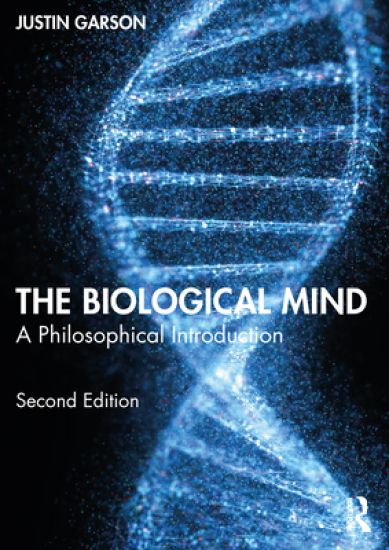
The Biological Mind

The Biological Mind

Justin Garson

TAYLOR FRANCIS LTD
2022
nidottu
For some, biology explains all there is to know about the mind. Yet many big questions remain: Is the mind shaped by genes or the environment? If mental traits are the result of adaptations built up over thousands of years, as evolutionary psychologists claim, how can such claims be tested? If the mind is a machine, as biologists argue, how does it allow for something as complex as human thought?Revised and updated to take account of new developments in the field, The Biological Mind: A Philosophical Introduction explores these questions and more, using the philosophy of biology to introduce and assess the nature of the mind. Justin Garson addresses the following key topics: moral psychology, altruism, and levels of selection;evolutionary psychology and the adaptationism debate;genes, environment, and the nature–nurture debate;natural selection and mental representation;psychiatric classification and the maladapted mind.This second edition includes three new chapters on race, sex, and human nature as well as new sections on group and kin selection, psychological altruism, and cultural evolution. Including chapter summaries, annotated further readings, a glossary of terms, and examples and case studies throughout, this is an indispensable introduction for those teaching philosophy of mind, philosophy of psychology, and philosophy of biology. It will also be an excellent resource for those in related fields such as biology.
The Biological Mind

The Biological Mind

Justin Garson

TAYLOR FRANCIS LTD
2022
sidottu
For some, biology explains all there is to know about the mind. Yet many big questions remain: Is the mind shaped by genes or the environment? If mental traits are the result of adaptations built up over thousands of years, as evolutionary psychologists claim, how can such claims be tested? If the mind is a machine, as biologists argue, how does it allow for something as complex as human thought?Revised and updated to take account of new developments in the field, The Biological Mind: A Philosophical Introduction explores these questions and more, using the philosophy of biology to introduce and assess the nature of the mind. Justin Garson addresses the following key topics: moral psychology, altruism, and levels of selection;evolutionary psychology and the adaptationism debate;genes, environment, and the nature–nurture debate;natural selection and mental representation;psychiatric classification and the maladapted mind.This second edition includes three new chapters on race, sex, and human nature as well as new sections on group and kin selection, psychological altruism, and cultural evolution. Including chapter summaries, annotated further readings, a glossary of terms, and examples and case studies throughout, this is an indispensable introduction for those teaching philosophy of mind, philosophy of psychology, and philosophy of biology. It will also be an excellent resource for those in related fields such as biology.
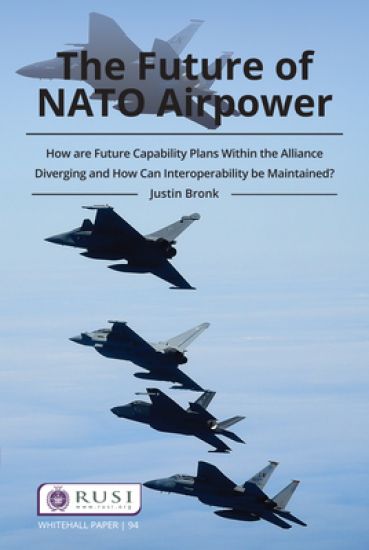
The Future of NATO Airpower

The Future of NATO Airpower

Justin Bronk

Routledge
2020
nidottu
Airpower remains the cornerstone of NATO’s military advantage, so maintaining the ability to win air superiority over peer opponents in a conflict is key to long-term deterrence stability in both Europe and the Pacific. This Whitehall Paper examines the various modernisation and future capability development efforts being undertaken within NATO, and analyses the major threat systems and overall modernisation trends of the West’s main peer-competitors – Russia and China.US airpower capability development efforts are increasingly focused on countering the growing challenge from the Chinese military in the Pacific. To meet this challenge, the Pentagon is planning to transform the way it operates across all domains over the next 15 years. New platforms, weapons systems and increasing automation of command and control threaten to leave NATO allies behind.Current acquisition and modernisation plans of European air forces may eventually close the capability gap with current US theatre entry standard capabilities, but by then the US will have leapt ahead once more. Furthermore, many of the airpower capabilities which the US is pursuing for the Pacific theatre are significantly less relevant for the demands of deterrence against Russia in Europe. Given continuing dependence on US enablers on the part of other NATO members, a significant divergence in capability plans threatens to undermine crucial Alliance interoperability if not recognised and managed early.
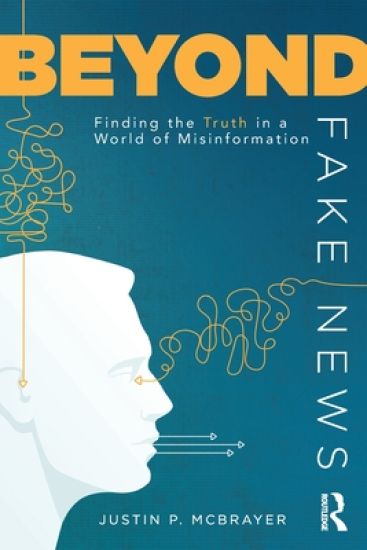
Beyond Fake News

Beyond Fake News

Justin P. McBrayer

Routledge
2020
nidottu
The world is swimming in misinformation. Conflicting messages bombard us every day with news on everything from politics and world events to investments and alternative health. The daily paper, nightly news, websites, and social media each compete for our attention and each often insist on a different version of the facts. Inevitably, we have questions:Who is telling the truth?How would we know?How did we get here?What can we do? Beyond Fake News answers these and other queries. It offers a technological and market-based explanation for how our informational environment became so polluted. It shows how purveyors of news often have incentives to mislead us, and how consumers of information often have incentives to be misled. And it chronicles how, as technology improves and the regulatory burdens drop, our information-scape becomes ever more littered with misinformation. Beyond Fake News argues that even when we really want the truth, our minds are built in such a way so as to be incapable of grasping many facts, and blind spots mar our view of the world. But we can do better, both as individuals and as a society. As individuals, we can improve the accuracy of our understanding of the world by knowing who to trust and recognizing our limitations. And as a society, we can take important steps to reduce the quantity and effects of misinformation.
Beyond Fake News

Beyond Fake News

Justin P. McBrayer

Routledge
2020
sidottu
The world is swimming in misinformation. Conflicting messages bombard us every day with news on everything from politics and world events to investments and alternative health. The daily paper, nightly news, websites, and social media each compete for our attention and each often insist on a different version of the facts. Inevitably, we have questions:Who is telling the truth?How would we know?How did we get here?What can we do? Beyond Fake News answers these and other queries. It offers a technological and market-based explanation for how our informational environment became so polluted. It shows how purveyors of news often have incentives to mislead us, and how consumers of information often have incentives to be misled. And it chronicles how, as technology improves and the regulatory burdens drop, our information-scape becomes ever more littered with misinformation. Beyond Fake News argues that even when we really want the truth, our minds are built in such a way so as to be incapable of grasping many facts, and blind spots mar our view of the world. But we can do better, both as individuals and as a society. As individuals, we can improve the accuracy of our understanding of the world by knowing who to trust and recognizing our limitations. And as a society, we can take important steps to reduce the quantity and effects of misinformation.
Morality and the Emotions

Morality and the Emotions

Justin Oakley

Routledge
2020
sidottu
Originally published in 1992 this book attacks many recent philosophical and psychological theories of the emotions and argues that our emotions themselves have intrinsic moral significance. He demonstrates that a proper understanding of the emotions reveals the fundamental role they play in our moral lives and the practical consequences that arise from being morally responsible for our emotions.
Morality and the Emotions

Morality and the Emotions

Justin Oakley

TAYLOR FRANCIS LTD
2022
nidottu
Originally published in 1992 this book attacks many recent philosophical and psychological theories of the emotions and argues that our emotions themselves have intrinsic moral significance. He demonstrates that a proper understanding of the emotions reveals the fundamental role they play in our moral lives and the practical consequences that arise from being morally responsible for our emotions.
Write My Name

Write My Name

Justin Tonra

TAYLOR FRANCIS LTD
2023
nidottu
Write My Name: Authorship in the Poetry of Thomas Moore is the first monograph devoted to Moore’s poetry. The focus of the book is on Moore’s poetry and differing formulations of authorship therein. Its scope comprises poetic publications from Moore’s early career, from his Romantic Orientalist writings, and from selected musical works, and political and satirical verse. It shares the strong historicist awareness of much previous scholarship on Moore, but combines this with a range of new and interdisciplinary contexts that are of increasing interest to scholarship in the twenty-first century, and which are rarely adopted as frameworks for viewing Moore’s work: digital humanities, book history, legal history, and textual theory. Ultimately, the book argues for the value of attending to neglected aspects of Moore’s work through analysis of his shifting modes of authorship and their various motivations
Understanding Urban Cycling

Understanding Urban Cycling

Justin Spinney

TAYLOR FRANCIS LTD
2022
nidottu
Academic interest in cycling has burgeoned in recent years with significant literature relating to the health and environmental benefits of cycling, the necessity for cycle-specific infrastructure, and the embodied experiences of cycling.Based upon primary research in a variety of contexts such as London, Shanghai and Taipei, this book demonstrates that recent developments in urban cycling policy and practice are closely linked to broader processes of capital accumulation. It argues that cycling is increasingly caught up in discourses around smart cities that emphasise technological solutions to environmental problems and neoliberal ideas on individual responsibility and bio-political conduct, which only results in solutions that prioritise those who are already mobile. Accordingly, the central argument of the book is not that the popularisation of cycling is inherently bad, but that the manner in which cycling is being popularised gives cause for social and environmental concern. Ultimately the book argues that cycling has now become a vehicle for sustaining pro-growth agendas rather than subverting them or shifting to sustainable no-growth/de-growth and less technologically driven visions of modernity.This book makes an innovative contribution to the fields of Cycling Studies, Mobilities and Transport and will be of interest to students and academics working in Human Geography, Transport Studies, Urban Studies, Urban Planning, Public Policy, Sociology and Sustainability.
Numerical Algorithms

Numerical Algorithms

Justin Solomon

CRC Press
2020
nidottu
Numerical Algorithms: Methods for Computer Vision, Machine Learning, and Graphics presents a new approach to numerical analysis for modern computer scientists. Using examples from a broad base of computational tasks, including data processing, computational photography, and animation, the textbook introduces numerical modeling and algorithmic design from a practical standpoint and provides insight into the theoretical tools needed to support these skills.The book covers a wide range of topics—from numerical linear algebra to optimization and differential equations—focusing on real-world motivation and unifying themes. It incorporates cases from computer science research and practice, accompanied by highlights from in-depth literature on each subtopic. Comprehensive end-of-chapter exercises encourage critical thinking and build students’ intuition while introducing extensions of the basic material.The text is designed for advanced undergraduate and beginning graduate students in computer science and related fields with experience in calculus and linear algebra. For students with a background in discrete mathematics, the book includes some reminders of relevant continuous mathematical background.
Discordant Democracy: Noise, Affect, Populism, and the Presidential Campaign
Discordant Democracy: Noise, Affect, Populism, and the Presidential Campaign paints a portrait of the political experience at a pivotal time in American political and social history. The modern political campaign is aestheticized and assimilated into mass culture, divorced from fact and policy, and nakedly tethered to emotional appeal. Through a multi-modal comparative examination of the sonic and emotional cultures of the 2008 and 2016 campaigns, Justin Patch raises critical queries about our affective relationship to modern politics and the impact of emotional campaigning on democracy. Discordant Democracy asks: how do campaign sounds affect us; what role do we the electorate play in creating and sustaining these sounds and affects; and what actions do they generate? Theories from anthropology, cognitive science, sound studies and philosophy are engaged to grapple with these questions and connect bombastic mass-mediated political events, campaign media and individual sonic experience. The analyses complicate notions of top-down campaigning, political spin, and enthusiastic millennial populism by examining our role in producing and animating political sounds through conversation, applause, laughter, media, and music.
Nietzsche's Constructivism

Nietzsche's Constructivism

Justin Remhof

Routledge
2020
nidottu
Like Kant, the German Idealists, and many neo-Kantian philosophers before him, Nietzsche was persistently concerned with metaphysical questions about the nature of objects. His texts often address questions concerning the existence and non-existence of objects, the relation of objects to human minds, and how different views of objects impact commitments in many areas of philosophy—not just metaphysics, but also language, epistemology, science, logic and mathematics, and even ethics. In this book, Remhof presents a systematic and comprehensive analysis of Nietzsche’s material object metaphysics. He argues that Nietzsche embraces the controversial constructivist view that all concrete objects are socially constructed. Reading Nietzsche as a constructivist, Remhof contends, provides fresh insight into Nietzsche’s views on truth, science, naturalism, and nihilism. The book also investigates how Nietzsche’s view of objects compares with views offered by influential American pragmatists and explores the implications of Nietzsche’s constructivism for debates in contemporary material object metaphysics. Nietzsche’s Constructivism is a highly original and timely contribution to the steadily growing literature on Nietzsche’s thought.
The Virgin Suicides

The Virgin Suicides

Justin Wyatt

Routledge
2020
nidottu
Based on the best-selling novel by Jeffrey Eugenides, The Virgin Suicides is director Sofia Coppola’s evocative debut feature of young love, sex, loss and family pressures in mid-1970s America. Acclaimed by both critics and audiences on release, the film is now viewed as a remarkable and bold feature by a significant female director addressing many issues related to youth, female sexuality and family.This book helps readers understand the film’s significance and the stylistic and storytelling choices made by director Coppola. The analysis of the film occurs around three interlocking arguments: the unusual structuring absence in the film, the intricate manner through which music is used in the drama, communication and character creation, and the film’s careful and specific referencing of advertising in the 1970s (the decade of the film’s narrative). The film’s enigmatic structure and unique storytelling devices and their relationship to female adolescence, sexuality and ideology are also considered in depth. Without solving the mysteries of the film, the book is designed to uncover the reasons why the film continues to fascinate viewers so many years after its release.
Complete Revision Guide for MRCOG Part 3
The examination for Membership of the Royal College of Obstetricians and Gynaecologists (MRCOG) remains one of the most internationally recognised postgraduate examinations in the specialty. Over the years, the examination has evolved in keeping with changes in medical education; the Part 3 examination now consists of 14 tasks, each covering one of the 14 core modules in the curriculum and assessing specific skills which may include all or some of Information Gathering, Communication with Patients and Families, Communication with Colleagues, Patient Safety, and Applied Clinical Knowledge. This invaluable resource consists of analyses of different aspects of what is being tested, with general advice on how to prepare for the examination and discussion of the reasons why trainees fail the examination. There follow four sample ‘papers’ of tasks; in each of them, attempts have been made to cover all 14 modules in the core curriculum. There is also an additional paper with random tasks to help with preparation.
Complete Revision Guide for MRCOG Part 3
The examination for Membership of the Royal College of Obstetricians and Gynaecologists (MRCOG) remains one of the most internationally recognised postgraduate examinations in the specialty. Over the years, the examination has evolved in keeping with changes in medical education; the Part 3 examination now consists of 14 tasks, each covering one of the 14 core modules in the curriculum and assessing specific skills which may include all or some of Information Gathering, Communication with Patients and Families, Communication with Colleagues, Patient Safety, and Applied Clinical Knowledge. This invaluable resource consists of analyses of different aspects of what is being tested, with general advice on how to prepare for the examination and discussion of the reasons why trainees fail the examination. There follow four sample ‘papers’ of tasks; in each of them, attempts have been made to cover all 14 modules in the core curriculum. There is also an additional paper with random tasks to help with preparation.
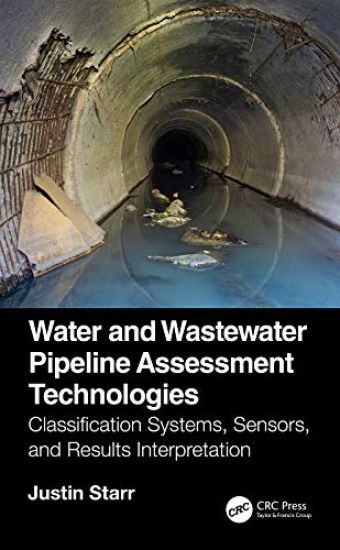
Water and Wastewater Pipeline Assessment Technologies
Water and wastewater infrastructure are a somewhat invisible, yet critical, part of modern life. Incredibly, many buried assets have been in service for 50-100 years and are still in good condition. Conversely, other systems fail well before their predicted design lives, causing property damage, injury, and even loss of life. In many cases, early detection could have prevented catastrophic failure, and understanding the state of underground infrastructure has become a key priority for many municipalities. Industry has responded with a number of new and innovative technologies for condition assessment, however, understanding these tools can be difficult, as many vendors treat their proprietary systems as trade secrets. Water and Wastewater Pipeline Assessment Technologies: Classification Systems, Sensors, and Results Interpretation provides a thorough guide to the technical workings of some of the most popular water and wastewater assessment technologies available, including CCTV crawlers, acoustic listening devices, laser sensors, 360° video cameras, pipe penetrating radar, and more. Features: Presents an overview of current technologies in CCTV inspection, including next generation video formats, high-definition resolution, and fisheye/sidescan technology. Provides helpful tips and tricks to cut through technical jargon and identify the technological specifications to compare between multiple vendors. Examines the pros and cons of competing technologies including laser and lidar, and provides an overview of unique approaches such as Pipe Penetrating Radar, Focused Electrode Leak Location, and more. Highlights the importance of coding standards, data management, and software tools that can be leveraged to create a successful asset management program.Water and Wastewater Pipeline Assessment Technologies: Classification Systems, Sensors, and Results Interpretation provides a mixture of theory and real-world, practical considerations ranging from deployment tips and data exchange formats to the technical limitations of different technologies. The book is a valuable resource for municipal employees, project engineers, and others involved in designing and implementing major inspection programs.
Removal of the Property Qualification for Voting in the United States
In Colonial America, democracy was centered in provincial assemblies and based on the collection of neighbors whose freehold ownership made them permanent stakeholders in the community. The removal of the property qualification for voting in the United States occurred over three-quarters of a century and was among the more important events in the history of democratization, functioning to shift voting from a corporate privilege toward a human right.Moving beyond the standard histories of property standard histories of property qualification removal, Justin Moeller and Ronald F. King adopt the theories and methods of social science to discover underlying patterns and regularities, attempting a more systematic understanding of subject. While no historical event has a single cause, party consolidation and party competition provided a necessary mechanism, making background factors politically relevant. No change in franchise rules could occur without the explicit consent of incumbent politicians, always sensitive to the anticipated impact. Moeller and King argue that political parties acted strategically, accepting or rejecting removal of the property qualification as a means of advancing their electoral position. The authors identify four different variants of the strategic calculation variable, significantly helping to explain both the temporal differences across states and the pattern of contestation with each state individually.
The Essential Guide to the Business & Law of Esports & Professional Video Gaming
"As esports has grown, the need for professional legal representation has grown with it. Justin's Essential Guide to the Business & Law of Esports & Professional Video Gaming provides a great baseline and will help prevent the legal horror stories of esports in the past." Mitch Reames, AdWeek and Esports Insider"Justin’s exploration of the business and law side of the esports sector fills a gap of knowledge that is an absolute necessity in truly understanding the esports space."Kevin Hitt, The Esports ObserverThe Essential Guide to the Business & Law of Esports & Professional Video Gaming covers everything you need to know about the past, present, and future of esports and professional video gaming. The book is written by one of the foremost attorneys and business practitioners in today’s esports and professional gaming scene, Justin M. Jacobson, Esq. This guide is meant to provide you with an in-depth look at the business and legal matters associated with the esports world. • Includes coverage of the stakeholders in the esports business "ecosystem," including the talent, the teams, the publishers, and the event organizers.• Explores various legal fields involved with esports, including intellectual property, employment and player unions, business investments and tax "write-offs," immigration and visas, event operation tips, social media and on-stream promotions, and much more.• The most current book on the market, with actual contract provisions modeled on existing major esports player, coach, shoutcaster, and sponsorship agreements. About the AuthorJustin M. Jacobson, Esq. is an entertainment and esports attorney located in New York City. For the last decade, he has worked with professional athletes, musicians, producers, DJs, record labels, fashion designers, as well as professional gamers, streamers, coaches, on-air talent, and esports organizations. He assists these creative individuals with their contract, copyright, trademark, immigration, tax, and related business, marketing, and legal issues. He is a frequent contributor to many industry publications and has been featured on a variety of entertainment, music, and esports publications and podcasts, including Business Insider, The Esports Observer, Esports Insider, Tunecore, and Sport Techie.Justin has positioned himself as a top esports business professional working with talent in a variety of franchise leagues including the Overwatch League, Overwatch Contenders, and Call of Duty Pro League as well as in many popular competitive titles such as Fortnite, CS:GO, Gears of War, Halo, Super Smash Brothers, Rainbow 6, PUBG, Madden, and FIFA and mobile games such as Brawlhalla, Clash of Clans, and Call of Duty mobile. Previously, he worked with various esports talent agencies as well as in an official capacity on behalf of several esports teams and brands.