Kirjahaku
Etsi kirjoja tekijän nimen, kirjan nimen tai ISBN:n perusteella.
1000 tulosta hakusanalla Lee Read

Lee joins the school soccer team. This B-level story uses decodable text to raise confidence in early readers. The book features long "e" sounds and uses a combination of sight words and long-vowel words in repetition to build recognition. Original illustrations help guide readers through the text. Author Cecilia Minden, Ph.D., a literacy consultant and former director of the Language and Literacy program at Harvard Graduate School of Education developed the series format. Includes author biography, phonetics, and teaching guides.
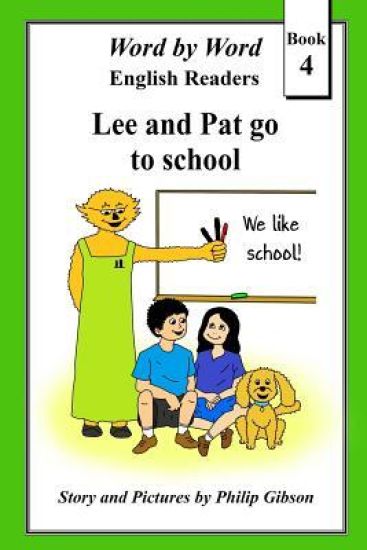
Lee and Pat go to school: (Monochrome Version)
Philip Gibson
Createspace Independent Publishing Platform
2016
nidottu
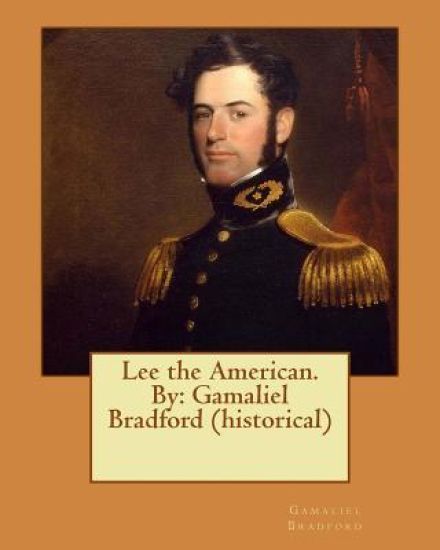
Lee the American. By: Gamaliel Bradford (historical)
Gamaliel Bradford
Createspace Independent Publishing Platform
2016
nidottu
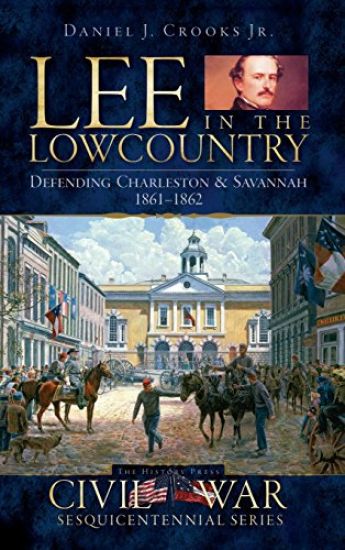
Lee in the Lowcountry: Defending Charleston & Savannah 1861-1862
Daniel J. Crooks
History Press Library Editions
2008
sidottu
In so many words, General Lee laid out the challenge of defending the young Southern Republic and two of its key cities: Charleston and Savannah. While in the Lowcountry, Lee acquired the two most famous trademarks of his wartime career. Long hours in the saddle prompted Lee to grow his signature beard and, while at Pocotaligo, he acquired his beloved equine companion, Traveller. Charleston historian Danny Crooks examines Lee's first year serving the Confederacy, a year of confusion and convoluted loyalty. Using Lee's own words and those of his contemporaries, Crooks helps the reader to understand why Lee, and only Lee, could bring order to the early chaos of the war.
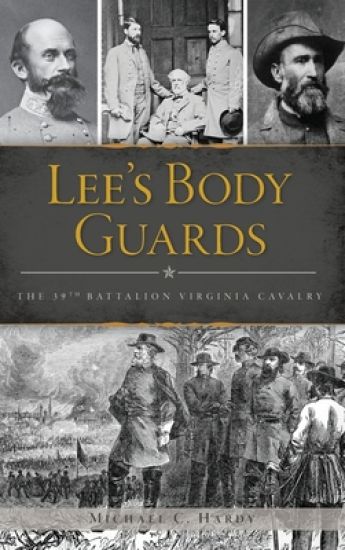
Lee's Body Guards: The 39th Virginia Cavalry
Michael C. Hardy
History Press Library Editions
2019
sidottu
They considered themselves "Lee's Body Guard," cavalrymen specifically recruited to serve as scouts, couriers and guides for General Robert E. Lee. Though their battle experiences might pale compared to those of soldiers under J.E.B. Stuart and Wade Hampton, the men of the 39th Virginia served crucial roles in the Confederate army. From the fields of Second Manassas to Appomattox Court House, they were privy to the inner workings of the Confederate high command. They were also firsthand witnesses to the army's victories and triumphs and to its tragedies and trials, from losing Stonewall Jackson at Chancellorsville to losing the opportunity to win the war at Gettysburg. Award-winning author Michael C. Hardy chronicles the experiences of this unique group of Confederate cavalrymen.
Lee&Farrow combined family reunion (Past&Present) ...'2015, '2016, '2017 Directory-Souvenir Booklet-(LIMITED EDITION)
Jennifer L. Gordon-Campbell
Createspace Independent Publishing Platform
2017
nidottu
A combined Lee and Farrow Family Reunion Souvenir Booklet of family reunion memories, pictures, history, genealogy and directory of family history. Combined years of: 1900's to 2017.
Lee in Virginia: A Story the American civil war
G. H. Henty; Klaus Schwanitz
Createspace Independent Publishing Platform
2017
nidottu
Lee County, Kentucky, Births, Deaths, and Marriages 1874-1878 and 1900-1910
Margaret Millar Hayes
Heritage Books
2013
pokkari

Many of Krasner's male colleagues - including her husband, Jackson Pollock - developed a unique "signature" style that identified them throughout their careers. Krasner, however, experimented with one style after another, from her early geometric abstractions (created while she was one of Hans Hofmann's most talented students), through her large-scale organic images of mid-career, to the hard-edge compositions of her late years. Certain elements recur throughout - most notably, her distinctive sense of colour, her affinity for swelling forms inspired by nature, and her fearlessness in experimenting with new techniques. Krasner's unwillingness to stick to one style, her readiness to put her career aside to focus on Pollock's, and her feuds with some of the period's most powerful critics all reduced her visibility in the art world. She has been the subject of exhibition catalogs, but this is the first monograph devoted to her work, and it brings to light all the intriguing complexities of her approach to making art. Dr. Robert Hobbs skillfully explores the twists and turns of her career, offering new information and insight about one of the most intriguing painters of the postwar era. About the Modern Masters series: With informative, enjoyable texts and over 100 illustrations - approximately 48 in full colour - this innovative series offers a fresh look at the most creative and influential artists of the postwar era. The authors are highly respected art historians and critics chosen for their ability to think clearly and write well. Each handsomely designed volume presents a thorough survey of the artist's life and work, as well as statements by the artist, an illustrated chapter on technique, a chronology, lists of exhibitions and public collections, an annotated bibliography, and an index. Every art lover, from the casual museumgoer to the serious student, teacher, critic, or curator, will be eager to collect these Modern Masters. And with such a low price, they can afford to collect them all.
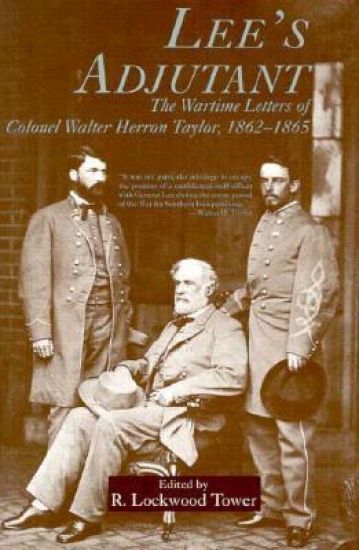
Of all those who served with Robert E. Lee in the headquarters of the Army of Northern Virginia, no one was as close to him as Walter Taylor. Twenty-two years old when hostilities broke out, Taylor served at Lee's side virtually without interruption during the entire Civil War. The only officer who could lay claim to such a distinction, Taylor served first as aide-de-camp and subsequently as assistant adjutant general of the Army of Northern Virginia. Taylor traveled with Lee, ate at his mess, shielded him from a flood of administrative concerns, and on occasion delivered his battlefield orders. Taylor's personal correspondence, written without reserve as he enjoyed an unparalleled opportunity to observe Lee and his inner circle, constitutes a unique addition to the Civil War record. The 110 letters compiled in Lee's Adjutant shed light on day-to-day life at Lee's headquarters and on the general himself. Written to Taylor's fiancee and family, the recount the Army of Northern Virginia's early triumphs, invasions of the North, defeat at Gettysburg, and final surrender. To these revealing letters, R. Lockwood Tower adds a biographical sketch of the young adjutant that describes his role in helping Lee organize the Army of Virginia and-as an officer who lived to see the fiftieth anniversary of the war's end-in shaping Confederate memory.
Lee and His Generals
University of Tennessee Press
2012
sidottu
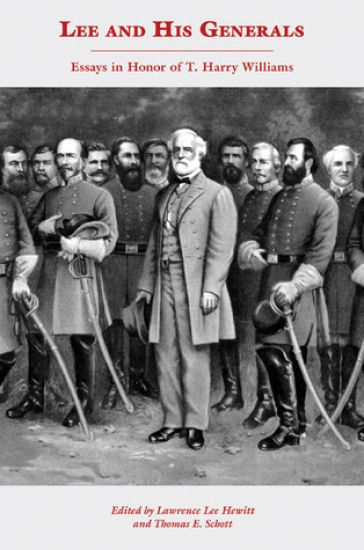
A legendary professor at Louisiana State University, T. Harry Williams not only produced such acclaimed works as Lincoln and the Radicals, Lincoln and His Generals, and a biography of Huey Long that won both the Pulitzer Prize and the National Book Award, but he also mentored generations of students who became distinguished historians in their own right. In this collection, ten of those former students, along with one author greatly inspired by Williams's example, offer incisive essays that honor both Williams and his career-long dedication to sound, imaginative scholarship and broad historical inquiry. The opening and closing essays, fittingly enough, deal with Williams himself: a biographical sketch by Frank J. Wetta and a piece by Roger Spiller that place Williams in larger historical perspective among writers on Civil War generalship. The bulk of the book focuses on Robert E. Lee and a number of the commanders who served under him, starting with Charles Roland's seminal article 'The Generalship of Robert E. Lee,' the only one in the collection that has been previously published. Among the essays that follow Roland's are contributions by Brian Holden Reid on the ebb and flow of Lee's reputation, George C. Rable on Stonewall Jackson's deep religious commitment, A. Wilson Greene on P. G. T. Beauregard's role in the Petersburg Campaign, and William L. Richter on James Longstreet as postwar pariah. Together these gifted historians raise a host of penetrating and original questions about how we are to understand America's defining conflict in our own time - just as T. Harry Williams did in his. And by encompassing such varied subjects as military history, religion, and historiography, Lee and His Generals demonstrates once more what a fertile field Civil War scholarship remains. Lawrence Lee Hewitt is professor of history emeritus at Southeastern Louisiana University. Most recently, he and Arthur W. Bergeron, now deceased, coedited three volumes of essays under the collective title Confederate Generals in the Western Theater. Thomas E. Schott served for many years as a historian for the U.S. Air Force and U.S. Special Operations Command. He is the author of Alexander H. Stephens of Georgia: A Biography, which won both the Society of American Historians Award and the Jefferson Davis Award.|A legendary professor at Louisiana State University, T. Harry Williams not only produced such acclaimed works as Lincoln and the Radicals, Lincoln and His Generals, and a biography of Huey Long that won both the Pulitzer Prize and the National Book Award, but he also mentored generations of students who became distinguished historians in their own right. In this collection, ten of those former students, along with one author greatly inspired by Williams's example, offer incisive essays that honor both Williams and his career-long dedication to sound, imaginative scholarship and broad historical inquiry. The opening and closing essays, fittingly enough, deal with Williams himself: a biographical sketch by Frank J. Wetta and a piece by Roger Spiller that place Williams in larger historical perspective among writers on Civil War generalship. The bulk of the book focuses on Robert E. Lee and a number of the commanders who served under him, starting with Charles Roland's seminal article 'The Generalship of Robert E. Lee,' the only one in the collection that has been previously published. Among the essays that follow Roland's are contributions by Brian Holden Reid on the ebb and flow of Lee's reputation, George C. Rable on Stonewall Jackson's deep religious commitment, A. Wilson Greene on P. G. T. Beauregard's role in the Petersburg Campaign, and William L. Richter on James Longstreet as postwar pariah. Together these gifted historians raise a host of penetrating and original questions about how we are to understand America's defining conflict in our own time - just as T. Harry Williams did in his. And by encompassing such varied subjects as military history, religion, and historiography, Lee and His Generals demonstrates once more what a fertile field Civil War scholarship remains. Lawrence Lee Hewitt is professor of history emeritus at Southeastern Louisiana University. Most recently, he and Arthur W. Bergeron, now deceased, coedited three volumes of essays under the collective title Confederate Generals in the Western Theater. Thomas E. Schott served for many years as a historian for the U.S. Air Force and U.S. Special Operations Command. He is the author of Alexander H. Stephens of Georgia: A Biography, which won both the Society of American Historians Award and the Jefferson Davis Award.
Lee and Jackson's Bloody Twelfth
University of Tennessee Press
2012
nidottu
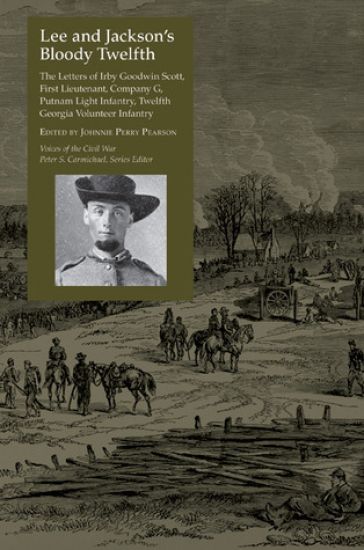
Offering a fascinating look at an ordinary soldier's struggle to survive not only the horrors of combat but also the unrelenting hardship of camp life, Lee and Jackson's Bloody Twelfth brings together for the first time the extant correspondence of Confederate lieutenant Irby Goodwin Scott, who served in the hard-fighting Twelfth Georgia Infantry. The collection begins with Scott's first letter home from Richmond, Virginia, in June 1861, and ends with his last letter to his father in February 1865. Scott miraculously completed the journey from naïve recruit to hardened veteran while seeing action in many of the Eastern Theatre’s most important campaigns: the Shenandoah Valley, the Peninsula, Second Manassas, and Gettysburg. His writings brim with vivid descriptions of the men's activities in camp, on the march, and in battle. Particularly revelatory are the details the letters provide about the relationship between Scott and his two African American body servants, whom he wrote about with great affection. And in addition to maps, photographs, and a roster of Scott's unit, the book also features an insightful introduction by editor Johnnie Perry Pearson, who highlights the key themes found throughout the correspondence. By illuminating in depth how one young Confederate stood up to the physical and emotional duress of war, the book stands as a poignant tribute to the ways in which all ordinary Civil War soldiers, whether fighting for the South or the North, sacrificed, suffered, and endured. Johnnie Perry Pearson is a retired state service officer formerly with the North Carolina Division of Veteran Affairs. He served as an infantry platoon sergeant during the Vietnam War and lives in Hickory, North Carolina.
Lee's Last Casualty
University of Tennessee Press
2012
nidottu
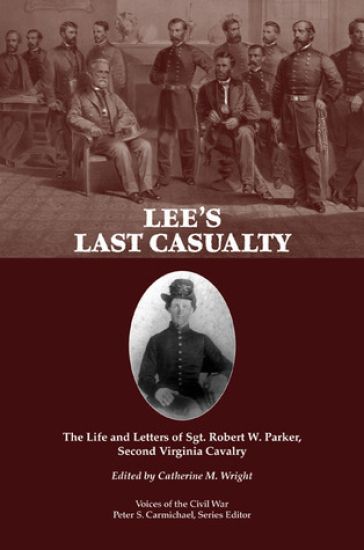
The letters assembled in this extraordinarily rich collection were written by Robert W. Parker, an enlisted Confederate cavalryman who is thought to have been the last man killed in action in the Army of Northern Virginia during the Civil War. He is representative of the Confederate Everyman: a modest farmer in the antebellum years, his patriotic fervour spurred him at the beginning of the war to enlist in the Confederate Army, in which he served until his death during the last charge at Appomattox Court House on April 9, 1865.Parker fought in most of the major campaigns in Virginia, including the 1862 Valley Campaign, the 1862 Peninsula Campaign, the 1863 Maryland Campaign, and the 1864 Overland Campaign. In letters to his wife Rebecca back home in Bedford County, Virginia, Parker described his life as an enlisted soldier in the Second Regiment Virginia Cavalry. His letters reveal how local communities worked together to provide the necessary stuff of war to soldiers, from food and clothing to moral support. They also show the importance of correspondence and religion in sustaining Confederate morale and nationalism.Catherine Wright provides a valuable introduction that illuminates not only these particular letters but also the many roles of correspondence during the Civil War. She points out how women-in this case, Parker's wife and his mother-made sure that men in the ranks understood that more than politics or manly honour was at stake in fighting the Yankees. Parker believed that the war was a supreme test in which God would look deep into the souls of Northerners and Southerners. His private beliefs informed his public views on how Southerners should act as citizens of a Confederate nation. People of all classes, Parker reasoned, had to give themselves to country and to God if Southern armies were to succeed on the battlefield. Parker's steadfastness was surely due in part to the words of his family, who instilled in him “just cause” to continue fighting.Anyone with an interest in how a typical soldier experienced the Civil War will find these letters both absorbing and enlightening.

Surrealist artist, muse of Man Ray, photographer, fashion model and Vogue war correspondent - Lee Miller defies categorization. Beginning her career as a Condé Nast model in 1920s New York, she made the unprecedented transition from one side of the lens to the other, creating stunning photos that imbued fashion with surrealist wit and whimsy. Fashion model, surrealist artist, muse, photographer, war correspondent - Lee Miller defies categorization. She was a woman who refused to be penned in, a free spirit constantly on the move from New York to London to Paris, from husbands to lovers and back, from photojournalistic objectivism to surrealism. Midcareer, she made the unprecedented transition from one side of the lens to the other, from a Condé Nast model in Jazz Age New York to fashion photographer, creating stunning images that imbued fashion with her signature wit and whimsy. Miller became a celebrated Surrealist under the tutelage of her lover, Man Ray, and then joined the war effort during World War II, documenting everything from the liberation of concentration camps to the daily life of Nazi-occupied Paris. Miller was recognized as “one of the most distinguished living photographers” during her hey-day as a fashion photographer, but an astonishing number of these images have remained unpublished. Lee Miller in Fashion is the first book to examine how her career as a model and fashion photographer illuminates her life story and connects to international fashion history from the late 1920s until the early 1950s. The world of fashion emerges as the backbone of Miller’s creative development, as well as an integral lens through which to understand the effects of war on the lives of women in the 1940s and 1950s. Miller witnessed incredible acts of resistance born out through fashion - and her photographic record of women’s indomitable spirit even in times of war has remained an invaluable resource in fashion and global history. Lee Miller in Fashion presents these striking archival fashion photographs as well as contact sheets, memos, and Miller’s published illustrations, vividly setting the wit, irrepressible creativity, and daring of Miller within the larger story of women’s experience of fashion, art, and war in the twentieth century. “In all her different worlds, she moved with freedom. In all her roles, she was her own bold self.” - Antony Penrose
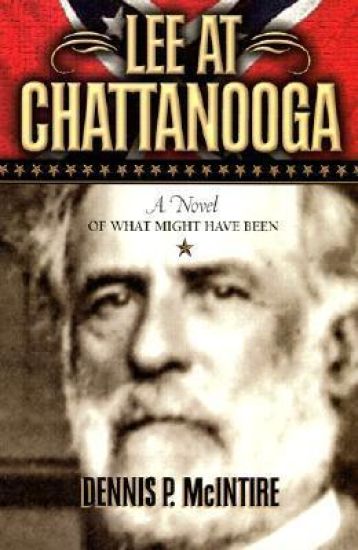
The possibility that Confederate President Jefferson Davis might have sent General Robert E. Lee to aide Braxton Bragg in his battle at Chattanooga is explored in this novel. What might have happened that September 1863 if this had occurred?