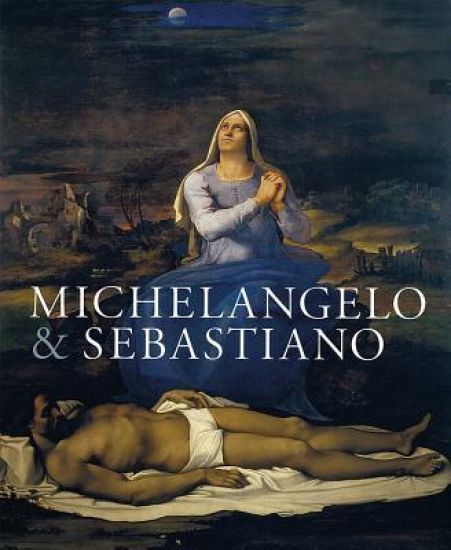
The first publication to consider the relationship between these two major artists of the High Renaissance Through most of Michelangelo’s working life, one of his closest colleagues was the great Venetian painter Sebastiano del Piombo (1485–1541). The two men met in Rome in 1511, shortly after Sebastiano’s arrival from his native city, and while Michelangelo was based in Florence from 1516 to 1534 Sebastiano remained one of his Roman confidants, painting several works after partial designs by him. This landmark publication is about the artists’ extraordinary professional alliance and the friendship that underpinned it. It situates them in the dramatic context of their time, tracing their evolving artistic relationship through more than three decades of creative dialogue. Matthias Wivel and other leading scholars investigate Michelangelo’s profound influence on Sebastiano and the Venetian artist’s highly original interpretation of his friend’s formal and thematic concerns. The lavishly illustrated text examines their shared preoccupation with the depiction of death and resurrection, primarily in the life of Christ, through a close analysis of drawings, paintings, and sculpture. The book also brings the austerely beautiful work of Sebastiano to a new audience, offering a reappraisal of this less famous but most accomplished artist. Published by National Gallery Company/Distributed by Yale University PressExhibition Schedule:The National Gallery, London (03/15/17–06/25/17)
A New York Times best art book of 2021 Titian (active 1506–1576) produced a masterful group of paintings for Philip II of Spain, celebrating the loves of gods, goddesses, and mortals. Depicting scenes from Ovid’s narrative poem Metamorphoses, Titian named them “poesie” and considered the works as visual equivalents of poetry. This volume presents a detailed study of the complete series—Danaë, Venus and Adonis, Perseus and Andromeda, Diana and Actaeon, Diana and Callisto, and The Rape of Europa, as well as The Death of Actaeon—lavishly illustrated with details of these emotionally charged paintings. The book explores Titian’s creative process and technique, in addition to his use of literary and visual sources and his correspondence with Philip II. The artistic legacy of the series for later European painting is also examined in the works of artists such as Rubens, Velázquez, and Rembrandt. Offering the most comprehensive overview of these remarkable works, Titian: Love, Desire, Death is an indispensable resource for scholars and admirers of Renaissance painting.Published by National Gallery Company/Distributed by Yale University PressExhibition Schedule:National Gallery, London (March 16–June 14, 2020)National Galleries of Scotland, Edinburgh (July 11–September 27, 2020)Isabella Stewart Gardner Museum, Boston (February 11–May 9, 2021)
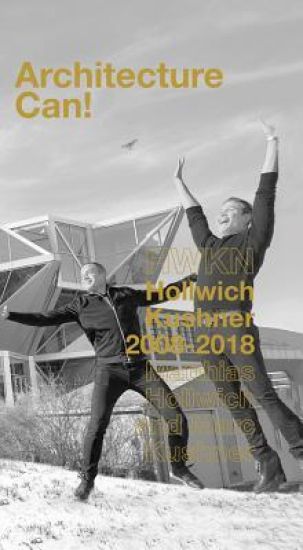
"Architecture is not preserved in a museum - it is the museum." Architecture Can! is an intriguing journey through the works and projects of the groundbreaking architecture firm Hollwich Kushner, based in New York. Partners Matthias Hollwich and Marc Kushner design projects at every scale: intimate, awe-inspiring, and everything inbetween; from residences to universities, museums, and urban plans. As two founders of leading architecture social media network Architizer, Hollwich and Kushner frankly admit the power of social media in contemporary architecture practice. Images of new and advanced buildings and concepts travel the globe at high speed, influencing a new generation of projects before the previous generation has broken ground. To stand out, they believe, architecture must "empower people to engage with others, to produce memorable experiences, and to live with a sense of wonder".
"I never wanted to be a prophet..." Read the biography of a woman of the people, who was called by God to serve Him by being the interpreter of His word as a prophet. The author, Matthias Holzbauer, passes on stories from Gabriele, in which she describes her childhood and youth. She tells what it meant for her to accept the call of God and to serve Him, the Eternal, as the interpreter of His word of light. And she accepted this call. One hundred percent — until today. "I still have many things to say to you, but you cannot bear them now. When the Spirit of truth comes, he will guide you into all the truth.” So spoke Jesus of Nazareth 2000 years ago. Gabriele is the living proof that also today, in our time, God does not let Himself be silenced — for the Free Spirit blows where it will. Gabriele is the proof that God, the Father of us all, loves His children. For He never forsakes us — not even in times of upheavals and disasters, into which we human beings have maneuvered ourselves. An excerpt from the biography, a quote from Gabriele: "'Life is revelation,' this is how He spoke to me. 'If you are for the life, then you are linked in unity and love with the innermost part of your neighbor, and also with the love in the animals, in the plants and in the minerals.' He taught me the fine and subtle langue of light of the animals, of the plants and the stones. ...And so, the prophetic Spirit does not simply speak through the prophet without further ado — first, the prophet has to do what God wants. Whatever the prophet passes on to his fellow people from the law of life, he has to first have learned on himself. Then he becomes clean and is constantly connected to the prophetic stream... This book contains 2 CDs: CD1: "Deep Breathing" and "Abide in You" – 2 meditations and CD2: “You Spurn the One God and Believe in Eternal Damnation. I Am the God of Love!” – A God-Father Revelation from 1996"
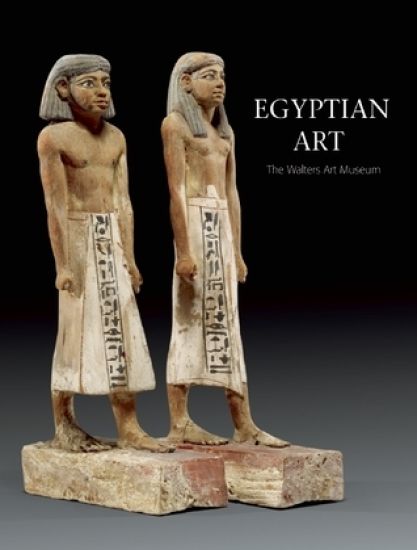
This volume is the latest in a growing list of beautifully illustrated titles about some of the most significant and popular subjects in art history and archaeology published in association with the Walters Art Museum. It presents 79 objects from the museum's internationally renowned collection of ancient Egyptian art, ranging in date from the early dynastic to the Roman period.An introductory overview of Egyptian art is followed by the main presentation of artworks, which are divided into six chronological sections, reflecting the broader divisions of Egyptian political history: the Old Kingdom; the Middle Kingdom; the New Kingdom; the Third Intermediate Period; the Ptolemaic Period; and, the Meroitic Period. Each section is prefaced by an introduction to the key political, artistic and wider cultural developments of that period. Each artwork is accompanied by an extended entry that places it within the context of ancient Egyptian art and discusses stylistic, decorative and technical information.
Welcome to the Pot-Limit Omaha boot camp! Are you ready to work hard and study hard? If the answer is yes", then this book will teach you all you need to know to start playing PLO, establish your game at the low-stakes and then move up to the higher limits. You will learn all the key concepts in step-by-step fashion. The material is split into 28 chapters and each chapter topic is discussed in four sections: *The Introduction*The Exercise*The Solutions*The Practice At the end of each chapter there is an overview of the material so you can be absolutely sure that you have understood all the key information. This book is ideal for players at the low-stakes level but there is also a great deal of useful information for more advanced players
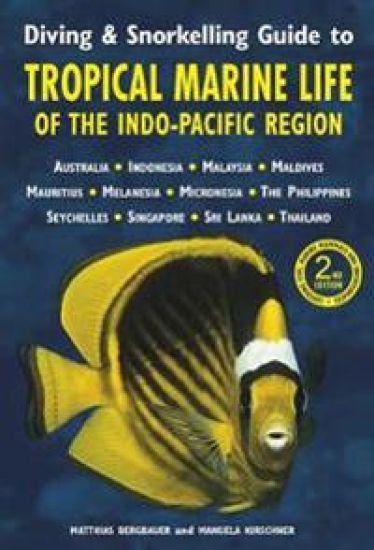
This handy pocket guide enables divers and snorkelers to identify more than 270 of the most common species of marine life likely to be encountered in and around the coral reefs of the Indo-Pacific region, including fish, reptiles and amphibians, and invertebrates.
Two Ways to Live: The choice we all facethe Gospel of LukeWhat, we thought, if we combined to two?That's what The Essential Jesus does. Most of its 80 pages are made up of a fresh and accurate translation of Luke's Gospel. But the text of Luke is preceded by some important background information ('Previously in the Bible') that explains the biblical context and Jewish expectations as Jesus walks on centre stage (this explanation is based on boxes 1 to 3 of Two Ways to Live). The text of Luke also includes numerous footnotes, helpfully explaining to the modern reader some of the unfamiliar terms and names that appear from time to time. After Luke's account of Jesus, a summary of the message is presented using the Two Ways to Live framework, concepts and illustrations, but linking back to the content of Luke. This second edition includes updates in the Two Ways to Live-related sections so that it matches the updated Two Ways to Live tract.
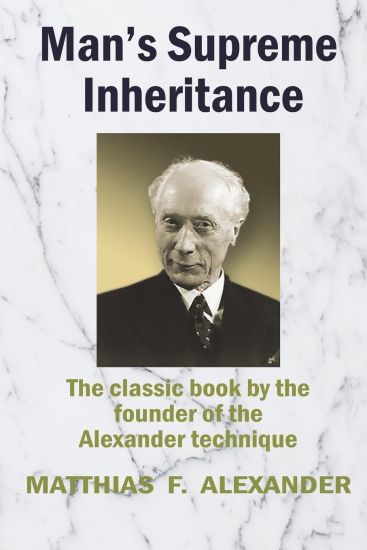
F.M. Alexander (1869-1955) was an Australian actor who began to experience chronic laryngitis whenever he performed. When his doctors could not help him, Alexander discovered a solution on his own. He had not been aware that excess tension in his neck and body were causing his problems, and began to find new ways to speak and move with greater ease.His health improved to such an extent that his friends and several of the doctors he had consulted earlier persuaded him to teach others what he had learned. Over a career span of more than fifty years, he refined his method of instruction. After teaching for over 35 years, he began to train teachers of what has now become known as the Alexander Technique.Written by the founder of the Alexander Technique, this book lays down some of the foundation principles in regards to posture, body use, 'conscious guidance' of movement, habit, and the Alexander Technique in general. Man's Supreme Inheritance sets the scene for how the Alexander Technique started and where it currently sits today.
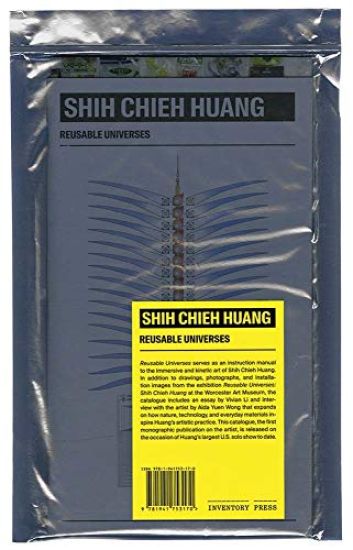
Packaged in a resealable plastic envelope, Reusable Universes serves as an instruction manual to the immersive kinetic art of Taiwanese artist Shih Chieh Huang (born 1975), showing how nature, technology and everyday materials inspire Huang’s practice.
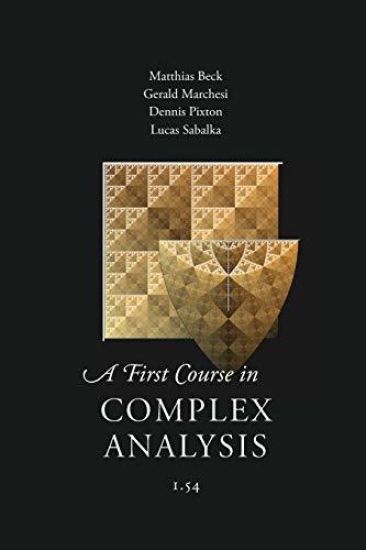
A First Course in Complex Analysis was developed from lecture notes for a one-semester undergraduate course taught by the authors. For many students, complex analysis is the first rigorous analysis (if not mathematics) class they take, and these notes reflect this. The authors try to rely on as few concepts from real analysis as possible. In particular, series and sequences are treated from scratch.
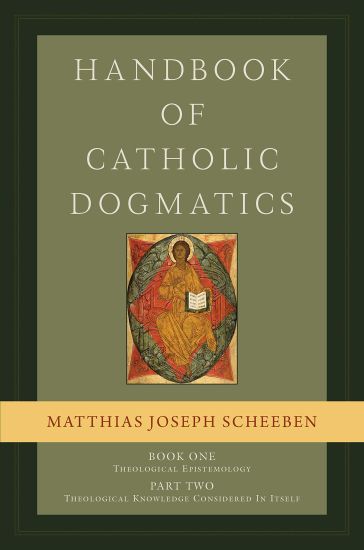
Where and how do we encounter God's revelation made once for-all in Christ Jesus? The answer to this urgent question is explored in Matthias Joseph Scheeben's Handbook of Catholic Dogmatics, Book One, Part One, here translated for the first time in English by Michael J. Miller. Scheeben (1835–1888), a renowned German theologian.This unabridged first part of a two-volume set, begins with a discussion of the nature and scope of dogmatic theology as a science. He treats divine revelation as the source of theological knowledge and as transmitted in Scripture and in the Apostolic Tradition. Included in this volume is Scheeben's treatise, "The Objective Principles of Theological Knowledge". Scheeben writes on faith in its source, contents, and handing on in the Church as it confronts the believer, eliciting his or her assent.
Matthias Joseph Scheeben's masterful Handbook of Catholic Dogmatics: Book One, Part Two concludes the first book of Scheeben's magnum opus.Readers will find Scheeben's examination of faith, the subjective principle of theological knowledge. In exact yet beautiful prose, he moves from the study of human belief to supernatural faith, while preserving the reasonableness, freedom, and certainty that accompany faith.Maintaining theology is indeed a "sacred science", Scheeben treats the understanding of faith by demonstrating human reason's relationship to the deposit of faith. He concludes this work by shedding light on the subject of dogmatic theology itself, recounting its history from the Patristic era to his own time.
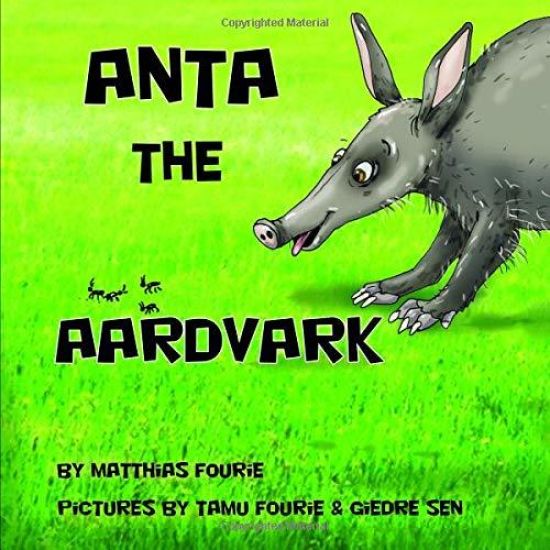
Anta the aardvark learns to appreciate his own looks and stop trying to be like all of his friends. He discovers that he is like no one else and that is a good thing.
Synopsis: Innovating: How to Thrive in an Ever-Changing Business Environment, is a comprehensive guide to navigate the challenges of the modern business world. Written by Dr. Matthias I. Chijioke, the book draws on his experience in finance, accounting, and business management to provide practical advice and insights for individuals and business organizations seeking to adapt to the rapidly evolving business environment. The book is divided into three parts. Part one focuses on understanding the changing business landscape and the factors driving innovation and disruption. It covers topics such as the impact of technology, globalization, and changing consumer behavior on business models. Part two is dedicated strategies for driving innovation and growth in businesses. It covers topics such as product innovation, marketing strategies, and talent management. This section also includes case studies and examples of successful companies that have adapted to the changing business landscape. Finally, part three focuses on leadership and management in an ever-changing business environment. It covers topics such as effective communication, risk management and developing a culture of Innovation. Throughout the book, Dr. Chijioke emphasizes the significance of adapting to change and staying ahead of the curve in order to thrive in the modern business world. He provides practical advice and insights that can be applied by individuals and organizations at all levels. Innovating Corporate America is a valuable resource for anyone seeking to understand and navigate the business challenges of the modern landscape. Whether you are a business leader, entrepreneur, or student of business, this book provides insights and strategies that can help you stay ahead of the curve and thrive in an ever-changing world.Autobiography: DR. MATTHIAS I. CHIJIOKE is an Enrolled Agent (EA) representing taxpayers before the Internal Revenue Services (IRS), and Business Consultant, a highly accomplished professional with extensive experience in the fields of finance, accounting, and business management. As the President and CEO of Macro Resource Group, he has demonstrated a remarkable ability to lead and grow organizations in the ever-changing business Environment.
"The exposition will be as profound and comprehensive as I can make it; nature and grace must furnish the basis for a reasonable chart of life and growth. My cherished aim is to bring out the supernatural character of the Christian economy of salvation in its full sublimity, beauty, and riches. The main task of our time, it seems to me, consists in propoupding and emphasizing the supernatural quality of Christianity, for the benefit of both science and life. Theoretical as well as practical naturalism and rationalism, which seek to throttle and destroy all that is specifically Christian, must be resolutely and energetically repudiated." Thus writes the great 19th-century theologian Matthias Scheeben, a vibrant, original, and poetic author who re-opened the enchanting world of St. Thomas to new generations of Catholics in a period marred by the desiccated rationalism of the Enlightenment period in its last rays before the darkness of modernism. In the new Thomism that has sprung up in the postconciliar Church, Scheeben makes for essential reading.
Wir leben in Fernsehbildern und sind alle Teil eines gro en Werbefilms f r das demokratische und kapitalistische westliche Gesellschaftssystem. F r Theodor Adorno ist das Fernsehen das alles berragende Instrument der verflachenden Kulturindustrie, f r Neil Postman ist es eine Verdummungsmaschine, f r Hans-Magnus Enzensberger das Nullmedium, und der Kriminologe Christian Pfeiffer kommt zu dem Schluss: "Ein berma an Medienkonsum macht dick, dumm, krank und traurig." Was fr her undenkbar schien, ist heute Wirklichkeit und wird nicht mehr als mediales Absurdistan erkannt: dass Shows Menschen dazu zwingen, ihren Kopf in eine Box mit Kakerlaken zu stecken oder sich in F kalien zu w lzen, dass Fernsehsender sich darin berbieten, dreistellige Millionen-Euro-Betr ge auszugeben f r die bertragungsrechte von Sportereignissen, dass den ffentlich-rechtlichen Sendern in Deutschland mehr als acht Milliarden Euro an Einnahmen zuflie en, dass fr hlich-anspruchslose TV-Moderatoren zweistellige Millionenhonorare bekommen, dass die Geb hrensender sich ohne Not dem Quotenwettlauf der privaten anschlie en und ihre Vollprogramme zunehmend nach den Unterhaltungsanspr chen der kommerziellen Konkurrenz ausrichten, dass nicht der ffentlich-rechtliche Rundfunk in Deutschland die Politik kontrolliert, sondern die Rollen vertauscht sind und die politischen Parteien die Sender kontrollieren undsoweiter. Das selbstreferentielle System ist berversorgt mit Geld und es berversorgt die Menschen mit Kan len, die niemand braucht und kaum jemand sieht. Es steht au erhalb der konomie, verwaltet sich selbst, ist durchdrungen von Vetternwirtschaft, Pfr ndedenken, Parteieneinfluss und festgefahren in Verwaltungshandeln. Der Intendant lebt wie ein absolutistischer Herrscher. Die Welt au erhalb seines Senders versteht er nicht. Er denkt gro , in Kategorien von Gottschalk, Jauch, Weltmeisterschaft, Olympia, Tatort und Tagesthemen. Das ist seine Welt. Die Welt der Medien spielt verr ckt, und diese irre digitale Gegenwelt wird zunehmend zum Ma stab f r die echte. Das Fernsehen versorgt uns mit Gegenwart, definiert, worauf es im Leben ankommt und beeinflusst unseren Realit tssinn. Es kolonisiert gleichzeitig andere Systeme wie die Wirtschaft, die Politik, die Kultur, denn wer sich seinen Gesetzen und Vorgaben nicht beugt, verliert an Bedeutung, deshalb machen alle mit. Dabei verspricht das Fernsehen best ndiges Gl ck. Alle Probleme der Welt sind auf der anderen Seite, weit entfernt oder fiktional. Es wirkt wie die Werbung, die uns sagt: Wir sind in Ordnung, Du bist in Ordnung, ich bin in Ordnung. Alles ist in Ordnung. So wird das System stabilisiert, der Status quo gefestigt und niemand muss sich Sorgen machen. Je schlimmer das Fernsehen die Zust nde zeigt, desto eher geben sich die Zuschauer zufrieden mit ihrer eigenen kleinen Welt, so unbefriedigend ihre Lage auch sei. Wirklichkeit und Illusion, tats chliches Erleben und gesehene Handlungen, die Fiktionen des Fernsehens, die nachgestellten Szenen, die Inszenierungen und die nicht nachpr fbaren und wie mit einem Maschinengewehr abgefeuerten Nachrichten aus der ganzen Welt, das Innere und das u ere, die ganze therische Welt im Kopf wirken auf die Menschen ein, verwirren und stiften Unruhe. Das Reale wird verwechselbar. War es berhaupt echt? Wo ist es uns unter gekommen? Wo haben wir den Eindruck her? Die Konfusion geht einher mit einer sensorischen Deprivation.
Got RESTful APIs? Great. API consumers love them. But today, such RESTful APIs are not enough for the evolving expectations of API consumers. Their apps need to be responsive, event-based and react to changes in near real-time. This results in a new set of requirements for the APIs, which power the apps. APIs now need to provide concepts such as events, notifications, triggers, and subscriptions. These concepts are not natively supported by the REST architectural style. The good thing: we can engineer RESTful APIs that support events with a webhook infrastructure. The bad thing: it requires some heavy lifting. The webhook infrastructure needs to be developer-friendly, easy to use, reliable, secure and highly available. With the best practices and design templates provided in this book, we want to help you extend your API portfolio with a modern webhook infrastructure. So you can offer both APIs and events that developers love to use.