Kirjojen hintavertailu. Mukana 11 509 571 kirjaa ja 12 kauppaa.

Kirjahaku

Etsi kirjoja tekijän nimen, kirjan nimen tai ISBN:n perusteella.

1000 tulosta hakusanalla Paul Clements

Paul & the Law

Paul & the Law

Inter-Varsity Press,US
2000
pokkari
No issue in contemporary Pauline studies is more contested than Paul's view of the law. Headline proponents of the "new perspective" on Paul, such as E.P. Sanders and J.D.G. Dunn, have maintained that the Reformational readings of Paul have led to distorted understandings of first-century Judaism, of Paul and particularly of Paul's diagnosis of the Jewish situation under the law. Others have responded by arguing that while our understanding of Paul needs to be tuned to the clearer sounds now emanating from Jewish texts of the apostle's day, the basic Reformational insight into Paul's analysis of the human plight remains true to the apostle. Paul was opposing works righteousness. Paul & The Law is a careful attempt to assault this crucial interpretive problem with a new strategy. Rather than taking a systematic, topical approach, Frank Thielman examines Paul's view of the law in context: the context of each letter's language and argument. While many studies have focused on Paul's explicit statements about the law, Thielman goes further in investigating those contexts where Paul's language is allusive and his view implied. The result is an illuminating and significant contribution to Pauline studies.Paul & the Law clarifies our understanding of Paul's perspective on the law in the light of his gospel of Jesus Christ, and it reaffirms the coherence and integrity of Pauline theology as it relates to this pivotal axis of his thought.
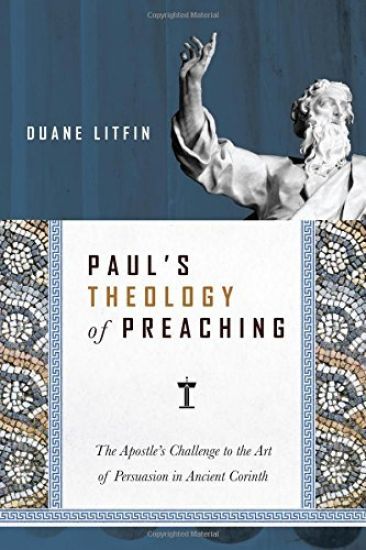
Paul`s Theology of Preaching – The Apostle`s Challenge to the Art of Persuasion in Ancient Corinth
"We preach Christ crucified: a stumbling block to Jews and foolishness to Gentiles, but to those whom God has called, both Jews and Greeks, Christ the power of God and the wisdom of God." When Paul preached about the crucified and risen Jesus Christ to the church at Corinth and elsewhere, did he follow the well-established rhetorical strategy of his day or did he pursue a different path? And what does that mean for the preaching of the church today? Through a detailed analysis of 1 Corinthians 1-4, Duane Litfin explores the rhetorical context of Paul's preaching and his own understanding of his task as a preacher. What is revealed in this investigation is a sharp distinction between Greco-Roman rhetorical strategies, which sought to persuade, and Paul's theology of preaching, which was based on the model of an obedient herald. This revised and expanded version of Litfin's previous St. Paul's Theology of Proclamation will provide insight to those engaged in Pauline and New Testament studies, rhetorical theory, and Greco-Roman studies. Moreover, by offering a better understanding of Paul's method as well as the content of his declaration concerning "the power and wisdom of God" revealed in Jesus, this book will help preachers as they undertake the ongoing task to "preach Christ crucified."
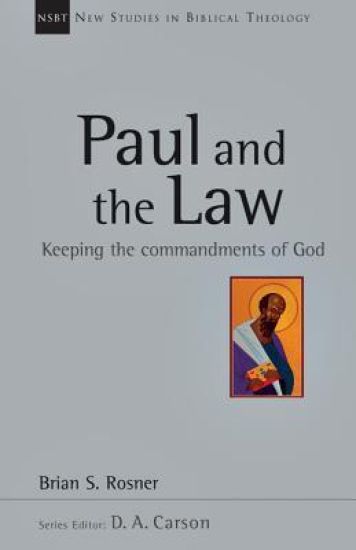
Paul and the Law

Paul and the Law

Brian S. Rosner

INTERVARSITY PRESS
2013
nidottu
Preaching's Preacher's Guide to the Best Bible Reference"For neither circumcision counts for anything nor uncircumcision, but keeping the commandments of God" (1 Cor 7:19).The apostle Paul's relationship to the Law of Moses is notoriously complex and much studied. Difficulties begin with questions of definition (of the extent of Paul's corpus and the meanings of "the law") and are exacerbated by numerous problems of interpretation of the key texts. Major positions are entrenched, yet none of them seems to know what to do with all the pieces of the puzzle.Inextricably linked to Paul's view of the law is his teaching concerning salvation history, Israel, the church, anthropology, ethics and eschatology. Understanding "Paul and the law" is critical to the study of the New Testament, because it touches on the perennial question of the relationship between the grace of God in the gift of salvation and the demand of God in the call for holy living. Misunderstanding can lead to distortions of one or both.This New Studies in Biblical Theology volume is something of a breakthrough, bringing neglected evidence to the discussion and asking different questions of the material, while also building on the work of others. Brian Rosner argues that Paul undertakes a polemical re-evaluation of the Law of Moses, which involves not only its repudiation as law-covenant and its replacement by other things, but also its wholehearted re-appropriation as prophecy (with reference to the gospel) and as wisdom (for Christian living).Addressing key issues in biblical theology, the works comprising New Studies in Biblical Theology are creative attempts to help Christians better understand their Bibles. The NSBT series is edited by D. A. Carson, aiming to simultaneously instruct and to edify, to interact with current scholarship and to point the way ahead.
Paul and Judaism Revisited

Paul and Judaism Revisited

Sprinkle Preston M.

Inter-Varsity Press,US
2013
nidottu
Preaching's Preacher's Guide to the Best Bible Reference for 2014 (Pauline Studies) Ever since E. P. Sanders publishedPaul and Palestinian Judaism in 1977, students of Paul have been probing, weighing and debating the similarities and dissimilarities between the understandings of salvation in Judaism and in Paul. Do they really share a common notion of divine and human agency? Or do they differ at a deep level? And if so, how? Broadly speaking, the answers have lined up on either side of the old perspective and new perspective divide. But can we move beyond this impasse? Preston Sprinkle reviews the state of the question and then tackles the problem. Buried in the Old Testament's Deuteronomic and prophetic perspectives on divine and human agency, he finds a key that starts to turn the rusted lock on Paul's critique of Judaism. Here is a proposal that offers a new line of investigation and thinking about a crucial issue in Pauline theology.
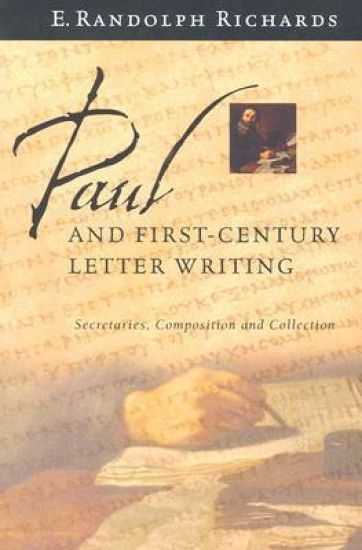
Paul and First-Century Letter Writing

Paul and First-Century Letter Writing

E. Randolph Richards

INTERVARSITY PRESS
2004
nidottu
Traditional Christian art depicts Paul the letter writer, pen in hand, attentive to the Spirit. We might think we know better and imagine him pacing in agitation as he rapidly dictates to a secretary his letter to the Galatians. But in reality neither of these pictures is accurate.In Paul's day, producing a letter was a time-consuming and costly business. And we have ample resources from the ancient world to piece together what it must have been like. A secretary was usually part of the picture. But so were notes, drafts, corrections and careful rewrites, not to speak of scratchy pens, sooty ink and coarse papyrus. Interestingly, there is evidence that Paul involved his missionary team in the writing of letters. And then came the delivery over land and sea, the reading and circulation, as well as the epistolary afterlife of copying, collecting and storing. E. Randolph Richards has extensively studied ancient letter writing and secretaries. Informed by the historical evidence and with a sharp eye for telltale clues in Paul's letters, he takes us into this world and places us on the scene with Paul the letter writer. What first appears to be just a study of secretaries and stationery turns out to be an intriguing glimpse of Paul the letter writer that overthrows our preconceptions and offers a new perspective on how this important portion of Christian Scripture came to be.
Paul the Missionary

Paul the Missionary

Eckhard J. Schnabel

INTERVARSITY PRESS
2008
nidottu
Biblical Foundations Book AwardEckhard Schnabel's two-volume Early Christian Mission is widely recognized as the most complete and authoritative contemporary study of the first-century Christian missionary movement. Now in Paul the Missionary Schnabel condenses volume two of the set, drawing on his research to provide a manageable study for students of Paul as well as students and practitioners of Christian mission today.Schnabel first focuses the spotlight on Paul's missionary work--the realities he faced, and the strategies and methods he employed. Applying his grasp of the wide range of ancient sources and of contemporary scholarship, he clarifies our understanding, expands our knowledge and corrects our misconceptions of Paul the missionary.In a final chapter Schnabel shines the recovered light of Paul's missionary methods and practices on Christian mission today. Much like Roland Allen's classic Missionary Methods: St. Paul's or Ours? of nearly a century ago, Schnabel offers both praise and criticism. For those who take the time to immerse themselves in the world of Paul's missionary endeavor, this final chapter will be both rewarding and searching.
Paul Through Mediterranean Eyes

Paul Through Mediterranean Eyes

Kenneth E. Bailey

INTERVARSITY PRESS
2011
nidottu
Christianity Today Book Award winnerPaul was a Hebrew of the Hebrews, steeped in the learning of his people.But he was also a Roman citizen who widely traveled the Mediterranean basin, and was very knowledgeable of the dominant Greek and Roman culture of his day. These two mighty rivers of influence converge in Paul's first letter to the Corinthians.With razor-sharp attention to the text, Kenneth Bailey examines the cultural milieu and rhetorical strategies that shaped this pivotal epistle. He discovers the deep layers of the Hebraic prophetic tradition informing Paul's writing, linking the Apostle with the great prophets of the Old Testament.Throughout, Bailey employs his expert knowledge of Near Eastern and Mediterranean culture to deliver to readers a new understanding of Paul and his world. Familiar passages take on a new hue as they are stripped of standard Western interpretations and rendered back into their ancient setting.
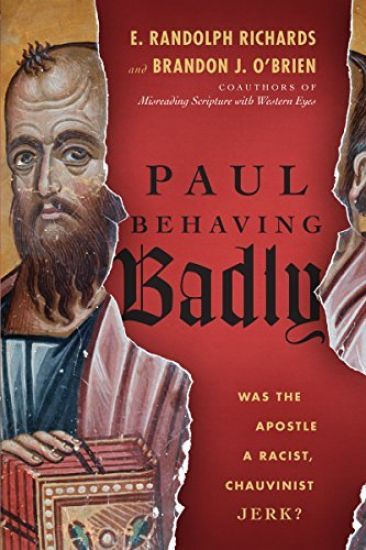
Paul Behaving Badly – Was the Apostle a Racist, Chauvinist Jerk?

Paul Behaving Badly – Was the Apostle a Racist, Chauvinist Jerk?

E. Randolph Richards; Brandon J. O`brien

Inter-Varsity Press,US
2016
nidottu
The apostle Paul was kind of a jerk. He was arrogant and stubborn. He called his opponents derogatory, racist names. He legitimized slavery and silenced women. He was a moralistic, homophobic killjoy who imposed his narrow religious views on others. Or was he? Randolph Richards and Brandon O'Brien explore the complicated persona and teachings of the apostle Paul. Unpacking his personal history and cultural context, they show how Paul both offended Roman perspectives and scandalized Jewish sensibilities. His vision of Christian faith was deeply disturbing to those in his day and remains so in ours. Paul behaved badly, but not just in the ways we might think. Take another look at Paul and see why this "worst of sinners" dares to say, "Follow my example, as I follow the example of Christ."
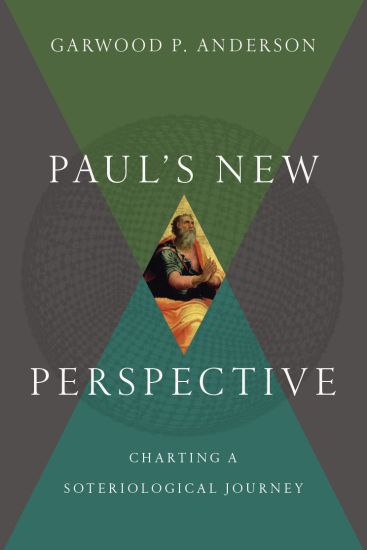
Paul`s New Perspective – Charting a Soteriological Journey

Paul`s New Perspective – Charting a Soteriological Journey

Garwood P. Anderson

Inter-Varsity Press,US
2016
sidottu
The debate between proponents of the old and new perspectives on Paul has been followed closely over the years, consolidating allegiances on either side. But the debate has now reached a stalemate, with defectors turning to apocalyptic and other solutions. Garwood Anderson recounts the issues and concludes that "both 'camps' are right, but not all the time." And with that teaser, he rolls up his exegetical sleeves and proceeds to unfold a new proposal for overcoming the deadlock. But in a field crowded with opinions, could anything new emerge? Anderson's interaction with Paul and his interpreters is at the highest level, and his penetrating and energetic analysis captures attention. What if Paul's own theological perspective was contextually formed and coherently developed over time? Have we asked justification to carry a burden it was never meant to bear? Would fresh eyes and a proper sequencing of Paul's letters reveal Paul's own new perspective? Might we turn a corner and find a bold and invigorating panorama of Pauline soteriology? This is a Pauline study worthy of its great theme, and one that will infuse new energy into the quest for understanding Paul's mind and letters.
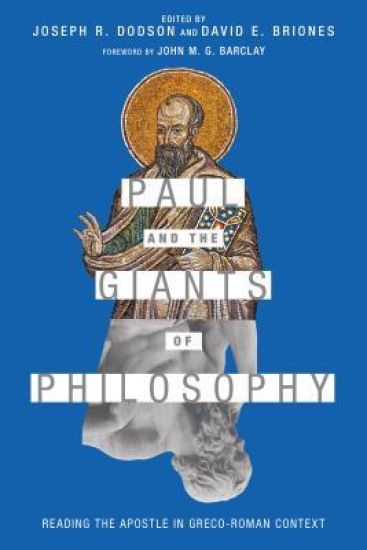
Paul and the Giants of Philosophy – Reading the Apostle in Greco–Roman Context

Paul and the Giants of Philosophy – Reading the Apostle in Greco–Roman Context

Joseph R. Dodson; David E. Briones; John M. G. Barclay

IVP Academic
2019
nidottu
Biblical Foundations Award Finalist What forces shaped the intellectual world of the apostle Paul? How familiar was he with the great philosophers of his age, and to what extent was he influenced by them? When he quoted Greco-Roman sources, what was his aim? Pauline scholars wrestle with such questions in journal articles and technical monographs, but now Paul and the Giants of Philosophy brings the conversation into the college classroom and the church. Each essay addresses Paul's interaction with Greco-Roman philosophical thinking on a particular topic, such as faith, slavery, gift-giving, and the afterlife. And each chapter includes discussion questions and reading lists to help readers engage the material further. Dodson and Briones have gathered contributors with diverse views from various traditions who are united in the desire to make Paul's engagement with ancient philosophy accessible to many readers.
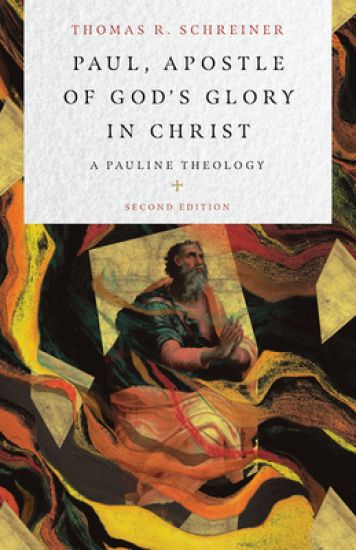
Paul, Apostle of God`s Glory in Christ – A Pauline Theology
The theology of the apostle Paul is complex, set forth in numerous occasional letters, and subject to a seemingly endless variety of interpretations. How should students of Scripture engage the challenging task of discerning the shape of Paul's thought? In Paul, Apostle of God's Glory in Christ, Thomas R. Schreiner seeks to unearth Paul's worldview by observing what Paul actually says in his writings and laying out the most important themes and how they are connected. According to Schreiner, "The passion of Paul's life, the foundation and capstone of his vision, and the animating motive of his mission was the supremacy of God in and through the Lord Jesus Christ." While continuing to return to this foundation, Schreiner explores themes such as the inclusion of the Gentiles in God's people, the power of sin, God's liberating work of grace, and the unity of the church, as well as the often-neglected topics of Paul as a missionary and his apostolic sufferings. This second edition is revised throughout and engages with more recent works on Paul. While thoroughly informed by the issues of contemporary Pauline studies, Schreiner offers an accessible account of Paul's theology that focuses on the primary sources. Paul, Apostle of God's Glory in Christ remains a sound, insightful, and trusted exposition of Paul's theology that is well-geared to the needs of seminary students and working pastors.
Paul's Works of the Law in the Perspective of Second-Century Reception
Jesus Creed Book of the Year 2018What did Paul mean by "works of the law"? Paul writes that we are justified by faith apart from "works of the law," a disputed term that represents a fault line between "old" and "new" perspectives on Paul. Was the apostle reacting against the Jews' good works done to earn salvation, or the Mosaic law's practices that identified the Jewish people? Matthew J. Thomas examines how Paul's second-century readers understood these points in conflict, how their readings relate to "old" and "new" perspectives, and what their collective witness suggests about the apostle's own meaning. Surprisingly, these early witnesses align closely with the "new" perspective, though their reasoning often differs from both modern viewpoints. They suggest that Paul opposes these works neither due to moralism, nor primarily for experiential or social reasons, but because the promised new law and covenant, which are transformative and universal in scope, have come in Christ.
Paul's Missionary Methods

Paul's Missionary Methods

INTERVARSITY PRESS
2012
nidottu
What does Paul's missions strategy mean for today?A century ago Roland Allen published Missionary Methods: Saint Paul's or Ours?, a missiological classic which tackled many important issues, including what biblically rooted missions looks like in light of the apostle Paul's evangelistic efforts. Although Allen's work is still valuable, new understandings have been gained regarding Paul's milieu and missionary activity, and how his practices ought to inform missions in our ever-changing world.Using the centennial anniversary of Allen's work as a springboard for celebration and reflection, the contributors to Paul's Missionary Methods have revisited Paul's first-century missionary methods and their applicability today. This book examines Paul's missionary efforts in two parts. First Paul is examined in his first-century context: what was his environment, missions strategy and teaching on particular issues? The second part addresses the implications of Paul's example for missions today: is Paul's model still relevant, and if so, what would it look like in modern contexts?Experts in New Testament studies and missiology contribute fresh, key insights from their fields, analyzing Paul's missionary methods in his time and pointing the way forward in ours.Contributors includeMichael F. BirdEckhard J. SchnabelBenjamin L. MerkleChristoph W. StenschkeDon N. Howell Jr.Craig KeenerDavid J. HesselgraveMichael PocockEd StetzerM. David SillsChuck LawlessJ. D. Payne
Paul's Journey Letters

Paul's Journey Letters

Smith

Inter-Varsity Press,US
2011
nidottu
Feel, live, and breathe Paul's letters when you study them in the context of his life and work. These studies will guide you through Paul's first six letters, leading you through the where, when, and why they were written, leaving you a much deeper and personal understanding of what God was doing on his eventual journey to Rome. Follow the dramatic unfolding story of Paul's life through 1 and 2 Thessalonians, 1 and 2 Corinthians, Galatians, and Romans. He spread the gospel, guided and directed the work of local churches, and explained to the wider world who knew nothing of Jesus just who Jesus is and what he has done. TheUnderstanding the Books of the Bible series enables groups to take a new approach to studying the Bible together. Instead of following artificial chapter and verse divisions, these study guides lead groups through whole books following their natural outlines, and pose engaging questions for discussion and personal application all along the way.
Paul's Prison Letters

Paul's Prison Letters

Smith

Inter-Varsity Press,US
2012
nidottu
Feel, live, and breathe the letters that Paul wrote from prison as you study them in the context of his life and work with this excellent guide by Christopher R. Smith. This guide will lead you through Paul's final seven letters (Colossians, Ephesians, Philemon, Philippians, 1 Timothy, Titus, 2 Timothy), explaining where, when, and why they were written. It will give you a deeper and more personal understanding of what God was doing among the early communities of Jesus' followers and how their experiences can impact you today. You'll witness the dramatic story unfold of how--despite his imprisonments--Paul continued to be active in spreading the gospel, guiding and directing the work of local churches, and explaining to the wider world who Jesus is and what he has done.
Paul Ramsey's Political Ethics

Paul Ramsey's Political Ethics

David Attwood

Rowman Littlefield
1991
nidottu
The thought of Paul Ramsey continues to assert an enormous influence on Christian ethics. In this book, David Attwood provides the first book-length presentation of Paul Ramsey's political ethics since his death, taking into account his last work, Speak Up for Just War or Pacificism. Attwood gives a clear, detailed, and accurate account of Ramsey's work, exposing the coherent logic and systematic thought holding together his theology and ethical applications. This book traces the theological and ethical basis for Ramsey's just war theory, the theological basis for ethics in Christian covenant love and its expression in principles and exceptionless moral rules. Attwood examines the theological foundations of Ramsey's political theory and the way he combined political and ethical analysis in his consideration of the morality of nuclear deterrence. The introductory section sketches Ramsey's career, with the emphasis on his work in politics and just war theory.
Paul Ricoeur

Paul Ricoeur

Bernard P. Dauenhauer

Rowman Littlefield
1998
nidottu
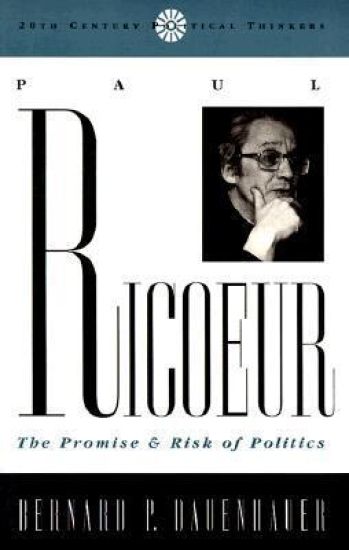
Paul Ricoeur, with Rawls, Walzer, and Habermas as some of his main interlocutors, has developed a substantial and distinctive body of political thought. On the one hand, it articulates a rich conception of the paradoxical character of the domain of politics. On the other, it provides a fresh approach to such major topics as the relationship among politics, economics, and ethics and between concern for universal human rights and respect for cultural plurality. His work, rooted as it is in Aristotle, Kant, and Hegel, also provides resources for a fruitful rethinking of the issues at stake in the liberal-communitarian debate.
Paul R. Williams

Paul R. Williams

Karen E. Hudson; Michael S. Smith

Rizzoli International Publications
2021
sidottu
Over a career spanning six decades, architect Paul Revere Williams came to define what gracious living looked like for the Hollywood elite. Williams mastered an array of architectural idioms—including American Colonial, Spanish Mediterranean, English Tudor, French Normandy, Art Deco, and, of course, the California ranch style—to create the sophisticated yet understated showplaces that are featured here in all new full-color photography.Among the most celebrated architects of his generation, Williams was also the first African-American member of the American Institute of Architects, and he was deeply involved in the black community in Los Angeles and in African-American affairs nationally. Williams moved among many worlds, and with celebrity clients such as Frank Sinatra, Lucille Ball and Desi Arnaz, Tyrone Power, and Barbara Stanwyck, as well as clients who made Hollywood run behind the scenes, not to mention members of Los Angeles high society, Williams left his mark in the city’s most glamorous and exclusive enclaves—Beverly Hills, Brentwood, Bel Air, and the Hollywood Hills.Paul R. Williams: Classic Hollywood Style is a dazzling tour of this prolific architect’s most spectacular houses, by his granddaughter Karen Hudson, with a special focus on their roles not only as places for high living but also as venues for world-class entertaining.
Paul Resika

Paul Resika

Avis Berman

Rizzoli International Publications
2020
sidottu
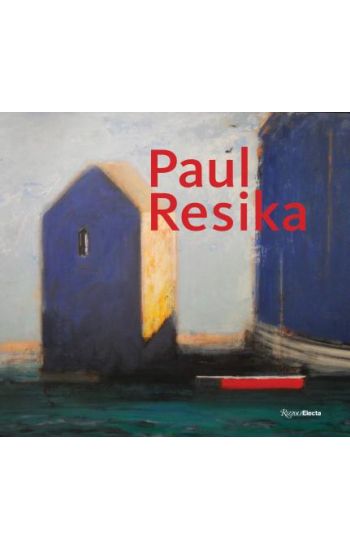
This new monograph is the most comprehensive book on the work of Paul Resika (b. 1928) to date, highlighting his landscapes, portraits, and still lifes from the 1940s to the present. Resika s most important teacher was Hans Hofmann, with whom he studied on Cape Cod and in New York City in the mid-forties. Resika's subjects are drawn from nature and reflect his surroundings, which change with the seasons: in winter, he lives in New York; in summer, Cape Cod; in spring he spends time painting in the south of France and in Italy. Provincetown piers, fishing boats in the harbor, figures on the beach, and French farmhouses in the countryside emanate a dreamlike serenity and make up the rich visual vocabulary for which Resika is best known. Produced in a large format with more than 220 color illustrations, this book reflects over eight decades of Resika's output, with scholarly essays that reveal his ongoing dialogue with Hofmann's sophisticated ideas about color and pictorial structure.
Paul as Apostle to the Gentiles

Paul as Apostle to the Gentiles

Daniel J Chae

Paternoster Press
1997
nidottu
The author competently demonstrates that the equality of Jew and Gentile is the main subject matter of Paul's soteriological argument in his letter to the Romans. Chae argues that it is Paul's self-awareness of being an apostle to the Gentiles that has significantly influenced the shape, content and structure of his inclusive argument. Thus he offers an important alternative to the prevailing post-Holocaust interpretation of Romans and of Paul.