Kirjojen hintavertailu. Mukana 12 390 323 kirjaa ja 12 kauppaa.

Kirjahaku

Etsi kirjoja tekijän nimen, kirjan nimen tai ISBN:n perusteella.

1000 tulosta hakusanalla Raymond De Block

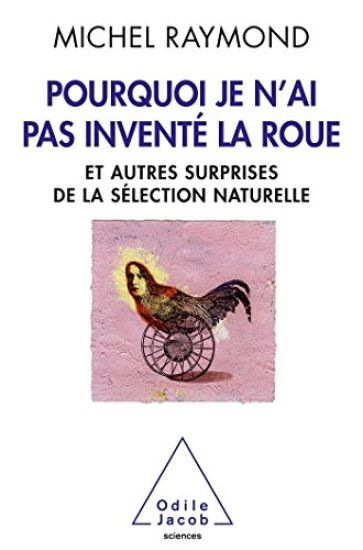
Why I Didn't Invent the Wheel / Pourquoi je n'ai pas inventé la roue: Et autres surprises de la sélection naturelle
A research director at the French National Centre for Scientific Research (CNRS), Michel Raymond works at the Evolutionary Science Institute, in Montpellier, France. He is the author of such successful works as" Cro-Magnon toI'm me Petit Guide Darwinien de la vie quotidienne" (2008) and "Biologie volutive" (edited by M. Raymond, F. Thomas and T. Lef vre, 2010). Biology tells us that there are two major ingredients in the evolution of the species: chance and selection. It is easy to understand how, through natural selection, the environment can favour certain traits that eventually, after several generations, result in sometimes startling changes. But it is more difficult to acknowledge that'such a form of selection can also apply to humans - cultural animals par excellence. In his examination of this controversial issue, the author begins by explaining the extraordinary efficacy of natural selection in resolving - bliedly - the most complex problems. Yet he does not omit certain conceptual errors (the eye is cabled upside down) and the obvious dead ends: there are no animals endowed with wheels, and the flying fish opted to remain a sea creature instead of taking to the skies, which it could have easily done when bieds did not yet exist. But the author goes beyond a simple reflection on nature's greatest feats or on the promises of bI'mimicry (the engineered emulation of solutions developed through natural selection), in order to re-examine the question of human evolution. By probing the biological impact of cultural innovations (both the use of fire and animal domestication disrupted human metabolI'm and modified the human genome), by investigating the link between political power and reproductive power and even by delving into the biological origins of morality and religion, the author incites us to question the legitimacy of nothing less than the age-old opposition between nature and culture. To assert that humans and human culture obey the same laws as other living creatures is a highly controversial argument. But it is also one that has given rise to many fascinating studies that cannot be ignored by anyone wishing to understand human evolution.- Although popular studies on animal evolution abound those on human evolution remain rare: this book fills that gap.
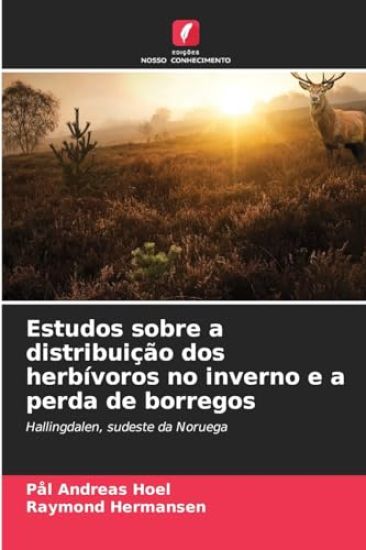
Estudos sobre a distribuição dos herbívoros no inverno e a perda de borregos

Estudos sobre a distribuição dos herbívoros no inverno e a perda de borregos

Pål Andreas Hoel; Raymond Hermansen

Edicoes Nosso Conhecimento
2024
pokkari
Os estudos foram realizados por encomenda do Instituto Noruegu s para a Natureza e a Ci ncia (NINA) e uma coopera o entre o NINA e a Faculdade de Artes e Ci ncias, Departamento de Estudos Ambientais e de Sa de, Col gio Universit rio de Telemark. O projeto foi inclu do na investiga o escandinava em curso sobre o lince, Scandlynx em 2007 - 2008 e resultou em dois artigos: "Distribui o invernal de cerv deos e lebres da montanha em rela o topografia e profundidade da neve" e "Perda de cordeiros em rela o densidade de cor os no sudeste da Noruega".
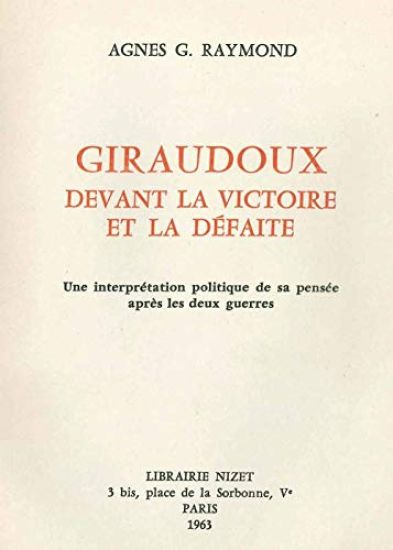
Giraudoux Devant La Victoire Et La Defaite: Une Interpretation Politique de Sa Pensee Apres Les Deux Guerres
Agnes G. Raymond, dans cet ouvrage, poursuit une tache delicate et subtile, de nature presque archeologique: mettre en lumiere la pensee politique de Giraudoux en s'en tenant a son oeuvre litteraire, d'apparence apolitique, a quelques rares exceptions pres. En decodant les metaphores, les images et les symboles saturant les pieces theatrales de Giraudoux - et dans une mesure moindre, certains de ses romans -, en depassant le niveau de l'apparence stylistique (humour fantaisiste, style iconoclaste, etc.), l'auteur exhume les traces d'une pensee politique cachee (ou cryptee), a la maniere d'une enquetrice policiere. Agnes G. Raymond avoue meme avoir "trouve sa these au bout de ses recherches ..." Se focalisant sur le "cycle de Siegfried" (lie a la Guerre 1914-1918) puis sur les trois pieces Sodome et Gomorrhe, La Folle de Chaillot et Les Hommes-tigres ("volet" Seconde Guerre mondiale et occupation), Agnes G. Raymond montre que la clef de sa quete passe en partie par l'analyse de la femme giralducienne, symbole politique evident et constant. In fine, L'image "exhumee" du Giraudoux politique est celle d'un citoyen soucieux de l'etat et du destin de son pays, et qui exige de lui de la dignite (de la "tenue") et la permanence d'un style caracteristique, celui definit par Renan en son temps, fonde sur le combat des valeurs intellectuelles et culturelles contre la decadence materialiste des "gens d'argent".
Educação, Diálogo E Formação de Carácter

Educação, Diálogo E Formação de Carácter

Valentine B Ngalim; Nelson Shang; Raymond T Tanwie

Edicoes Nosso Conhecimento
2023
pokkari
A educa o com um impulso distinto na forma o do car cter especialmente relevante na nossa era p s-verdade que se caracteriza por um aumento crescente da decad ncia moral, do vazio espiritual e existencial. O sector educacional n o est livre desta crise, da a necessidade de levar a cabo esta investiga o. A forma o do car cter vital, n o s por parte dos estudantes, mas tamb m por parte dos professores. O pensamento educativo de Buber transmite a ideia do homem como um ser dial gico ou relacional. Buber considera assim o ser humano como basicamente relacionando-se e partilhando, em vez de criaturas ego stas, auto-realizadoras, individualmente criativas ou simples de orienta o social. A exist ncia humana constru da por uma malha de v rias rela es humanas que s o interactivas, sociais e educativas, e que animam, aprofundam, e realizam o crescimento individual. Na esfera educacional, tal rela o baseia-se na confian a entre o professor e o aluno e actualiza-se atrav s do princ pio "I-Thou" do di logo. Assim, o principal argumento do livro que a educa o n o nos pode ajudar enquanto n o der lugar forma o de car cter.
The Ethics

The Ethics

Benedict de Spinoza; Raymond L. Weiss

Dover Publications Inc.
2018
nidottu
What does it mean to live an ethical life? For seventeenth-century philosopher Benedict de Spinoza, this question led to a doctrine in which God is present in all things and the human mind is part of God's infinite intellect. Spinoza regarded ethics as a rational system corresponding to the rational nature of the universe and employed a deductive method derived from Euclidean geometry to show that the validity of ethical ideas can be demonstrated by a mathematical style argument. His conclusion: to be guided by reason is to live freely, motivated by love and goodwill rather than fear or hatred. These ideas challenged both conventional views of God and the related social and political structure. Reviled by the religious authorities of his native Amsterdam, Spinoza remained an uncompromising model of intellectual courage. His vision, published posthumously as The Ethics, has served as an inspiration to Enlightenment philosophers, Romantic poets, and generations of thinkers.