

Kirjahaku
Etsi kirjoja tekijän nimen, kirjan nimen tai ISBN:n perusteella.
1000 tulosta hakusanalla Robert Simpson


Speeches by the Right Honorable Sir Robert Peel During His Administration; Also His Address to the Electors of Borough of Tamworth
Robert Peel
Trieste Publishing
2018
nidottu

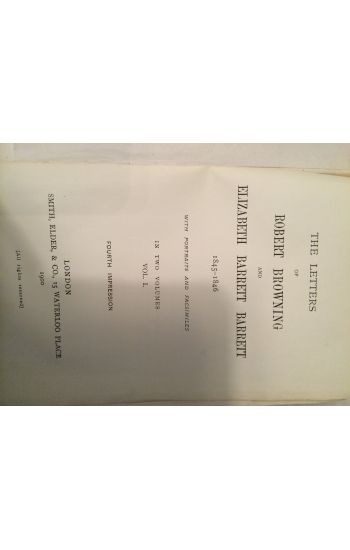
The Letters of Robert Browning and Elizabeth Barrett Barrett, 1845-1846
Robert Browning; Elizabeth Barrett Browning
Harvard University Press
2004
sidottu
The Letters of Robert Browning and Elizabeth Barrett Barrett, 1845-1846
Robert Browning; Elizabeth Barrett Browning
Harvard University Press
2004
sidottu

Arguably no other nineteenth-century German composer was as literate or as finely attuned to setting verse as Robert Schumann. Jon W. Finson challenges long-standing assumptions about Schumann's Lieder, engaging traditionally held interpretations. He argues against the belief that the "Year of Song" simply reflects Schumann's personal life. Finson also devotes attention to the form and metric structure of German poetry that is almost entirely new to the discussion of Schumann's songs.Arranged in part thematically, rather than merely by strict compositional chronology, this book speaks to the heart of Schumann's music. Finson's sustained attention to performance, such as questions of whether two singers might divide performance of cycles or whether miscellanies form coherent entities, allows the reader to engage Schumann's songs in novel ways.Finson brings original research and the most recent scholarship to the musically literate public and the expert alike. This represents the definitive work on Schumann's songs and the standard reference for any Schumann enthusiast.

Robert Frost is one of the most widely read, well loved, and misunderstood of modern writers. In his day, he was also an inveterate note-taker, penning thousands of intense aphoristic thoughts, observations, and meditations in small pocket pads and school theme books throughout his life. These notebooks, transcribed and presented here in their entirety for the first time, offer unprecedented insight into Frost's complex and often highly contradictory thinking about poetics, politics, education, psychology, science, and religion--his attitude toward Marxism, the New Deal, World War--as well as Yeats, Pound, Santayana, and William James. Covering a period from the late 1890s to early 1960s, the notebooks reveal the full range of the mind of one of America's greatest poets. Their depth and complexity convey the restless and probing quality of his thought, and show how the unruliness of chaotic modernity was always just beneath his appearance of supreme poetic control.Edited and annotated by Robert Faggen, the notebooks are cross-referenced to mark thematic connections within these and Frost's other writings, including his poetry, letters, and other prose. This is a major new addition to the canon of Robert Frost's writings.
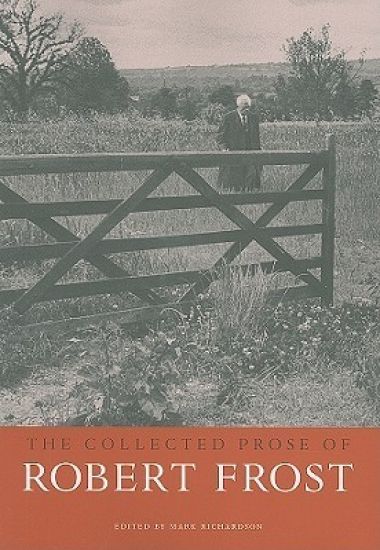
During his lifetime, Robert Frost notoriously resisted collecting his prose--going so far as to halt the publication of one prepared compilation and to "lose" the transcripts of the Charles Eliot Norton Lectures he delivered at Harvard in 1936. But for all his qualms, Frost conceded to his son that "you can say a lot in prose that verse won't let you say," and that the prose he had written had in fact "made good competition for [his] verse." This volume, the first critical edition of Robert Frost's prose, allows readers and scholars to appreciate the great American author's forays beyond poetry, and to discover in the prose that he did make public--in newspapers, magazines, journals, speeches, and books--the wit, force, and grace that made his poetry famous.The Collected Prose of Robert Frost offers an extensive and illuminating body of work, ranging from juvenilia--Frost's contributions to his high school Bulletin--to the charming "chicken stories" he wrote as a young family man for The Eastern Poultryman and Farm Poultry, to such famous essays as "The Figure a Poem Makes" and the speeches and contributions to magazines solicited when he had become the Grand Old Man of American letters. Gathered, annotated, and cross-referenced by Mark Richardson, the collection is based on extensive work in archives of Frost's manuscripts. It provides detailed notes on the author's habits of composition and on important textual issues and includes much previously unpublished material. It is a book of boundless appeal and importance, one that should find a home on the bookshelf of anyone interested in Frost.

One of the acknowledged giants of twentieth-century American literature, Robert Frost was a public figure much celebrated in his day. Although his poetry reached a wide audience, the private Frost—pensive, mercurial, and often very funny—remains less appreciated. Following upon the publication of Frost’s notebooks and collected prose, The Letters of Robert Frost is the first major edition of the poet’s written correspondence. The hundreds of previously unpublished letters in these annotated volumes deepen our understanding and appreciation of this most complex and subtle of verbal artists.Volume One traverses the years of Frost’s earliest poems to the acclaimed collections North of Boston and Mountain Interval that cemented his reputation as one of the leading lights of his era. The drama of his personal life—as well as the growth of the audacious mind that produced his poetry—unfolds before us in Frost’s day-to-day missives. These rhetorical performances are at once revealing and tantalizingly evasive about relationships with family and close friends, including the poet Edward Thomas. We listen in as Frost defines himself against contemporaries Ezra Pound and William Butler Yeats, and we witness the evolution of his thoughts about prosody, sound, style, and other aspects of poetic craft.In its literary interest and sheer display of personality, Frost’s correspondence is on a par with the letters of Emily Dickinson, Robert Lowell, and Samuel Beckett. The Letters of Robert Frost holds hours of pleasurable reading for lovers of Frost and modern American poetry.

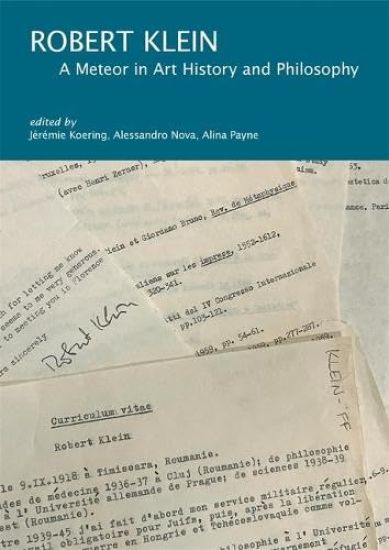
Although Robert Klein (1918–1967), well known for his erudition and the originality of his research, was an important, even paradigmatic figure for the field of art history in the twentieth century, no sustained study has yet been dedicated to his work.Klein undertook to rethink Renaissance art and its history from the Aristotelian notion of techne as early as the 1950s, long before anyone was interested in this other genealogy of Renaissance art. For him, the Mannerist work is intended to create awe and wonder, inviting the viewer to question the technical process, a combination of intelligence and manual skill, that made it possible to realize in this specific form.As his newly discovered papers and unpublished manuscripts testify, techne and Mannerism are far from being Klein’s only preoccupations. Other concepts have been studied with great originality by Klein, such as mnemonic art, paragone, dream, and responsibility.This book, proceeding from a conference organized by Villa I Tatti, Kunsthistorisches Institut in Florence, and the Institut national d’histoire de l’art (INHA) in Paris, sheds light on Klein’s investigations as well as on the intellectual journey of an important art historian and philosopher of the past century.
Robert Louis Stevenson and the Fiction of Adventure
Robert Kiely
Harvard University Press
1964
sidottu

The Letters of Robert Frost, Volume 2: 1920–1928 is the second installment of Harvard’s five-volume edition of the poet’s correspondence. Nearly three hundred letters in the critically-acclaimed first volume had never before been collected; here, close to four hundred are gathered for the first time. Volume 2 includes letters to some 160 correspondents: family and friends; colleagues, fellow writers, visual artists, editors, and publishers; educators of all kinds; farmers, librarians, and admirers.In the years covered here, publication of Selected Poems, New Hampshire, and West-Running Brook enhanced Frost’s stature in America and abroad, and the demands of managing his career—as public speaker, poet, and teacher—intensified. A good portion of the correspondence is devoted to Frost’s appointments at the University of Michigan and Amherst College, ?through which he played a major part in staking out the positions poets would later hold in American universities.?? Other letters show Frost helping to shape the Bread Loaf School of English and its affiliated Writers’ Conference.? We encounter him discussing his craft with students and fostering the careers of younger poets. His ??observations (and reservations) about educators are illuminating and remain pertinent. And family life—with all its joys and sorrows, hardships and satisfactions—is never less than central to Frost’s concerns.Robert Frost was a masterful prose stylist, often brilliant and always engaging.? Thoroughly annotated and accompanied by a biographical glossary, chronology, and detailed index, these letters are both the record of a remarkable literary life and a unique contribution to American literature.