Kirjojen hintavertailu. Mukana 12 390 323 kirjaa ja 12 kauppaa.

Kirjahaku

Etsi kirjoja tekijän nimen, kirjan nimen tai ISBN:n perusteella.

1000 tulosta hakusanalla Rohan Mukherjee

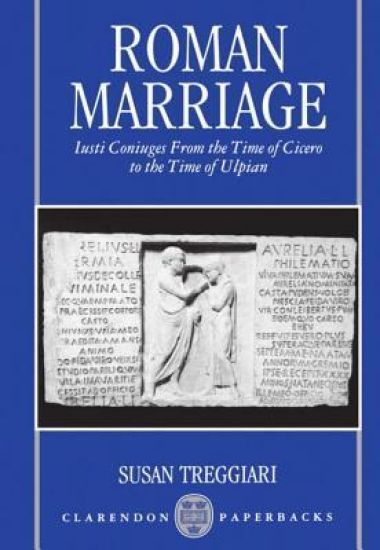
Roman Marriage

Roman Marriage

Treggiari

Clarendon Press
1993
nidottu
Marriage, a fundamental institution in human societies, takes varying forms. This book seeks to explore the practicalities, the cultural assumptions, and the affective possibilities of marriage during the later Republic and the Principate (c.100 BC-AD 235). It takes a fresh view of the interaction of law and reality within Roman marriage, and builds on the accumulation of legal scholarship in the field, as well as on the latest insights into Roman society. Through detailed examination of original sources (which are translated), Professor Treggiari shows that marriage affected a Roman woman's social status and might entail legal consequences. The socio-legal effect on a man as an individual was less striking but it enabled him to father legitimate children, which was the main object of the institution. The creation of new family alignments, shifts in the distribution of property, and the birth of new generations were important for society as a whole. Professor Treggiari also examines the dynamics of the various influences on the choice of partner; behavioural norms; and the motives for divorce.
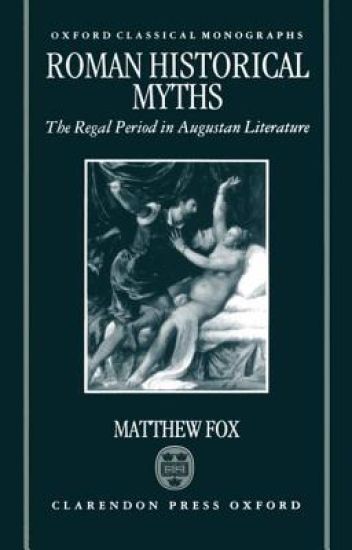
Roman Historical Myths

Roman Historical Myths

Matthew Fox

Clarendon Press
1996
sidottu
This book offers an enlivening and sophisticated analysis of the pervasive use of historical myth in some of the best-known writers of the Late Republic and Augustan periods - from Cicero in the De Republica and the first book of Livy to Propertius IV and Ovid's Fasti. The chapters on prose narrative uncover an uneasy tension between the desire for accurate historical representation and the legendary character of traditional stories. In the light of modern theories of historical truth, the book argues that the narrative itself expresses a kind of belief in myths, and that this belief is in turn conditioned by historical circumstance. In this way, the accounts of Rome's regal period in both prose and verse bear witness to the uncertainties and upheavals at the end of the republic. At the same time, Dr Fox argues for a more sophisticated relationship between political and textual reality, and concludes that interpretations of political subversion need to be balanced by the sense of destiny and desire for the reinterpretation inherent in recounting the origins of Rome.
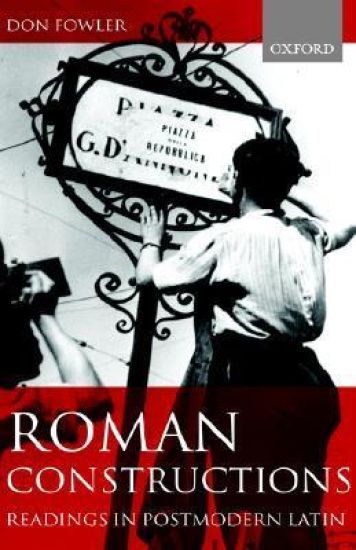
Roman Constructions

Roman Constructions

Don Fowler

Oxford University Press
2000
sidottu
Roman Constructions collects together twelve published and unpublished papers on Latin literature and literary theory from the decade 1989 to 1999. The papers share a common 'postmodern' emphasis on the role of the modern scholar and critic in the construction, rather than recreation, of meaning, and attempt to show how this approach works in detailed readings of a number of Latin authors, above all Vergil. The papers deal with such topics as point of view and focalization, intertextuality, historical contextualization, and closure, and each section is introduced by reflections on recent work in these areas subsequent to the original papers. The work makes a plea for classical scholars to accept their historical situatedness and to give up the pretence of scientific objectivity so that they can play a fuller part in the cultural dialogues of the present.
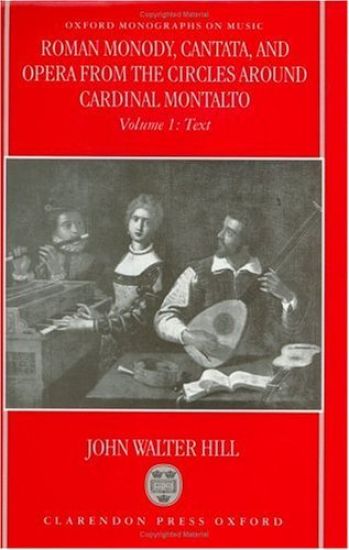
Roman Monody, Cantata and Opera from the Circles around Cardinal Montalto
The subject of this book arises from the author's discovery or identification of ten important manuscripts of early seventeenth-century Italian solo song (monody) previously unexplored by modern scholars. Almost by coincidence, the author's research shows that all ten manuscripts preserve portions of Roman repertoire largely by composers associated with the most significant music patron of the period, Alessandro Peretti, Cardinal montalto. Through extensive archival documentation, Cardinal Montalto's patronage of music is set in the broader context of the network of political, economic, and cultural clientela to which Montalto belonged. Hill documents new explanations of the origin of monody, focusing on the roles of Naples and rome and their unwritten traditions. A thorough analysis of the repertoire itself reveals and explains distinct subgenres of monody that have not previously been distinguished. Music for Battista Guarini's last stage work and for the first Roman opera brought forth. Thus, identified, examined, analysed and placed in context, this repertoire and its genesis call forth a fundamental revision of existing narratives and explanations of the early Baroque vocal music in Rome and the rise of the Italian chamber cantata, next to opera, the most significant musical genre of the seventeenth century.
Roman Law, Contemporary Law, European Law

Roman Law, Contemporary Law, European Law

Reinhard Zimmermann

Oxford University Press
2001
sidottu
Legal history helps us to understand our modern law. It explains why the law has become what it is. It lays open the premises on which the modern law is based. It constitutes a rich source of experience which is as valuable for the development of modern legal doctrines as for law reform. It may also reveal where a wong turn has been taken and thus prevent us from repeating an error. Today, however, historical legal scholarship has acquired an added significance in view of the Europeanization of private law and private law scholarship. It enables us to see the common ground between our modern national legal sustems and to understand existing differences. It makes us aware of the fact that the law has not developed in national isolation and can, therefore, not properly be understood under purely national auspices. It constitutes the foundation for scholarship in comparative law and paves the way towards re-establishing a European legal culture. The focus of these Clarendon lectures is on the "vital connection that ties the present to the past" (Savigny) and on the link between legal history, modern legal doctrine, and comparative law. They aim to recreate an awareness of a fundamental intellectual unity based on a common tradition. Such awareness is of central importance to sustain the process of a Europeanization of private law which we experience today. Lecture One: The End of an Era: Transformation of Scholarship in Roman Law Lecture Two: The Transition from Civil Law to Civil Code: Dawn of a New Era? Lecture Three: A Change in Perspective: European Private Law and its Historical Foundations
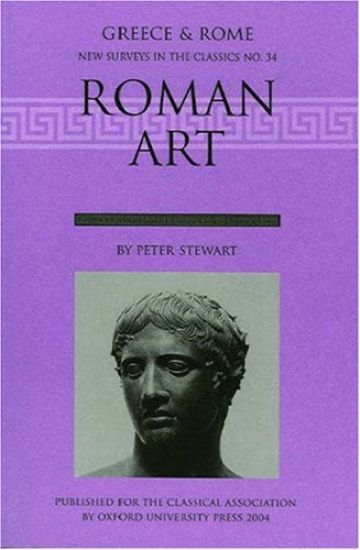
Roman Art

Roman Art

Peter Stewart

Oxford University Press
2004
pokkari
From the faces of emperors to mythological sarcophagi, from imperial propaganda to domestic wall-painting and the earliest Christian images, this New Survey offers an up-to-date, illustrated overview of the history of Roman art. Explaining the material in an accessible and even-handed way, the author seeks not only to introduce the art itself, but also to survey and evaluate the range of approaches adopted by scholars in the field. Organized around the loose categories of portraiture, public monuments, funerary art, domestic art, and late antiquity, the discussion introduces representative monuments and problems in Roman art. It also serves as an accessible, critical survey of the range of approaches adopted by those attempting to explain the works. The text is aimed at students, teachers, and anyone who wants to navigate a path through the complexities of this vast but increasingly popular area of study.
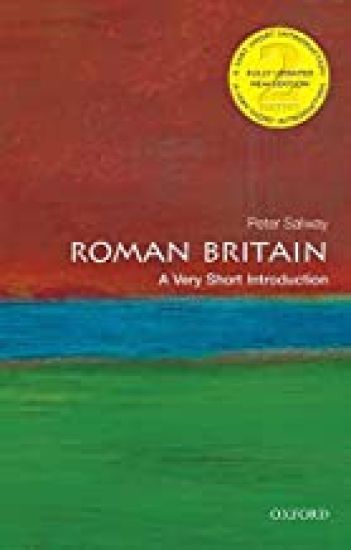
Roman Britain

Roman Britain

Peter Salway

Oxford University Press
2015
nidottu
For four centuries Britain was an integral part of the Roman Empire, a political system stretching from Turkey to Portugal and from the Red Sea to the Tyne and beyond. Its involvement with Rome started long before the Conquest launched by the Emperor Claudius in 43 AD, and it continued to be a part of the Roman world for some time after the final break with Roman rule. Bringing together archaeological investigation and historical scholarship, Peter Salway explores some of the key issues arising from this period in Britain's history, discussing the question of identity at this time and analysing the importance of widespread literacy in Roman Britain. Covering the period from Julius Caesar's first forays into Britain and Claudius' subsequent conquest, as well as Britain under the later Roman Empire, Salway outlines the key events of this time period, providing a focus on society in Roman Britain, and offering a thoughtful consideration of the aftermath of Roman rule. In the new edition of this Very Short Introduction, Peter Salway makes a number of essential updates in light of recent research in the area. He looks at issues of ethnicity, 'Britishness', and post-colonialism, provides alternative theories to the end of the Roman period in Britain, and draws parallels between the history of Roman Britain and a wide range of other periods, territories, and themes, including the modern experience of empires and national stereotypes. ABOUT THE SERIES: The Very Short Introductions series from Oxford University Press contains hundreds of titles in almost every subject area. These pocket-sized books are the perfect way to get ahead in a new subject quickly. Our expert authors combine facts, analysis, perspective, new ideas, and enthusiasm to make interesting and challenging topics highly readable.
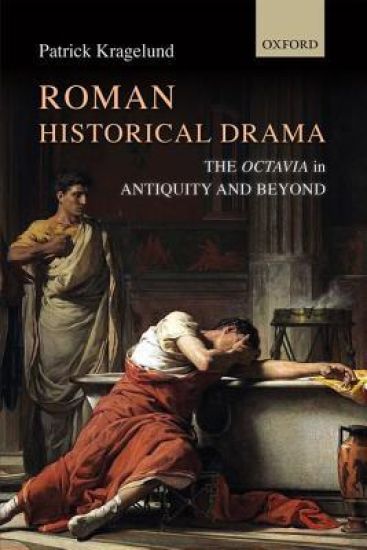
Roman Historical Drama

Roman Historical Drama

Patrick Kragelund

Oxford University Press
2015
sidottu
The Octavia is the only surviving historical drama from ancient Rome. With a plot rich in sex, dynastic intrigue, riots, and murder, the play's characters include the philosopher Seneca, the emperor Nero, the ghost of his murdered mother, his wife Octavia, and his mistress and empress-to-be Poppaea. For centuries dismissed as a feeble, rhetorically overblown closet-drama written without consideration for the demands of plot or stage, the Octavia's dynamic changes of time and setting, its startling interplay of the verbal and visual, and its integration of issues pervading the politics of the period in which it was written, reflect scenic conventions and a notion of the dramatic that radically transforms and expands our knowledge of ancient theatre and the Roman stage. Roman Historical Drama is the first comprehensive interpretation of ancient historical drama in relation to this exciting play, revealing how the Octavia mirrors the genre's traditions by mixing formats and stock characters from traditional tragedy with elements drawn from new developments of the Hellenistic and Roman stage. The volume explores the role and impact of historical (and political) drama in Rome, offering a pioneering reading of the Octavia in relation to ancient performance practice, as well as to the politics of those who in AD 68 brought down the tyrant Nero. In its final section, the volume provides a panoramic survey of the revival and reinvention of classical tragedy in the Renaissance period, tracing the impact of the Octavia from Italy through France to Elizabethan England.
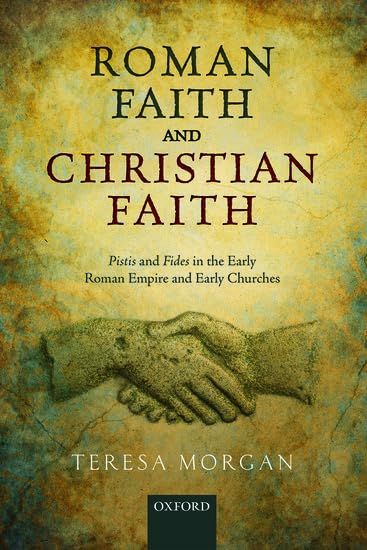
Roman Faith and Christian Faith

Roman Faith and Christian Faith

Teresa Morgan

Oxford University Press
2015
sidottu
This study investigates why 'faith' (pistis/fides) was so important to early Christians that the concept and praxis dominated the writings of the New Testament. It argues that such a study must be interdisciplinary, locating emerging Christianities in the social practices and mentalités of contemporary Judaism and the early Roman empire. This can, therefore, equally be read as a study of the operation of pistis/fides in the world of the early Roman principate, taking one small but relatively well-attested cult as a case study in how micro-societies within that world could treat it distinctively. Drawing on recent work in sociology and economics, the book traces the varying shapes taken by pistis/fides in Greek and Roman human and divine-human relationships: whom or what is represented as easy or difficult to trust or believe in; where pistis/fides is 'deferred' and 'reified' in practices such as oaths and proofs; how pistis/fides is related to fear, doubt and scepticism; and which foundations of pistis/fides are treated as more or less secure. The book then traces the evolution of representations of human and divine-human pistis in the Septuagint, before turning to ^pistis/pisteuein in New Testament writings and their role in the development of early Christologies (incorporating a new interpretation of pistis Christou) and ecclesiologies. It argues for the integration of the study of pistis/pisteuein with that of New Testament ethics. It explores the interiority of Graeco-Roman and early Christian pistis/fides. Finally, it discusses eschatological pistis and the shape of the divine-human community in the eschatological kingdom.
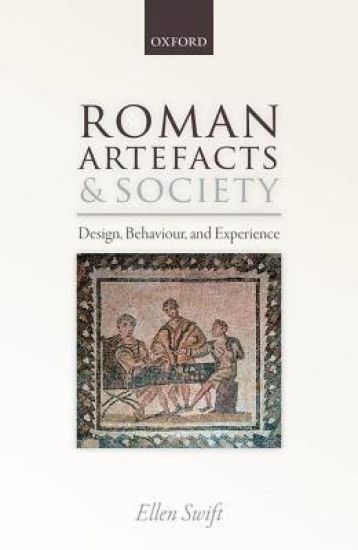
Roman Artefacts and Society

Roman Artefacts and Society

Ellen Swift

Oxford University Press
2017
sidottu
In this book, Ellen Swift uses design theory, previously neglected in Roman archaeology, to investigate Roman artefacts in a new way, making a significant contribution to both Roman social history, and our understanding of the relationships that exist between artefacts and people. Based on extensive data collection and the close study of artefacts from museum collections and archives, the book examines the relationship between artefacts, everyday behaviour, and experience. The concept of 'affordances'-features of an artefact that make possible, and incline users towards, particular uses for functional artefacts-is an important one for the approach taken. This concept is carefully evaluated by considering affordances in relation to other sources of evidence, such as use-wear, archaeological context, the end-products resulting from artefact use, and experimental reconstruction. Artefact types explored in the case studies include locks and keys, pens, shears, glass vessels, dice, boxes, and finger-rings, using material mainly drawn from the north-western Roman provinces, with some material also from Roman Egypt. The book then considers how we can use artefacts to understand particular aspects of Roman behaviour and experience, including discrepant experiences according to factors such as age, social position, and left- or right-handedness, which are fostered through artefact design. The relationship between production and users of artefacts is also explored, investigating what particular production methods make possible in terms of user experience, and also examining production constraints that have unintended consequences for users. The book examines topics such as the perceived agency of objects, differences in social practice across the provinces, cultural change and development in daily practice, and the persistence of tradition and social convention. It shows that design intentions, everyday habits of use, and the constraints of production processes each contribute to the reproduction and transformation of material culture.
Roman Law and Economics

Roman Law and Economics

Oxford University Press
2020
sidottu
Ancient Rome is the only society in the history of the western world whose legal profession evolved autonomously, distinct and separate from institutions of political and religious power. Roman legal thought has left behind an enduring legacy and exerted enormous influence on the shaping of modern legal frameworks and systems, but its own genesis and context pose their own explanatory problems. The economic analysis of Roman law has enormous untapped potential in this regard: by exploring the intersecting perspectives of legal history, economic history, and the economic analysis of law, the two volumes of Roman Law and Economics are able to offer a uniquely interdisciplinary examination of the origins of Roman legal institutions, their functions, and their evolution over a period of more than 1000 years, in response to changes in the underlying economic activities that those institutions regulated. Volume I explores these legal institutions and organizations in detail, from the constitution of the Roman Republic to the management of business in the Empire, while Volume II covers the concepts of exchange, ownership, and disputes, analysing the detailed workings of credit, property, and slavery, among others. Throughout each volume, contributions from specialists in legal and economic history, law, and legal theory are underpinned by rigorous analysis drawing on modern empirical and theoretical techniques and methodologies borrowed from economics. In demonstrating how these can be fruitfully applied to the study of ancient societies, with due deference to the historical context, Roman Law and Economics opens up a host of new avenues of research for scholars and students in each of these fields and in the social sciences more broadly, offering new ways in which different modes of enquiry can connect with and inform each other.
Roman Law and Economics

Roman Law and Economics

Oxford University Press
2020
sidottu
Ancient Rome is the only society in the history of the western world whose legal profession evolved autonomously, distinct and separate from institutions of political and religious power. Roman legal thought has left behind an enduring legacy and exerted enormous influence on the shaping of modern legal frameworks and systems, but its own genesis and context pose their own explanatory problems. The economic analysis of Roman law has enormous untapped potential in this regard: by exploring the intersecting perspectives of legal history, economic history, and the economic analysis of law, the two volumes of Roman Law and Economics are able to offer a uniquely interdisciplinary examination of the origins of Roman legal institutions, their functions, and their evolution over a period of more than 1000 years, in response to changes in the underlying economic activities that those institutions regulated. Volume II covers the concepts of exchange, ownership, and disputes, analysing the detailed workings of credit, property, and slavery, among others, while Volume I explores Roman legal institutions and organizations in detail, from the constitution of the Republic to the management of business in the Empire. Throughout each volume, contributions from specialists in legal and economic history, law, and legal theory are underpinned by rigorous analysis drawing on modern empirical and theoretical techniques and methodologies borrowed from economics. In demonstrating how these can be fruitfully applied to the study of ancient societies, with due deference to the historical context, Roman Law and Economics opens up a host of new avenues of research for scholars and students in each of these fields and in the social sciences more broadly, offering new ways in which different modes of enquiry can connect with and inform each other.
Roman Faith and Christian Faith

Roman Faith and Christian Faith

Teresa Morgan

Oxford University Press
2017
nidottu
This study investigates why 'faith' (pistis/fides) was so important to early Christians that the concept and praxis dominated the writings of the New Testament. It argues that such a study must be interdisciplinary, locating emerging Christianities in the social practices and mentalités of contemporary Judaism and the early Roman empire. This can, therefore, equally be read as a study of the operation of pistis/fides in the world of the early Roman principate, taking one but relatively well-attested cult as a case study in how micro-societies within that world could treat it distinctively. Drawing on recent work in sociology and economics, the book traces the varying shapes taken by pistis/fides in Greek and Roman human and divine-human relationships: whom or what is represented as easy or difficult to trust or believe in; where pistis/fides is 'deferred' and 'reified' in practices such as oaths and proofs; how pistis/fides is related to fear, doubt and scepticism; and which foundations of pistis/fides are treated as more or less secure. The book then traces the evolution of representations of human and divine-human pistis in the Septuagint, before turning to pistis/pisteuein in New Testament writings and their role in the development of early Christologies (incorporating a new interpretation of pistis Christou) and ecclesiologies. It argues for the integration of the study of pistis/pisteuein with that of New Testament ethics. It explores the interiority of Graeco-Roman and early Christian pistis/fides. Finally, it discusses eschatological pistis and the shape of the divine-human community in the eschatological kingdom.
Roman Error

Roman Error

Oxford University Press
2017
sidottu
In the eyes of posterity, ancient Rome is deeply flawed. The list of censures is long and varied, from political corruption and the practice of slavery, to religious intolerance and sexual immorality, yet for centuries the Romans' "errors" have not only provoked opprobrium, but also inspired wayward and novel forms of thought and representation, themselves errant in the broad sense of the Latin verb. This volume is the first to examine this phenomenon in depth, treating examples from history, philosophy, literature, psychoanalysis, and art history, from antiquity to the present, to examine how the Romans' faults have become the basis for creative experimentation, for rejections of prevailing ideology, even for comedy and delight. In demonstrating that the reception of Rome's missteps and mistakes has been far more complex than simply denouncing them as an exemplum malum to be shunned and avoided, it argues compellingly that these "alternative" receptions are historically important and enduringly relevant in their own right. "Roman error" comes to signify both ancient misstep and something that we may commit when engaging with Roman antiquity, whereby reception may even be conceived as "error" of a kind: while the volume ably addresses popular fascination with a wide range of Roman vices, including violence, imperial domination, and decadence, it also asks us to consider what makes certain receptions matter, how they matter, and why.
Roman Receptions of Sappho

Roman Receptions of Sappho

Oxford University Press
2019
sidottu
Sappho, a towering figure in Western culture, is an exemplary case in the history of classical receptions. There are three prominent reasons for this. Firstly, Sappho is associated with some of the earliest poetry in the classical tradition, which makes her reception history one of the longest we know of. Furthermore, Sappho's poetry promotes ideologically challenging concepts such as female authority and homoeroticism, which have prompted very conspicuous interpretative strategies to deal with issues of gender and sexuality, revealing the values of the societies that have received her works through time. Finally, Sappho's legacy has been very well explored from the perspective of reception studies: important investigations have been made into responses both to her as poet-figure and to her poetry from her earliest reception through to our own time. However, one of the few eras in Sappho's longstanding reception history that has not been systematically explored before this volume is the Roman period. The omission is a paradox. Receptions of Sappho can be traced in more than eighteen Roman poets, among them many of the most central authors in the history of Latin literature. Surely, few other Greek poets can rival the impact of Sappho at Rome. This important fact calls out for a systematic approach to Sappho's Roman reception, which is the aim of Roman Receptions of Sappho that focuses on the poetry of the central period of Roman literary history, from the time of Lucretius to that of Martial.
Roman Republican Augury

Roman Republican Augury

Lindsay G. Driediger-Murphy

Oxford University Press
2019
sidottu
Roman Republican Augury: Freedom and Control proposes a new way of understanding augury, a form of Roman state divination designed to consult the god Jupiter. Previous scholarly studies of augury have tended to focus either upon its legal-constitutional effects or upon its role in maintaining and perpetuating Roman social and political structures. This volume makes a new contribution to the study of Roman religion, politics, and cultural history by focusing instead upon what augury can tell us about how Romans understood their relationship with their gods. Augury is often thought to have told Romans what they wanted to hear. This volume argues that augury left space for perceived expressions of divine will which contradicted human wishes, and that its rules and precepts did not permit human beings to create or ignore signs at will. This analysis allows the Jupiter whom Romans approached in augury to emerge as not simply a source of power to be channelled to human ends, but a person with his own interests and desires, which did not always overlap with those of his human enquirers. When human will and divine will clashed, it was the will of Jupiter which was supposed to prevail. In theory as in practice, it was the Romans, not their supreme god, who were bound by the auguries and auspices.
Roman Political Culture

Roman Political Culture

Laurens E. Tacoma

Oxford University Press
2020
sidottu
This volume offers an innovative analysis of Roman political culture in Italy from the first to the sixth century AD on the basis of seven case studies. Its main contention is that, during the period in which Italy was subject to single rule, political culture took on a specific form, being the product of the continued existence of two traditional political institutions: the senate in the city of Rome and the local city councils in the rest of Italy. Under single rule, the position of both institutions was increasingly weakened and they became part of a much wider institutional landscape, although the fact that they continued to function until the end of the sixth century AD must imply that they retained meaning for their members, even while society as a whole was undergoing radical changes. As their powers and prerogatives shrank considerably, their significance became social rather than political as they allowed elites to enact and negotiate their own position in society. However, the tension between the participatory nature of these institutions and the restriction of their power generated complex social dynamics: on the one hand, participants became locked in mutual expectations about each other's behaviour and were compelled to enact particular social roles, while on the other hand they retained a degree of agency. They were encapsulated in an honorific language and in a set of conventions that regulated their behaviour, but that at the same time offered them room for manoeuvre: this degree of autonomy provides a compelling basis on which to challenge the prevailing view among historians that deliberative and participatory politics effectively ended with the institution of the Roman monarchy under Augustus.
Roman Artefacts and Society

Roman Artefacts and Society

Ellen Swift

Oxford University Press
2020
nidottu
In this book, Ellen Swift uses design theory, previously neglected in Roman archaeology, to investigate Roman artefacts in a new way, making a significant contribution to both Roman social history, and our understanding of the relationships that exist between artefacts and people. Based on extensive data collection and the close study of artefacts from museum collections and archives, the book examines the relationship between artefacts, everyday behaviour, and experience. The concept of 'affordances'—features of an artefact that make possible, and incline users towards, particular uses for functional artefacts—is an important one for the approach taken. This concept is carefully evaluated by considering affordances in relation to other sources of evidence, such as use—wear, archaeological context, the end—products resulting from artefact use, and experimental reconstruction. Artefact types explored in the case studies include locks and keys, pens, shears, glass vessels, dice, boxes, and finger-rings, using material mainly drawn from the north-western Roman provinces, with some material also from Roman Egypt. The book then considers how we can use artefacts to understand particular aspects of Roman behaviour and experience, including discrepant experiences according to factors such as age, social position, and left- or right-handedness, which are fostered through artefact design. The relationship between production and users of artefacts is also explored, investigating what particular production methods make possible in terms of user experience, and also examining production constraints that have unintended consequences for users. The book examines topics such as the perceived agency of objects, differences in social practice across the provinces, cultural change and development in daily practice, and the persistence of tradition and social convention. It shows that design intentions, everyday habits of use, and the constraints of production processes each contribute to the reproduction and transformation of material culture.
Roman Comedy against the Subject

Roman Comedy against the Subject

Mario Telò

Oxford University Press
2025
sidottu
Roman Comedy against the Subject provides an expansive interpretation of four Roman comedies named after objects--Plautus's Cistellaria, Aulularia, and Rudens, and Terence's Eunuchus. In this book, the titular object provides an opportunity not to reconceive the relational politics of Roman comedy, but to conceive a different politics of familial and social relations with Roman comedy. Employing object-oriented ontology, psychoanalysis, queer theory, and Black critical theory, the book radically recasts perennial problems of Roman comedy and literature in general: the author, in relation to "mothering" (alternative maternities); character, in relation to neurodiversity; genre, in relation to sibling-like parentality; and the title itself, in relation to gendering and ungendering. Roman Comedy against the Subject explores the aesthetic and political possibilities of becoming object, of embracing "itness." Rather than assimilating objects to subjects or vital agents, the book finds emancipatory potential in renouncing the normative and intrinsically exclusionary subjecthood of "he," "she," and "they," markers of privilege that are burdened by the violence of humanization and often dehumanizing of others. The introduction features nine brief but acute readings of object-oriented modern dramas: Tennessee Williams's Glass Menagerie, Yukio Mishima's The Damask Drum, Eugène Ionesco's Les Chaises, and Alice Childress's String, among others.