Kirjojen hintavertailu. Mukana 12 149 849 kirjaa ja 12 kauppaa.

Kirjahaku

Etsi kirjoja tekijän nimen, kirjan nimen tai ISBN:n perusteella.

1000 tulosta hakusanalla S. Englander

The Oxford Edition of Blackstone's: Commentaries on the Laws of England
Oxford's variorum edition of William Blackstone's seminal treatise on the common law of England and Wales offers the definitive account of the Commentaries' development in a modern format. For the first time it is possible to trace the evolution of English law and Blackstone's thought through the eight editions of Blackstone's lifetime, and the authorial corrections of the posthumous ninth edition. Introductions by the general editor and the volume editors set the Commentaries in their historical context, examining Blackstone's distinctive view of the common law, and editorial notes throughout the four volumes assist the modern reader in understanding this key text in the Anglo-American common law tradition. Book I: Of the Rights of Persons covers the key topics of constitutional and public law. Blackstone's inaugural lecture 'On the Study of the Law' introduces a series of general essays on the nature of law, including a chapter on 'The Absolute Rights of Individuals' . This is followed by an extended account of England's political constitution. The various categories of people or subjects are then surveyed, with special attention to the rights and obligations of masters and servants, husbands and wives, parents and children, and lastly 'artificial persons', or corporations. In addition to David Lemmings' introduction to the volume, Book I includes an introduction from the General Editor Wilfrid Prest.
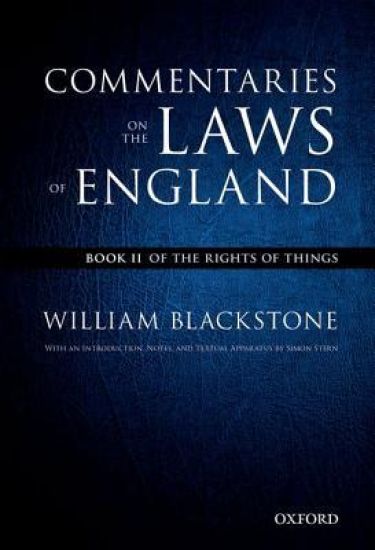
The Oxford Edition of Blackstone's: Commentaries on the Laws of England
Oxford's variorum edition of William Blackstone's seminal treatise on the common law of England and Wales offers the definitive account of the Commentaries' development in a modern format. For the first time it is possible to trace the evolution of English law and Blackstone's thought through the eight editions of Blackstone's lifetime, and the authorial corrections of the posthumous ninth edition. Introductions by the general editor and the volume editors set the Commentaries in their historical context, examining Blackstone's distinctive view of the common law, and editorial notes throughout the four volumes assist the modern reader in understanding this key text in the Anglo-American common law tradition. Property law is the subject of Book II, the second and longest volume of Blackstone's Commentaries. His lucid exposition covers feudalism and its history, real estate and the forms of tenure that a land-owner may have, and personal property, including the new kinds of intangible property that were developing in Blackstone's era, such as negotiable instruments and intellectual property.
The Oxford Edition of Blackstone's: Commentaries on the Laws of England
Oxford's variorum edition of William Blackstone's seminal treatise on the common law of England and Wales offers the definitive account of the Commentaries' development in a modern format. For the first time it is possible to trace the evolution of English law and Blackstone's thought through the eight editions of Blackstone's lifetime, and the authorial corrections of the posthumous ninth edition. Introductions by the general editor and the volume editors set the Commentaries in their historical context, examining Blackstone's distinctive view of the common law, and editorial notes throughout the four volumes assist the modern reader in understanding this key text in the Anglo-American common law tradition. Entitled Of Private Wrongs, Book III can be divided into three principal parts. The first describes the multiple courts in England and their jurisdictions, including the wrongs cognizable in each of them. The second describes some aspects of the substantive common law: wrongs to persons and to personal and real property. The third describes the processes of litigation in the courts of common law and equity.
The Oxford Edition of Blackstone's: Commentaries on the Laws of England
Oxford's variorum edition of William Blackstone's seminal treatise on the common law of England and Wales offers the definitive account of the Commentaries' development in a modern format. For the first time it is possible to trace the evolution of English law and Blackstone's thought through the eight editions of Blackstone's lifetime, and the authorial corrections of the posthumous ninth edition. Introductions by the general editor and the volume editors set the Commentaries in their historical context, examining Blackstone's distinctive view of the common law, and editorial notes throughout the four volumes assist the modern reader in understanding this key text in the Anglo-American common law tradition. In the final volume of the Commentaries Blackstone presents a comprehensive and critical overview of English criminal law and procedure, prefaced by a discussion of the philosophical and basis of the criminal justice system. His final chapter 'On the Rise, Progress, and Gradual Improvements, of the Laws of England' provides a fitting historical conclusion to the work as a whole.
England's Culture Wars

England's Culture Wars

Bernard Capp

Oxford University Press
2012
sidottu
Following the execution of the king in 1649, the new Commonwealth and then Oliver Cromwell set out to drive forward a puritan reformation of manners. They wanted to reform the church and its services, enforce the Sabbath, suppress Christmas, and spread the gospel. They sought to impose a stern moral discipline to regulate and reform sexual behaviour, drinking practices, language, dress, and leisure activities ranging from music and plays to football. England's Culture Wars explores how far this agenda could be enforced, especially in urban communities which offered the greatest potential to build a godly civic commonwealth. How far were local magistrates and ministers willing to cooperate, and what coercive powers did the regime possess to silence or remove dissidents? How far did the reformers themselves wish to go, and how did they reconcile godly reformation with the demands of decency and civility? Music and dancing lived on, in genteel contexts, early opera replaced the plays now forbidden, and puritans themselves were often fond of hunting and hawking. Bernard Capp explores the propaganda wars waged in press and pulpit, how energetically reformation was pursued, and how much or little was achieved. Many recent historians have dismissed interregnum reformation as a failure. He demonstrates that while the reforming drive varied enormously from place to place, its impact could be powerful. The book is therefore structured in three parts: setting out the reform agenda and challenges, surveying general issues and patterns, and finally offering a number of representative case-studies. It draws on a wide range of sources, including local and central government records, judicial records, pamphlets, sermons, newspapers, diaries, letters, and memoirs; and demonstrates how court records by themselves give us only a very limited picture of what was happening on the ground.
England's Great Transformation

England's Great Transformation

Marc W. Steinberg

University of Chicago Press
2016
sidottu
With England’s Great Transformation, Marc W. Steinberg throws a wrench into our understanding of the English Industrial Revolution, largely revising the thesis at heart of Karl Polanyi’s landmark The Great Transformation. The conventional wisdom has been that in the nineteenth century, England quickly moved toward a modern labor market where workers were free to shift from employer to employer in response to market signals. Expanding on recent historical research, Steinberg finds to the contrary that labor contracts, centered on insidious master-servant laws, allowed employers and legal institutions to work in tandem to keep employees in line. Building his argument on three case studies—the Hanley pottery industry, Hull fisheries, and Redditch needlemakers—Steinberg employs both local and national analyses to emphasize the ways in which these master-servant laws allowed employers to use the criminal prosecutions of workers to maintain control of their labor force. Steinberg provides a fresh perspective on the dynamics of labor control and class power, integrating the complex pathways of Marxism, historical institutionalism, and feminism, and giving readers a subtle yet revelatory new understanding of workplace control and power during England’s Industrial Revolution.
England's Great Transformation

England's Great Transformation

Marc W. Steinberg

University of Chicago Press
2016
nidottu
With England’s Great Transformation, Marc W. Steinberg throws a wrench into our understanding of the English Industrial Revolution, largely revising the thesis at heart of Karl Polanyi’s landmark The Great Transformation. The conventional wisdom has been that in the nineteenth century, England quickly moved toward a modern labor market where workers were free to shift from employer to employer in response to market signals. Expanding on recent historical research, Steinberg finds to the contrary that labor contracts, centered on insidious master-servant laws, allowed employers and legal institutions to work in tandem to keep employees in line. Building his argument on three case studies—the Hanley pottery industry, Hull fisheries, and Redditch needlemakers—Steinberg employs both local and national analyses to emphasize the ways in which these master-servant laws allowed employers to use the criminal prosecutions of workers to maintain control of their labor force. Steinberg provides a fresh perspective on the dynamics of labor control and class power, integrating the complex pathways of Marxism, historical institutionalism, and feminism, and giving readers a subtle yet revelatory new understanding of workplace control and power during England’s Industrial Revolution.
England's Last Hope

England's Last Hope

K. Mitchinson

Palgrave Macmillan
2008
sidottu
England's Last Hope studies how the part-time auxiliary Territorial Force was raised, clothed, trained, housed and administered during the crucial years of its development in the years before the Great War. As such, it fills a fundamental gap in the understanding of how the force's units were able to take the field as part of the BEF in 1914.
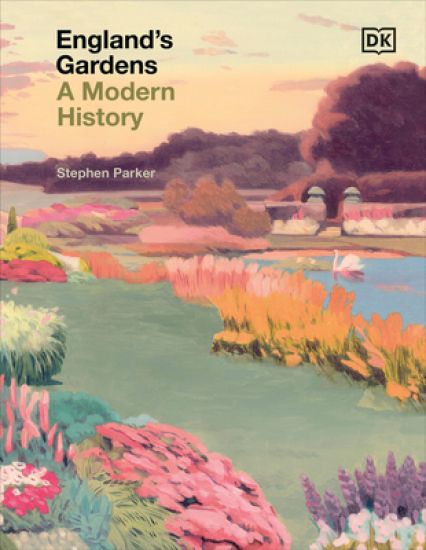
England's Gardens

England's Gardens

Stephen Parker

DORLING KINDERSLEY LTD
2023
sidottu
We may all feel we know what an "English" garden is, but do we really? England's Gardens offers a holistic, modern-day tour and an update on the history of some of the most iconic, enduring, and influential gardens across the country.A fresh take on a much-loved subject, this book will help you get to know England's gardens up close and personal. Garden historian Stephen Parker leads you through England's horticultural history, unearthing the cultural context and hidden stories behind the gardens, and bringing lesser-known garden makers to the fore. In five detailed historical chapters, Parker explores the making of the so-called "English" garden - from its origins in the formal splendour of stately homes, all the way to climate-change resilience and future-facing designs of the modern era.Inside the pages of this stunning book on England's country gardens, you will find:- 5 chapters of detailed narrative essays arranged in chronological order.- Detailed profiles showcase significant garden makers.- More than 20 photography-led garden case studies explore key gardens to visit in England today.- Stunning, full-bleed, contemporary photography brings the gardens to life.- Archival photography and historical art sheds light on the history and making of the gardens.Discover the best gardens to visit today - with garden case studies showcasing everything England's gardens have to offer through stunning contemporary photography and careful analysis of planting schemes and garden makers' creative influences. From iconic sites like Sissinghurst and Great Dixter, to more unusual examples such as Prospect Cottage and The Laskett - this book celebrates England's gardens in all their glorious diversity, sublime beauty, and exuberant eccentricity.
DK England's South Coast

DK England's South Coast

DORLING KINDERSLEY LTD
2025
nidottu
Make your trip to England’s South Coast extraordinaryA hike along the South West Coast Path. Sampling craft beer in London. Castle hopping in Kent. With so much to see and do, England’s South Coast is a must-visit. Whatever your dream trip involves, this DK travel guide is the perfect companion.Our updated guide brings England’s South Coast to life, transporting you there like no other travel guide does with expert-led insights, trusted travel advice, detailed breakdowns of all the must-see sights, photographs on practically every page, and our hand-drawn illustrations, which take you inside the region’s buildings and neighbourhoods.You'll discover:- our pick of England’s South Coast must-sees and top experience- beautiful photography and detailed illustrations, taking you to the heart of England’s South Coast- the best spots to eat, drink, shop and stay- detailed maps and walks which make navigating the region easy- easy-to-follow itineraries- expert advice: get ready, get around and stay safe- colour-coded chapters to each part of England’s South Coast- a lightweight format, so you can take it with you wherever you goSpending more time in Cornwall? Try Top 10 Cornwall and Devon.
England's Edging

England's Edging

Will Daunt

Lulu.com
2020
pokkari
This is the first half of England's Edging, Will Daunt's sequence of one hundred poems, each of one hundred syllables. The poems travel to the edges of nationality, through fifty or so locations, some illustrated, some beyond England's borders. They happen to have been written as the U.K. approached Brexit.
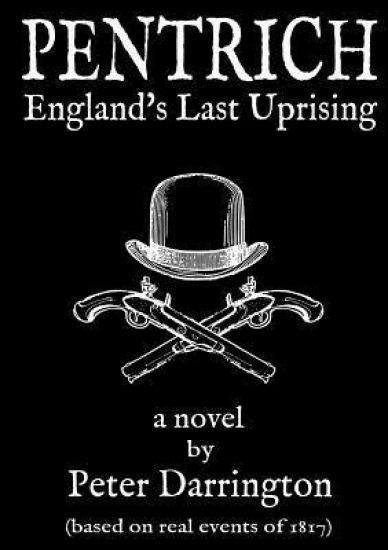
Pentrich - England's Last Uprising

Pentrich - England's Last Uprising

Peter Darrington

Lulu.com
2017
nidottu
A novel based on the story of a real attempt at a working class revolt in 19th Century Derbyshire, England. Taking their cues from the French and American Revolutions, a growing band of peasants calling themselves 'The Regenerators' led by Thomas Bacon and Jeremiah Brandreth plotted insurrection from secret meeting rooms in Nottingham and Derbyshire pubs on a scale that would bring down the government. On the night of June 9, the uprising began when the rebels embarked on a march to a prearranged site in Nottingham, hoping to meet thousands more revolutionaries from Nottingham and the north east that would join forces and together march to London and attack Parliament. But betrayal from within the plotters led to the entire operation going terribly wrong with devastating consequences for all those involved.
England's Empty Throne

England's Empty Throne

Paul Strohm

University of Notre Dame Press
2006
nidottu
After the dethronement and subsequent murder of Richard II, the usurping Lancastrian dynasty faced an exceptional challenge. Interrupting a long period of Plantagenet rule, Henry IV and Henry V needed not only to establish physical possession of the English throne but to occupy it symbolically as well. In this boldly revisionary book, Paul Strohm provides a new account of the Lancastrian revolution and its aftermath. Integrating techniques of literary and historical analysis, he reveals the Lancastrian monarchs as masters of outward display, persuasively "performing" their kingship through a variety of novel ceremonies in a quest for legitimacy. He also describes far-reaching Lancastrian experiments in domination, including the proscription of prophecy; the enlistment of poetry as court propaganda; the extensive use of spies and informers; and, most ambitiously, the redefinition of treason to cover not only overt deeds but words and thoughts as well. Strohm's account of the Lancastrian quest for legitimacy and the uses of symbolic power illuminates—indeed, recasts—our understanding of a period of unprecedented political upheaval.
England's Empty Throne

England's Empty Throne

Paul Strohm

Yale University Press
2013
pokkari
After the dethronement and subsequent murder of Richard II, the usurping Lancastrian dynasty faced an exceptional challenge. Interrupting a long period of Plantagenet rule, Henry IV and Henry V needed not only to establish physical possession of the English throne, but to occupy it symbolically as well. In this boldly revisionary book, Paul Strohm provides a new account of the Lancastrian revolution and its aftermath. Integrating techniques of literary and historical analysis, he explores the new dynasty`s quest for legitimacy and the importance of symbolic activity to the making of kingship.Strohm reveals the Lancastrian monarchs as masters of outward display, persuasively "performing" their kingship in a variety of novel ceremonies. Henry IV is crowned with a newly discovered coronation oil. The murdered Richard II is elaborately reburied. Opinion is courted and deceived with invented chronicles, false prophecies, and bogus genealogies. Opponents of the new regime are subject to new varieties of trial and punishment. Far-reaching Lancastrian experiments in domination include the proscription of prophecy, the enlistment of poetry, the use of spies and hired informers, and, most ambitiously, the redefinition of treason to cover not only overt deeds but also things said and even thought. Strohm`s account of the Lancastrian quest for legitimacy and the uses of symbolic power illuminates—indeed recasts—our understanding of a period of unprecedented political upheaval.
The History of England's Cathedrals

The History of England's Cathedrals

Nicholas Orme

YALE UNIVERSITY PRESS
2024
pokkari
The first history of all the English cathedrals, from Birmingham and Bury St Edmunds to Worcester and York Minster England’s sixty-two Anglican and Catholic cathedrals are some of our most iconic buildings, attracting millions of worshippers and visitors every year. Yet although much has been written about their architecture, there is no complete history of their life and activities. This is the first such book to provide one, stretching from Roman times to the present day. The History of England’s Cathedrals explains where and why they were founded, who staffed them, and how their structures evolved. It describes their worship and how this changed over the centuries, their schools and libraries, and their links with the outside world. The history of these astonishing buildings is the history of England. Reading this book will bring you face to face with the Anglo-Saxons, Vikings, Normans, Reformation, Civil War, Victorian England, World War Two, and finally modern democracy.
England's Glorious Revolution

England's Glorious Revolution

Steven C.A. Pincus

St Martin's Press
2005
nidottu
England's Glorious Revolution is a fresh and engaging examination of the Revolution of 1688–1689, when the English people rose up and deposed King James II, placing William III and Mary II on the throne. Steven Pincus's introduction explains the context of the revolution, why these events were so stunning to contemporaries, and how the profound changes in political, economic, and foreign policies that ensued make it the first modern revolution. This volume offers 40 documents from a wide array of sources and perspectives. The collection provides an invaluable insight into all the key events of the period, the social and economic background, developments in political and foreign policy and the perspective of the Church. This text also examines the Eighteenth Century debates and John Locke’s writings delving into contemporary historiographical and philosophical reactions to the Glorious Revolution.
England's Dreaming, Revised Edition

England's Dreaming, Revised Edition

Jon Savage

St Martin's Press
2002
pokkari
England's Dreaming is the ultimate book on punk, its progenitors, the Sex Pistols, and the moment they defined for music fans in England and the United States. Savage brings to life the sensational story of the meteoric rise and rapid implosion of the Pistols through layers of rich detail, exclusive interviews, and rare photographs. This fully revised and updated edition of the book covers the legacy of punk twenty-five years later and provides an account of the Pistols' 1996 reunion as well as a freshly updated discography and a completely new introduction.