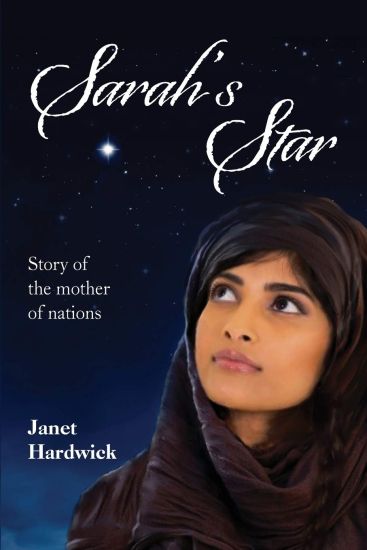
Sarah's Star is the story of Sarah, wife of Abraham, as she struggles with infertility and her husband's devotion to a strange god that keeps their lives in a state of upheaval. It follows her journey through many tears and trials as she discovers God's promises always come to pass even when it looks impossible.
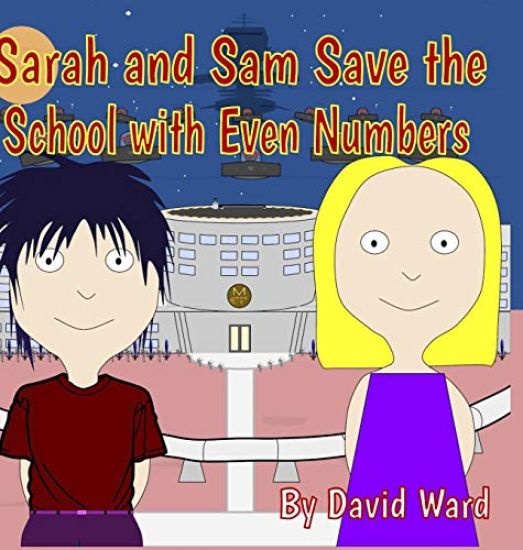
Sarah and Sam thought it was just another day at the Martian Mathematics Academy. Boy, were they wrong Join them as they use a lesson on even and odd numbers to defend the school against saturnian logic bombers.
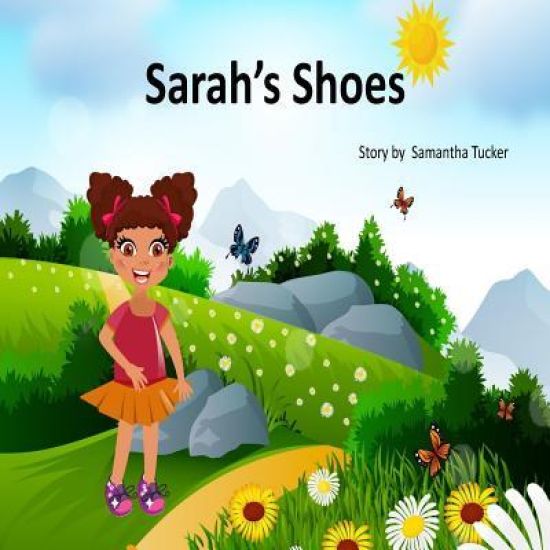
Have you seen Sarah's shoe? Go on an adventure with Sarah as she question's her family and friends about her lost shoe. At the end of the story enjoy Sarah's Shoe Song aimed to help beginners learn how to tie their shoe. This book helps build solid foundational literacy skills as it includes repetitive words, phrases, predictable text, and rhyme.
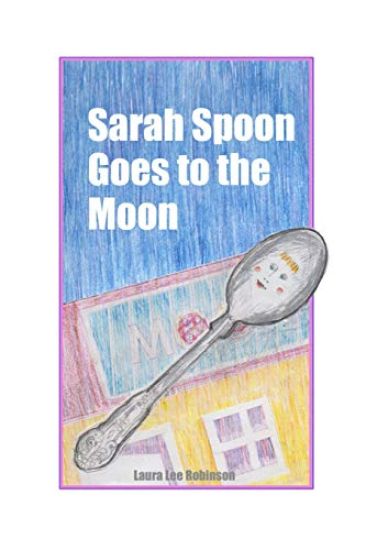
Sarah Spoon was not happy. She did not like going to school because she was much bigger than everyone else and she didn't have any friends. One morning she passes in front of the MOON Pizza Parlor and decides to walk inside and ask for a job. From that moment on everything changes.
A long time ago, near a village called Dewsbury, there lived a dragon that has a nest high above the village in an old, dead tree. Everyone in Dewsbury feared the dragon... Everyone but one very brave young girl. Sarah.
Sarah, a fitness instructor at a luxury London gym, meets decorated British Army veteran Jason Palmer. They have great sex together but they each have a secret. Sarah knows from her own experience that as much as she craves Jason, falling in love is dangerous. Jason cannot reveal his true identity, an assassin. This novel is about character and killing: loyalty, betrayal, love, sex, infatuation, human trafficking, law without morality, morality without law, murder and guilt.
Sarah Stickney Ellis, born Sarah Stickney (1799 - 16 June 1872), also known as Sarah Ellis, was a Quaker turned Congregationalist who was the author of numerous books, mostly written about women's roles in society. She argued that it was the religious duty of women, as daughters, wives, and mothers, to provide the influence for good that would improve society. Conduct novels: Particularly well-known are The Wives of England (1843), The Women of England, The Mothers of England, and The Daughters of England, also her more directly educational works such as Rawdon House and Education of the Heart: Women's Best Work. Related to her principal literary theme of moral education for women, she established Rawdon House in Hertfordshire; a school for young ladies intended to apply the principles illustrated in her books to the "moral training, the formation of character, and in some degree the domestic duties of young ladies." Unusually for the time, the school was non-denominational and included cookery and house management in the curriculum. With few exceptions, boys and girls were educated separately in 19th-century England, and the question of how to educate women was a subject of debate. It was common for women, as well as men, to believe that the former should not be educated in the full range of subjects, but should focus on domestic skills. Elizabeth Sandford wrote for women in support of this view, whilst others such as Susanna Corder ran a novel Quaker girls' school at Abney Park instituted by the philanthropist William Allen, which dissented from convention by teaching all the latest sciences as early as the 1820s. In Education of the Heart: Women's Best Work (1869) Sarah Ellis accepted the importance of intellectual education for women as well as training in domestic duties, but stressed that because women were the earliest educators of the men who predominantly ran and decided upon education in Victorian society, women primarily needed a system of education that developed sound moral character in their offspring. Ellis aimed much of her prescriptive writing in the 1840s and 1850s at the expanding lower middle-class in the suburbs. Her readers were women who might be the first in their family to employ a domestic servant, striving to adapt to an exclusively domestic role. Understandably, historians have focused on Ellis's education of these women in domestic duties, together with appropriate submission to their husbands, in the famous phrase, to 'suffer and be still'. But there was another side to her writing. She insisted that women should remain single if they could not find a 'reasonable' husband; she was conscious of the widespread incidence of marital disharmony in middle-class marriages as women struggled to submit to husbands whom Ellis calls, ambiguously, 'the lords of creation'; and she wrote of the need for wives to 'humour', or manipulate, their husbands in their own interests and in the interests of marital harmony. In private correspondence she spoke of tensions in her own marriage with Wiliam Ellis and of friends who had left their husbands. In 1837, Sarah married the Rev. William Ellis, who held a prominent position in the London Missionary Society, and with whom she worked for the missionary cause and to promote their common interest in temperance. After thirty-five years of marriage they died within a week of each other. Of independent mind, she was buried in the countryside near their home, whilst her husband was laid to rest in the Congregationalists' non-denominational Abney Park Cemetery in the outskirts of Victorian London.
Sarah Bonetta Forbes, 'Queen Victoria's African Princess', was rescued from Africa as a girl of seven after the slaughter of her family. Offered by King Gezo of Dahomey as a gift to the Queen, she was taken to England. Spending part of her childhood there and part back in Africa, she married Captain James Davies in 1862 and they settled in their native continent, where she became a teacher and died of tuberculosis at Madeira in 1880. Her story has rarely been told before by earlier biographers, or even noticed in lives of the Queen. It makes one of the most unusual, not to say fascinating, episodes in the annals of the British Victorian court.
At Raising Human Beans, we believe Education is life- and that kids should learn accordingly. Passion and Interest based learning, show so much more progress than traditional sit down and study learning. With my Unit Studies, your child can see what the world is really like- because the world is our true classroom. Look through my Unit Studies, and let your Child pick what they are interested in Don't see what you are looking for? Message me I am open to new ideas. Don't forget to check us out online at raisinghumanbeans.com
This is a 2 part series, on the Animals of the Arctic. These Unit Studies cover many topics such as Math, Science, and writing We play games, make recipes, trace pictures and words, and learn learn learn But more importantly, it is FUN Check out the other item in our Series- Penguins