
Kirjahaku
Etsi kirjoja tekijän nimen, kirjan nimen tai ISBN:n perusteella.
1000 tulosta hakusanalla Terry Mapson

In essays on literary images of lesbianism from Defoe and Diderot to Virginia Woolf and Djuna Barnes, on the homosexual reputation of Marie Antoinette, on the lesbian writings of Anne Lister, Sylvia Townsend Warner, and Janet Flanner, and on Henry James's The Bostonians, Castle shows how a lesbian presence can be identified in the literature, history, and culture of the past three centuries.

-- The Nation
Dying, Death, and Bereavement in Social Work Practice
Terry A. Wolfer; Vicki M. Runnion
Columbia University Press
2008
sidottu
Practitioners who work with clients at the end of their lives face difficult decisions concerning the client's self-determination, the kind of death he or she will have, and the prolongation of life. They must also remain sensitive to the beliefs and needs of family members and the legal, ethical, and spiritual ramifications of the client's death. Featuring twenty-three decision cases based on interviews with professional social workers, this unique volume allows students to wrestle with the often incomplete and conflicting information, ethical issues, and time constraints of actual cases. Instead of offering easy solutions, this book provides detailed accounts that provoke stimulating debates among students, enabling them to confront their own responses, beliefs, and uncertainties to hone their critical thinking and decision making skills for professional practice. *Please note: Teaching Notes for this volume will be available from Electronic Hallway in Spring 2010. To access the Teaching Notes, you must first become a member of the Electronic Hallway. The main Electronic Hallway web page is at https://hallway.org/index.php. To join, click Become a Hallway Member in the Get Involved category or point your browser directly to https://hallway.org/involved/join.php and provide the required information. After your instructor status has been confirmed, you will receive an e-mail granting access to the Electronic Hallway. Once logged on to Electronic Hallway as a member, click Case Search in the Cases and Resources category on themain web page. Enter "death, dying, bereavement" (without the quotation marks) in the search box, select "all of the words" in the drop down menu, and click Submit. The search process will generate a list of Teaching Notes for cases from Dying, Death, and Bereavement in Social Work Practice: Decision Cases for Advanced Practice.
Dying, Death, and Bereavement in Social Work Practice
Terry A. Wolfer; Vicki M. Runnion
Columbia University Press
2008
pokkari
Practitioners who work with clients at the end of their lives face difficult decisions concerning the client's self-determination, the kind of death he or she will have, and the prolongation of life. They must also remain sensitive to the beliefs and needs of family members and the legal, ethical, and spiritual ramifications of the client's death. Featuring twenty-three decision cases based on interviews with professional social workers, this unique volume allows students to wrestle with the often incomplete and conflicting information, ethical issues, and time constraints of actual cases. Instead of offering easy solutions, this book provides detailed accounts that provoke stimulating debates among students, enabling them to confront their own responses, beliefs, and uncertainties to hone their critical thinking and decision making skills for professional practice. *Please note: Teaching Notes for this volume will be available from Electronic Hallway in Spring 2010. To access the Teaching Notes, you must first become a member of the Electronic Hallway. The main Electronic Hallway web page is at https://hallway.org/index.php. To join, click Become a Hallway Member in the Get Involved category or point your browser directly to https://hallway.org/involved/join.php and provide the required information. After your instructor status has been confirmed, you will receive an e-mail granting access to the Electronic Hallway. Once logged on to Electronic Hallway as a member, click Case Search in the Cases and Resources category on themain web page. Enter "death, dying, bereavement" (without the quotation marks) in the search box, select "all of the words" in the drop down menu, and click Submit. The search process will generate a list of Teaching Notes for cases from Dying, Death, and Bereavement in Social Work Practice: Decision Cases for Advanced Practice.
Decision Cases for Advanced Social Work Practice
Terry Wolfer; Lori Franklin; Karen Gray
Columbia University Press
2013
sidottu
These fifteen cases take place in child welfare, mental health, hospital, hospice, domestic violence, refugee resettlement, veterans' administration, and school settings and reflect individual, family, group, and supervised social work practice. They confront common ethical and treatment issues and raise issues regarding practice interventions, programs, policies, and laws. Cases represent open-ended situations, encouraging students to apply knowledge from across the social work curriculum to develop problem-solving and critical-thinking skills. An instructor's manual with teaching notes is available by emailing: [email protected].
Decision Cases for Advanced Social Work Practice
Terry Wolfer; Lori Franklin; Karen Gray
Columbia University Press
2013
pokkari
These fifteen cases take place in child welfare, mental health, hospital, hospice, domestic violence, refugee resettlement, veterans' administration, and school settings and reflect individual, family, group, and supervised social work practice. They confront common ethical and treatment issues and raise issues regarding practice interventions, programs, policies, and laws. Cases represent open-ended situations, encouraging students to apply knowledge from across the social work curriculum to develop problem-solving and critical-thinking skills. An instructor's manual with teaching notes is available by emailing: [email protected].
This vivid account of hustling in New York City explores the sociological reasons why con artists play their game and the psychological tricks they use to win it. Terry Williams and Trevor B. Milton, two prominent sociologists and ethnographers, spent years with New York con artists to uncover their secrets. The result is an unprecedented view into how con games operate, whether in back alleys and side streets or in police precincts and Wall Street boiler rooms. Whether it's selling bootleg goods, playing the numbers, squatting rent-free, scamming tourists with bogus stories, selling knockoffs on Canal Street, or crafting Ponzi schemes, con artists use verbal persuasion, physical misdirection, and sheer charm to convince others to do what they want. Williams and Milton examine this act of performance art and find meaning in its methods to exact bounty from unsuspecting tourists and ordinary New Yorkers alike. Through their sophisticated exploration of the personal experiences and influences that create a successful hustler, they build a portrait of unusual emotional and psychological depth. Their work also offers a new take on structure and opportunity, showing how the city's unique urban and social architecture lends itself to the perfect con.
This vivid account of hustling in New York City explores the sociological reasons why con artists play their game and the psychological tricks they use to win it. Terry Williams and Trevor B. Milton, two prominent sociologists and ethnographers, spent years with New York con artists to uncover their secrets. The result is an unprecedented view into how con games operate, whether in back alleys and side streets or in police precincts and Wall Street boiler rooms. Whether it's selling bootleg goods, playing the numbers, squatting rent-free, scamming tourists with bogus stories, selling knockoffs on Canal Street, or crafting Ponzi schemes, con artists use verbal persuasion, physical misdirection, and sheer charm to convince others to do what they want. Williams and Milton examine this act of performance art and find meaning in its methods to exact bounty from unsuspecting tourists and ordinary New Yorkers alike. Through their sophisticated exploration of the personal experiences and influences that create a successful hustler, they build a portrait of unusual emotional and psychological depth. Their work also offers a new take on structure and opportunity, showing how the city's unique urban and social architecture lends itself to the perfect con.

The “after-hours club” is a fixture of the African American ghetto. It is a semisecret, unlicensed “spot” where “regulars” and “tourists” mingle with “hustlers” to buy and use drugs long after regular bars are closed and the party has ended for the “squares.” After-hours clubs are found in most cities, but for people outside of their particular milieu, they are formidably difficult to identify and even more difficult to access.The sociologist Terry Williams returns to the cocaine culture of Harlem in the 1980s and ’90s with an ethnographic account of a club he calls Le Boogie Woogie. He explores the life of a cast of characters that includes regulars and bar workers, dealers and hustlers, following social interaction around the club’s active bar, with its colorful staff and owner and the “sniffers” who patronize it. In so doing, Williams delves into the world of after-hours clubs, exploring their longstanding function in the African American community as neighborhood institutions and places of autonomy for people whom mainstream society grants few spaces of freedom. He contrasts Le Boogie Woogie, which he visited in the 1990s, with a Lower East Side club, dubbed Murphy’s Bar, twenty years later to show how “cool” remains essential to those outside the margins of society even as what it means to be “cool” changes. Le Boogie Woogie is an exceptional ethnographic portrait of an underground culture and its place within a changing city.

The “after-hours club” is a fixture of the African American ghetto. It is a semisecret, unlicensed “spot” where “regulars” and “tourists” mingle with “hustlers” to buy and use drugs long after regular bars are closed and the party has ended for the “squares.” After-hours clubs are found in most cities, but for people outside of their particular milieu, they are formidably difficult to identify and even more difficult to access.The sociologist Terry Williams returns to the cocaine culture of Harlem in the 1980s and ’90s with an ethnographic account of a club he calls Le Boogie Woogie. He explores the life of a cast of characters that includes regulars and bar workers, dealers and hustlers, following social interaction around the club’s active bar, with its colorful staff and owner and the “sniffers” who patronize it. In so doing, Williams delves into the world of after-hours clubs, exploring their longstanding function in the African American community as neighborhood institutions and places of autonomy for people whom mainstream society grants few spaces of freedom. He contrasts Le Boogie Woogie, which he visited in the 1990s, with a Lower East Side club, dubbed Murphy’s Bar, twenty years later to show how “cool” remains essential to those outside the margins of society even as what it means to be “cool” changes. Le Boogie Woogie is an exceptional ethnographic portrait of an underground culture and its place within a changing city.
"Picturing myself dying in a way I choose myself seems so comforting, healing and heroic. I'd look at my wrists, watch the blood seeping, and be a spectator in my last act of self-determination. By having lost all my self-respect it seems like the last pride I own, determining the time I die."-Kyra V., seventeen Reading the confessions of a teenager contemplating suicide is uncomfortable, but we must do so to understand why self-harm has become epidemic, especially in the United States. What drives teenagers to self-harm? What makes death so attractive, so liberating, and so inevitable for so many? In Teenage Suicide Notes, sociologist Terry Williams pores over the writings of a diverse group of troubled youths to better grasp the motivations behind teenage suicide and to humanize those at risk of taking their own lives. Williams evaluates young people in rural and urban contexts and across lines of race, class, gender, and sexual orientation. His approach, which combines sensitive portrayals with sociological analysis, adds a clarifying dimension to the fickle and often frustrating behavior of adolescents. Williams reads between the lines of his subjects' seemingly straightforward reflections on alienation, agency, euphoria, and loss, and investigates how this cocktail of emotions can lead to suicide-or not. Rather than treating these notes as exceptional examples of self-expression, Williams situates them at the center of teenage life, linking them to abuse, violence, depression, anxiety, religion, peer pressure, sexual identity, and family dynamics. He captures the currents that turn self-destruction into an act of self-determination and proposes more effective solutions to resolving the suicide crisis.
Winner, 2024-2025 New York City Book Awards, New York Society LibraryAboveground, Manhattan’s Riverside Park provides open space for the densely populated Upper West Side. Beneath its surface run railroad tunnels, disused for decades, where over the years unhoused people have taken shelter. The sociologist Terry Williams ventured into the tunnel residents’ world, seeking to understand life on the margins and out of sight. He visited the tunnels between West Seventy-Second and West Ninety-Sixth Streets hundreds of times from 1991 to 1996, when authorities cleared them out to make way for Amtrak passenger service, and again between 2000 and 2020.Life Underground explores this society below the surface and the varieties of experience among unhoused people. Bringing together anecdotal material, field observations, photographs, transcribed conversations with residents, and excerpts from personal journals, Williams provides a vivid ethnographic portrait of individual people, day-to-day activities, and the social world of the underground and their engagement with the world above, which they call “topside.” He shows how marginalized people strive to make a place for themselves amid neglect and isolation as they struggle for dignity. Featuring Williams’s distinctive ethnographic eye and deep empathy for those on the margins, Life Underground shines a unique light on a vanished subterranean community.
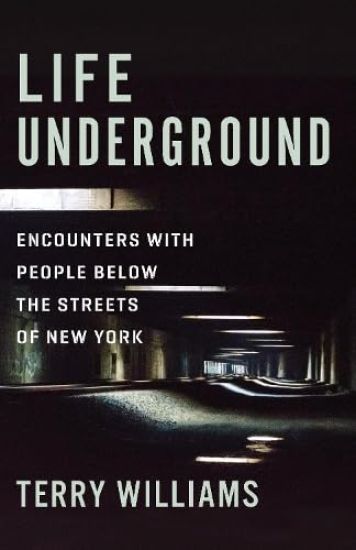
Winner, 2024-2025 New York City Book Awards, New York Society LibraryAboveground, Manhattan’s Riverside Park provides open space for the densely populated Upper West Side. Beneath its surface run railroad tunnels, disused for decades, where over the years unhoused people have taken shelter. The sociologist Terry Williams ventured into the tunnel residents’ world, seeking to understand life on the margins and out of sight. He visited the tunnels between West Seventy-Second and West Ninety-Sixth Streets hundreds of times from 1991 to 1996, when authorities cleared them out to make way for Amtrak passenger service, and again between 2000 and 2020.Life Underground explores this society below the surface and the varieties of experience among unhoused people. Bringing together anecdotal material, field observations, photographs, transcribed conversations with residents, and excerpts from personal journals, Williams provides a vivid ethnographic portrait of individual people, day-to-day activities, and the social world of the underground and their engagement with the world above, which they call “topside.” He shows how marginalized people strive to make a place for themselves amid neglect and isolation as they struggle for dignity. Featuring Williams’s distinctive ethnographic eye and deep empathy for those on the margins, Life Underground shines a unique light on a vanished subterranean community.

There is no rawer human experience than sex, and in a city as diverse as New York, sexual experiences come in many forms. In the pre-Giuliani days, temptation flooded Times Square on theater marquees and neon signs. Behind unmarked doors downtown, more adventurous experiences awaited for those in the know.In The Soft City, the ethnographer Terry Williams, with the help of accomplices and informants, ventures deep into the underground world of sex in New York. The book explores different aspects of the “perverse space” of the city: porn theaters, sex shops, peep shows, restroom cruising, sadomasochism clubs, swingers’ events, and many more. Featuring field notes taken between 1975 and the present, The Soft City documents the ways that New Yorkers on the social periphery have thought about and pursued sex, whether for recreation or to make a living. It also presents an unconventional account of New York City’s many transformations, showing how the soft city—its people and their unique character—evolved in response to official and social pressures. Featuring Williams’s unmistakable portraits of the demimonde as well as the accounts of other ethnographers challenging themselves to dive into the city’s hidden crannies, The Soft City is as irreproducible as it is provocative.

There is no rawer human experience than sex, and in a city as diverse as New York, sexual experiences come in many forms. In the pre-Giuliani days, temptation flooded Times Square on theater marquees and neon signs. Behind unmarked doors downtown, more adventurous experiences awaited for those in the know.In The Soft City, the ethnographer Terry Williams, with the help of accomplices and informants, ventures deep into the underground world of sex in New York. The book explores different aspects of the “perverse space” of the city: porn theaters, sex shops, peep shows, restroom cruising, sadomasochism clubs, swingers’ events, and many more. Featuring field notes taken between 1975 and the present, The Soft City documents the ways that New Yorkers on the social periphery have thought about and pursued sex, whether for recreation or to make a living. It also presents an unconventional account of New York City’s many transformations, showing how the soft city—its people and their unique character—evolved in response to official and social pressures. Featuring Williams’s unmistakable portraits of the demimonde as well as the accounts of other ethnographers challenging themselves to dive into the city’s hidden crannies, The Soft City is as irreproducible as it is provocative.

Dilemmas in Social Work Field Education
Terry Wolfer; Melissa Reitmeier
Columbia University Press
2021
sidottu
Field education is social work’s signature pedagogy, the essential preparation for professional practice. Its success depends on field educators—field instructors, task supervisors or preceptors, and faculty field liaisons—to guide and assess student learning and maintain the pedagogical integrity of the field experience. Despite its importance and complexity, few resources exist for orienting and preparing field educators.This anthology presents decision cases that depict the actual experiences of social work field educators and students. They showcase the complex dynamics of field education and highlight a range of dilemmas experienced by novice and seasoned field educators. In various combinations, the dilemmas include interpersonal boundaries, emotional reactivity, initiative, expectations, role confusion, inadequate performance, accountability, interpersonal conflict, personal values, and impairment. The cases show how other field educators have navigated the issues that typically arise, with greater or lesser success. The cases portray the intricacy and rewards of this educational role and are selected for their ability to facilitate in-depth discussion among field educators during their initial training or continuing education. Guided discussions of these cases can bolster supervisory competence and confidence. They enable field educators to develop important problem-solving and critical-thinking skills related to their overlapping roles as instructors, supervisors, mentors, advisors, colleagues, and role models, helping them thrive and continue to serve the profession.An accompanying instructor manual provides extensive information for each decision case and also includes guidance for field directors on how to use the case method of teaching and sources for additional information.
Dilemmas in Social Work Field Education
Terry Wolfer; Melissa Reitmeier
Columbia University Press
2021
pokkari
Field education is social work’s signature pedagogy, the essential preparation for professional practice. Its success depends on field educators—field instructors, task supervisors or preceptors, and faculty field liaisons—to guide and assess student learning and maintain the pedagogical integrity of the field experience. Despite its importance and complexity, few resources exist for orienting and preparing field educators.This anthology presents decision cases that depict the actual experiences of social work field educators and students. They showcase the complex dynamics of field education and highlight a range of dilemmas experienced by novice and seasoned field educators. In various combinations, the dilemmas include interpersonal boundaries, emotional reactivity, initiative, expectations, role confusion, inadequate performance, accountability, interpersonal conflict, personal values, and impairment. The cases show how other field educators have navigated the issues that typically arise, with greater or lesser success. The cases portray the intricacy and rewards of this educational role and are selected for their ability to facilitate in-depth discussion among field educators during their initial training or continuing education. Guided discussions of these cases can bolster supervisory competence and confidence. They enable field educators to develop important problem-solving and critical-thinking skills related to their overlapping roles as instructors, supervisors, mentors, advisors, colleagues, and role models, helping them thrive and continue to serve the profession.An accompanying instructor manual provides extensive information for each decision case and also includes guidance for field directors on how to use the case method of teaching and sources for additional information.

City Money. Political Processes, Fiscal Strain, and Retrenchment
Terry Nichols Clark; Lorna Crowley Ferguson
Columbia University Press
2022
sidottu