Kirjojen hintavertailu. Mukana 12 368 479 kirjaa ja 12 kauppaa.

Kirjahaku

Etsi kirjoja tekijän nimen, kirjan nimen tai ISBN:n perusteella.

1000 tulosta hakusanalla Wright Stuart Thomas

The Young Mill-wright & Miller's Guide. In Five Parts --embellished With Twenty Five [i.e., Twenty-six] Plates ... By Oliver Evans, of Philadelphia
The 18th century was a wealth of knowledge, exploration and rapidly growing technology and expanding record-keeping made possible by advances in the printing press. In its determination to preserve the century of revolution, Gale initiated a revolution of its own: digitization of epic proportions to preserve these invaluable works in the largest archive of its kind. Now for the first time these high-quality digital copies of original 18th century manuscripts are available in print, making them highly accessible to libraries, undergraduate students, and independent scholars.Medical theory and practice of the 1700s developed rapidly, as is evidenced by the extensive collection, which includes descriptions of diseases, their conditions, and treatments. Books on science and technology, agriculture, military technology, natural philosophy, even cookbooks, are all contained here.++++The below data was compiled from various identification fields in the bibliographic record of this title. This data is provided as an additional tool in helping to insure edition identification: ++++Library of CongressW029728Error in paging: page numbers 98-99 omitted from pagination of Part II. Plate X, 2nd count, signed: J.J. Bury, sculp. "A list of the subscriber's names."--p. 1-9], last count. Errata statement and author's advertisement for mill equipment, p. 11-12], last count.Philadelphia: Printed for, and sold by the author, no. 215, North Second Street, 1795. 8], 160, ii, 1], 4-178 i.e., 4-176], x, 1], 12-90, 10, 12] p., XII, XIV leaves of plates (some folded): ill.; 8
The Accomplish'd Ship-wright and Mariner. ... By John Hardingham, of Great Yarmouth. To Which is Added, a ... Table ... By John Thornton
The 18th century was a wealth of knowledge, exploration and rapidly growing technology and expanding record-keeping made possible by advances in the printing press. In its determination to preserve the century of revolution, Gale initiated a revolution of its own: digitization of epic proportions to preserve these invaluable works in the largest archive of its kind. Now for the first time these high-quality digital copies of original 18th century manuscripts are available in print, making them highly accessible to libraries, undergraduate students, and independent scholars.Delve into what it was like to live during the eighteenth century by reading the first-hand accounts of everyday people, including city dwellers and farmers, businessmen and bankers, artisans and merchants, artists and their patrons, politicians and their constituents. Original texts make the American, French, and Industrial revolutions vividly contemporary.++++The below data was compiled from various identification fields in the bibliographic record of this title. This data is provided as an additional tool in helping to insure edition identification: ++++British LibraryT101501The 'Table of latitude and longtitude of the chief capes, headlands, harbours, and islands in the known world' has a separate titlepage, after p.394, and irregular pagination, pp.387-94 apparently being an insert.London: printed for, and sold by John Thornton, and Henry White, 1706. 12],394, 2],389-90,399-406p.; 4
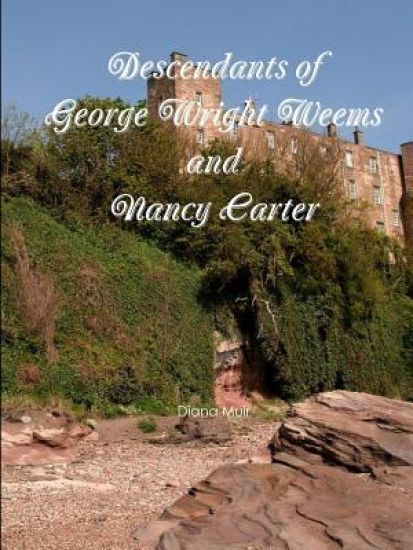
Descendants of George Wright Weems and Nancy Carter
From the castles of Wester Wemyss inFifeshire, Scotland to the hills of easternTennessee, the Wemyss family made itsimprint on the new nation in many ways.Their ancestors were Earls and Kings ofScotland and in the Americas theybecame doctors, nurses, lawyers,accountants, teachers, farmers andsoldiers.They fought in every war, the Revolution,War of the Regulators, War of1812, CivilWar, Korean, Vietnam, WW1 and WW2.Cover photo - Wemyss Castle on the Firthof Forth in Wemyss, ScotlandRear Cover photo - 2 story cabin built in1777 in Jonesborough, Tennesse, the oldest town in Tennessee.
On Frank Lloyd Wright's Concrete Adobe

On Frank Lloyd Wright's Concrete Adobe

Donald Leslie Johnson

Ashgate Publishing Limited
2013
sidottu
During the years 1919 into 1925 Frank Lloyd Wright worked on four houses and a kindergarten located in metropolitan Los Angeles using concrete blocks as the main building material. The construction system has been described by Wright and others as ’uniquely molded’, ’woven like a textile fabric’ and perceived as ground breaking, truly modern, unprecedented. Many have attempted to uphold these claims while some thought the house-designs borrowed from old exotic buildings. For the first time this book brings together Wright’s declarations, the support of upholders and inferences in order to determine their accuracy and correctness, or the possibility of feigned or fictional stories. It examines technical developments of concrete blocks by Wright and others before his experiences in Los Angeles began in 1919. It also studies the manner of Wright’s design process by an examination of relevant pictorial and textual documents. A unique, in-depth and critical analysis of the houses is set within historical, biographical and theoretical contexts. Consequently, the book explains the impact upon Wright of California contemporaries, architects Irving Gill and Rudolph Schindler, and their instrumentally profound role upon the course of modernism 1907-1923. In doing so, it allows a full appreciation of Wright’s, Gill’s and Schindler’s buildings beyond their experiential qualities.
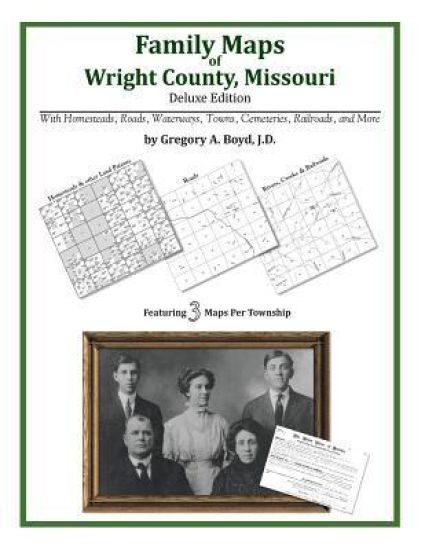
Family Maps of Wright County, Missouri

Family Maps of Wright County, Missouri

Gregory a. Boyd J. D.

Arphax Publishing Co.
2010
nidottu
288 pages with 80 total maps Locating original landowners in maps has never been an easy task-until now. This volume in the Family Maps series contains newly created maps of original landowners (patent maps) in what is now Wright County, Missouri, gleaned from the indexes of the U.S. Bureau of Land Management. But it offers much more than that. For each township in the county, there are two additional maps accompanying the patent map: a road map and a map showing waterways, railroads, and both modern and many historical city-centers and cemeteries. Included are indexes to help you locate what you are looking for, whether you know a person's name, a last name, a place-name, or a cemetery. The combination of maps and indexes are designed to aid researchers of American history or genealogy to explore frontier neighborhoods, examine family migrations, locate hard-to-find cemeteries and towns, as well as locate land based on legal descriptions found in old documents or deeds. The patent-maps are essentially plat maps but instead of depicting owners for a particular year, these maps show original landowners, no matter when the transfer from the federal government was completed. Dates of patents typically begin near the time of statehood and run into the early 1900s. What's Mapped in this book (that you'll not likely find elsewhere) . . . 5327 Parcels of Land (with original landowner names and patent-dates labeled in the relevant map) 54 Cemeteries plus . . . Roads, and existing Rivers, Creeks, Streams, Railroads, and Small-towns (including some historical), etc. What YEARS are these maps for? Here are the counts for parcels of land mapped, by the decade in which the corresponding land patents were issued: Decade Parcel-count 1840s 150 1850s 568 1860s 774 1870s 1242 1880s 739 1890s 1254 1900s 442 1910s 147 1920s 11 What Cities and Towns are in Wright County, Missouri (and in this book)? Antler (historical), Antrim, Astoria, Boyer, Burney Ford, Cedar Gap, Crossroads Store, Dawson, Duggan, Durbin, Embree, Fuson, Graff, Green Mountain, Grimes Mill, Grovespring, Hartville, Hawley (historical), Jerico, Jerktail, Latham Mill, Loring, Macomb, Maines, Manes, Mansfield, Midway, Mingsville, Mountain Grove, New Grove, Norwood, Odin, Owens, Rail, Rayborn, Rembert (historical), Saint George, Smittle, Talmage, Umpire