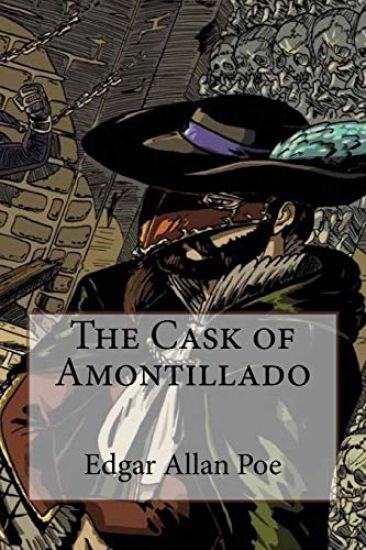
"The Cask of Amontillado" (sometimes spelled "The Casque of Amontillado") is a short story, written by Edgar Allan Poe and first published in the November 1846 issue of Godey's Lady's Book. The story is set in a nameless Italian city in an unspecified year (possibly sometime during the eighteenth century) and concerns the deadly revenge taken by the narrator on a friend who he claims has insulted him. Like several of Poe's stories, and in keeping with the 19th-century fascination with the subject, the narrative revolves around a person being buried alive - in this case, by immurement.
It was in the Fall of nineteen seventeen at an officers' training camp that I first became acquainted with John Carter, War Lord of Barsoom, through the pages of your novel "A Princess of Mars." The story made a profound impression upon me and while my better judgment assured me that it was but a highly imaginative piece of fiction, a suggestion of the verity of it pervaded my inner consciousness to such an extent that I found myself dreaming of Mars and John Carter, of Dejah Thoris, of Tars Tarkas and of Woola as if they had been entities of my own experience rather than the figments of your imagination.
Edgar Allan Poe born Edgar Poe; January 19, 1809 - October 7, 1849) was an American writer, editor, and literary critic. Poe is best known for his poetry and short stories, particularly his tales of mystery and the macabre. He is widely regarded as a central figure of Romanticism in the United States and American literature as a whole, and he was one of the country's earliest practitioners of the short story. Poe is generally considered the inventor of the detective fiction genre and is further credited with contributing to the emerging genre of science fiction. He was the CONTENTS. The Gold-Bug 1 The Black Cat 37 Mesmeric Revelation 47 Lionizing 58 The Fall of the House of Usher 64 A Descent into the Maelstr m 83 The Colloquy of Monos and Una 100 The Conversation of Eiros and Charmion 110 The Murders in the Rue Morgue 119 The Mystery of Marie Roget 151 The Purloined Letter 200 The Man in the Crowd 219
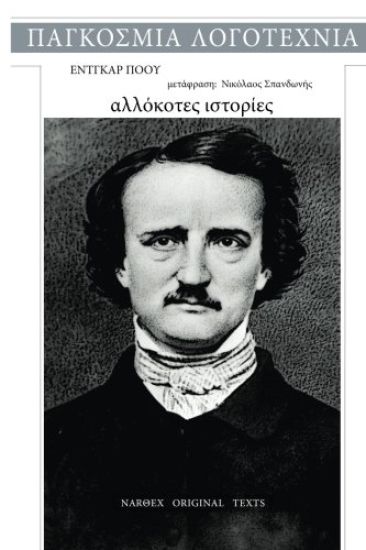
O ntngar lan P e yenn thike sti Vost ni to 1809, ap gon s theatr nous. Prin kl si ta d o tou khr nia, i gon s tou p thanan, kai o ntngar vr thike sto R tsmont, sto sp ti tou emp rou Tzon llan, pou mos den ton iioth tise pot . I skh sis tou me ton patri tou den tan pot kal s, all epidin thikan tan o llan an ngase ton ntngar na diak psi tis spoud s tou sto panepist mio tis Virtz nia, epid den tan diatethim nos na anal vi ta xod tou. To 1830 o ntngar b ke sti Stratiotik Akadim a tou Gou st P int, ap' pou apop mphthike ton ep meno khr no prokal ntas ep tides sk ndalo yia na ekdikith ton patri tou. Do lepse pita yia na meg lo di stima se di phores ephimer des tou R tsmont, tis Philad lphias kai tis N as I rkis, yia l gous vioporistiko s, all katakt ntas par llila ti ph mi tou ngirou kritiko . "To Kor ki kai lla pi mata," pou kikloph rise to 1845, ton kathi rose en mia nikt os singraph a, khor s mos na tou anakouph si ti pht khia stin op a khe z si li tin os t te z tou. To 1836 pantr ftike ti dekatetr khroni exad lphi tou Virtz nia, pou p thane phimatik nteka khr nia arg tera. P thane to 1849, alkoolik s kai opioman s kinig ntas diark s to rama tis kham nis Virtz nia, kai t phike d pla tis sti Valtim ri, pos to epithimo se.
Starting out as a harrowing wartime sea adventure, Burroughs's story ultimately develops into a lost world story reminiscent of such novels as Sir Arthur Conan Doyle's The Lost World (1912) and Jules Verne's The Mysterious Island (1874) and Journey to the Center of the Earth (1864). Burroughs adds his own twist by postulating a unique biological system for his lost world, in which the slow progress of evolution in the world outside is recapitulated as a matter of individual metamorphosis.
Old acquaintances, made in the two other stories, reappear: Tars Tarkas, Tardos Mors and others. There is a happy ending to the story in the union of the Warlord, the title conferred upon John Carter, with Dejah Thoris.
The Chessmen of Mars is a science fantasy novel by American wrtier Edgar Rice Burroughs, the fifth of his Barsoom series. Burroughs began writing it in January, 1921, and the finished story was first published in Argosy All-Story Weekly as a six-part serial in the issues for February 18 and 25 and March 4, 11, 18 and 25, 1922. It was later published as a complete novel by A. C. McClurg in November 1922.
Angelically beautiful Jean Briggerland is a sociopathic criminal, so lovely that none can see her guilt -- even in connection with the most blatant crimes Can Jack Glover, best friend and lawyer to Jean's latest victim, bring her to justice before she murders her way to unspeakable wealth and power?
Commissioner Sanders is called upon by the British Government "to keep a watchful eye upon some quarter of a million cannibal folk, who ten years before had regarded white men as we regard the unicorn." Written when world powers were vying for colonial honor, Sanders of the River encapsulates the beliefs and assumptions that motivated such quests. There is religious palava, raiding palava, and all the while, Bosambo, magnificent chief of the Ochori, watches on. .., . Richard Horatio Edgar Wallace (1 April 1875 - 10 February 1932) was an English writer. Born into poverty as an illegitimate London child, Wallace left school at age 12. He joined the army at age 21 and was a war correspondent during the Second Boer War, for Reuters and the Daily Mail. Struggling with debt, he left South Africa, returned to London, and began writing thrillers to raise income, publishing books including The Four Just Men (1905). Drawing on his time as a reporter in the Congo, covering the Belgian atrocities, Wallace serialised short stories in magazines such as The Windsor Magazine and later published collections such as Sanders of the River (1911). He signed with Hodder and Stoughton in 1921 and became an internationally recognised author. After an unsuccessful bid to stand as Liberal MP for Blackpool (as one of David Lloyd George's Independent Liberals) in the 1931 general election, Wallace moved to Hollywood, where he worked as a script writer for RKO studios. He died suddenly from undiagnosed diabetes, during the initial drafting of King Kong (1933). Wallace was such a prolific writer that one of his publishers claimed that a quarter of all books in England were written by him. As well as journalism, Wallace wrote screen plays, poetry, historical non-fiction, 18 stage plays, 957 short stories, and over 170 novels, 12 in 1929 alone. More than 160 films have been made of Wallace's work. He is remembered for the creation of King Kong, as a writer of 'the colonial imagination', for the J. G. Reeder detective stories, and for the The Green Archer serial. He sold over 50 million copies of his combined works in various editions, and The Economist describes him as "one of the most prolific thriller writers of the 20th] century", although few of his books are still in print in the UK....Wallace was born at 7 Ashburnham Grove, Greenwich, to actors Richard Horatio Edgar and Mary Jane "Polly" Richards, n e Blair. 4] 5] 6] Wallace's mother was born in 1843, in Liverpool, to an Irish Catholic family. Mary's family had been in show business, and she worked in the theatre as a stagehand, usherette, and bit-part actress until she married in 1867. Mary's husband, Captain Joseph Richards, was also born in Liverpool, in 1838; he was also from an Irish Catholic family. He and his father John Richards were both Merchant Navy captains, and his mother Catherine Richards came from a mariner family. When Mary was eight months pregnant, in January 1868, her husband died at sea. After the birth, destitute, Mary took to the stage, assuming the stage name "Polly" Richards. In 1872, Polly met and joined the Marriott family theatre troupe, managed by Mrs. Alice Edgar, her husband Richard Edgar, and their three adult children, Grace Edgar, Adeline Edgar, and Richard Horatio Edgar. Richard Horatio Edgar and Polly had a "broom cupboard" style sexual encounter during an after-show party. Discovering she was pregnant, Polly invented a fictitious obligation in Greenwich that would last at least half a year and obtained a room in a boarding house where she lived until her son's birth, on 1 April 1875. 7] During her confinement she had asked her midwife to find a couple to foster the child. The midwife introduced Polly to her close friend, Mrs Freeman, a mother of ten children, whose husband George Freeman was a Billingsgate fishmonger. On 9 April 1875, Polly took Edgar to the semi-literate Freeman family, and made arrangements to visit often....