Title: The Popham Colony. A discussion of its historical claims. By W. F. Poole, E. Ballard, and F. Kidder.] With a bibliography of the subject by W. F. Poole].Publisher: British Library, Historical Print EditionsThe British Library is the national library of the United Kingdom. It is one of the world's largest research libraries holding over 150 million items in all known languages and formats: books, journals, newspapers, sound recordings, patents, maps, stamps, prints and much more. Its collections include around 14 million books, along with substantial additional collections of manuscripts and historical items dating back as far as 300 BC.The HISTORY OF COLONIAL NORTH AMERICA collection includes books from the British Library digitised by Microsoft. This collection refers to the European settlements in North America through independence, with emphasis on the history of the thirteen colonies of Britain. Attention is paid to the histories of Jamestown and the early colonial interactions with Native Americans. The contextual framework of this collection highlights 16th century English, Scottish, French, Spanish, and Dutch expansion. ++++The below data was compiled from various identification fields in the bibliographic record of this title. This data is provided as an additional tool in helping to insure edition identification: ++++ British Library Poole, William Frederick; Ballard, Edward; 1866. 8 . 10410.ee.10.
This book has been considered by academicians and scholars of great significance and value to literature. This forms a part of the knowledge base for future generations. So that the book is never forgotten we have represented this book in a print format as the same form as it was originally first published. Hence any marks or annotations seen are left intentionally to preserve its true nature.
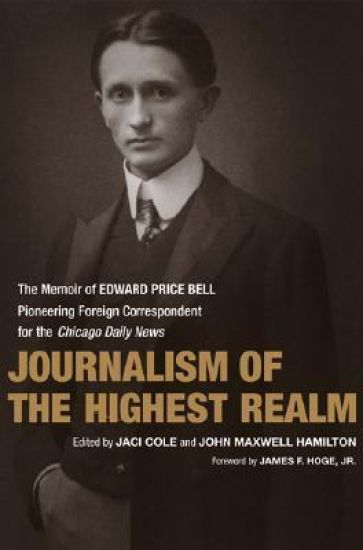
Once considered the ""best American newspaperman London has ever had,"" Edward Price Bell (1869--1943) helped invent the ideal of a professional foreign news service at the late and great Chicago Daily News, which in its heyday had the second-largest daily newspaper circulation in the United States. At the turn of the twentieth century, professional overseas reporting was still an experiment. The Chicago Daily News's visionary owner and publisher Victor Lawson was not certain how to organise the service or even what kind of news it should cover. Bell, who had distinguished himself as a young reporter in Chicago, became the anchor for the service when Lawson sent him to London in 1900. The course he set established the standard for the New York Times and other prestigious American newspapers. Unfortunately, few journalists or scholars are familiar with Bell's contributions, in part because his autobiography remained archived at the Newberry Library in Chicago. In Journalism of the Highest Realm, Jaci Cole and John Maxwell Hamilton have edited and annotated Bell's story, focusing on his lively account of the early days of the Chicago Daily News's foreign service as well as the dramatic stories his correspondents covered. James F. Hoge, Jr., the last editor-in-chief of the Chicago Daily News and present editor of Foreign Affairs, sets the stage for Bell's memoir with an informative foreword on the evolution of foreign news gathering over the last century. A bright-eyed midwestern teenager who learned journalism on the job at a small newspaper in Terre Haute, Indiana, Bell quickly established himself as an enterprising reporter. Moving on to Chicago, he became the Daily News's go-to man. He was assigned big stories and landed interviews with leading politicians, a knack that became a trademark of his overseas reporting. Over more than two decades in London, Bell entrenched himself in politics and culture, sending back thoughtful background and analysis of current events. In his memoir, Bell recounts his exclusive wartime interviews with Sir Edward Grey, the British foreign secretary, and Lord Richard Haldane, the minister of war; a later sit-down with the charismatic Il Duce, Benito Mussolini; and his rather tense exchanges with former vice president Charles Dawes, American ambassador to Britain. The respect Bell commanded among British elites and his years of experience as a London insider thrust him into a diplomatic role. Bell became an unofficial envoy to the British government and also a conduit for British views to the United States and its leaders. After Bell returned to Chicago in the early 1920s, the Daily News dispatched him on special missions to Europe and Asia to interview leaders about world peace. His accounts were published in two books and earned him a nomination for the Nobel Peace Prize in the 1930s. Despite this acclaim -- indeed, to some extent because of it -- Bell fell out of favour when new owners acquired the newspaper in 1931, and he retired to the Mississippi Gulf Coast.With Journalism of the Highest Realm Cole and Hamilton put this great newspaperman into a broader context. As they show in their thoughtful introduction, Bell and the Daily News continually grappled with problems that still bedevil overseas correspondence. Foreign news, they show, has always been an enterprise that is at once valuable and vulnerable.
Examines the political, social, and economic challenges the Cuban government and people will likely face in a post-Castro Cuba; When the end of the Castro era arrives, the successor government and the Cuban people will need to answer certain questions: How is CastroOs more than four-decade rule likely to affect a post-Castro Cuba? What will be the political, social, and economic challenges Cuba will confront? What are the impediments to CubaOs economic development and democratic transition? The authors examine CastroOs political legacies, CubaOs generational and racial divisions, its demographic predicament, the legacy of a centralized economy, and the need for industrial restructuring.