
Kirjahaku
Etsi kirjoja tekijän nimen, kirjan nimen tai ISBN:n perusteella.
1000 tulosta hakusanalla Geiger Ludwig
Can university-based scientific research contribute to the economic development of a region? Can it generate wealth for the university? American universities are under increasing pressure to maximize their economic contributions. Tapping the Riches of Science offers a rigorous and far-sighted explanation of this controversial and little-understood movement.Just how do universities contribute to innovation in industry? How have state legislatures promoted local university commitments to economic relevance? And how has the pressure to be economically productive affected the core academic missions of teaching and research? Drawing from a range of social science analyses, campus interviews, and examples of university-industry partnerships, Roger Geiger and Creso Sá reveal the ways that economic development has been incorporated into university commitments. Noting enduring cultural differences between the academic and business worlds, Geiger and Sá deflate both suspicious and overconfident views. They show how elusive success can be for embryonic discoveries with as-yet-unclear applications. Warning against promising—and expecting—too much, Tapping the Riches of Science nonetheless makes a strong case for the long-term promise of practical uses for academic research.
This book tells the compelling saga of American higher education from the founding of Harvard College in 1636 to the outbreak of World War II. The most in-depth and authoritative history of the subject available, The History of American Higher Education traces how colleges and universities were shaped by the shifting influences of culture, the emergence of new career opportunities, and the unrelenting advancement of knowledge. Roger Geiger, arguably today's leading historian of American higher education, vividly describes how colonial colleges developed a unified yet diverse educational tradition capable of weathering the social upheaval of the Revolution as well as the evangelical fervor of the Second Great Awakening. He shows how the character of college education in different regions diverged significantly in the years leading up to the Civil War--for example, the state universities of the antebellum South were dominated by the sons of planters and their culture--and how higher education was later revolutionized by the land-grant movement, the growth of academic professionalism, and the transformation of campus life by students. By the beginning of the Second World War, the standard American university had taken shape, setting the stage for the postwar education boom. Breathtaking in scope and rich in narrative detail, The History of American Higher Education is the most comprehensive single-volume history of the origins and development of of higher education in the United States.
American Higher Education since World War II
Roger L. Geiger
PRINCETON UNIVERSITY PRESS
2019
sidottu
A masterful history of the postwar transformation of American higher educationAmerican higher education is nearly four centuries old. But in the decades after World War II, as government and social support surged and enrollments exploded, the role of colleges and universities in American society changed dramatically. Roger Geiger provides the most complete and in-depth history of this remarkable transformation, taking readers from the GI Bill and the postwar expansion of higher education to the social upheaval of the 1960s and 1970s, desegregation and coeducation, and the challenges confronting American colleges today.Shedding critical light on the tensions and triumphs of an era of rapid change, Geiger shows how American universities emerged after the war as the world’s most successful system for the advancement of knowledge, how the pioneering of mass higher education led to the goal of higher education for all, and how the “selectivity sweepstakes” for admission to the most elite schools has resulted in increased stratification today. He identifies 1980 as a turning point when the link between research and economic development stimulated a revival in academic research—and the ascendancy of the modern research university—that continues to the present.Sweeping in scope and richly insightful, this groundbreaking book demonstrates how growth has been the defining feature of modern higher education, but how each generation since the war has pursued it for different reasons. It provides the context we need to understand the complex issues facing our colleges and universities today, from rising inequality and skyrocketing costs to deficiencies in student preparedness and lax educational standards.
American Higher Education since World War II
Roger L. Geiger
Princeton University Press
2021
pokkari
A masterful history of the postwar transformation of American higher educationIn the decades after World War II, as government and social support surged and enrollments exploded, the role of colleges and universities in American society changed dramatically. Roger Geiger provides an in-depth history of this remarkable transformation, taking readers from the GI Bill and the postwar expansion of higher education to the social upheaval of the 1960s and 1970s, desegregation and coeducation, and the ascendancy of the modern research university. He demonstrates how growth has been the defining feature of modern higher education, but how each generation since the war has pursued it for different reasons. Sweeping in scope and richly insightful, this groundbreaking book provides the context we need to understand the complex issues facing our colleges and universities today, from rising inequality and skyrocketing costs to deficiencies in student preparedness and lax educational standards.

In the Matter of Edwin Potter: Mental Illness and Criminal Justice Reform
David E. Geiger
David E.\ Geiger
2016
nidottu
What is the book about?It is an autobiography about Edwin Potter (not his real name), a man with schizophrenia. He had no treatment, and, as a result, he killed somebody. This is the true story of his trial, his struggle, and his comeback. David Geiger initiated his journey into criminal justice reform in May 1998 and wrote many copyrighted articles on the topic. In 2018, he received the Albert Nelson Marquis Lifetime Achievement Award from Marquis Who's Who. In November 2022, he was a panel member for an FDA conference which initiated drug research into schizophrenia. In May 2024, he participated in a SOAR Forum with NJ Reentry Corporation and Rutgers University Newark Center for Applied Appreciative Inquiry "to offer your valuable public policy ideas to improve and transform the breadth of mental health and addiction treatment services for Justice-involved individuals." Winner of the London Book Reviews seal Honoring Excellence.Winner of the Toronto Book Review Literary Award. Web site: www.davidegeiger.com
American research universities are part of the foundation for the supremacy of American science. Although they emerged as universities in the late nineteenth century, the incorporation of research as a distinct part of their mission largely occurred after 1900. To Advance Knowledge relates how these institutions, by 1940, advanced from provincial outposts in the world of knowledge to leaders in critical areas of science. This study is the first to systematically examine the preconditions for the development of a university research role. These include the formation of academic disciplines--communities that sponsored associations and journals, which defined and advanced fields of knowledge. Only a few universities were able to engage in these activities. Indeed, universities before World War I struggled to find the means to support their own research through endowments, research funds, and faculty time. To Advance Knowledge shows how these institutions developed the size and wealth to harbor a learned faculty. The book illustrates how arrangements for research changed markedly in the 1920s when the great foundations established from the Rockefeller and Carnegie fortunes embraced the advancement of knowledge as a goal. Universities emerged in this decade as the best-suited vessels to carry this mission. Foundation resources made possible the development of an American social science. In the natural sciences, this patronage allowed the United States to gain parity with Europe on scientific frontiers, of which the most important was undoubtedly nuclear physics. The research role of universities cannot be isolated from the institutions themselves. To Advance Knowledge focuses on sixteen universities that were significantly engaged with research during this era. It analyzes all facets of these institutions--collegiate life, sources of funding, treatment of faculty--since all were relevant to shaping the research role.
History of Higher Education Annual, Volume 23 provides insight into the struggle for civil rights and desegregation of Southern higher education, illuminating how this conflict affected private, historically black colleges and white denominational colleges, while interpreting the dynamics of segregation and desegregation in South Carolina. Other contributions examine town-gown relations for Harvard students in the eighteenth century and the challenge of creating an urban public university in Chicago. Review essays examine the demographic and cultural transformation of British higher education and the curious phenomenon of historical encyclopedias of individual colleges and universities. History of Higher Education Annual will be of interest to historians, sociologists, educational policymakers as well as those concerned with the future of higher education in the United States and throughout the world. Roger L. Geiger is Distinguished Professor of Higher Education at the Pennsylvania State University. He has edited the History of Higher Education Annual since 1993. His two volumes Research and Relevant Knowledge and To Advance Knowledge (both published by Transaction) cover the history of universities in the United States during the twentieth century.

During World War II, hundreds of military training installations were built throughout the United States to prepare servicemen for the rigors of overseas combat. One such installation was Camp Cooke in California, which since 1957 has become an internationally recognized missile and rocket base renamed Vandenberg Air Force Base. This book examines the history of the camp, starting with its construction. Established some 150 miles north of Los Angeles, Cooke was designed for armored divisions, but by the end of the war hundreds of other specialized organizations trained there. It supported many USO clubs and attracted some of Hollywood's leading entertainers as well as many from radio and stage. With the outbreak of the Korean War, Cooke supported Army National Guard and reserve units. Its large hospital cared for war evacuees and Army medical cases from other parts of the globe. When it became an Air Force base, America's first spy satellite program was conducted from there. The intelligence data collected from these missions exploded the myth of a "missile gap" with the Soviet Union. At the height of the Cold War, America's first ICBM missile equipped with a nuclear warhead was based at Vandenberg.
Market forces have profoundly affected the contemporary research university's fundamental tasks of creating and disseminating knowledge. They arguably have provided American universities access to greater wealth, better students, and stronger links with the economy. Yet they also have exaggerated inequalities, diminished the university's control over its own activities, and weakened the university's mission of serving the public. Incorporating twenty years of research and new data covering 99 research universities, Knowledge and Money explains this paradox by assessing how market forces have affected universities in four key spheres of activity: finance, undergraduate education, primary research, and participation in regional and national economic development. The book begins by chronicling how universities have enlarged revenues by optimizing tuitions, and how they have managed these funds. It reveals why competition for the best students through selective undergraduate admissions has led to increased student consumerism and weakened university control over learning. The book also explains why research has become an increasingly autonomous activity within the university, expanding faster than class instruction or faculty resources. Finally, it shows how the linkage of research to economic development has engendered closer ties with industry and encouraged the commercialization of knowledge.
Market forces have profoundly affected the contemporary research university's fundamental tasks of creating and disseminating knowledge. They arguably have provided American universities access to greater wealth, better students, and stronger links with the economy. Yet they also have exaggerated inequalities, diminished the university's control over its own activities, and weakened the university's mission of serving the public. Incorporating twenty years of research and new data covering 99 research universities, Knowledge and Money explains this paradox by assessing how market forces have affected universities in four key spheres of activity: finance, undergraduate education, primary research, and participation in regional and national economic development. The book begins by chronicling how universities have enlarged revenues by optimizing tuitions, and how they have managed these funds. It reveals why competition for the best students through selective undergraduate admissions has led to increased student consumerism and weakened university control over learning. The book also explains why research has become an increasingly autonomous activity within the university, expanding faster than class instruction or faculty resources. Finally, it shows how the linkage of research to economic development has engendered closer ties with industry and encouraged the commercialization of knowledge.

Phytonymic Derivational Systems in the Romance Languages
Walter E. Geiger
The University of North Carolina Press
1978
nidottu
Volume 187 in the North Carolina Studies in the Romance Languages and Literatures series.
This proper Philadelphia story starts with the city's golden age at the close of the eighteenth century. It is a classic study of an American business aristocracy of colonial stock with Protestant affiliations as well as an analysis of how fabulously wealthy nineteenth-century family founders in Boston, New York, and Philadelphia, supported various exclusive institutions that in the course of the twentieth century produced a national upper-class way of life. But as that way of life became an end of itself, instead of an effort to consolidate power and control, the upper-class outlived its function; this, argues Baltzell, is precisely what took place in the Philadelphia class system.Philadelphia Gentlemen emphasizes that class is largely a matter of family, whereas an elite is largely a matter of individual achievement. The emphasis in Philadelphia on old classes, in contrast to the emphasis in New York and Boston on individual achievement and elite striving, helps to explain the dramatically different outcomes of ruling class domination in major centers of the Eastern Establishment. In emphasizing class membership or family prestige, the dynamics of industrial and urban life passed by rather than through Philadelphia. As a result in the race for urban preeminence, Philadelphia lost precious time and eventually lost the struggle for ruling preeminence as such.When the book initially appeared, it was hailed by The New York Times as "a very, very important book." Writing in the pages of the American Sociological Review, Seymour Martin Lipset noted that "Philadelphia Gentlemen says important things about class and power in America, and says them in ways that will interest and fascinate both sociologists and laymen." And in the American Historical Review, Baltzell's book was identified simply as "a gold mine of information." In short, for sociologists, historians, and those concerned with issues of culture and the economy, this is indeed a classic of modern social science.


Magazin FÃ1/4r Pharmacie Und Die Dahin Einschlagenden Wissenschaften Siebenundzwanzigster Band, Siebenter Jahrgang
Justus Liebig; Philipp Lorenz Geiger; Georg Friedrich Hänle
Hutson Street Press
2025
sidottu

Magazin FÃ1/4r Pharmacie Und Die Dahin Einschlagenden Wissenschaften Siebenundzwanzigster Band, Siebenter Jahrgang
Justus Liebig; Philipp Lorenz Geiger; Georg Friedrich Hänle
Hutson Street Press
2025
pokkari

Human Rights and Intellectual Property Before the European Courts
Elena Izyumenko; Christophe Geiger
EDWARD ELGAR PUBLISHING LTD
2025
sidottu
This unique reference work serves as a comprehensive guide to how Europe’s top courts – the Court of Justice of the European Union (CJEU) and the European Court of Human Rights (ECtHR) – address the intersection of intellectual property (IP) and human rights. It traces the evolution of the courts’ jurisprudence in these fields and explores how human and fundamental rights including freedom of expression, right to property, freedom to conduct a business, privacy, and the right to a fair trial can influence copyright, trademarks, patents, and other IP rights. Key Features: Over 200 cases analysed, many previously overlooked or untranslated, enabling new lines of academic inquiry Supports informed policy development that balances innovation, commercial interests, and fundamental rights, while proactively identifying and addressing legal risks in public regulation Presents practical guidance and legal reasoning for handling IP cases involving human rights claims, acting as a guide to precedent from the CJEU and ECtHR Side-by-side analysis of both European courts with thorough cross-referencing and an extensive study of relevant case law from 1952 to 2025, to provide a clear view of European courts’ evolving approach. This in-depth Commentary is a vital resource for legal practitioners, researchers and policymakers in European law, human rights, and intellectual property law. NGOs and civil society organizations will also benefit from its tools for building rights-based arguments.

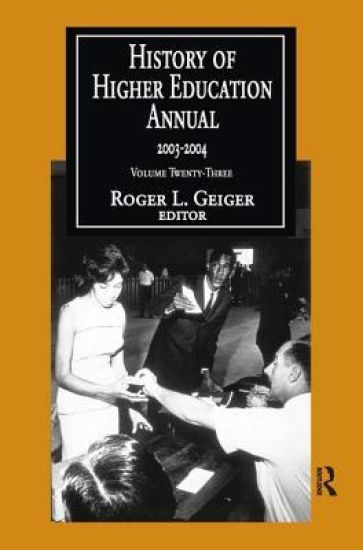
History of Higher Education Annual, Volume 23 provides insight into the struggle for civil rights and desegregation of Southern higher education, illuminating how this conflict affected private, historically black colleges and white denominational colleges, while interpreting the dynamics of segregation and desegregation in South Carolina. Other contributions examine town-gown relations for Harvard students in the eighteenth century and the challenge of creating an urban public university in Chicago. Review essays examine the demographic and cultural transformation of British higher education and the curious phenomenon of historical encyclopedias of individual colleges and universities. History of Higher Education Annual will be of interest to historians, sociologists, educational policymakers as well as those concerned with the future of higher education in the United States and throughout the world. Roger L. Geiger is Distinguished Professor of Higher Education at the Pennsylvania State University. He has edited the History of Higher Education Annual since 1993. His two volumes Research and Relevant Knowledge and To Advance Knowledge (both published by Transaction) cover the history of universities in the United States during the twentieth century.
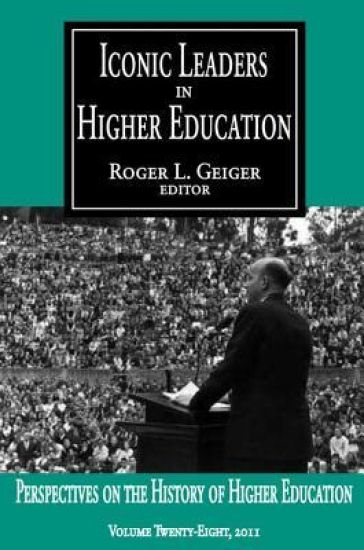
Iconic leaders are those who have become symbols of their institutions. This volume of historical studies portrays a collection of college and university presidents who acquired iconic qualities that transcend mere identification with their institution.The volume begins with Roger L. Geiger's observation that creating and controlling one's image requires managing publicity. Andrea Turpin describes how Mount Holyoke Seminar's evolution into a modern women's college required reshaping the image of Mary Lyon, its founder. Roger L. Geiger and Nathan M. Sorber show how College of Philadelphia provost William Smith's partisan politics and patronage tainted the college he symbolized. Joby Topper reveals how presidents Seth Low of Columbia and Francis Patton of Princeton mastered the modern art of publicity.Katherine Chaddock explains how John Erskine the Columbia University English professor responsible for the first Great Books program and his unusual career inverted the normal route to iconic status. In contrast, Christian Anderson's analysis of John G. Bowman, chancellor of the University of Pittsburgh, shows how he substituted architectural vision for academic leadership. James Capshew explores the background that made Herman Wells a revered leader of Indiana University. Nancy Diamond details how building Brandeis University involved a challenging series of decisions successfully navigated by founding president Abram Sachar. Finally, Ethan Schrum depicts how Clark Kerr's controversial understanding of the role of contemporary universities was formed by his earlier career in industrial relations. This study of iconic leaders probes new dimensions of leadership and the construction of institutional images.