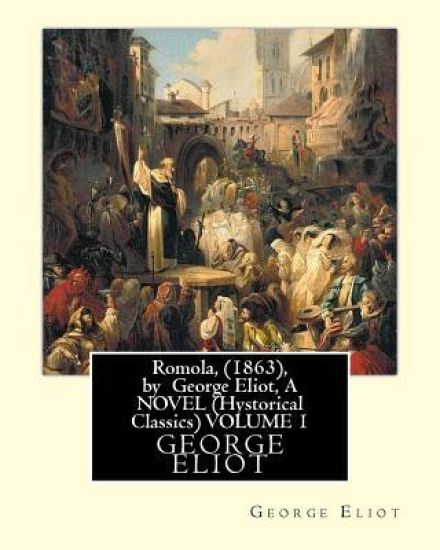
Romola (1862-63) is a historical novel by George Eliot set in the fifteenth century, and is "a deep study of life in the city of Florence from an intellectual, artistic, religious, and social point of view". citation needed] It first appeared in fourteen parts published in Cornhill Magazine from July 1862 to August 1863 . The story takes place amidst actual historical events during the Italian Renaissance, and includes in its plot several notable figures from Florentine history.Florence, 1492: Christopher Columbus has sailed towards the New World, and Florence has just mourned the death of its legendary leader, Lorenzo de' Medici. In this setting, a Florentine trader meets a shipwrecked stranger, who introduces himself as Tito Melema, a young Italianate-Greek scholar. Tito becomes acquainted with several other Florentines, including Nello the barber and a young girl named Tessa. He is also introduced to a blind scholar named Bardo de' Bardi, and his daughter Romola. As Tito becomes settled in Florence, assisting Bardo with classical studies, he falls in love with Romola. However, Tessa falls in love with Tito, and the two are "married" in a mock ceremony. Tito learns from Fra Luca, a Dominican monk, that his adoptive father has been forced into slavery and is asking for assistance. Tito introspects, comparing filial duty to his new ambitions in Florence, and decides that it would be futile to attempt to rescue his adoptive father. This paves the way for Romola and Tito to marry. Fra Luca shortly thereafter falls ill and before his death he speaks to his estranged sister, Romola. Ignorant of Romola's plans, Fra Luca warns her of a vision foretelling a marriage between her and a mysterious stranger who will bring pain to her and her father. After Fra Luca's death, Tito dismisses the warning and advises Romola to trust him. Tito and Romola become betrothed at the end of Carnival, to be married at Easter after Tito returns from a visit to Rome... etc... Christian Bernhard, Freiherr von Tauchnitz (August 25, 1816 Schleinitz, present day Unterkaka - August 11, 1895 Leipzig), the founder of the firm of Bernhard Tauchnitz, was the nephew of the first-mentioned. Christian's father died when he was young and his uncle played an important part in his development. His printing and publishing firm was started at Leipzig (Germany) on February 1, 1837.Bernhard started the Collection of British and American Authors in 1841, a reprint series familiar to anglophone travellers on the continent of Europe. These inexpensive paperbound editions, a direct precursor to mass-market paperbacks, were begun in 1841, and eventually ran to over 5,000 volumes. In 1868 he began the Collection of German Authors, followed in 1886 by the Students' Tauchnitz Editions.
Title: Jubilee Jottings. The Jubilee of George the Third. 25 October, 1809. A record of the festivities with the proclamations ... Compiled ... by T. P.Publisher: British Library, Historical Print EditionsThe British Library is the national library of the United Kingdom. It is one of the world's largest research libraries holding over 150 million items in all known languages and formats: books, journals, newspapers, sound recordings, patents, maps, stamps, prints and much more. Its collections include around 14 million books, along with substantial additional collections of manuscripts and historical items dating back as far as 300 BC.The HISTORY OF BRITAIN & IRELAND collection includes books from the British Library digitised by Microsoft. As well as historical works, this collection includes geographies, travelogues, and titles covering periods of competition and cooperation among the people of Great Britain and Ireland. Works also explore the countries' relations with France, Germany, the Low Countries, Denmark, and Scandinavia. ++++The below data was compiled from various identification fields in the bibliographic record of this title. This data is provided as an additional tool in helping to insure edition identification: ++++ British Library Preston, Thomas; 1887. lvi, 277 p.; 8 . 9525.df.11.
This work has been selected by scholars as being culturally important, and is part of the knowledge base of civilization as we know it. This work was reproduced from the original artifact, and remains as true to the original work as possible. Therefore, you will see the original copyright references, library stamps (as most of these works have been housed in our most important libraries around the world), and other notations in the work.This work is in the public domain in the United States of America, and possibly other nations. Within the United States, you may freely copy and distribute this work, as no entity (individual or corporate) has a copyright on the body of the work.As a reproduction of a historical artifact, this work may contain missing or blurred pages, poor pictures, errant marks, etc. Scholars believe, and we concur, that this work is important enough to be preserved, reproduced, and made generally available to the public. We appreciate your support of the preservation process, and thank you for being an important part of keeping this knowledge alive and relevant.
*Weaves the lives and careers of the 4 famous cadets into one entertaining and educational narrative. *Includes pictures of important people and places, as well as maps of battles like Antietam and Gettysburg. *Discusses the relationships between the men, including Hill's close friendship with McClellan and Hill's feuds with Jackson. *Includes Bibliographies of each general. *Includes quotes and letters from the generals. West Point has long been America's most famous military academy, but in the early 19th century, it was a highly unimpressive school consisting of a few ugly buildings facing a desolate, barren parade ground. Established with just five officers and ten cadets of the Corps of Engineers on March 16, 1802, the Academy was built on a spot just 50 miles north of New York City which had been a key Hudson River military fortress during the Revolutionary War. Cadets attending during the "Point's" first several decades were obliged to maintain their daily regimen knowing the school might shut down at any moment, as the U. S. government frequently questioned why it should provide free education. As it turned out, West Point would become the foremost military academy in the nation, but none of the West Point classes became as famous as the Class of 1846, which boasted more than a dozen future Civil War generals. The Class of 1846 included a shy kid named Thomas Jonathan Jackson who made few friends and struggled with his studies, finishing 17th in his class 15 years before becoming Stonewall. Also in that class was A.P. Hill, who was already in love with the future wife of George McClellan, a young prodigy who finished second in the class of 1846. A popular and mischievous George Pickett would play hooky at the local bar and struggle just to finish last in the class, and the Class of 1846 also churned out critical Union generals like Jesse Reno, Darius Couch, and George Stoneman. Before these men opposed each other on Civil War battlefields, they forged their own friendships and charted their future paths together at West Point and the Mexican-American War. The Legends of the West Point Class of 1846 profiles the lives and careers of that class's 4 most famous cadets, chronicling their relationships with each other and their Civil War records. Along with pictures of important people and places, you will learn about Stonewall, McClellan, A.P. Hill and Pickett like you never have before.
George W. Bush remains a highly controversial figure, a man for whom millions of Americans have very strong feelings. Dan McAdams' book offers an astute psychological portrait of Bush, one of the first biographies to appear since he left office as well as the first to draw systematically from personality science to analyze his life. McAdams, an international leader in personality psychology and the narrative study of lives, focuses on several key events in Bush's life, such as the death of his sister at age 7, his commitment to sobriety on his 40th birthday, and his reaction to the terrorist attacks of September 11, and his decision to invade Iraq. He sheds light on Bush's life goals, the story he constructed to make sense of his life, and the psychological dynamics that account for his behavior. Although there are many popular biographies of George W. Bush, McAdams' is the first true psychological analysis based on established theories and the latest research. Short and focused, written in an engaging style, this book offers a truly penetrating look at our forty-third president.
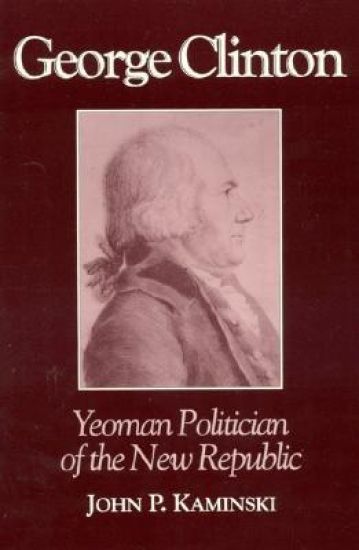
From an upstart Ulster County militia officer to 'Pharaoh of New York' and vice president under both Jefferson and Madison, George Clinton cast a political shadow over the young republic for almost forty years. As outspoken supporter of the patriot cause, antifederalism, and later of Republican politics, he dominated the imbroglio of New York politics until his death in 1812. The first biography of this pivotal figure in over half a century, George Clinton analyzes the public career of this leader who, because of the destruction of his papers, has remained largely lost to history. In addition to exploring the complexities of Clinton's life, Kaminski clarifies the often arcane issues of Confederation politics. His mastery of detail, his broad knowledge of the period, and his sensitivity to the subtleties of politics on state and national levels enable him to redefine Clinton and his age. George Clinton describes how politics worked from county to Congress and how Clinton worked from behind the scenes to dominate New York. In a revelatory new interpretation, Kaminski describes how Clinton, the leading Antifederalist in the coutnry, allowed the New York State Convention to ratify the Constitution in pursuit of his ambition to become Washington's first vice president and ultimately, his successor. With this book Clinton is given his rightful place in American historiography alongside Patrick Henry, Alexander Hamilton, and Samuel Adams.
This work has been selected by scholars as being culturally important and is part of the knowledge base of civilization as we know it.This work is in the public domain in the United States of America, and possibly other nations. Within the United States, you may freely copy and distribute this work, as no entity (individual or corporate) has a copyright on the body of the work.Scholars believe, and we concur, that this work is important enough to be preserved, reproduced, and made generally available to the public. To ensure a quality reading experience, this work has been proofread and republished using a format that seamlessly blends the original graphical elements with text in an easy-to-read typeface.We appreciate your support of the preservation process, and thank you for being an important part of keeping this knowledge alive and relevant.
This work has been selected by scholars as being culturally important and is part of the knowledge base of civilization as we know it.This work is in the public domain in the United States of America, and possibly other nations. Within the United States, you may freely copy and distribute this work, as no entity (individual or corporate) has a copyright on the body of the work.Scholars believe, and we concur, that this work is important enough to be preserved, reproduced, and made generally available to the public. To ensure a quality reading experience, this work has been proofread and republished using a format that seamlessly blends the original graphical elements with text in an easy-to-read typeface.We appreciate your support of the preservation process, and thank you for being an important part of keeping this knowledge alive and relevant.


![A Peep at the P*v****n [pavilion], or Boiled Mutton and Caper Sauce at the Temple of Joss ... a Satirical Poem [upon George IV.].](/covers/9781241026271.jpg)






![Oedipus Tyrannus; Or, Swellfoot the Tyrant. a Tragedy. in Two Acts. Translated from the Original Doric. [a Satire in Verse on George IV. and Queen Caroline, by P. B. Shelley.]](/covers/9781241055615.jpg)
![A Mystery of Sixty Centuries; Or, a Modern St. George and the Dragon. [A Romance.] Written, Printed, Illustrated and Published by S. P. Widnall.](/covers/9781241219963.jpg)