Kirjojen hintavertailu. Mukana 12 016 292 kirjaa ja 12 kauppaa.

Kirjahaku

Etsi kirjoja tekijän nimen, kirjan nimen tai ISBN:n perusteella.

1000 tulosta hakusanalla Ian Merkel

Oh Joy! Oh Rapture!

Oh Joy! Oh Rapture!

Ian Bradley

Oxford University Press Inc
2007
nidottu
In Oh Joy! Oh Rapture! expert and enthusiast Ian Bradley explores the world of Gilbert and Sullivan over the last four and a half decades, looking at the way this "phenomenon" is passed from generation to generation. Taking as his starting point the expiry of copyright on the opera libretti at the end of 1961 and using fascinating hitherto unpublished archive material, Bradley reveals the extraordinary story of the last years of the old D'Oyly Carte Opera Company, the guardian of Savoy tradition for over a hundred years, and the troubled history of its successor. He explores the rich vein of parodies, spoofs, and spin-offs of the songs, as well as their influence on twentieth century lyricists and composers. He analyzes professional productions across the world, looks at the unique place of G&S in schools, colleges, and universities, and lovingly explores the culture of amateur performance. He also uncovers the largely male world of the obsessive fans, those collecting memorabilia, the myriad magazines, journals, websites, and festivals devoted to G&S, and the arcane interests of some of the faithful "inner brotherhood."
The World from Beginnings to 4000 BCE

The World from Beginnings to 4000 BCE

Ian Tattersall

Oxford University Press Inc
2008
nidottu
This book narrates the story of human biological and cultural evolution, from the earliest beginnings of our zoological family Hominidae, through the emergence of Homo sapiens, to the Agricultural Revolution. It concludes with a brief overview of the subsequent diversification of cultural and technological traditions in all the areas our species inhabits. A particular focus is on the pattern of events/innovations in human biological and cultural evolution, which have tended not to proceed in lockstep. Prior to the emergence of Homo sapiens innovations of this kind were generally sporadic, and rare; since that event their frequency has been steadily increasing. Tattersall draws on his own research to demonstrate that the history of humankind has not been one of a singleminded struggle from primitiveness to perfection, but has rather been one of trial and error, of evolutionary experimentation that as often ended in failure as in success. In the process he thoroughly examines both the fossil and the archaeological records that document our human prehistory. All human beings have a thirst to know where they came from, whether as individuals or as a species. This book responds to this desire for knowledge, whether in the classroom where the subject has a place in history as well as in science curricula or in more informal contexts. There currently exist no high school texts or supplemental readings that treat this subject in an authoritative manner, written by a practicing scientist in the field. This volume will have the advantage of being written by one whose opinions are first hand, and conditioned by direct familiarity with the original evidence.
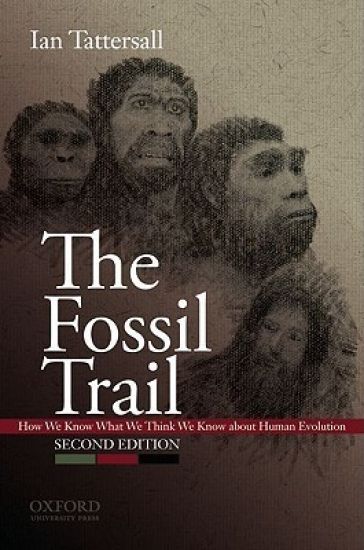
The Fossil Trail

The Fossil Trail

Ian Tattersall

Oxford University Press Inc
2008
nidottu
Ideal for courses in Human Evolution, History of Paleoanthropology, and as a supplement for Introduction to Biological Anthropology, The Fossil Trail is a history of paleoanthropological thought and discovery. Ian Tattersall's account of the study of human evolution offers a colorful history of fossil discoveries and a revealing insider's look at how these finds have been interpreted-and misinterpreted-through time. The second edition of The Fossil Trail brings the text up-to-date with a look at what has happened in paleoanthropology in the thirteen intervening years since the first edition's publication. There has been not only a dramatic increase in the size and scope of the human fossil record, but the introduction of new techniques of analysis and of ways of interpreting that record. Through it all, Tattersall discusses the great researchers and discoveries within the context of their social and scientific milieu to reveal the many forces that shape how we interpret fossil findings, and to give a picture of what lies ahead for the field. The Second Edition updates the original first fifteen chapters with the most recent research.The new edition also features a substantially revised Chapter 16, which provides a bridge to later developments about the Neanderthals and their precursors. Tattersall has also added two new chapters that cover the discoveries published over the past thirteen years. Chapter 17 launches a discussion of the state of paleoanthropology at the turn of the 21st Century, and Chapter 18 ties our most recent knowledge back to the beginning to look at where we've been and where we're headed. The author has also added a new gallery of maps of fossil sites-including Western Europe, Central Europe, The Caucuses and Near East, East Asia, Northern Africa, and Southern Africa-and updated the opening timeline to include the discovery of nearly 20 new species.
The Power of Deliberation

The Power of Deliberation

Ian Johnstone

Oxford University Press Inc
2011
sidottu
Arguing about matters of public policy is ubiquitous in democracies. The ability to resolve conflicts through peaceful contestation is a measure of any well-ordered society. Arguing is almost as ubiquitous in international affairs, yet it is not viewed as an important element of world order. In The Power of Deliberation: International Law, Politics and Organizations, Ian Johnstone challenges the assumption that arguing is mere lip service with no real impact on the behavior of states or the structure of the international system. Johnstone focuses on legal argumentation and asks why, if the rhetoric of law is inconsequential, governments and other international actors bother engaging in it. Johnstone joins the efforts of international relations scholars and democracy theorists who consider why argumentation occurs beyond nation states. He focuses on deliberation in and around international organizations, drawing on various strands of legal, political and international relations theory to identify common features of legal argumentation and deliberative politics. Johnstone's central claim is that international organizations are places where "interpretive communities" coalesce, and the quality of the deliberations these communities provoke is a measure of the legitimacy of the organization.
The Last Kings of Macedonia and the Triumph of Rome

The Last Kings of Macedonia and the Triumph of Rome

Ian Worthington

OXFORD UNIVERSITY PRESS INC
2023
sidottu
In the history of ancient Macedonia, the last three Antigonid kings--Philip V (r. 221-179), his son Perseus (r. 179-168), and the pretender Andriscus or Philip VI (r. 149-148)--are commonly overlooked in favor of their predecessors Philip II (r. 359-336) and his son Alexander the Great (r. 336-323), who established a Macedonian empire. By the time Philip V became king, Macedonia was no longer an imperial power and Rome was fast spreading its dominance over the Mediterranean. Viewed as postscripts to the kingdom's heyday, the last Macedonian kings are often denounced for self-serving ambitions, flawed policies, and questionable personal qualities by hostile ancient writers. They are condemned for defeats by Rome that saw both the end of the monarchy and the fall of the formidable Macedonian phalanx before the Roman legion. In The Last Kings of Macedonia and the Triumph of Rome, Ian Worthington reassesses these three kings and demonstrates how such denunciations are inaccurate. Producing the first full-scale treatment of Philip V in eighty years and the first in English of Perseus and Andriscus in more than fifty, Worthington argues that this period was far from a postscript to Macedonia's Classical greatness and disagrees that the last Antigonid kings were merely collateral damage in Rome's ascendancy in the east. Despite superior Roman manpower and resources, Philip and Perseus often had the upper hand in their wars against Rome. As Worthington asserts, these kings deserve to be remembered for striving to preserve their kingdom's independence against staggering odds.
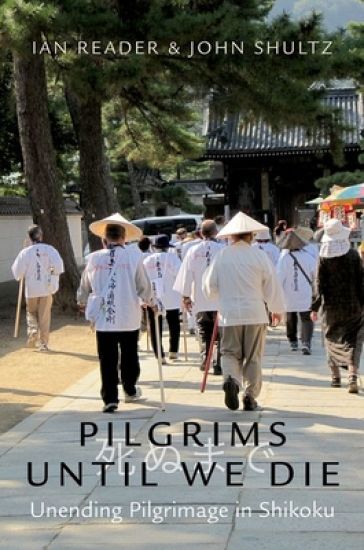
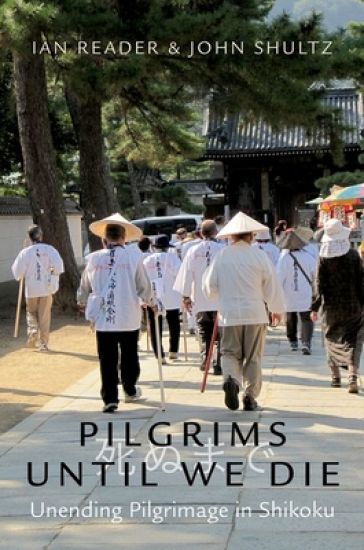
Pilgrims Until We Die

Pilgrims Until We Die

Ian Reader; John Shultz

Oxford University Press Inc
2021
sidottu
The Shikoku pilgrimage, a 1400 kilometre, eighty-eight temple circuit around Japan's fourth largest island, takes around forty days by foot, or one week by car. Historically, Buddhist ascetics walked it without ceasing, creating a tradition of unending pilgrimage that continues in the present era, both by pilgrims on foot and by others in cars. Some spend decades walking the pilgrimage, while others drive it repeatedly, completing hundreds of pilgrimage circuits. Most are retired and make the pilgrimage the centre of their post-work lives. Others who work full-time spend their holidays and weekends as pilgrims. Some have only done the pilgrimage a few times but already imagine themselves as unending pilgrims and intend to do it “until we die”. They talk happily of being addicted and having Shikokuby?, 'Shikoku illness', portraying this 'illness' and addiction as blessings. Featuring extensive fieldwork and interviews, this study of Japan's most famous Buddhist pilgrimage presents new theoretical perspectives on pilgrimage in general, along with rich ethnographic examples of pilgrimage practices in contemporary Japan. Pilgrims Until We Die counteracts normative portrayals of pilgrimage as a transient activity, defined by a temporary leave of absence from home to visit sacred places outside the parameters of everyday life, showing that many participants view pilgrimage as a way of creating a sense of home and permanence on the road. Examining how obsession, devotion, and a sense of addiction aided by modern developments and economic factors have created a culture of recurrent pilgrimage, Pilgrims Until We Die challenges standard understandings of pilgrimage.
Pilgrims Until We Die

Pilgrims Until We Die

Ian Reader; John Shultz

Oxford University Press Inc
2021
nidottu
The Shikoku pilgrimage, a 1400 kilometre, eighty-eight temple circuit around Japan's fourth largest island, takes around forty days by foot, or one week by car. Historically, Buddhist ascetics walked it without ceasing, creating a tradition of unending pilgrimage that continues in the present era, both by pilgrims on foot and by others in cars. Some spend decades walking the pilgrimage, while others drive it repeatedly, completing hundreds of pilgrimage circuits. Most are retired and make the pilgrimage the centre of their post-work lives. Others who work full-time spend their holidays and weekends as pilgrims. Some have only done the pilgrimage a few times but already imagine themselves as unending pilgrims and intend to do it “until we die”. They talk happily of being addicted and having Shikokuby?, 'Shikoku illness', portraying this 'illness' and addiction as blessings. Featuring extensive fieldwork and interviews, this study of Japan's most famous Buddhist pilgrimage presents new theoretical perspectives on pilgrimage in general, along with rich ethnographic examples of pilgrimage practices in contemporary Japan. Pilgrims Until We Die counteracts normative portrayals of pilgrimage as a transient activity, defined by a temporary leave of absence from home to visit sacred places outside the parameters of everyday life, showing that many participants view pilgrimage as a way of creating a sense of home and permanence on the road. Examining how obsession, devotion, and a sense of addiction aided by modern developments and economic factors have created a culture of recurrent pilgrimage, Pilgrims Until We Die challenges standard understandings of pilgrimage.
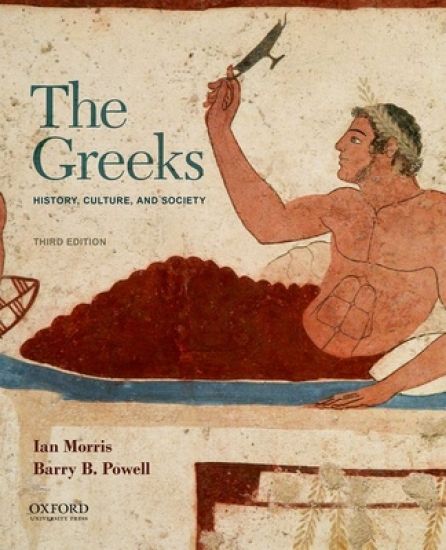
The Greeks

The Greeks

Ian Morris; Barry B. Powell

OXFORD UNIVERSITY PRESS INC
2022
nidottu
In The Greeks, Ian Morris and Barry B. Powell try to see ancient Greece as a whole: not just a narrative of events or an overview of culture, but history and culture taken together. From ancient Greece comes the modern conviction that through open discussion and the exercise of reason a society of free citizens can solve the problems that challenge it. In one period of Greek history, a society just so governed produced timeless masterpieces of literature, art, and rational thought at the same time that it waged terrible wars and committed countless cruelties. If we understand the past, we can live better in the present, but the past is hard to understand. In The Greeks, Morris and Powell offer new ways of thinking about old problems.
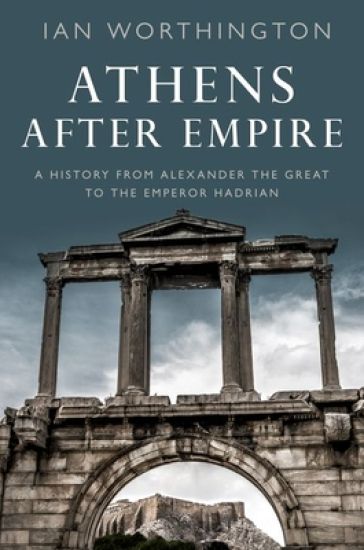
Athens After Empire

Athens After Empire

Ian Worthington

OXFORD UNIVERSITY PRESS INC
2023
nidottu
A major new history of Athens' remarkably long and influential life after the collapse of its empire. To many the history of post-Classical Athens is one of decline. True, Athens hardly commanded the number of allies it had when hegemon of its fifth-century Delian League or even its fourth-century Naval Confederacy, and its navy was but a shadow of its former self. But Athens recovered from its perilous position in the closing quarter of the fourth century and became once again a player in Greek affairs, even during the Roman occupation. Athenian democracy survived and evolved, even through its dealings with Hellenistic Kings, its military clashes with Macedonia, and its alliance with Rome. Famous Romans, including Julius Caesar and Mark Antony, saw Athens as much more than an isolated center for philosophy. Athens After Empire offers a new narrative history of post-Classical Athens, extending the period down to the aftermath of Hadrian's reign.
Faustian Bargain

Faustian Bargain

Ian Ona Johnson

OXFORD UNIVERSITY PRESS INC
2024
nidottu
When Nazi Germany invaded Poland on September 1, 1939, launching World War Two, its army seemed an unstoppable force. The Luftwaffe bombed towns and cities across the country, and fifty divisions of the Wehrmacht crossed the border. Yet only two decades earlier, at the end of World War One, Germany had been an utterly and abjectly defeated military power. Foreign troops occupied its industrial heartland and the Treaty of Versailles reduced the vaunted German army of World War One to a fraction of its size, banning it from developing new military technologies. When Hitler came to power in 1933, these strictures were still in effect. By 1939, however, he had at his disposal a fighting force of 4.2 million men, armed with the most advanced weapons in the world. How could this nearly miraculous turnaround have happened? The answer lies in Russia. Beginning in the years immediately after World War One and continuing for more than a decade, the German military and the Soviet Union--despite having been mortal enemies--entered into a partnership designed to overturn the order in Europe. Centering on economic and military cooperation, the arrangement led to the establishment of a network of military bases and industrial facilities on Soviet soil. Through their alliance, which continued for over a decade, Germany gained the space to rebuild its army. In return, the Soviet Union received vital military, technological and economic assistance. Both became, once again, military powers capable of a mass destruction that was eventually directed against one another. Drawing from archives in five countries, including new collections of declassified Russian documents, The Faustian Bargain offers the definitive exploration of a shadowy but fateful alliance.
Music of the Night

Music of the Night

Ian Bradley

OXFORD UNIVERSITY PRESS INC
2025
sidottu
This book offers readers a fascinating new look into the spiritual side of operetta and musical theatre, two closely related genres often dismissed as trivial, shallow, and essentially secular. Bradley challenges these judgements and seeks to show that there have been clear religious influences and spiritual resonances in some of the best known and most popular works in both genres. He points to the darker and more serious side of operetta and musical theatre to analyse the work of Offenbach, Lehár, Gilbert and Sullivan, Rodgers and Hammerstein, Sondheim, Schwartz, Lloyd Webber, and Boublil and Schoenberg. Readers will never listen to The Mikado, The Sound of Music, Fiddler on the Roof, Sweeney Todd, Wicked, Les Miserables and The Lion King in the same way again. Using hitherto largely neglected sources, Music of the Night explores the Jewish and Catholic roots of French operetta composers, the impact of Franz Lehár's Catholic faith, the effect of Oscar Hammerstein's early exposure to Universalism, and the High Church aesthetic of Andrew Lloyd-Webber. Further chapters discuss Arthur Sullivan's softening and spiritualising effect on W. S. Gilbert's lyrics in the Savoy operas, Stephen Sondheim's secularism, and Stephen Schwartz as the 'reluctant pilgrim'. There is specific analysis of the religious influences and spiritual resonances in six key musicals: The Sound of Music, Fiddler on the Roof, Godspell, Jesus Christ Superstar, Les Misérables and The Lion King. A concluding chapter briefly surveys the musicals of the twenty-first century.
Music of the Night

Music of the Night

Ian Bradley

OXFORD UNIVERSITY PRESS INC
2025
nidottu
This book offers readers a fascinating new look into the spiritual side of operetta and musical theatre, two closely related genres often dismissed as trivial, shallow, and essentially secular. Bradley challenges these judgements and seeks to show that there have been clear religious influences and spiritual resonances in some of the best known and most popular works in both genres. He points to the darker and more serious side of operetta and musical theatre to analyse the work of Offenbach, Lehár, Gilbert and Sullivan, Rodgers and Hammerstein, Sondheim, Schwartz, Lloyd Webber, and Boublil and Schoenberg. Readers will never listen to The Mikado, The Sound of Music, Fiddler on the Roof, Sweeney Todd, Wicked, Les Miserables and The Lion King in the same way again. Using hitherto largely neglected sources, Music of the Night explores the Jewish and Catholic roots of French operetta composers, the impact of Franz Lehár's Catholic faith, the effect of Oscar Hammerstein's early exposure to Universalism, and the High Church aesthetic of Andrew Lloyd-Webber. Further chapters discuss Arthur Sullivan's softening and spiritualising effect on W. S. Gilbert's lyrics in the Savoy operas, Stephen Sondheim's secularism, and Stephen Schwartz as the 'reluctant pilgrim'. There is specific analysis of the religious influences and spiritual resonances in six key musicals: The Sound of Music, Fiddler on the Roof, Godspell, Jesus Christ Superstar, Les Misérables and The Lion King. A concluding chapter briefly surveys the musicals of the twenty-first century.
Conditions for Criticism

Conditions for Criticism

Ian Small

Clarendon Press
1991
sidottu
Conditions for Criticism studies changes in the practice of literary criticism in the nineteenth century and locates those changes within wider movements in British intellectual culture. The growth of knowledge and its subsequent institutionalization in universities produced new forms of intellectual authority. This book examines these processes in a wide variety of disciplines, including economics, historiography, sociology, psychology, and philosophical aesthetics, and explores their impact upon literary criticism. Its thesis is that the work of late nineteenth-century writers such as Walter Pater and Oscar Wilde can be best understood in terms of their engagement with, and reaction to, these general intellectual changes, a view which in its turn reveals the seriousness of their work.
Ben Jonson

Ben Jonson

Ian Donaldson

Oxford University Press
2011
sidottu
Ben Jonson was the greatest of Shakespeare's contemporaries. In the century following his death he was seen by many as the finest of all English writers, living or dead. His fame rested not only on the numerous plays he had written for the theatre, but on his achievements over three decades as principal masque-writer to the early Stuart court, where he had worked in creative, and often stormy, collaboration with Inigo Jones. One of the most accomplished poets of the age, he had become - in fact if not in title - the first Poet Laureate in England. Jonson's life was full of drama. Serving in the Low Countries as a young man, he overcame a Spanish adversary in single combat in full view of both the armies. His early satirical play, The Isle of Dogs, landed him in prison, and brought all theatrical activity in London to a temporary -- and very nearly to a permanent -- standstill. He was 'almost at the gallows' for killing a fellow actor after a quarrel, and converted to Catholicism while awaiting execution. He supped with the Gunpowder conspirators on the eve of their planned coup at Westminster. After satirizing the Scots in Eastward Ho! he was imprisoned again; and throughout his career was repeatedly interrogated about plays and poems thought to contain seditious or slanderous material. In his middle years, twenty stone in weight, he walked to Scotland and back, seemingly partly to fulfil a wager, and partly to see the land of his forebears. He travelled in Europe as tutor to the mischievous son of Sir Walter Ralegh, who 'caused him to be drunken and dead drunk' and wheeled provocatively through the streets of Paris. During his later years he presided over a sociable club in the Apollo Room in Fleet Street, mixed with the most learned scholars of his day, and viewed with keen interest the political, religious, and scientific controversies of the day. Ian Donaldson's new biography draws on freshly discovered writings by and about Ben Jonson, and locates his work within the social and intellectual contexts of his time. Jonson emerges from this study as a more complex and volatile character than his own self-declarations (and much modern scholarship) would allow, and as a writer whose work strikingly foresees - and at times pre-emptively satirizes - the modern age.
Pindar's Paeans

Pindar's Paeans

Ian Rutherford

Clarendon Press
2001
sidottu
The paean, or sacred hymn to Apollo, had a central place in the song-dance culture of classical Greece. The most celebrated examples of the genre in antiquity were Pindar's paeans, which became known to scholars in this century thanks to the discovery of papyrus fragments, some published as recently as 1989. Long overdue, this book offers the first comprehensive re-evaluation of the poems. It includes a text and translation of all the paeans of Pindar, newly classified, with a supplement comprising fragments from poems of uncertain genres. Dr Rutherford accompanies each fragment with an interpretation dealing with issues of religion, performance, and genre. A two-part comprehensive introduction looks at general aspects of the genre, including early history, functions, performance, form, eidographic determinacy, use in Greek tragedy, and paeanic ambiguity - as well as offering an overview of the Pindaric paeans and their Hellenistic edition.
Canons of Style in the Antonine Age

Canons of Style in the Antonine Age

Ian Rutherford

Clarendon Press
1998
sidottu
The purpose of this study is to explore the relationship between literature and stylistic theory in the Antonine Age. The literature is the prose literature of the Second Sophistic and the stylistic theory is the so-called idea-theory set out in the Peri Ideon of Hermogenes of Tarsus, as well as two anonymous works: the Peri Politikou Logou and the Peri Aphelous Logou. The author discusses the relationship between idea-theory and sophistic declamation, the relative value attributed to prose and poetry, attitudes towards Xenophon and Demosthenes, and the reputation of Aelius Aristides. He concludes that the links between literary theory and literary practice are greater than previously imagined. A translation of the anonymous Peri Aphelous Logou (`On Plain Language') is included as an appendix. This has not previously been translated although it is the major source for the reception of Xenoephon in this period.
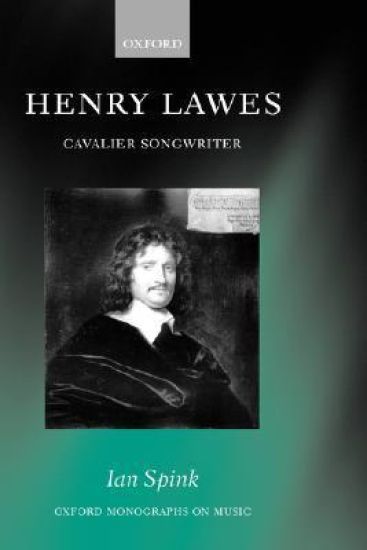
Henry Lawes

Henry Lawes

Ian Spink

Oxford University Press
2000
sidottu
Henry Lawes (1596-1662) has long been acknowledged as the most important and prolific English songwriter between the death of John Dowland in 1626 and the birth of Henry Purcell in 1659. He is celebrated as Milton's collaborator in Comus (1634). Although he wrote some church music, Lawess significance as a composer lies in his settings of many of the choicest lyrics by Cavalier poets such as Carew, Herrick, Suckling, and Waller–who, like Lawes himself, belonged to the brilliant court of Charles I. This book combines an account of his life with a study of his development as a songwriter during this fascinating historic period. Following the execution of the King in 1649, Lawes played an important part in establishing concerts in London during the 1650s, and was one of the composers of the first English opera, Davenant's The Siege of Rhodes (1656). At the Restoration he set Zadok the Priest for the coronation of Charles II, but died the following year. The last book on Lawes appeared in 1940, since when the importance of his songs has been increasingly recognized–thanks in part to Ian Spink's own previous study, English Song: Dowland to Purcell (1986), and his edition of Cavalier Songs: 1625-1660 for Musica Britannica.