Kirjojen hintavertailu. Mukana 11 699 587 kirjaa ja 12 kauppaa.

Kirjahaku

Etsi kirjoja tekijän nimen, kirjan nimen tai ISBN:n perusteella.

1000 tulosta hakusanalla Jennifer Pyron; Mac Freeman

Sacred Sounds, Secular Spaces

Sacred Sounds, Secular Spaces

Jennifer Walker

Oxford University Press Inc
2021
sidottu
Military defeat, political and civil turmoil, and a growing unrest between Catholic traditionalists and increasingly secular Republicans formed the basis of a deep-seated identity crisis in Third Republic France. Beginning in the early 1880s, Republican politicians introduced increasingly secularizing legislation to the parliamentary floor that included, but was not limited to, the secularization of the French educational system. As the divide between Church and State widened on the political stage, more and more composers began writing religious—even liturgical—music for performance in decidedly secular venues, including popular cabaret theaters, prestigious opera houses, and international exhibitions. This trend coincided with Pope Leo XIII's Ralliement politics that encouraged conservative Catholics to "rally" with the Republican government. But the idea of a musical Ralliement has largely gone unquestioned by historians and musicologists alike. Sacred Sounds, Secular Spaces provides the first fundamental reconsideration of music's role in the relationship between the French state and the Catholic Church in the Third Republic. In doing so, the book dismantles the somewhat simplistic epistemological position that emphasizes a sharp division between the Church and the "secular" Republic during this period. Drawing on extensive archival research, critical reception studies, and musical analysis, author Jennifer Walker reveals how composers and critics from often opposing ideological factions undermined the secular/sacred binary through composition and musical performance in an effort to craft a brand of Frenchness that was built on the dual foundations of secular Republicanism and the heritage of the French Catholic Church.
We're Still Here

We're Still Here

Jennifer M. Silva

OXFORD UNIVERSITY PRESS INC
2021
nidottu
A deep, multi-generational story of pain, place, and politics. The economy has been brutal to American workers for several decades. The chance to give one's children a better life than one's own -- the promise at the heart of the American Dream -- is withering away. While onlookers assume those suffering in marginalized working-class communities will instinctively rise up, the 2016 election threw into sharp relief how little we know about how the working-class translate their grievances into politics. In We're Still Here, Jennifer M. Silva tells a deep, multi-generational story of pain, place, and politics that will endure long after the Trump administration. Drawing on over 100 interviews with black, white, and Latino working-class residents of a declining coal town in Pennsylvania, Silva reveals how the decline of the American Dream is lived and felt. The routines and rhythms of traditional working-class life such as manual labor, unions, marriage, church, and social clubs have diminished. In their place, she argues, individualized strategies for coping with pain, and finding personal redemption, have themselves become sources of political stimulus and reaction among the working class. Understanding how generations of Democratic voters come to reject the social safety net and often politics altogether requires moving beyond simple partisanship into a maze of addiction, joblessness, family disruption, violence, and trauma. Instead, Silva argues that we need to uncover the relationships, loyalties, longings, and moral visions that underlie and generate the civic and political disengagement of working-class people. We're Still Here provides powerful, on the ground evidence of the remaking of working-class identity and politics that will spark new tensions but also open up the possibility for shifting alliances and new possibilities.
Mission, Race, and Empire

Mission, Race, and Empire

Jennifer C. Snow

OXFORD UNIVERSITY PRESS INC
2023
sidottu
The history of the Episcopal Church is intimately bound up with the history of empire. The two grew in tandem in the modern era, and as they grew they developed particular ideologies and practices around race. As slavery was carried over into the new political formations of the United States, so too were racially based exclusions carried over in the Episcopal Church. Mission, Race, and Empire presents a new history of the Episcopal Church from its origins in the early British Empire up to the present, told through the lenses of empire and race. The book demonstrates the dramatic shifts within the Episcopal Church, from initial colonial violence to reflective self-critique. Jennifer Snow centers the stories of groups and individuals that have often been sidelined, including Native Americans, Black Americans, Asian Americans, women, and LGBTQ people, as well as the institutional leaders who sought to create, or fought against, a church that desired to be a house of prayer for all people.
The Gods of Indian Country

The Gods of Indian Country

Jennifer Graber

OXFORD UNIVERSITY PRESS INC
2022
nidottu
During the nineteenth century, white Americans sought the cultural transformation and physical displacement of Native people. Though this process was certainly a clash of rival economic systems and racial ideologies, it was also a profound spiritual struggle. The fight over Indian Country sparked religious crises among both Natives and Americans. In The Gods of Indian Country, Jennifer Graber tells the story of the Kiowa Indians during Anglo-Americans' hundred-year effort to seize their homeland. Like Native people across the American West, Kiowas had known struggle and dislocation before. But the forces bearing down on them-soldiers, missionaries, and government officials-were unrelenting. With pressure mounting, Kiowas adapted their ritual practices in the hope that they could use sacred power to save their lands and community. Against the Kiowas stood Protestant and Catholic leaders, missionaries, and reformers who hoped to remake Indian Country. These activists saw themselves as the Indians' friends, teachers, and protectors. They also asserted the primacy of white Christian civilization and the need to transform the spiritual and material lives of Native people. When Kiowas and other Native people resisted their designs, these Christians supported policies that broke treaties and appropriated Indian lands. They argued that the gifts bestowed by Christianity and civilization outweighed the pains that accompanied the denial of freedoms, the destruction of communities, and the theft of resources. In order to secure Indian Country and control indigenous populations, Christian activists sanctified the economic and racial hierarchies of their day. The Gods of Indian Country tells a complex, fascinating-and ultimately heartbreaking-tale of the struggle for the American West.
Slow Media

Slow Media

Jennifer Rauch

OXFORD UNIVERSITY PRESS INC
2022
nidottu
Today we recognize that we have a different relationship to media technology--and to information more broadly--than we had even five years ago. We are connected to the news media, to our jobs, and to each other, 24 hours a day. But many people have found their mediated lives to be too fast, too digital, too disposable, and too distracted. This group--which includes many technologists and young people--believes that current practices of digital media production and consumption are unsustainable, and works to promote alternate ways of living. Until recently, sustainable media practices have been mostly overlooked, or thought of as a counterculture. But, as Jennifer Rauch argues in this book, the concept of sustainable media has taken hold and continues to gain momentum. Slow media is not merely a lifestyle choice, she argues, but has potentially great implications for our communities and for the natural world. In eight chapters, Rauch offers a model of sustainable media that is slow, green, and mindful. She examines the principles of the Slow Food movement--humanism, localism, simplicity, self-reliance, and fairness--and applies them to the use and production of media. Challenging the perception that digital media is necessarily eco-friendly, she examines green media, which offers an alternative to a current commodities system that produces electronic waste and promotes consumption of nonrenewable resources. Lastly, she draws attention to mindfulness in media practice--"mindful emailing" or "contemplative computing," for example--arguing that media has significant impacts on human health and psychological wellbeing. Slow Media will ultimately help readers understand the complex and surprising relationships between everyday media choices, human well-being, and the natural world. It has the potential to transform the way we produce and use media by nurturing a media ecosystem that is more satisfying for people, and more sustainable for the planet.
Dreaming the New Woman

Dreaming the New Woman

Jennifer Bond

OXFORD UNIVERSITY PRESS INC
2024
sidottu
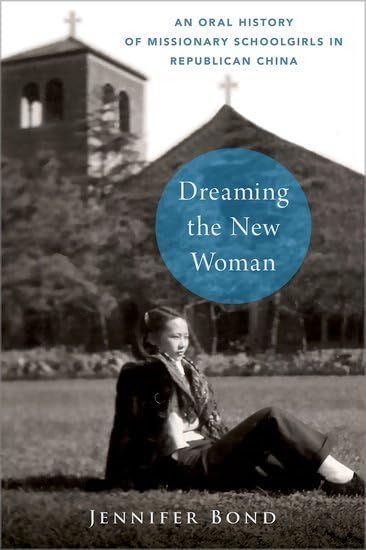
Based on extensive oral history interviews, Dreaming the New Woman uncovers the experiences of girls who attended missionary middle schools in Republican China in the first half of the twentieth century. Chinese missionary schoolgirls were often labelled "foreign puppets" or seen as passive recipients of a western-style education. By focusing on the pupils' own perspectives and drawing on seventy-five oral history interviews conducted with missionary school alumnae, alongside student writings, missionary reports, and newspaper sources, this fascinating book provides fresh insights into what it meant to be Chinese, female, and Christian during the first half of China's turbulent twentieth century. The oral history interviews show how missionary schoolgirls weathered periods of anti-Christian hostility, experimented with new gender roles at school, experienced the Second Sino-Japanese War in Shanghai, and applied Christianity to the Communist cause after 1949. Jennifer Bond reveals how pupils used their schools as a laboratory, blending different ideas from Christianity, nationalism, Communism, and feminism to forge new notions of Chinese womanhood. Girls skillfully combined Christian aspects of missionary education such as the rhetoric of "service" with discussion of women's roles in nation building to widen their sphere of operation in society. The daily practices and lifestyles within the hybrid cultural environment of missionary schools fostered new identities that influenced the girls' aspirations and later careers. A fluency in English, western social graces, and membership in Christian churches admitted them as members of a new western-educated Chinese elite that emerged in the Republican era.
Making Christianity Manly Again

Making Christianity Manly Again

Jennifer McKinney

OXFORD UNIVERSITY PRESS INC
2023
sidottu
A look inside one of America's most politically consequential churches Mark Driscoll, the founding pastor of Seattle's Mars Hill Church, indelibly impacted American evangelicalism. Driscoll's brash, authoritarian, and profanity-laden leadership grew Mars Hill Church into one of the fastest growing, most innovative, and most influential churches in the country--not an easy task in one of America's most secular cities. Driscoll's gender theology put men at the forefront of American Christianity, rebranding Jesus from a "gay hippie in a dress" to a sword-carrying, "robe-dipped-in-blood" warrior. This type of rhetoric paved the way for evangelicals' embrace of hypermasculine Christianity, priming the pump for their unprecedented support of Donald Trump in the 2016 and 2020 Presidential elections. Making Christianity Manly Again places Driscoll's gender theology in its social and historical contexts and analyzes the contemporary social patterns that explain how a hypermasculine theology helped create a megachurch empire. By addressing the rhetoric of Driscoll's movement through his sermons, along with narratives from former Mars Hill Church members, sociologist Jennifer McKinney leads us to a better understanding of the dynamics of the evangelical impulse to reclaim and glorify men's power. These dynamics, as McKinney shows, have fueled a growing Christian nationalist movement, with enormous implications for religion and politics in America.
Body and Soul

Body and Soul

Jennifer Whiting

OXFORD UNIVERSITY PRESS INC
2023
sidottu
Body and Soul: Essays on Aristotle's Hylomorphism is one of three volumes collecting previously published essays by Jennifer Whiting. This volume contains two sets of essays, one centered on Aristotle's account of an animal's body as standing to its soul as matter (hulê) to form (morphê), the other exploring Aristotle's conception of practical reason as the proper form of human desire. In the first set Whiting presents Aristotle's conception of the soul as the form and essence of an organic (and so living) body as part of his solution to Presocratic puzzles about whether there is a real (and not simply conventional) distinction between the coming-to-be (or passing-away) of an individual substance and what is merely the alteration or rearrangement of pre-existing stuffs. The solution also involves taking each individual animal within a species to have its own numerically distinct “individual” form, which (unlike species forms traditionally conceived) exists when and only when it does. The remaining essays account for various deficiencies in the lives of rational animals by appeal to the explanatory asymmetries afforded by Aristotle's teleology, where formal and final causes dominate when things go as they should (teleologically speaking) go, and material-efficient causes dominate when things go wrong. Just as Aristotle traces the birth of females to the failure of menstrual fluid to be fully “mastered” by the formal movements in the father's semen, so too he traces akratic and other defective forms of action to the failure of desires to be fully “mastered” by the activities of reason. Whiting argues that phronêsis is on this account the proper form of the desiring part of the soul, which (when things go well) is one with the practically reasoning part.
Berlioz's Requiem

Berlioz's Requiem

Jennifer Walker

OXFORD UNIVERSITY PRESS INC
2025
sidottu
Hector Berlioz's Requiem (Grande Messe des Morts, 1837) remains a fixture in the repertoire of choirs and orchestras today. Since 2003, it has been performed in its entirety over one hundred times and has appeared on concert programs spanning the globe: from Russia to the United Kingdom, Finland to the United States, and many locations in between. These performances have, for the most part, been received positively but critics have not always been this kind to Berlioz and his Requiem. Romantic grandiosity, empty dramatic effect, religious insincerity: such are the descriptors that undergird many modern understandings of Berlioz's now-canonic work. Nineteenth-century critics and audiences, however, heard the Requiem in different and compelling ways. This book presenting a broad new musical and social context for understanding the Requiem as Berlioz conceived it and his contemporaries heard it. It asks what, if anything, did nineteenth-century listeners find to be notable about the work, and why? The answers to these questions lie in detailed explorations of Berlioz's relationship to the aesthetics of French sacred music, the theological sublime, and aural architecture. Theatrical as they may have appeared, Berlioz's innovative orchestrations and colossal choral configurations in the Requiem may now be heard as an embrace of the aural possibilities offered by the sounding of the sacred sublime, the physical architecture of French churches, and the interplay between the sacred and the secular.
Berlioz's Requiem

Berlioz's Requiem

Jennifer Walker

OXFORD UNIVERSITY PRESS INC
2025
nidottu
Hector Berlioz's Requiem (Grande Messe des Morts, 1837) remains a fixture in the repertoire of choirs and orchestras today. Since 2003, it has been performed in its entirety over one hundred times and has appeared on concert programs spanning the globe: from Russia to the United Kingdom, Finland to the United States, and many locations in between. These performances have, for the most part, been received positively but critics have not always been this kind to Berlioz and his Requiem. Romantic grandiosity, empty dramatic effect, religious insincerity: such are the descriptors that undergird many modern understandings of Berlioz's now-canonic work. Nineteenth-century critics and audiences, however, heard the Requiem in different and compelling ways. This book presenting a broad new musical and social context for understanding the Requiem as Berlioz conceived it and his contemporaries heard it. It asks what, if anything, did nineteenth-century listeners find to be notable about the work, and why? The answers to these questions lie in detailed explorations of Berlioz's relationship to the aesthetics of French sacred music, the theological sublime, and aural architecture. Theatrical as they may have appeared, Berlioz's innovative orchestrations and colossal choral configurations in the Requiem may now be heard as an embrace of the aural possibilities offered by the sounding of the sacred sublime, the physical architecture of French churches, and the interplay between the sacred and the secular.
Genomic Politics

Genomic Politics

Jennifer Hochschild

OXFORD UNIVERSITY PRESS INC
2025
nidottu
A groundbreaking analysis of how the genomic revolution is transforming American society and creating new social divisions-some along racial lines-that promise to fundamentally shape American politics for years to come. The emergence of genomic science in the last quarter century has revolutionized medicine, the justice system, and our understanding of who we are. We use genomics to determine guilt and exonerate the falsely convicted; devise new medicines; test embryos; and discover our ethnic and national roots. One might think that, given these advances, most would favor the availability of genomic tools. Yet as Jennifer Hochschild explains in Genomic Politics, the uses of genomic science are both politically charged and hotly contested. After all, genomics might result in bioterrorism, a demand for "designer babies," or a revival of racial biology. Political divisions around genomics do not follow the usual left-right ideological divides that dominate most of American politics. Through four controversial innovations resulting from genomic science—medicines for heart disease approved for use by only African-Americans, on the grounds of genetic distinctiveness; use of DNA evidence in the criminal justice system; the search for one's roots through genetic ancestry; and the use of genetic tests in prenatal exams—Hochschild reveals how the phenomenon is polarizing America in novel ways. Advocates of genomic science argue that these applications will make life better, while opponents point out the potential for misuse—from racial profiling to "selecting out" fetuses that gene tests show to have conditions like Down syndrome. Hochschild's central message is that the divide hinges on answers to two questions: How significant are genetic factors in explaining human traits and behaviors? And what is the right balance between risk acceptance and risk avoidance for a society grappling with innovations arising from genomic science? Experts differ among themselves about who should make decisions about governing genomics' uses, and Americans as a whole trust almost no one to do so. A deeply researched and original analysis of the politics surrounding one of the signal issues of our times, this is essential reading for anyone interested in how the genetics revolution is shaping society.
Toxic Demography

Toxic Demography

Jennifer D. Sciubba; Michael S. Teitelbaum; Jay Winter

OXFORD UNIVERSITY PRESS INC
2025
sidottu
Population politics has taken many forms throughout history. Political leaders from both democracies and non-democracies commonly place population issues at the center of their political programs, manufacturing alarm over changing demographic distributions. From fears of existential decline to debates over migration and fertility, demographic issues are often distorted by political ideologies that obscure understanding and fuel divisive narratives. In Toxic Demography, Jennifer D. Sciubba, Michael S. Teitelbaum, and Jay Winter explore the deep entanglement of population dynamics with identity, modernization, nationalism, and populism. They unravel how concepts like "family" and "nation"--often seen as straightforward--carry diverse and politicized meanings that shape demographic debates. Focusing on the United States, Europe, and Asia, the authors examine the demographic dimensions of political conflict and the societal changes driven by aging populations and low fertility rates. These regions, at the forefront of unprecedented demographic transitions, reveal how population trends have been co-opted to serve political agendas that transform population debates into battlegrounds for broader ideological struggles. Drawing on historical and contemporary examples, Toxic Demography offers a critical lens to understand the persistent politicization of reproduction, fertility, and migration, showing how these distortions shape the futures of nations and societies.
Toxic Demography

Toxic Demography

Jennifer D. Sciubba; Michael S. Teitelbaum; Jay Winter

OXFORD UNIVERSITY PRESS INC
2026
nidottu
Population politics has taken many forms throughout history. Political leaders from both democracies and non-democracies commonly place population issues at the center of their political programs, manufacturing alarm over changing demographic distributions. From fears of existential decline to debates over migration and fertility, demographic issues are often distorted by political ideologies that obscure understanding and fuel divisive narratives. In Toxic Demography, Jennifer D. Sciubba, Michael S. Teitelbaum, and Jay Winter explore the deep entanglement of population dynamics with identity, modernization, nationalism, and populism. They unravel how concepts like "family" and "nation"--often seen as straightforward--carry diverse and politicized meanings that shape demographic debates. Focusing on the United States, Europe, and Asia, the authors examine the demographic dimensions of political conflict and the societal changes driven by aging populations and low fertility rates. These regions, at the forefront of unprecedented demographic transitions, reveal how population trends have been co-opted to serve political agendas that transform population debates into battlegrounds for broader ideological struggles. Drawing on historical and contemporary examples, Toxic Demography offers a critical lens to understand the persistent politicization of reproduction, fertility, and migration, showing how these distortions shape the futures of nations and societies.
The Limits of Sino-Russian Strategic Partnership

The Limits of Sino-Russian Strategic Partnership

Jennifer Anderson

Oxford University Press Inc
2005
nidottu
Russia and China claim to have established a "strategic partnership". Jennifer Anderson argues that this relationship merely overlays a diplomatic agenda established in the late 1980s, and that China's pragmatic, limited approach (coupled with Russia's domestic economic and political difficulties) have meant that the Sino-Russian strategic partnership is unwieldy and imprecise.
National Minorities and the European Nation-States System

National Minorities and the European Nation-States System

Jennifer Jackson Preece

Oxford University Press
1998
sidottu
The collapse of Yugoslavia, Czechoslovakia, and the Soviet Union has resulted in a proliferation of discontented national minorities. Thus, the possibility for destabilizing ethnic conflict has become acute. National minorities have accordingly emerged as a major focus of international relations in post-Cold War Europe. Jennifer Jackson Preece's powerful new study offers an innovative analysis of these developments. Scrutinizing them within the historical context of changing practices and evolving norms, she reveals that the European national minority question is nothing new - rather its foundations extend deep into contemporary history. Moreover, the problem is intrinsically derivative of the nation-states system itself, a system which potentially intensifies minority disaffection. Examining these issues against the backdrop of relevant treaties, diplomatic negotiations, and international practices, Jackson Preece presents the definitive assessment of the fate of national minorities in the European states system.
Energy, the Subtle Concept

Energy, the Subtle Concept

Jennifer Coopersmith

Oxford University Press
2015
nidottu
Energy is at the heart of physics and of huge importance to society and yet no book exists specifically to explain it, and in simple terms. In tracking the history of energy, this book is filled with the thrill of the chase, the mystery of smoke and mirrors, and presents a fascinating human-interest story. Moreover, following the history provides a crucial aid to understanding: this book explains the intellectual revolutions required to comprehend energy, revolutions as profound as those stemming from Relativity and Quantum Theory. Texts by Descartes, Leibniz, Bernoulli, d'Alembert, Lagrange, Hamilton, Boltzmann, Clausius, Carnot and others are made accessible, and the engines of Watt and Joule are explained. Many fascinating questions are covered, including: - Why just kinetic and potential energies - is one more fundamental than the other? - What are heat, temperature and action? - What is the Hamiltonian? - What have engines to do with physics? - Why did the steam-engine evolve only in England? - Why S=klogW works and why temperature is IT. Using only a minimum of mathematics, this book explains the emergence of the modern concept of energy, in all its forms: Hamilton's mechanics and how it shaped twentieth-century physics, and the meaning of kinetic energy, potential energy, temperature, action, and entropy. It is as much an explanation of fundamental physics as a history of the fascinating discoveries that lie behind our knowledge today.
Dispositional Pluralism

Dispositional Pluralism

Jennifer McKitrick

Oxford University Press
2018
sidottu
Jennifer McKitrick offers an opinionated guide to the philosophy of dispositions. In her view, when an object has a disposition, it is such that, if a certain type of circumstance were to occur, a certain kind of event would occur. Since it is very common for this to be the case for a variety of reasons, dispositions are very abundant and diverse. They include such varied properties as character traits like a hero's courage, characteristics of physical objects like a wine glass's fragility, and characteristics of microphysical entities like an electron's charge. Some dispositions are natural while others are non-natural. Some dispositions called "powers" are ungrounded while non-fundamental dispositions are grounded in other properties. Some dispositions manifest constantly, some of them manifest spontaneously, while others manifest only when they are triggered to do so. Some dispositions manifest by causing another dispositional property to be instantiated, while others have manifestations that involve non-dispositional properties and relations. Some dispositions are intrinsic to their bearers while others are extrinsic. Some of them are causally relevant to their manifestations while others are not. Some dispositions manifest in some particular way in particular circumstances, while other dispositions manifest in various ways in various circumstances. What makes all of these diverse properties dispositions is their connection to a certain kind of counterfactual fact. Nevertheless, disposition ascriptions are not semantically reducible to counterfactual claims.
The Colonial Comedy: Imperialism in the French Realist Novel
Nineteenth-century French Realism focuses on metropolitan France, with Paris as its undisputed heart. Through Jennifer Yee's close reading of the great novelists of the French realist and naturalist canon - Balzac, Flaubert, Zola, Maupassant - The Colonial Comedy reveals that the colonies play a role at a distance even in the most apparently metropolitan texts. In what Edward Said called 'geographical notations' of race and imperialism the presence of the colonies off-stage is apparent as imported objects, colonial merchandise, and individuals whose colonial experience is transformative. Indeed, the realist novel registers the presence of the emerging global world-system through networks of importation, financial speculation, and immigration as well as direct colonial violence and power structures. The literature of the century responds to the last decades of French slavery, and direct colonialism (notably in Algeria), but also economic imperialism and the extension of French influence elsewhere. Far from imperialist triumphalism, in the realist novel exotic objects are portrayed as fake or mass-produced for the growing bourgeois market, while economic imperialism is associated with fraud and manipulation. The deliberate contrast of colonialism and exoticism within the metropolitan novel, and ironic distancing of colonial narratives, reveal the realist mode to be capable of questioning its own epistemological basis. The Colonial Comedy argues for the existence in the nineteenth century of a Critical Orientalism characterized by critique of its own discursive foundations. Using the tools of literary analysis within a materialist approach, The Colonial Comedy opens up the domestic Paris-Provinces axis to signifying chains pointing towards the colonial space.
Parliament Under the Tudors

Parliament Under the Tudors

Jennifer Loach

Clarendon Press
1991
sidottu
This is an examination of the role and development of parliament throughout the Tudor period, now a central topic in the study of Tudor history. Jennifer Loach examines the constitutional position, political activities, and relationships of the two houses of parliament from the late Middle Ages until the accession of the Stuarts. She explores the growing importance of the Commons and examines the ways in which the Tudor monarchs, from Henry VII to Elizabeth I, attempted to exert their royal power. Topics covered include elections, patronage, and constitutional issues such as the succession to the throne; the fundamental part played by parliament in taxation and other financial matters; the social and economic background; and the vexed and vital question of religion. Thoroughly grounded in contemporary sources, this is a comprehensive and lucid account, which will be invaluable to students of Tudor history.