Kirjojen hintavertailu. Mukana 12 016 292 kirjaa ja 12 kauppaa.

Kirjahaku

Etsi kirjoja tekijän nimen, kirjan nimen tai ISBN:n perusteella.

1000 tulosta hakusanalla Jeremy Halstead

Appealing to the Crowd

Appealing to the Crowd

Jeremy Snyder

OXFORD UNIVERSITY PRESS INC
2023
sidottu
This is an open access title available under the terms of a CC BY-NC-ND 4.0 license. It is free to read on Oxford Academic and offered as a free PDF download from OUP and selected open access locations. This book offers a close examination of the ethical, political, and practical dimensions of donation-based online crowdfunding for basic needs including medical treatment, housing, food, and education. Crowdfunding uses online platforms and social networks to raise money from friends, family, and complete strangers for a variety of projects and needs. This practice has grown massively worldwide in recent years in terms of the numbers of crowdfunding campaigns and donors, money raised, visibility, and cultural influence. While the money raised through crowdfunding has helped millions of recipients, there is also reason for concern around how it may undermine campaigners' privacy and dignity, mirror and exacerbate social inequities, mask and deepen social injustice, defraud donors, and spread misinformation and hate. Author Jeremy Snyder places this discussion of crowdfunding in the wider historical and ethical context of giving practices. In doing so, Snyder shows that crowdfunding can repeat and exacerbate problems with traditional giving practices while creating other, new problems. Snyder concludes by presenting nine values that should guide donation-based crowdfunding: benefit, choice, solidarity, privacy, dignity, equity, social justice, non-maleficence, and accountability. These values can help crowdfunding donors, campaigners, recipients, platforms, and policy makers preserve the good that can come from crowdfunding while addressing some of its many negative aspects.
Sensation & Perception

Sensation & Perception

Jeremy M. Wolfe; Dennis M. Levi; Lori L. Holt

Sinauer Associates Is an Imprint of Oxford Un
2024
nidottu
Winner of the Textbook & Academic Authors Association's McGuffey Longevity Award Sensation and Perception, Seventh Edition, introduces students to the fascinating world of human senses and helps them answer such interesting questions as "Why do some substances taste sweet" or "Why does music sound musical?" The authors, specialists in their respective domains, strive to spread their enthusiasm for fundamental questions about the human senses and the impact that answers to those questions have on medical and societal issues. Offering a comprehensive and balanced blend of neuroscience and cognitive psychology, Sensation and Perception studies the interaction and multisensory nature of sensory experiences of the senses. Using clear writing and engaging and relevant features that apply scientific knowledge to everyday life and walk students through the scientific process and experimental design, this unique text is accessible to students from various majors.
Julian Augustus

Julian Augustus

Jeremy Swist

OXFORD UNIVERSITY PRESS INC
2025
sidottu
The Roman emperor Julian (r. 361-363 CE) was a man of action and of letters, which he employed in an effort to return the Empire to the light of the pagan gods, and reverse the Christianization of the empire advanced by his uncle Constantine and the sons of Constantine. This enterprise was inspired and guided by his conversion to the Neoplatonic philosophy and radical pagan Hellenism of Iamblichus and his disciples, and promoted by his production of Greek orations, letters, and satires. These works present a coherent vision of the providentially guided history and destiny of Rome as a series of foundations and refoundations enacted by rulers such as Romulus, Numa, and Caesar Augustus. As this book demonstrates, Julian offers an Iamblichean approach to the exegesis of the legends of Rome's founding, the allegories of Plato's dialogues, and myths of his own creation in order to articulate his own role in the refounding of the Empire. Furthermore, argues Jeremy Swist, approaching the wider examination of Julian's imperial self-image on these terms ends up nuancing and challenging common assumptions influenced by the rhetoric of his contemporary proponents. In his reverence for the gods and for philosophy, the emperor's self-construction embraces the identities of a statesman and soldier more than of a philosopher, of a Roman more than a Greek, and of a mere human rather than a semi-divine being. While distancing himself from the ideal models of philosophical virtue and imperial founding that inspire his own actions, he adopts a different set of exemplary figures as mirrors of himself.
Holy Living and Holy Dying: Volume I: Holy Living
As well as being two of the most famous prose works of English literature, Jeremy Taylor's Holy Living and Holy Dying are among the greatest examples of Anglican spirituality. This is the first critical and fully annotated edition since the Oxford Movement began, over 150 years ago. The texts are based on the first editions of 1650 and 1651, collated with those editions published during Taylor's lifetime. The critical apparatus includes textual variants, a full commentary, and a textual introduction. The general introduction to both volumes sets out Taylor's life and the intellectual background of these devotional and literary classics.
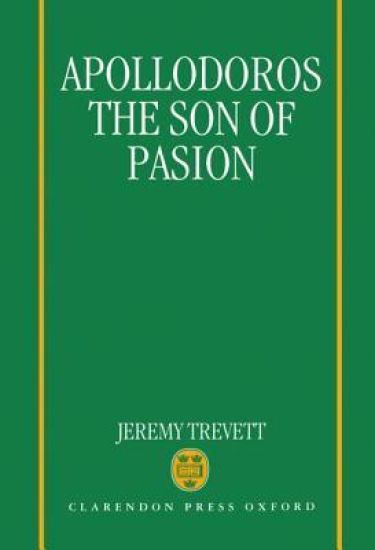
Apollodoros the Son of Pasion

Apollodoros the Son of Pasion

Jeremy Trevett

Clarendon Press
1992
sidottu
This is a study of an influential fourth-century BC Athenian politician, Apollodoros the son of Pasion. It provides the first full-length treatment of his career and of the seven lawcourt speeches which he delivered, and which have come down to us attributed - wrongly - to the famous orator Demosthenes. These speeches, which are our main source of information about Apollodoros, not only tell us about his political career but also illuminate Athenian banking and social attitudes, since his father had risen from servile origins to become a very wealthy banker and, ultimately, an Athenian citizen. Dr Trevett also considers the authenticity, style, and rhetorical technique of the speeches, and argues conclusively that they were all written by the same author, probably Apollodoros himself. At the same time, he shows that the speeches were composed with considerably more skill than has generally been recognized.
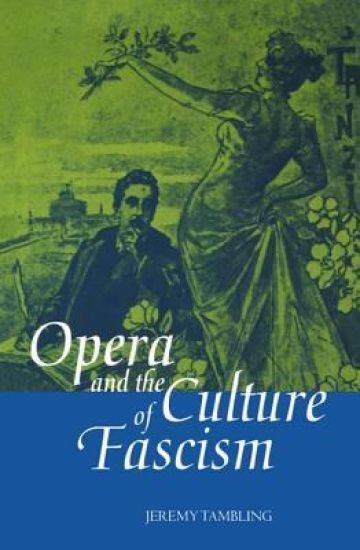
Opera and the Culture of Fascism

Opera and the Culture of Fascism

Jeremy Tambling

Clarendon Press
1996
sidottu
This study looks at nineteenth - and early twentieth-century opera as part of a culture which produced fascism as a crisis-state, and threatened to extinguish the genre as an influential and contemporary high form of art altogether. Jeremy Tambling highlights the themes of the cultural crisis through a detailed discussion of some dozen operas and a general overview of the works of Wagner, Verdi, Puccini, Strauss, and others, drawing on the writings of Nietzsche, Adorno, Benjamin, and Heidegger, for an understanding of the ideological background. Reading fascism as a political, intellectual, and psychological phenomenon, the author draws on the works of Bataille, Theweleit, and Kristeva, for discussion of proto-fascist and fascist thought, and for its relation to gender-politics. Resisting the clichés about Wagner or Strauss's relationship to the Third Reich, Tambling takes the opera out the hermetically sealed-off state in which it is normally discussed, and presents it as both complicit in, and in opposition to, the reactionary and regressive pressures that made up the `culture of fascism', and those that tried to make opera part of the `fascism of culture'.
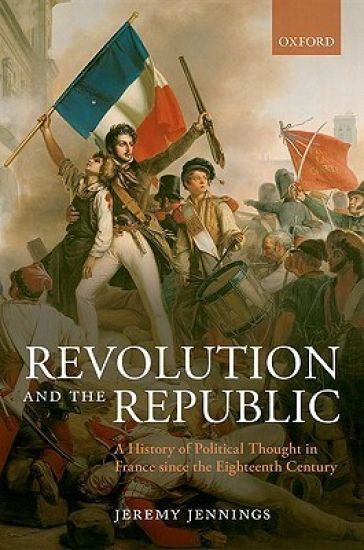
Revolution and the Republic

Revolution and the Republic

Jeremy Jennings

Oxford University Press
2011
sidottu
Revolution and the Republic provides a new and wide-ranging interpretation of political thought in France from the eighteenth century to the present day. At its heart are the dramatic and violent events associated with the French Revolution of 1789 and the birth of the First Republic in 1792. For the next two centuries, writers in France struggled to make sense of these and subsequent events in French revolutionary history, producing a rich and perceptive analysis of the nature of republican government. But, as Revolution and the Republic shows, these important debates were not limited to the narrow confines of politics and to the writing of constitutions. Such was their significance that they occupied a central place in discussions about religion, science, philosophy, commerce, and the writing of history. They also shaped arguments about the character of France and the French nation as well as polemics about the role of intellectuals in French society. Moreover, they continue to be of importance in France today as the country faces the challenges posed by globalisation, multiculturalism, and the reform of the welfare state. Integrating the perspectives of intellectual history, political theory, social and cultural history, and political economy, Jeremy Jennings has written a study of political ideas that appeals to all those interested in the history of modern France and Europe more generally.
Revolution from Above, Rebellion from Below

Revolution from Above, Rebellion from Below

Jeremy Krikler

Clarendon Press
1993
sidottu
This is a study of rural society and struggle in the Transvaal during the watershed period of the early twentieth century. Though much has been written about the South African War and `Reconstruction' period, this is the first scholarly and comprehensive analysis of their impact on the agrarian Transvaal. Jeremy Krikler analyses the `Revolution from Above' unleashed by British imperialism as it wrought changes of immense significance for the countryside. He explores the relationships between landowners and peasants, traces the struggle between them, and examines the agrarian changes attempted by the British after the war. It is an original, thoroughly researched, and lucidly written account, which illuminates our understanding of the South African War and its aftermath. It also offers new insights into peasant struggles, and into the nature of private property and the colonial state in the Transvaal.
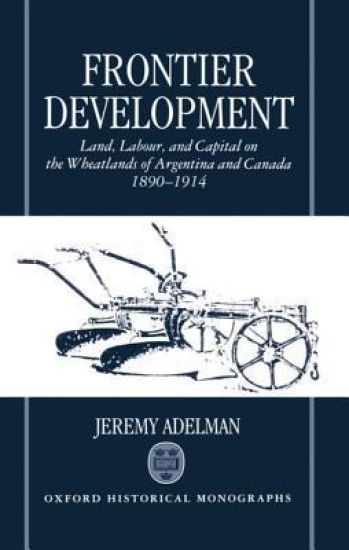
Frontier Development

Frontier Development

Jeremy Adelman

Clarendon Press
1994
sidottu
This is a scholarly and stimulating study of settlement and expansions on the frontier lands in Canada and Argentina during their `Golden Years' of the late nineteenth and early twentieth centuries. Jeremy Adelman challenges many of the assumptions made about the economic `success' of North America and the `failure' of Latin America. Based on extensive primary research in Argentina, Canada, and Britain, Dr Adelman's book points to the central importance of property relations in economic history. The distribution, control, and use of land, labour, and capital shaped these emerging economies. At the centre of the analysis is the development of family farming in Canada, and large estates in Argentina. Each system presented opportunities and posed costs - Argentine estates proving more efficient than hitherto argueed, while Canadian farms involved high social and economic costs. The approach taken here suggests directions for future research for comparative historians.
Restoration, Reformation, and Reform, 1660-1828
This wide-ranging and original book makes a significant contribution to our understanding of the Church of England in the long eighteenth century. It explores the nature of the Restoration ecclesiastical regime, the character of the clerical profession, the quality of the clergy's pastoral work, and the question of Church reform through a detailed study of the diocese of the archbishops of Canterbury. In so doing the book covers the political, social, economic, cultural, intellectual and pastoral functions of the Church and, by adopting a broad chronological span, it allows the problems and difficulties often ascribed to the eighteenth-century Church to be viewed as emerging from the seventeenth century and as continuing well into the nineteenth century. Moreover, the author argues that some of the traditional periodizations and characterisations of conventional religious history need modification. Much of the evidence presented here indicates that clergy in the one hundred and seventy years after 1660 were preoccupied with difficulties which had concerned their forebears and would concern their successors. In many ways, clergy in the diocese of Canterbury between 1660 and 1828 continued the work of seventeenth-century clergy, particularly in following through, and in some instances instigating, the pastoral and professional aims of the Reformation, as well as participating in processes relating to Church reform, and further anticipating some of the deals of the Evangelical and Oxford Movements. Reluctance to recognise this has led historians to neglect the strengths of the Church between the Restoration and the 1830s, which, it is argued, should not be judged primarily for its failure to attain the ideals of these other movements, but as an institution possessing its own coherent and positive rationale.
The Nazi Party in Lower Saxony 1921-1933

The Nazi Party in Lower Saxony 1921-1933

Jeremy Noakes

Oxford University Press
1971
sidottu
This book addresses the Nazi Party in Lower Saxony. By concentrating on the Nationalverband deutscher Offiziere, 39 Nazi Party (NSDAP) in one particular area between 1921 and 1933, it is hoped to provide a case study of the growth of Nazi organization and propaganda at regional level, and thereby to provide an answer to these and other questions. Above all, this study hopes to give a picture of the development of the party, the phases through which it moved, and the changes in orientation that occurred at various periods.
The Right to Private Property

The Right to Private Property

Jeremy Waldron

Clarendon Press
1990
nidottu
Can the right to private property be claimed as one of the `rights of mankind'? This is the central question of this comprehensive and critical examination of the subject of private property. Jeremy Waldron contrasts two types of arguments about rights: those based on historical entitlement, and those based on the importance of property to freedom. He provides a detailed discussion of the theories of property found in Locke's Second Treatise and Hegel's Philosophy of Right to illustrate this contrast. The book contains original analyses of the concept of ownership, the ideas of rights, and the relation between property and equality. The author's overriding determination throughout is to follow through the arguments and values used to justify private ownership. He finds that the traditional arguments about property yield some surprisingly radical conclusions.
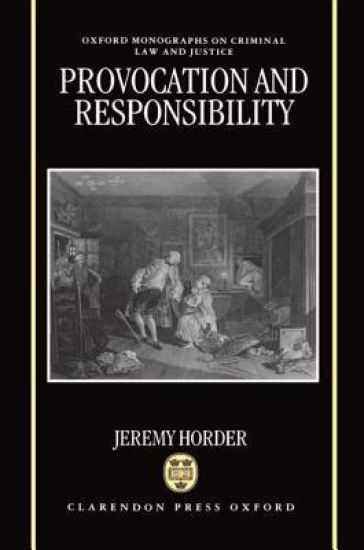
Provocation and Responsibility

Provocation and Responsibility

Jeremy Horder

Clarendon Press
1992
sidottu
Provocation and Responsibility breaks new ground by drawing on historical and philosophical sources not normally linked in analysis of the criminal law, to provide the first detailed study of the effect of provocation on culpability in morality and law. It traces the fascinating history and colourful development of the legal doctrine of provocation, right up to present-day controversies over the scope of the doctrine's application in murder cases. These developments are illuminated throughout by setting them in the context of the changing moral and philosophical understanding of anger, its effect on responsibility, and the role it plays in the human character.
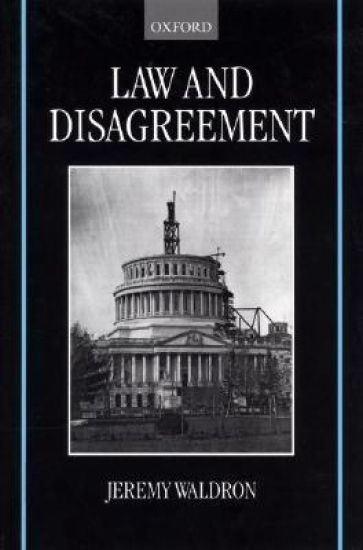
Law and Disagreement

Law and Disagreement

Jeremy Waldron

Clarendon Press
1999
sidottu
When people disagree about justice and about individual rights, how should political decisions be made among them? How should they decide about issues like tax policy, welfare provision, criminal procedure, discrimination law, hate speech, pornography, political dissent and the limits of religious toleration? The most familiar answer is that these decisions should be made democratically, by majority voting among the people or their representatives. Often, however, this answer is qualified by adding providing that the majority decision does not violate individual rights. In this book Jeremy Waldron has revisited and thoroughly revised thirteen of his most recent essays. He argues that the familiar answer is correct, but that the qualification about individual rights is incoherent. If rights are the very things we disagree about, then we are quarrelling precisely about what that qualification should amount to. At best, what it means is that disagreements about rights should be resolved by some other procedure, for example, by majority voting, not among the people or their representatives, but among judges in a court. This proposal although initially attractive seems much less agreeable when we consider that the judges too disagree about rights, and they disagree about them along exactly the same lines as the citizens. This book offers a comprehensive critique of the idea of the judicial review of legislation. The author argues that a belief in rights is not the same as a commitment to a Bill of Rights. He shows the flaws and difficulties in many common defences of the democratic character of judicial review. And he argues for an alternative approach to the problem of disagreement: when disagreements about rights arise, the respectful way to resolve them is by decision-making among the right-holders on a basis that reflects an equal respect for them as the holders of views about rights. This respect for ordinary right-holders, he argues, has been sadly lacking in the theories of justice, rights, and constitutionalism put forward in recent years by philosophers such as John Rawls and Donald Dworkin. But the book is not only about judicial review. The first tranche of essays is devoted to a theory of legislation, a theory which highlights the size, the scale and the diversity of modern legislative assemblies. Although legislation is often denigrated as a source of law, Waldron seeks to restore its tattered dignity. He deprecates the tendency to disparage legislatures and argues that such disparagement is often a way of bolstering the legitimacy of the courts, as if we had to transform our parliaments into something like the American Congress to justify importing American-style judicial reviews. Law and Disagreement redresses the balances in modern jurisprudence. It presents legislation by a representative assembly as a form of law making which is especially apt for a society whose members disagree with one another about fundamental issues of principle, for it is a form of law making that does not attempt to conceal the fact that our decisions are made and claim their authority in the midst of, not in spite of, our political and moral disagreements. This timely rights-based defence of majoritarian legislation will be welcomed by scholars of legal and political philosophy throughout the world.
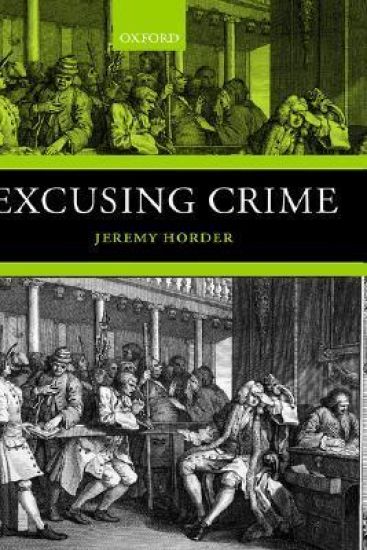
Excusing Crime

Excusing Crime

Jeremy Horder

Oxford University Press
2004
sidottu
When should someone who may have intentionally or knowingly committed criminal wrongdoing be excused? Excusing Crime examines what excusing conditions are, and why familiar excuses, such as duress, are thought to fulfil those conditions. The 'classical' view of excuses sees them as rational defects (such as mistake) in the motive force behind an action, but contrasts them with 'denials of responsibility', such as insanity, where the rational defect in that motive force is attributable to a mental defect in the agent him- or herself. This classical view of excuses has a long heritage, and is enshrined in different forms in many of the world's criminal codes, both liberal and non-liberal; however, in this book, Jeremy Horder contends that it is now time to move beyond it. Horder develops a 'liberal' account of excuses, arguing that the 'classical' distinction between rational defects and 'denials of responsibility' is too sharp, and also that the classical view of excuses is too narrow. He contends that it can be right to treat claims as excusatory even if they rely on a combination of elements of rational defect in the motive force behind the action, even if that defect is in part attributable to a mental deficiency in the agent him or herself ('diminished capacity'). Further, he argues that there can be a sound case for excuse even when people can give full rational assent to their actions, such as when they could not reasonably have been expected to do more than what they did to avoid committing wrongdoing ('due diligence'), or, more rarely, when their conscience understandably left them with no moral freedom to do other than commit the wrong ('demands-of-conscience').
Oxford Reading Tree TreeTops Chucklers: Level 10: Stodgepodge!
In Stodgepodge!, Cleo's dad makes the worst porridge in the universe. When she finds out that a black hole is heading towards Earth, a horrible breakfast is the least of her worries. Can she find a way to save the world? Chucklers is a series of funny novels, short stories, anthologies and comics that make reading a pleasure for 7-11 year olds. There is something for everyone in this varied collection which is packed with fantastic illustrations. Books contain inside cover notes to support children in their reading. Help with children's reading development also available at www.oxfordowl.co.uk. The series is written by top children's authors and edited by award-winning author Jeremy Strong. The books are finely levelled, making it easy to match every child to the right book.
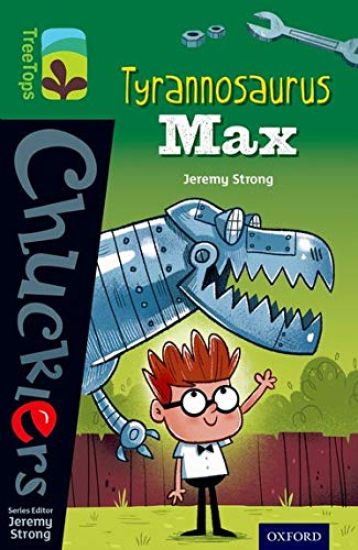
Oxford Reading Tree TreeTops Chucklers: Level 12: Tyrannosaurus Max
In Tyrannosaurus Max, Max's Dad is always inventing things and one day he creates some robot dinosaurs. When two robbers steal one of the dinosaurs and break into the bank, it's down to Max and his tyrannosaurus to save the day! This book was previously published as The Dinosaur Robbers by Hodder Wayland. Chucklers is a series of funny novels, short stories, anthologies and comics that make reading a pleasure for 7-11 year olds. There is something for everyone in this varied collection which is packed with fantastic illustrations. Books contain inside cover notes to support children in their reading. Help with children's reading development also available at www.oxfordowl.co.uk. The series is written by top children's authors and edited by award-winning author Jeremy Strong. The books are finely levelled, making it easy to match every child to the right book.
Protecting Group Chemistry

Protecting Group Chemistry

Jeremy Robertson

Oxford University Press
2000
nidottu
Protecting Group Chemistry provides an overview of the general methods that are used to block the reactivity of - i.e. protect - specific functional grops thus allowing others, present within the same molecule, to be manipulated unambiguously. An introductory chapter outlines protecting group strategy, relevant aspects of functional group reactivity, temporary protection, and introduces the concept of protecting group devices as an aid to unifying the wide range of available methods. The rest of the book is divided on the basis of broad classes of the experimental conditions that lead to cleavage of each protecting group (acid/electrophile, base/nucleophile, oxidising or reducing agent). The treatment differs from traditional texts in that it places the emphasis on making a connection between the fundamental mechanisms of organic chemsitry - ionisation, substitution, addition, elimination, oxidation and reduction, etc. - and how a particular protecting group can best be selected in a given situation.
The Hilbert Challenge

The Hilbert Challenge

Jeremy Gray

Oxford University Press
2000
sidottu
David Hilbert was arguably the leading mathematician of his generation. He was among the few mathematicians who could reshape mathematics, and was able to because he brought together an impressive technical power and mastery of detail with a vision of where the subject was going and how it should get there. This was the unique combination which he brought to the setting of his famous 23 Problems. Few problems in mathematics have the status of those posed by David Hilbert in 1900. Mathematicians have made their reputations by solving individual ones such as Fermat's last theorem, and several remain unsolved including the Riemann hypotheses, which has eluded all the great minds of this century. A hundred years on, it is timely to take a fresh look at the problems, the man who set them, and the reasons for their lasting impact on the mathematics of the twentieth century. In this fascinating new book, Jeremy Gray and David Rowe consider what has made this the pre-eminent collection of problems in mathematics, what they tell us about what drives mathematicians, and the nature of reputation, influence and power in the world of modern mathematics. The book is written in a clear and lively manner and will appeal both to the general reader with an interest in mathematics and to mathematicians themselves.