Kirjojen hintavertailu. Mukana 11 439 873 kirjaa ja 12 kauppaa.

Kirjahaku

Etsi kirjoja tekijän nimen, kirjan nimen tai ISBN:n perusteella.

1000 tulosta hakusanalla John Perry

The Early Poems of John Clare 1804-1822: Volume I
For the first time all Clare's early poems are brought together with all known variants, and with Clare's characteristic vocabulary, grammar, spelling, and punctuation preserved. Through this collection, ranging from juvenilia to the published poems that first established his reputation with Poems Descriptive of Rural Life and Scenery and The Village Minstrel, it becomes clear how many more poems Clare composed in these early years than have previously seen the light of day. Strenuous efforts have been made to recover poems obliterated in some of Clare's first manuscripts, and the complete text of The Parish, his major satirical poem, is included. A glossary is provided for both volumes, together with extensive annotation. Clare's own dating of his first poems is employed and every attempt has been made to establish a reliable chronology. This edition provides the first reliable basis for a new assessment of Clare's poetic growth, allowing his increasing assurance as a poet writing in a characteristic idiom of his own to be traced, and demonstrating how surprisingly early his individuality as a poet emerged.
The Early Poems of John Clare 1804-1822
For the first time all Clare's early poems are brought together with all known variants, and with Clare's characteristic vocabulary, grammar, spelling, and punctuation preserved. Through this collection, ranging from juvenilia to the published poems that first established his reputation with Poems Descriptive of Rural Life and Scenery and The Village Minstrel, it becomes clear how many more poems Clare composed in these early years than have previously seen the light of day. Strenuous efforts have been made to recover poems obliterated in some of Clare's first manuscripts, and the complete text of The Parish, his major satirical poem, is included. A glossary is provided for both volumes, together with extensive annotation. Clare's own dating of his first poems is employed and every attempt has been made to establish a reliable chronology. This edition provides the first reliable basis for a new assessment of Clare's poetic growth, allowing his increasing assurance as a poet writing in a characteristic idiom of his own to be traced, and demonstrating how surprisingly early his individuality as a poet emerged.
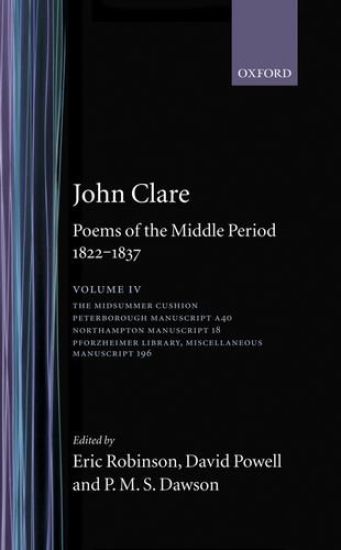
John Clare: Poems of the Middle Period, 1822-1837
These volumes represent the third and fourth of five volumes devoted to Clare's 'middle period', between 1822 and 1837, arguably the years of his finest creativity. The poems contained in these volumes range from examples of Clare's satirical and political verse, in 'The Summons' and 'The Hue & Cry', to a telling expression of his philosophy of nature, in 'The Eternity of Nature', and probably the most important statement of Clare's poetic objectives in 'To the Rural Muse'. If there is any lingering belief in the 'sameness' of Clare's verse, these volumes ought surely to dispel it.
The Miscellaneous Works of John Bunyan: Volume XIII: Israel's Hope Encouraged; The Desire of the Righteous Granted; The Saints Privilege and Profit; Christ a Compleat Saviour; The Saints Knowledge of Christ's Love; Of Antichrist, and His Ruine
The six treatises which make up this concluding volume of Bunyan's Miscellaneous Works were all published posthumously, in the 1692 Folio edited by Charles Doe. Most of them seem to have been composed in the final ten years of his life, while he was the height of his fame as a preacher and writer. They are characteristic Bunyan productions, designed to edify, exhort, and comform the saints, and brimful of his conviction that the Christian pilgrimage is a strenuous affair, calling for constant vigilence, self-examination and courage. The theme of endurance under persecution is prominent, and in a late millenarian work, Of Antichrist, and His Ruine, Bunyan offers a sombre, but eloquent account of the approaching downfall of the great enemy of the ture church, the Antichrist. Unlike many of his contemporaries, Bunyan is careful not to name dates, or interpret the apocalyptic texts too literally, but a striking feature of this work is his belief that kings would be God's chosen intruments in the destruction of Antichrist.
John Clare: Poems of the Middle Period, 1822-1837
These volumes represent the third and fourth of five volumes devoted to Clare's 'middle period', between 1822 and 1837, arguably the years of his finest creativity. The poems contained in these volumes range from examples of Clare's satirical and political verse, in 'The Summons' and 'The Hue & Cry', to a telling expression of his philosophy of nature, in 'The Eternity of Nature', and probably the most important statement of Clare's poetic objectives in 'To the Rural Muse'. If there is any lingering belief in the 'sameness' of Clare's verse, these volumes ought surely to dispel it.
John Clare: Poems of the Middle Period, 1822-1837

John Clare: Poems of the Middle Period, 1822-1837

John Clare

Oxford University Press
2003
sidottu
Completing the influential Oxford edition of Clare's collected poems, this volume presents the poems of the Northborough period of Clare's creativity. As with other volumes in the edition, many of the poems have never before been published, and Clare's spelling, punctuation, grammar, and vocabulary have all been carefully preserved. This final volume also includes corrections to the texts, variants, and notes in previously-published volumes in the series, along with a cumulative glossary and cumulative indices of first-lines and titles that will assist readers in their use of the edition as a whole. Clare's poetry deals not only with his own countryside, but also with its ceremonies and celebrations, its customs and games, its political, economic, and religious concerns, its proverbs, tales, and songs - indeed, with all aspects of its popular culture. The poems of the Northborough period are some of Clare's best work, demonstrating a particularly concise vision of Clare's experience of Nature.
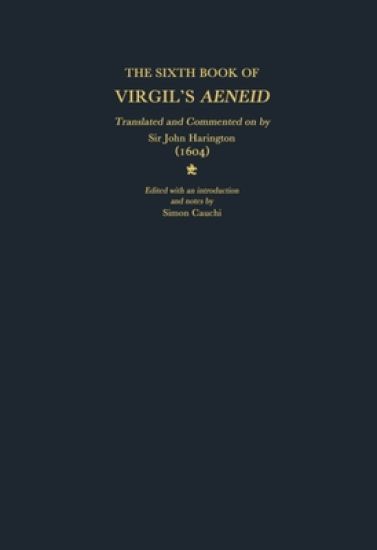
The Sixth Book of Virgil's Aeneid translated and commented on by Sir John Harington (1604)
Sir John Harington (1560-1612) is well known to students of Elizabethan and Jacobean history and literature as a courtier and wit, and as the author of an unusually diverse oeuvre, including a translation of Ariosto; letters; epigrams; and a satirical discourse on a primitive kind of water-closet of his own invention. The Sixth Book of Virgil's Aeneid shows him in more serious vein, and throws new light on his abilities in translation, criticism, theological discussion, and social comment. The original manuscript was prepared for the use of Prince Henry in 1604. Long thought to be lost, it is here published for the first time, and forms an important and interesting addition to the canon of Harington's published writings. The manuscript consists of 162 neatly written pages, containing an epistle to King James I, parallel English and Latin texts (the latter added, after the first eight lines, by a scribe), marginal explanatory notes, and a `comment' in seven chapters. Dr Cauchi has prepared a critical old-spelling edition, with an introduction and commentary.
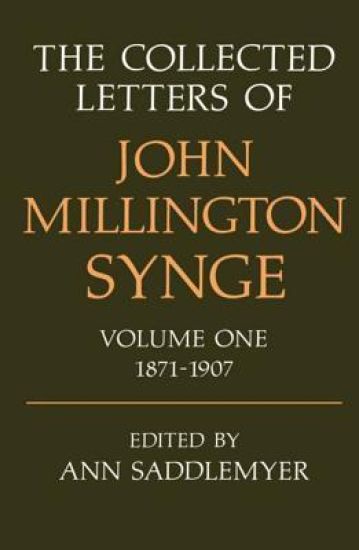
The Collected Letters of John Millington Synge Volume I: 1871-1907

The Collected Letters of John Millington Synge Volume I: 1871-1907

John Millington Synge

Oxford University Press
1983
sidottu
'This authoritative edition adds a dimension to our understanding of John Millington Synge...annotated in generous detail.' British Book News 'it is good to have all this material brought together, splendidly elucidated by Professor Saddlemyer's notes.' London Review of Books 'a model of editorial scholarship.' Times Higher Education Supplement
The Miscellaneous Works of John Bunyan: Volume I: Some Gospel-Truths Opened; A Vindication of Some Gospel-Truths Opened; A Few Sighs from Hell
A scholarly edition of The Miscellaneous Works of John Bunyan: Some Gospel Truths Opened; Vindication of "Some Gospel Truths Opened" and Few Sighs from Hell by T. L. Underwood and Roger Sharrock. The edition presents an authoritative text, together with an introduction, commentary notes, and scholarly apparatus.
The Miscellaneous Works of John Bunyan: The Miscellaneous Works of John Bunyan
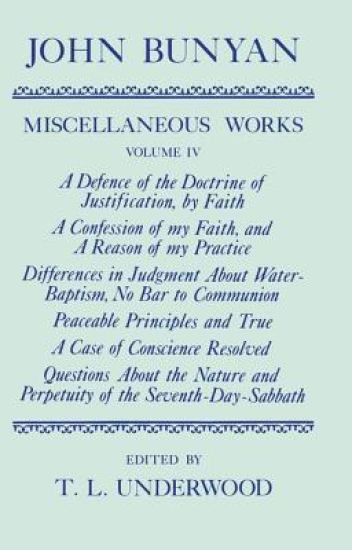
As defender of the faith and protector of his flock, at a time of great dissent on matters of theology and religious practice, Bunyan spent much of his energies on disputes, both in person and on the printed page. It was, indeed, such issues that had originally launched him into print in 1656-7 (see Volume I in this series). Six of Bunyan's controversial works, from a much later period of his life, are presented in the present volume. Bunyan directed the earliest of these works, A Defence of the Doctrine of Justification, by Faith (1672) at the latitudinarian rector Edward Fowler. A long-term dispute with some Baptists over open membership resulted in his A Confession of my Faith, and A Reason of my Practice (1672), Differences in Judgment About Water-Baptism, No Bar to Communion (1673) and Peaceable Principles and True (1674). Controversies concerning the status of women and the correct day for Sabbath observance led him to write A Case of Conscience Resolved (1683) and Questions About the Nature and Perpetuity of the Seventh-Day-Sabbath (1685). These polemical works display something of the rough and tumble world of the mechanick preachers of Bunyan's time. They add to our understanding of Bunyan's background, religious stance, and imaginative power and technique. They also reveal some of his personal human foibles.
The Miscellaneous Works of John Bunyan: Volume VII: Solomon's Temple Spiritualized, The House of the Forest of Lebanon, The Water of Life
These treatises from Bunyan's last year, 1688, are edited from the first editions, one of which was published in his lifetime, and the other two posthumously. All three are variations on the traditional typological method of biblical interpretation, and reflect similar variations practised in the work of other nonconformist theologians and preachers of the day. They are of interest both to students of Bunyan's theology and the struggles of `the Church in the wilderness', and to students of his art - the methods he explored to embody his ideas imaginatively and to intensify the appeal of his teaching.
The Miscellaneous Works of John Bunyan: Volume VIII: Instruction for the Ignorant; Light for them that sit in Darkness; Saved by Grace; Come, and Welcome to Jesus Christ
A scholarly edition of The Miscellaneous Works of John Bunyan: Instruction for the Ignorant; Light for Them That Sit in Darkness; Saved by Grace; Come and Welcome to Jesus Christ by Richard L. Greaves. The edition presents an authoritative text, together with an introduction, commentary notes, and scholarly apparatus.