Kirjojen hintavertailu. Mukana 11 627 220 kirjaa ja 12 kauppaa.

Kirjahaku

Etsi kirjoja tekijän nimen, kirjan nimen tai ISBN:n perusteella.

1000 tulosta hakusanalla Lydia Morrison

Stick Fly

Stick Fly

Lydia R. Diamond

Northwestern University Press
2008
nidottu
Adept at capturing the experience of the upper-middle-class African American, Diamond lays out two families' worth of secrets in this precise play. With only six characters, she constructs a vivid weekend of crossed pasts and uncertain but optimistic futures. On Martha's Vineyard, an affluent African American family gathers in their vacation home, joined by the housekeeper's daughter, who is filling in for her mother. The family patriarch is a philandering physician; one of his sons has followed in his footsteps, while the other, after numerous false starts in a variety of careers, is a struggling novelist.Both bring along their current girlfriends, to meet the family for the first time. With such highly - perhaps overly - educated vacationers, the conversation and the barbs fly, on subjects ranging from race to economics to politics. But there is also more than enough human drama, which reaches its climax when an old family secret comes out. Through lively exchanges and simmering wit, the family tackles a history filled with complications both within the family and in the outer world.
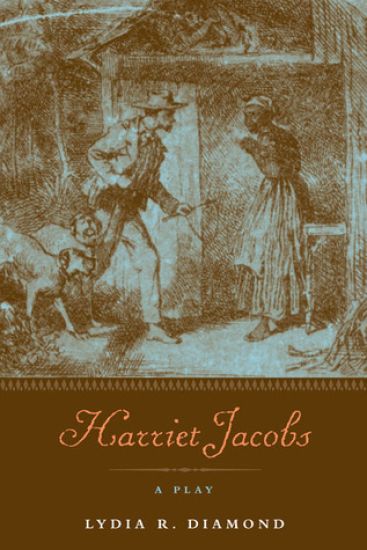
Harriet Jacobs

Harriet Jacobs

Lydia Diamond; Megan Sandberg-Zaki; Jean Fagan Yel

Northwestern University Press
2011
nidottu
Throughout her meteoric rise into the upper ranks of young playwrights, Lydia R. Diamond has boldly challenged assumptions about African American culture. In Harriet Jacobs, she turns one of the greatest of American slave narratives, Jacobs’ Incidents in the Life of a Slave Girl, into a penetrating, rousing work of theatre.
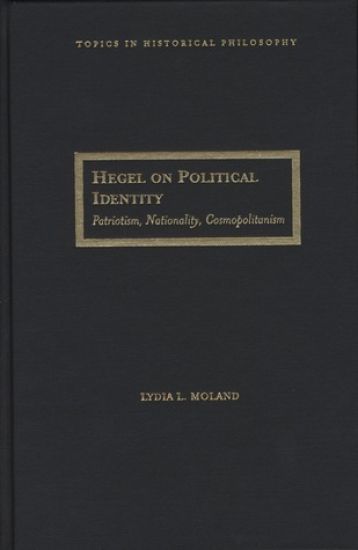
Hegel on Political Identity

Hegel on Political Identity

Lydia Moland

Northwestern University Press
2011
sidottu
In Hegel on Political Identity, Lydia Moland provocatively draws on Hegel's political philosophy to engage sometimes contentious contemporary issues such as patriotism, national identity, and cosmopolitanism. Moland argues that patriotism for Hegel indicates an attitude toward the state, whereas national identity is a response to culture. The two combine, Hegel claims, to enable citizens to develop concrete freedom. Moland argues that Hegel s account of political identity extends to his notorious theory of world history; she also proposes that his resistance to cosmopolitanism be reassessed in response to our globalized world. By focusing on Hegel s depiction of political identity as a central part of modern life, Moland shows the potential of Hegel s philosophy to address issues that lie at the heart of ethical and political philosophy.
Hegel on Political Identity

Hegel on Political Identity

Lydia Moland

Northwestern University Press
2012
nidottu
Lydia Moland provocatively draws on Hegel's political philosophy to engage sometimes contentious contemporary issues such as patriotism, national identity, and cosmopolitanism. By focusing on Hegel's depiction of political identity as a central part of modern life, Moland shows the potential of Hegel's philosophy to address issues that lie at the heart of ethical and political philosophy.
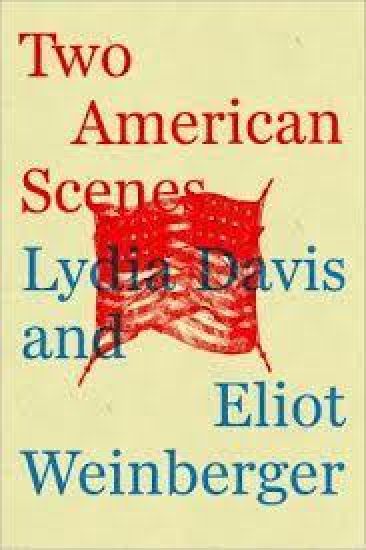
Two American Scenes

Two American Scenes

Lydia Davis; Eliot Weinberger

New Directions Publishing Corporation
2013
nidottu
Part of our revived "Poetry Pamphlet" series, Two American Scenes features two masters of the essay discussing "found material." Excerpts: It was given to me, in the nineteenth century, to spend a lifetime on this earth. Along with a few of the sorrows that are appointed unto men, I have had innumerable enjoyments; and the world has been to me, even from childhood,a great museum. — Lydia Davis Bad rapids. Bradley is knocked over the side; his foot catches under the seat and he is dragged, head under water. Camped on a sand beach, the wind blows a hurricane. Sand piles over us like a snow-drift. — Eliot Weinberge
Poetry Pamphlets 1-4

Poetry Pamphlets 1-4

Lydia Davis; Eliot Weinberger; Susan Howe; Bernadette Mayer; Sylvia Legris

New Directions Publishing Corporation
2023
nidottu
The first four collections in our revitalized Poetry Pamphlet series, established to highlight original work from writers around the world as well as forgotten treasures lost in the cracks of literary history. Included are: Two American Scenes: Our Village & A Journey on the Colorado River, by Lydia Davis and Eliot Weinberger; Sorting Facts, or Nineteen Ways of Looking at Chris Marker, by Susan Howe; The Helens of Troy, New York, by Bernadette Mayer; and Pneumatic Antiphonal, by Sylvia Legris.
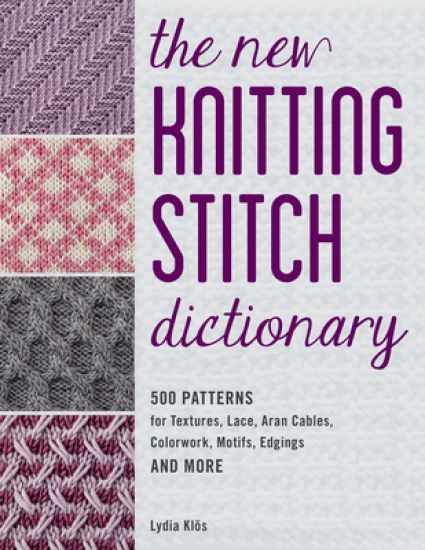
The New Knitting Stitch Dictionary

The New Knitting Stitch Dictionary

Lydia Klos

STACKPOLE BOOKS
2023
pokkari
Inspiration at your fingertips!Within the pages of The New Knitting Stitch Dictionary you will find not only 500 innovative knitting stitch patterns, but dozens of ideas popping through your mind. Cables may inspire designs for sweaters or blankets, cozy textures for scarves, colorwork for hats, mittens, and more. You will turn to this book again and again for fresh ideas!The stitches are divided into sections by type of stitch to make it easy to find what you want: texture, lace, cables, Aran cables, flower and leaf patterns, bobbles, lifted stitches, Fair Isle, intarsia, borders, and more. Instructions for each stitch are charted so that you can easily visualize the pattern and use it in your own design. You will find this stitch dictionary to be an invaluable reference on your knitting bookshelf.
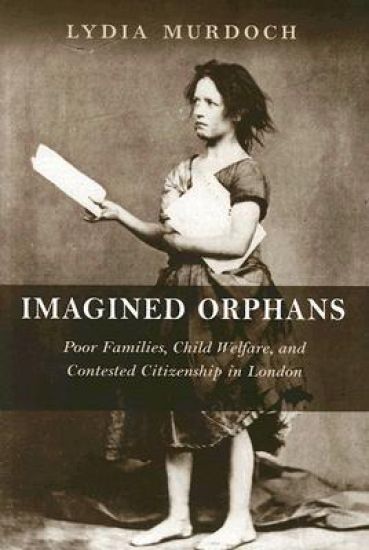
Imagined Orphans

Imagined Orphans

Lydia Murdoch

Rutgers University Press
2006
sidottu
With his dirty, tattered clothes and hollowed-out face, Oliver Twist is the enduring symbol of the young indigent spilling out of orphanages and haunting the streets of late-nineteenth-century London. Although poor children were often portrayed as real-life Oliver Twists—either orphaned or abandoned by unworthy parents—they in fact frequently maintained contact and were eventually reunited with their families.In Imagined Orphans, Lydia Murdoch focuses on this discrepancy between the representation and the reality of children’s experiences within welfare institutions—a discrepancy that she argues stems from conflicts over middle- and working-class notions of citizenship that arose in the 1870s and persisted until the First World War. Reformers’ efforts to depict poor children as either orphaned or endangered by abusive or “no-good” parents fed upon the poor’s increasing exclusion from the Victorian social body. Reformers used the public’s growing distrust and pitiless attitude toward poor adults to increase charity and state aid to the children.With a critical eye to social issues of the period, Murdoch urges readers to reconsider the complex situations of families living in poverty. While reformers’ motivations seem well intentioned, she shows how their methods solidified the public’s antipoor sentiment and justified a minimalist welfare state that engendered a cycle of poverty. As they worked to fashion model citizens, reformers’ efforts to protect and care for children took on an increasingly imperial cast that would continue into the twentieth century.
First in the Homes of His Countrymen

First in the Homes of His Countrymen

Lydia Mattice Brandt

University of Virginia Press
2016
sidottu
Over the past two hundred years, Americans have reproduced George Washington’s Mount Vernon plantation house more often, and in a greater variety of media, than any of their country’s other historic buildings. In this highly original new book, Lydia Mattice Brandt chronicles America’s obsession with the first president’s iconic home through advertising, prints, paintings, popular literature, and the full-scale replication of its architecture. Even before Washington’s 1799 death, his house was an important symbol for the new nation. His countrymen used it to idealize the past as well as to evoke contemporary--and even divisive--political and social ideals. In the wake of the mid-nineteenth century’s revival craze, Mount Vernon became an obvious choice for architects and patrons looking to reference the past through buildings in residential neighborhoods, at world’s fairs, and along the commercial strip. The singularity of the building’s trademark piazza and its connection to Washington made it immediately recognizable and easy to replicate. As a myriad of Americans imitated the building’s architecture, the Mount Vernon Ladies’ Association carefully interpreted and preserved its fabric. Purchasing the house in 1859 amid intense scrutiny, the organization safeguarded Washington’s home and ensured its accessibility as the nation’s leading historic house museum. Tension between popular images of Mount Vernon and the organization’s ""official"" narrative for the house over the past 150 years demonstrates the close and ever-shifting relationship between historic preservation and popular architecture.In existence for roughly as long as the United States itself, Mount Vernon’s image has remained strikingly relevant to many competing conceptions of our country’s historical and architectural identity.
The Sketch, the Tale, and the Beginnings of American Literature
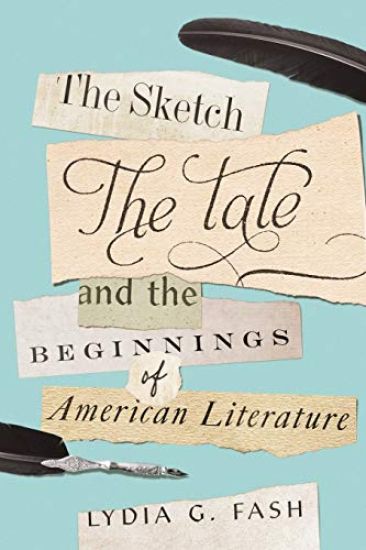
Accounts of the rise of American literature often start in the 1850s with a cluster of "great American novels"—Hawthorne's The Scarlet Letter, Melville's Moby-Dick and Stowe's Uncle Tom's Cabin. But these great works did not spring fully formed from the heads of their creators. All three relied on conventions of short fiction built up during the "culture of beginnings," the three decades following the War of 1812 when public figures glorified the American past and called for a patriotic national literature. Decentering the novel as the favored form of early nineteenth-century national literature, Lydia Fash repositions the sketch and the tale at the center of accounts of American literary history, revealing how cultural forces shaped short fiction that was subsequently mined for these celebrated midcentury novels and for the first novel published by an African American. In the shorter works of writers such as Washington Irving, Catharine Sedgwick, Edgar Allan Poe, and Lydia Maria Child, among others, the aesthetic of brevity enabled the beginning idea of a story to take the outsized importance fitted to the culture of beginnings. Fash argues that these short forms, with their ethnic exclusions and narrative innovations, coached readers on how to think about the United States' past and the nature of narrative time itself. Combining history, print history, and literary criticism, this book treats short fiction as a vital site for debate over what it meant to be American, thereby offering a new account of the birth of a self-consciously national literary tradition.
The Sketch, the Tale, and the Beginnings of American Literature
Accounts of the rise of American literature often start in the 1850s with a cluster of "great American novels"—Hawthorne's The Scarlet Letter, Melville's Moby-Dick and Stowe's Uncle Tom's Cabin. But these great works did not spring fully formed from the heads of their creators. All three relied on conventions of short fiction built up during the "culture of beginnings," the three decades following the War of 1812 when public figures glorified the American past and called for a patriotic national literature. Decentering the novel as the favored form of early nineteenth-century national literature, Lydia Fash repositions the sketch and the tale at the center of accounts of American literary history, revealing how cultural forces shaped short fiction that was subsequently mined for these celebrated midcentury novels and for the first novel published by an African American. In the shorter works of writers such as Washington Irving, Catharine Sedgwick, Edgar Allan Poe, and Lydia Maria Child, among others, the aesthetic of brevity enabled the beginning idea of a story to take the outsized importance fitted to the culture of beginnings. Fash argues that these short forms, with their ethnic exclusions and narrative innovations, coached readers on how to think about the United States' past and the nature of narrative time itself. Combining history, print history, and literary criticism, this book treats short fiction as a vital site for debate over what it meant to be American, thereby offering a new account of the birth of a self-consciously national literary tradition.
What We Mourn

What We Mourn

Lydia Murdoch

UNIVERSITY OF VIRGINIA PRESS
2025
sidottu
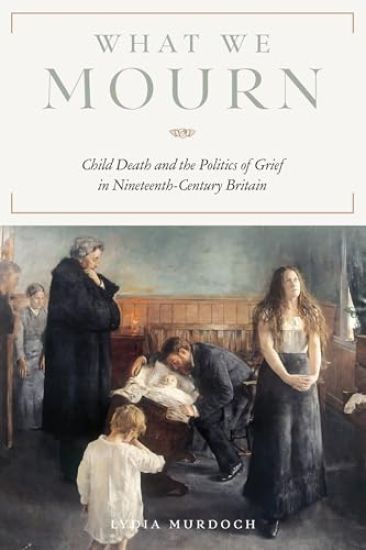
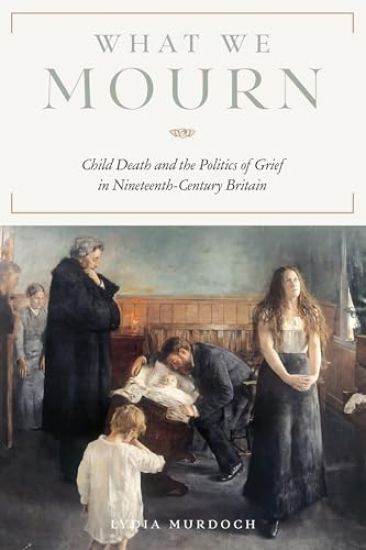
How a new culture of bereavement changed the relationship of the Victorian state to its most vulnerable subjects When the Tory Member of Parliament Michael Sadler argued in 1832 for state intervention on behalf of Britain's dying child factory workers, he elicited smirks and ridicule from his Liberal adversaries - a response that would have been unimaginable by the century's end. What We Mourn traces the changing understandings of child death within British, imperial, and transatlantic contexts and reveals the importance of youth and emotion to constructions of the modern state. As childhood took on new meanings over the course of the long nineteenth century, public mourning for the premature deaths of children emerged as a way of asserting and even redefining British rights and citizenship. Factory hands and abolitionists, sanitation reformers and suffragists democratized and politicized their grief as they called upon the state to recognize their lives as part of a new, reimagined political order. As Lydia Murdoch shows, carrying their own and others' private grief into the public sphere - with petitions and marches, public lectures and poetry - allowed marginalized members of society to assert their claim to rights. What We Mourn explores both the power and the limitations of a new politics founded on grief and the protection of child life.
What We Mourn

What We Mourn

Lydia Murdoch

UNIVERSITY OF VIRGINIA PRESS
2025
pokkari
How a new culture of bereavement changed the relationship of the Victorian state to its most vulnerable subjects When the Tory Member of Parliament Michael Sadler argued in 1832 for state intervention on behalf of Britain's dying child factory workers, he elicited smirks and ridicule from his Liberal adversaries - a response that would have been unimaginable by the century's end. What We Mourn traces the changing understandings of child death within British, imperial, and transatlantic contexts and reveals the importance of youth and emotion to constructions of the modern state. As childhood took on new meanings over the course of the long nineteenth century, public mourning for the premature deaths of children emerged as a way of asserting and even redefining British rights and citizenship. Factory hands and abolitionists, sanitation reformers and suffragists democratized and politicized their grief as they called upon the state to recognize their lives as part of a new, reimagined political order. As Lydia Murdoch shows, carrying their own and others' private grief into the public sphere - with petitions and marches, public lectures and poetry - allowed marginalized members of society to assert their claim to rights. What We Mourn explores both the power and the limitations of a new politics founded on grief and the protection of child life.
A Guide to Faculty-Led Study Abroad

A Guide to Faculty-Led Study Abroad

Lydia M. Andrade; Scott Dittloff; Lopita Nath

CRC Press Inc
2019
sidottu
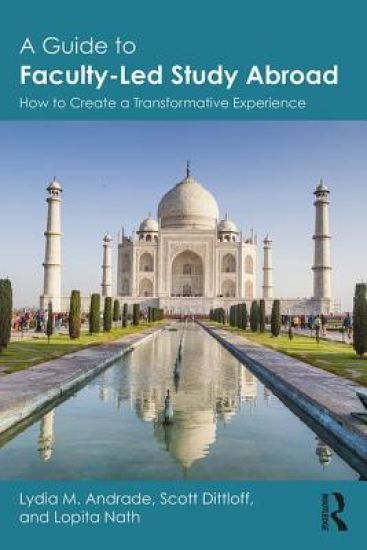
A Guide to Faculty-Led Study Abroad provides practical information on the curricular and administrative considerations necessary to design and implement a course-based study abroad experience of the highest quality. From techniques for funding the trip, to legal considerations, curricular development, and cultural preparation, this book explains how to create a meaningful and valuable international experience in a variety of settings and formats. The study abroad novice and experienced faculty or administrator alike will benefit from this step-by-step guide on how to create a truly transformative, course-based study abroad experience.
A Guide to Faculty-Led Study Abroad

A Guide to Faculty-Led Study Abroad

Lydia M. Andrade; Scott Dittloff; Lopita Nath

CRC Press Inc
2019
nidottu
A Guide to Faculty-Led Study Abroad provides practical information on the curricular and administrative considerations necessary to design and implement a course-based study abroad experience of the highest quality. From techniques for funding the trip, to legal considerations, curricular development, and cultural preparation, this book explains how to create a meaningful and valuable international experience in a variety of settings and formats. The study abroad novice and experienced faculty or administrator alike will benefit from this step-by-step guide on how to create a truly transformative, course-based study abroad experience.
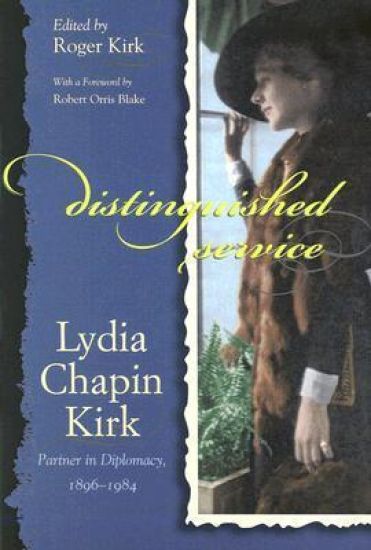
Distinguished Service

Distinguished Service

Lydia Kirk

Syracuse University Press
2007
sidottu
When her husband is offered the assignment of U.S. Naval attache in London in 1939, Lydia Chapin Kirk packs up her family and embarks on a lifelong journey, one in which she becomes a firsthand witness to the extraordinary world events of her time. Kirk's historical memoir offers a fascinating portrait of a remarkable life, told first from the perspective of a young girl in Erie, Pennsylvania, Paris, and Washington before World War I, and then from her husband's postings as U.S. naval attache and then as U.S. ambassador to Belgium, the Soviet Union, and Taiwan during the cold war. She brings alive the unique challenges and complex managerial and social responsibilities of a diplomat's spouse, especially when facing the perils of looming war, the challenges of Stalin's Moscow, and lengthy separations from her husband and children. An accomplished author of four books published in the 1950s and 1970s, Lydia Kirk captures the places and times in which she lived, the youthful adventures and wartime disruptions. With colorful prose and vivid detail, she offers recollections of such prominent people as President Theodore Roosevelt, Soviet Foreign Minister Gromyko, and Madame Chiang Kai-shek. Kirk has an artist's eye for her surroundings, revealing candid perceptions of human nature. Here is the story of a woman of consequence living through a transitional time when wives' roles were different than they are now. Her memoir gives voice to the many strong women of her generation whose untold contributions will inspire readers of all backgrounds.
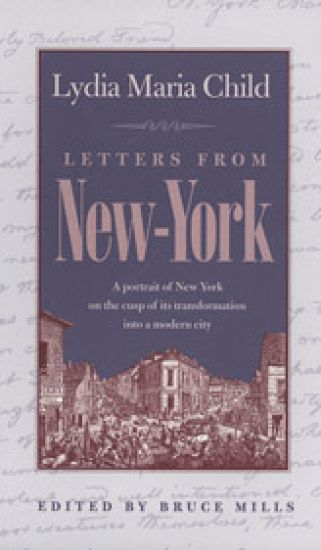
Letters from New-York

Letters from New-York

Lydia Maria Child

University of Georgia Press
1998
pokkari
Prominent author and abolitionist Lydia Maria Child began writing her "letters" from New York in August 1841 as a response to the troubling realities marking her private and public life. In particular, she was preoccupied by her editorial duties at the National Anti-Slavery Standard and dismayed by the growing sectarian spirit of antislavery reform. Collected primarily from the pages of the Standard, her literary essays on women's rights, the preaching of African American minister Julia Pell, the Crosby Street Synagogue, animal magnetism, the engineering miracle of Croton Aqueduct, and countless other people, topics, and events capture the breathless and sometimes unsettling transformation of one representative hub of national life.In his general introduction and annotation of the text, Bruce Mills reconstructs the biographical and cultural context surrounding the book's publication and documents substantive changes between the Standard's version of the letters and the book form. This edition also includes ten letters that Child chose to omit from earlier editions, including essays on the farewell gathering for the Amistad captives at the African Methodist Episcopal Zion Church and the near lynching of British abolitionist George Thompson.Long considered among Child's best writing, Letters from New-York still captivates readers with its moving descriptions of enduring cultural realities. It offers readers a telling glimpse of New York as an emerging urban center and is an invaluable addition to the library of American literature.
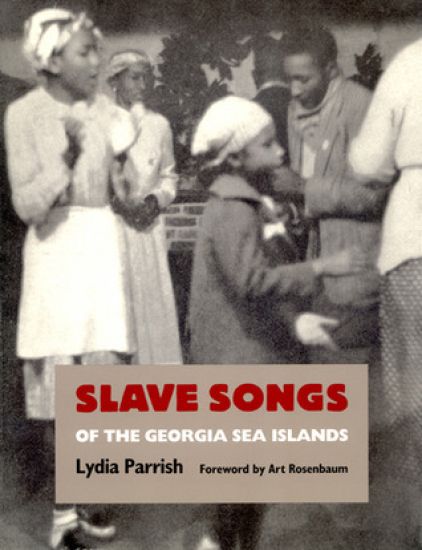
Slave Songs of the Georgia Sea Islands

Slave Songs of the Georgia Sea Islands

Lydia Parrish; Art Rosenbaum

University of Georgia Press
1992
pokkari
A valuable collection of folk music and lore from the Gullah culture, Slave Songs of the Georgia Sea Islands preserves the rich traditions of slave descendants on the barrier islands of Georgia by interweaving their music with descriptions of their language, religious and social customs, and material culture.Collected over a period of nearly twenty-five years by Lydia Parrish, the sixty folk songs and attendant lore included in this book are evidence of antebellum traditions kept alive in the relatively isolated coastal regions of Georgia.Over the years, Parrish won the confidence of many of the African-American singers, not only collecting their songs but also discovering other elements of traditional culture that formed the context of those songs. When it was first published in 1942, Slave Songs of the Georgia Sea Islands contained much material that had not previously appeared in print.The songs are grouped in categories, including African survival songs; shout songs; ring-play, dance, and fiddle songs; and religious and work songs. In additions to the lyrics and melodies, Slave Songs includes Lydia Parrish's explanatory notes, character sketches of her informants, anecdotes, and a striking portfolio of photographs.Reproduced in its original oversized format, Slave Songs of the Georgia Sea Islands will inform and delight students and scholars of African-American culture and folklore as well as folk music enthusiasts.
The Exit Is the Entrance

The Exit Is the Entrance

Lydia Paar

UNIVERSITY OF GEORGIA PRESS
2024
pokkari
Lydia Paar joined the American workforce at age fourteen, holding a wide variety of jobs (twenty-seven, at last count) between then and now, across twenty-five different homes in eight states. The essays in this collection explore her attempts to evade or transform the lower-middle class American experience across various cityscapes, towns, deserts, and in-between places. As she moves through these spaces, she seeks peace, connection, and freedom: from the hip streets of Portland to desolate deserts, Army basic training to cross-country bus trips, to eerie St. Louis funeral homes, and more. Each essay interrogates the interior emotional work that accompanies such grappling: labors of love and friendship, of learning, of motion, of maintenance, and of finding faith in potential for positive change. Across a range of interior and exterior landscapes, Paar meditates on subcultures, agendas, violences, alliances, and the intersection of the natural world with our human endeavors. Ultimately, she considers how what we try to transform so often transforms us.