Title: The Funeral Sermon for Dame Sarah Hewley ... preached at St. Saviourgate Chapel, York, 1710. By the Rev. Thomas Coulton, M.D. To which is added, the Rev. Edward Bowles's Catechism, appointed to be repeated by the inmates of her Ladyship's Hospital, Tanner Row, York.Publisher: British Library, Historical Print EditionsThe British Library is the national library of the United Kingdom. It is one of the world's largest research libraries holding over 150 million items in all known languages and formats: books, journals, newspapers, sound recordings, patents, maps, stamps, prints and much more. Its collections include around 14 million books, along with substantial additional collections of manuscripts and historical items dating back as far as 300 BC.The GENERAL HISTORICAL collection includes books from the British Library digitised by Microsoft. This varied collection includes material that gives readers a 19th century view of the world. Topics include health, education, economics, agriculture, environment, technology, culture, politics, labour and industry, mining, penal policy, and social order. ++++The below data was compiled from various identification fields in the bibliographic record of this title. This data is provided as an additional tool in helping to insure edition identification: ++++ British Library Coulton, Thomas; 1836. 23 p.; 8 . 8296.ff.16.(9.)
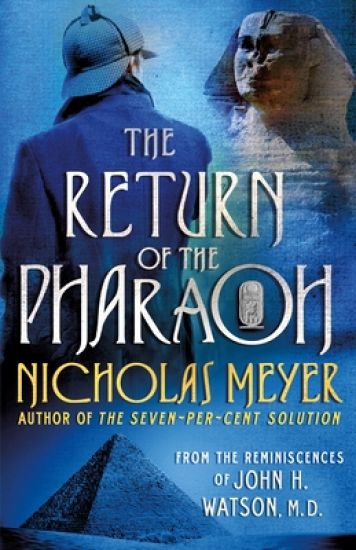
In Nicholas Meyer's The Return of the Pharaoh, Sherlock Holmes returns in an adventure that takes him to Egypt in search of a missing nobleman, a previously undiscovered pharaoh's tomb, and a conspiracy that threatens his very life. With his international bestseller, The Seven Per Cent Solution, Nicholas Meyer brought to light a previously unpublished case of Sherlock Holmes that reinvigorated the world's interest in the first consulting detective. Now, many years later, Meyer is given exclusive access to Dr. Watson's unpublished journal, wherein he details a previously unknown case. In 1910, Dr. John Watson travels to Egypt with his wife Juliet. Her tuberculosis has returned and her doctor recommends a stay at a sanitarium in a dry climate. But while his wife undergoes treatment, Dr. Watson bumps into an old friend--Sherlock Holmes, in disguise and on a case. An English Duke with a penchant for egyptology has disappeared, leading to enquiries from his wife and the Home Office. Holmes has discovered that the missing duke has indeed vanished from his lavish rooms in Cairo and that he was on the trail of a previous undiscovered and unopened tomb. And that he's only the latest Egyptologist to die or disappear under odd circumstances. With the help of Howard Carter, Holmes and Watson are on the trail of something much bigger, more important, and more sinister than an errant lord.
I believe that Diversity, Inclusion, and Equity are real issues with correctional facilities housing those most in need. There are many brain damaged and mentally retarded individuals in correctional facilities who are not able to grasp and process abstract and complex concepts necessary for living independently in the communityl These individuals do not have the intellectual capacity for restoration to safe and independent living in the community. They are in in need of guardians and conservators and supervision to prevent future crimes and incarcerations. This book details the variaous groups in prison that includes the criminals who exploit the brain damaged and mentally retarded who find themselves in prison. These issues are the subject of a book, Of Mice and Men is a novella written by John Steinbeck. 1] 2] Published in 1937, it narrates the experiences of George Milton and Lennie Small, two displaced migrant ranch workers, who move from place to place in California in search of new job opportunities during the Great Depression in the United States.
This book addresses the issues of treating temporary insanity manifesting as suicidal, homicidal, and gravely disabled in correctional facilities. Limitations of psychotropic medications, issues in scientific research and medical publications resulting in misinformation, and the complexities of mental illness and treatment of mental illness are explored from the point of view of the practicing psychiatrist.
I view correctional facilities as the best place to start programs addressing diversity, equity, and inclusion. Correctional facilities house mentally retarded and brain damaged individuals with impaired frontal lobe executive functions. The ability to grasp and process abstract and complex concepts necessary for independent functioning in the community is grossly impaired. This in large part provides the basis for recidivism, return to prison for repeated crimes. This population needs neuropsychiatric testing to inform the probation officers and parole boards a rational basis for restoration programs that will successfully return this population to communities without return to correctional facilities. Very often this population has multiple crimes prior to the first incarceration despite extensive engagement with mental health services and the criminal justice system.
This book addresses the limitations of medications, the complexities of practice in prisons, and the misinformation in the medical literature, from the perspective of the practicing psychiatrist. The trajectory of medicine over 50 years of clinical practice is reflected in the text amid the progression of the medical literature used to clarify the past, present, and future practice of psychiatry in correctional facilities.