Kirjojen hintavertailu. Mukana 12 083 612 kirjaa ja 12 kauppaa.

Kirjahaku

Etsi kirjoja tekijän nimen, kirjan nimen tai ISBN:n perusteella.

1000 tulosta hakusanalla Maria M

Math Mammoth Addition 1

Math Mammoth Addition 1

Maria Miller

Math Mammoth
2024
pokkari
Math Mammoth Addition 1 is a worktext (includes both teaching and exercises), dealing with the concept of addition and addition facts within 0-10 (in few occasions numbers between 10 and 20 are used). The book is most suitable for first grade.The book starts out with very easy addition problems within 0-5, using pictures. If the student does not yet know the symbols + and =, you can introduce them first orally. In other words, use blocks or rocks and make addition problems where you use both kinds of wordings: "Three blocks and four blocks makes seven blocks. Three blocks PLUS four blocks EQUALS seven blocks." Play like that until the child can use the words PLUS and EQUALS in his/her own speech. This will make it easier for him/her to use the written symbols.Soon the lessons start including "missing addend" problems. We first use pictures, and gradually get to the abstract 1 + __ = 5 with symbols only. Keep in mind that children may confuse this problem with1 + 5 = __. You can word these problems like this: "1 and how many more makes 5?" You can MODEL them by drawing: First draw 1 ball. Tell the child that we need to have a total of 5 balls. He is to draw more until there are five balls. In the missing addend problem, however many balls the child has to draw is the number that goes on the empty line. So, first there is one ball, then we need to add (draw) some more to make 5. But how many more were drawn?After that, the book contains many lessons called Sums with... whose goal is to help the child memorize addition facts.My approach to memorization is many-fold: Structured drill, such as you see in the lessons Sums with 5, Sums with 6, and so on. This is not random drill, because you will start it by showing the pattern or the structure in the facts. This will help the student to tie the addition facts in with a context and help him understand the facts more on a conceptual level, instead of merely memorizing them at random. In sums with 5, the child learns the number combinations that add up to 5: 0 & 5, 1 & 4, and 2 & 3. This understanding is the basis for the drills.Using addition facts in games, in math problems, everyday life, or anywhere else. Games are especially useful because they help children like mathematics.Random drilling may also be used as a tool among others.Memory helps such as silly mnemonics or writing math facts on a poster and hanging it on the wall. These are not needful for all children.However, keep in mind that children will need LOTS of opportunities to add numbers to actually memorize the facts, so the memorization may not totally occur as your child works through this book. These same addition facts are further studied and used in the Math Mammoth Subtraction 1 book, and in all later math work since they are constantly used. At the latest, your child should memorize addition facts during second grade.
Math Mammoth Subtraction 1

Math Mammoth Subtraction 1

Maria Miller

Math Mammoth
2024
pokkari
Math Mammoth Subtraction 1 is a worktext that covers the concept of subtraction, the relationship between addition and subtraction, and the various meanings of subtraction.In the first lesson, Subtraction Is Taking Away, the child learns the basic meaning of subtraction as taking away objects, and learns to write subtractions from an illustration where some objects are crossed out.In the next lesson, the child counts down to subtract, which ties in subtraction with the number line. This is a transitional strategy to solve subtraction problems, because later students will learn more efficient ways to subtract, but it is important conceptually.The following lesson, Subtraction and Addition in the Same Picture, begins the study of the relationship between addition and subtraction. This concept will span several lessons. This first lesson presents two sets of objects, such as blue and white balls, and the student writes both an addition sentence and a subtraction sentence from this illustration.The lesson When Can You Subtract? concentrates on the idea that some subtractions, such as 4 - 5, are meaningless when you think of taking away. The child also makes subtraction patterns in this lesson.Then we continue studying the connection between addition and subtraction in the lesson Two Subtractions from One Addition. As an example, the child writes both 8 - 3 = 5 and 8 - 5 = 3 from the addition 3 + 5 = 8. This idea ties in with fact families, a concept that is coming up soon.In the lesson Two Parts - One Total, we study word problems that do not involve the idea of taking away but have two parts making up a total. For example, if there are 10 flowers of which some are white and some are red, and seven of them are white, how many are red?Then we study fact families, which means writing two additions and two subtractions using the same three numbers.In the lesson How Many More? students find how many more or how many fewer objects one person has than the other by drawing the objects. This lesson can easily be done with manipulatives if desired.In the very next lesson, "How Many More" Problems and Differences, we continue the theme, this time writing a missing addend addition for problems that ask "how many more." For example, Veronica has 4 marbles and Ann has 6. We write the missing addend sentence 4 + ___ = 6 to find how many more Ann has. In the next lesson the child then learns to write subtraction sentences for such problems.
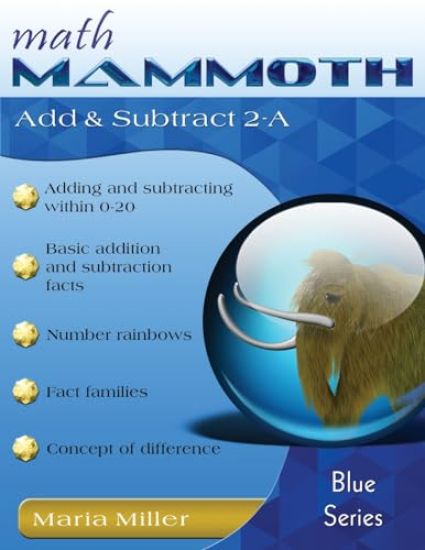
Math Mammoth Add & Subtract 2-A

Math Mammoth Add & Subtract 2-A

Maria Miller

Math Mammoth
2024
pokkari
Math Mammoth Add & Subtract 2-A deals with two main themes: strategies for adding and subtracting within 0-20; such as adding just one more, a trick with nine and eight, and subtracting using addition;memorizing the basic addition and subtraction facts of single-digit numbers with an answer between 10 and 18.While focusing on addition and subtraction techniques, the lessons also include many word problems.The goal is to memorize the facts, or at least become so fluent with them that an outsider cannot tell if the child remembers the answer or uses some mental math strategy to get the answer.Some children will accomplish this quicker and need less practice, whereas others will take longer. Thus, don't assign all the exercises in the book by default. Use your judgment, and try to match the amount of exercises to your child's need. The ones that don't get assigned can be used later for review. You can also use games to reinforce the facts, and in place of some of the exercises in the book (a list of games is provided in the book).Learning addition and subtraction facts is quite important for later study. For example, regrouping in addition and subtraction (carrying/borrowing) requires the ability to recall the basic facts efficiently and fluently.We will start the book with a few mental math strategies (Add Using "Just One More" and A Trick with Nine and Eight). The lesson Adding within 20 reviews those strategies and gives more practice. These initial lessons don't yet involve actual memorization techniques.The lesson Subtract to Ten explains another basic strategy, and has to do with subtracting in parts. For example, to do 13 - 5, one can subtract 5 in two parts: first do 13 - 3, which equals 10, and then subtract the rest, or 2 more. Memorizing the subtraction facts will be more efficient, but I want children to understand this strategy, because it is useful in many other situations also.Then we review how to complete the next whole ten, which is an important concept. An example of this concept is the question: What number do you add to 23 to get 30? As an equation, we write: 23 + __ = 30.In the next lesson, we study sums that go over ten, doing these sums in two parts. For example, in the sum 9 + 7, the child first completes 10 by adding 9 + 1. Then, the child adds the rest, or 6, to 10. Learning this prepares the child for addition facts where the sum is more than 10.The next lessons, Adding with 9, Adding with 8, Adding with 7, and Adding with 6, provide lots of practice for learning and memorizing the basic addition facts. There are 20 such facts: 9 + 2 till 9 + 9: 8 facts8 + 3 till 8 + 8: 6 facts7 + 4 till 7 + 7: 4 facts6 + 5 till 6 + 6: 2 factsThe last part of the book includes various lessons titled Number Rainbows and Fact Families with.... These give lots of practice and reinforcement for the basic addition and subtraction facts, emphasizing the connection between addition and subtraction as a strategy for subtraction facts.The follow-up to this book, Add & Subtract 2-B, practices adding and subtracting two-digit numbers mentally and in columns (regrouping).
Math Mammoth Add & Subtract 2-B

Math Mammoth Add & Subtract 2-B

Maria Miller

Math Mammoth
2024
pokkari
Math Mammoth Add & Subtract 2-B is a continuation to the book Math Mammoth Add & Subtract 2-A. The goal of this book is to study addition and subtraction within 0-100, both mentally and in columns, especially concentrating on regrouping in addition (carrying) and in subtraction (borrowing).Mental math is important because it builds number sense. This book includes many lessons that practice mental math. For example, the child practices adding and subtracting two-digit numbers when one of the numbers is a whole ten (such as 30 + 14 or 66 - 20).The students also learn to solve sums such as 36 + 8 or 45 + 9 with mental math (there is a regrouping), comparing them to the sums 6 + 8 and 5 + 9. Since 6 + 8 fills the first ten and is four more than the next ten, the sum 36 + 8 fills the next whole ten (40), and is four more than that, or 44.At the same time, students also learn to add two-digit numbers with regrouping. This is explained in detail with the help of visual models (base-ten blocks). You are welcome to use actual physical manipulatives, if you prefer. The main concept to understand is that 10 ones are regrouped to form a new ten, and this new ten is written using a little "1" in the tens column.After addition, the lessons focus on column subtraction, initially without regrouping and then with regrouping.The lesson Regrouping practices breaking down a ten into 10 ones. It is crucial that the child understands what happens here. Otherwise, they might end up only memorizing the procedure, and will probably at some point misremember how it was done. If you notice that the child does not understand the concept of regrouping, provide more practice with concrete manipulatives or visual exercises before proceeding.After learning regrouping, students practice mental subtraction in two separate lessons. One of them expounds on several methods for mental subtracting. The other is about Euclid's game-a fun game that also practices subtraction of two-digit numbers.
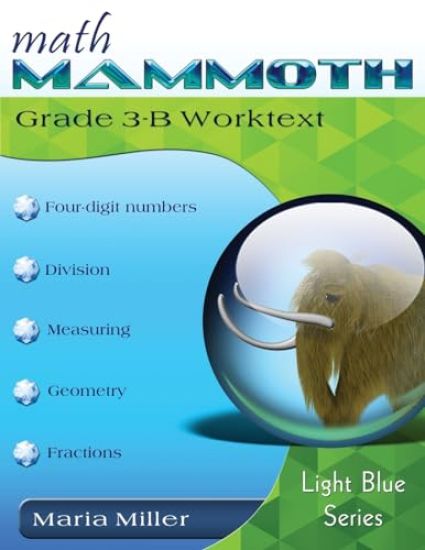
Math Mammoth Grade 3-B Worktext

Math Mammoth Grade 3-B Worktext

Maria Miller

Math Mammoth
2024
pokkari
Math Mammoth Grade 3-B Worktext (2024 edition) is the student book for the latter half of grade 3, and part of the Math Mammoth Grade 3 complete curriculum. This book covers four-digit numbers, division, measurement, geometry, and fractions. The worktext contains both the necessary instruction and the problems & exercises (the 'text' & and the 'work'; thus a "worktext"), and is fairly self-teaching. The curriculum meets and exceeds the Common Core standards. Please note this is a student worktext and does not contain the answers. The answer key book is available separately.FeaturesMath Mammoth focuses on conceptual understanding. It explains the "WHY", so your children can understand the math, not just learn "HOW" to do it.Concepts are often explained with visual models, followed by exercises using those models. These visual models can take the place of manipulatives for many children; however, it is very easy to add corresponding manipulatives to the lessons if so desired.The curriculum is mastery-oriented. This means it concentrates fairly long on a topic, delving into its various aspects. This promotes conceptual understanding, as opposed to spiral curricula that often tend to jump from topic to topic too much.There is a strong emphasis on mental math and number sense.It requires very little teacher preparation, which is a big help to most parents.The curriculum has no separate teacher's manual nor is it scripted. The introduction to each chapter has some notes for the teacher concerning the material in the chapter. All the instruction is written directly to the student in the worktext, and there also exist accompanying videos where you can see Maria herself teach the material.After each chapter introduction, you will find a list of Internet links and resources (games, quizzes, animations, etc.) that can be used for fun, illustrations, and further practice.For multiplication tables and division facts, you can use our online practice program (free).
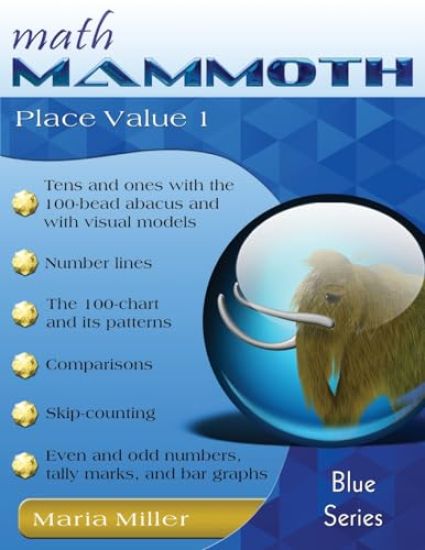
Math Mammoth Place Value 1

Math Mammoth Place Value 1

Maria Miller

Math Mammoth
2024
pokkari
Math Mammoth Place Value 1 focuses on place value and two-digit numbers and is primarily meant for first grade level math.When children count, they basically just learn numbers as some kind of continuum that goes on without end. With simple counting, your child might not catch on to the inherent structure of the number system. Our number system is based on the idea that if you have lots and lots of objects, the efficient way to count and denote them is with groups of tens, hundreds, and thousands - not individually.The crucial point in understanding the concept of place value is therefore that a certain position represents a certain size group. The digit in each position tells us how many groups of that size there are. For example, in the number 2,381, an adult already knows that the 8 represents eight tens, and not just "8" and that the 3 represents three hundreds, and not just "3". The place of the digit tells us the size of the group, and the digit itself tells how many of that group.The initial lessons of the book that introduce tens and ones use a 100-bead abacus extensively. This 100-bead abacus or school abacus simply contains ten beads on ten rods, for a total of 100 beads. It is not the special abacus used by the Chinese or the Japanese. Each bead simply represents one. The 100-bead abacus lets children both "see" the numbers and use their touch while making them.You will need to purchase this school abacus separately, such as on Amazon, or make your own.The abacus is used in the first lessons, but it is not the only model used in the book. We also use base-ten blocks as a visual representation of two-digit numbers. If you own a set of base-ten blocks (manipulatives), you can use them along with the visual exercises, if desired.Moreover, we also use number lines and the 100-chart. Number lines help to visualize how numbers continue indefinitely and also relate to the concept of measuring. The 100-chart helps the child to be familiar with the numbers below 100 and find patterns in the number system.While most of the lessons in the book focus on place value, students also practice adding and subtracting multiples of ten, and rounding numbers to the nearest ten. The two lessons near the end of the book about tally marks and graphs are real-life applications of two-digit numbers. The last lesson about regrouping can be challenging, thus is optional.
Math Mammoth Place Value 2

Math Mammoth Place Value 2

Maria Miller

Math Mammoth
2024
pokkari
Math Mammoth Place Value 2 is a short worktext dealing with place value and three-digit numbers.The first lessons present three-digit numbers using a visual model of the base-ten blocks (hundred-flats, ten-pillars, and one-cubes) and number lines. To reinforce the important concept of place value, children practice separating three-digit numbers into their different "parts" (hundreds, tens, and ones), and making numbers from these parts.Next, we study skip-counting by tens, by twos, and fives. Then students compare and order three-digit numbers, including comparing simple number expressions.After this, we study rounding three-digit numbers to the nearest ten and to the nearest hundred. Lastly, the book includes a lesson on reading bar graphs and pictographs, which provide a nice real-life application for using three-digit numbers.
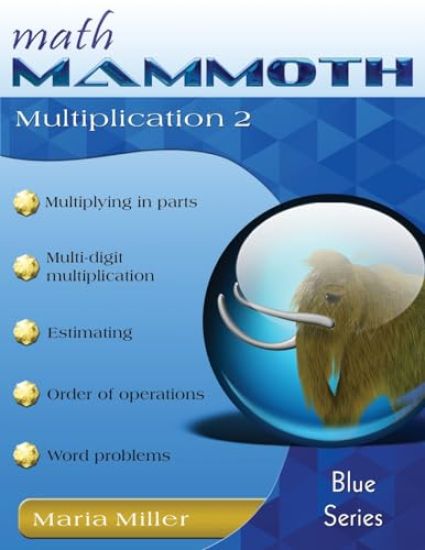
Math Mammoth Multiplication 2

Math Mammoth Multiplication 2

Maria Miller

Math Mammoth
2024
pokkari
Math Mammoth Multiplication 2 is a worktext focusing on multi-digit multiplication and related topics. It best suits fourth grade mathematics.The first lessons briefly review the concept of multiplication and the multiplication tables. Next, students encounter equations in disguise - presented with shapes on both sides of a pan balance - in the lesson Scales Puzzles. This lesson is intended to be fun and motivational.Then, the focus shifts to multi-digit multiplication (also called multiplication algorithm or multiplying in columns). We start out by learning to multiply numbers by multiples of ten and hundred (for example, 20 4 or 500 6). After this is mastered, students learn the very important concept of multiplying in parts, or partial products. This means that, for example, we multiply 4 63 in two parts: first we multiply 4 60 = 240 and 4 3 = 12, and lastly the results are added: 240 + 12 = 252.This principle underlies all other multiplication algorithms, so it is important to master. We don't want children to "blindly" memorize the multiplication algorithm without understanding what is going on with it. The partial products algorithm (multiplying in parts) also ties in with an area model, and it is very important that students see the connection between this visual model and the procedure.The book contains two lessons about multiplying in columns the "easy way". This "easy way" is a simplified form of the traditional multiplication algorithm, based on partial products. You may skip these two lessons at your discretion. The method taught in those lessons is most useful for students who may have trouble with the traditional form of the algorithm. This method is also helpful in cementing the student's understanding of the partial products method.The traditional, or standard, form of multiplication algorithm is taught next, and is hopefully fairly easy, with the partial products as a foundation.Students also study estimation, the order of operations, and multiplying with money. There are numerous word problems in all of the lessons. Students are encouraged to write number sentences for the word problems-essentially learning to show their work and their thinking process.The lesson So Many of the Same Thing has to do with proportional reasoning. The idea is really simple, and prepares students for learning ratios and proportions in middle school.The last major topic in the book is multiplying two-digit numbers by two-digit numbers. Again, we first study partial products and tie that in with an area model. The lesson Multiplying in Parts: Another Way is optional. Lastly, the book teaches the standard algorithm for two-digit by two-digit multiplication. Students will practice multiplication with more digits in the book Mammoth Multiplication & Division 3.
Math Mammoth The Four Operations (with a Touch of Algebra)
Math Mammoth The Four Operations (with a Touch of Algebra) is a mathematics worktext meant primarily for fifth and sixth grades. Being a worktext means that this book is a textbook and workbook together: the lessons include both the explanations of the concepts, as well as practice exercises.The main topics of this book are mental math strategies, simple equations and expressions, the order of operations, partial products, using all four operations in solving problems, and number patterns in the coordinate grid.Students encounter the exact definition of an equation and an expression. They practice the order of operations with problems that also reinforce the idea of the equal sign ("=") as denoting equality of the right and left sides of an equation. These kinds of exercises are needed because students may think that an equal sign signifies the act of finding the answer to a problem (such as 134 + 23 = ?), which is not so.Students solve simple equations with the help of a bar model. They also use the pan balance model to solve simple one and two-step equations and even some three-step equations.We review the thought of partial products (multiplying and dividing in parts), including how those partial products are seen in the multiplication algorithm, and how to use mental math to divide numbers in parts.Although the book is named "The Four Operations," the idea is not to practice each of the four operations separately, but rather to see how they are used together in solving problems and in simple equations. We are trying to develop the student's algebraic thinking, including the abilities to: translate problems into mathematical operations, comprehend the many operations needed to yield an answer to a problem, "undo" operations, and so on. Many of the ideas in this book are preparing students for algebra.The answers are appended.
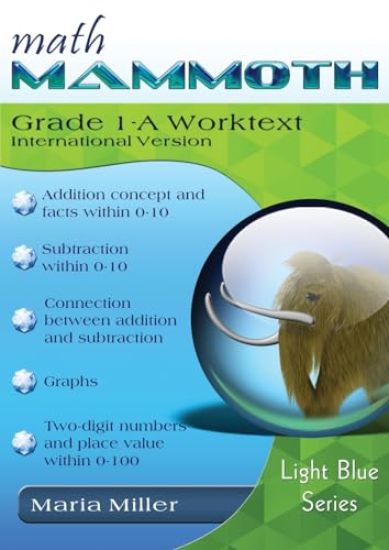
Math Mammoth Grade 1-A Worktext, International Version
Math Mammoth Grade 1-A Worktext (International Version) is the student worktext for the first half of grade 1 mathematics studies. In this part A, the main areas of study are: The concepts of addition and subtraction;strategies for addition and subtraction facts; anddeveloping understanding of whole number relationships and place value till 100.The worktext is in full color, and contains both the necessary instruction and the problems & exercises (the 'text' and the 'work'), and is for the most part self-teaching. It does not contain the answers.Features of the curriculum: Math Mammoth focuses on conceptual understanding. It explains the "WHY", so your children can understand the maths, not just learn "HOW" to do it. Concepts are often explained with visual models, followed by exercises using those models. These visual models can take the place of manipulatives for many children; however, it is very easy to add corresponding manipulatives to the lessons if so desired. The curriculum is mastery-oriented. This means it concentrates fairly long on a topic, delving into its various aspects. This promotes conceptual understanding, as opposed to spiral curricula that often tend to jump from topic to topic too much. There is a strong emphasis on mental maths and number sense. Requires very little teacher preparation, which is a big benefit to most teachers/parents.: ) The curriculum has no separate teacher's manual nor is it scripted. The introduction to each chapter has some notes for the teacher concerning the material in the chapter. All the instruction is written directly to the student in the worktext, and there also exist accompanying videos where you can see Maria herself teach the material. After each chapter introduction, you will find a list of Internet links and resources (games, quizzes, animations, etc.) that can be used for fun, illustrations, and further practice. For addition and subtraction facts, you can use our online practice program (free). A companion to this book, Math Mammoth Grade 1-B worktext, covers the second half of 1st grade maths (available separately). Also available are the answer keys and a book containing cumulative revisions and end-of-chapter tests..
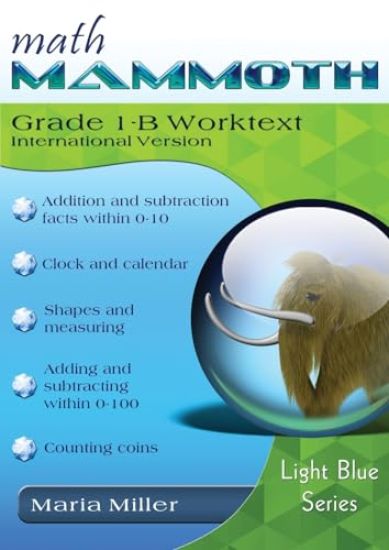
Math Mammoth Grade 1-B Worktext, International Version
Math Mammoth Grade 1-B Worktext (International Version) is the student worktext for the second half of grade 1 mathematics studies. In this part B, the main areas of study are: addition and subtraction facts within 10;clock to the half hour;geometric shapes and measuring length;adding and subtracting within 100; andcounting coins (Australian currency).The worktext is in full color, and contains both the necessary instruction and the problems & exercises (the 'text' and the 'work'), and is for the most part self-teaching. It does not contain the answers.Features of the curriculum: Math Mammoth focuses on conceptual understanding. It explains the "WHY", so your children can understand the maths, not just learn "HOW" to do it. Concepts are often explained with visual models, followed by exercises using those models. These visual models can take the place of manipulatives for many children; however, it is very easy to add corresponding manipulatives to the lessons if so desired. The curriculum is mastery-oriented. This means it concentrates fairly long on a topic, delving into its various aspects. This promotes conceptual understanding, as opposed to spiral curricula that often tend to jump from topic to topic too much. There is a strong emphasis on mental maths and number sense. Requires very little teacher preparation, which is a big benefit to most teachers/parents.: ) The curriculum has no separate teacher's manual nor is it scripted. The introduction to each chapter has some notes for the teacher concerning the material in the chapter. All the instruction is written directly to the student in the worktext, and there also exist accompanying videos where you can see Maria herself teach the material. After each chapter introduction, you will find a list of Internet links and resources (games, quizzes, animations, etc.) that can be used for fun, illustrations, and further practice. For addition and subtraction facts, you can use our online practice program (free). A companion to this book, Math Mammoth Grade 1-A worktext, covers the first half of 1st grade maths (available separately). Also available are the answer keys and a book containing cumulative revisions and end-of-chapter tests.