Kirjojen hintavertailu. Mukana 11 342 296 kirjaa ja 12 kauppaa.

Kirjahaku

Etsi kirjoja tekijän nimen, kirjan nimen tai ISBN:n perusteella.

1000 tulosta hakusanalla Neil T. Sinclair

The Metaphor of Mental Illness

The Metaphor of Mental Illness

Neil Pickering

Oxford University Press
2005
nidottu
Despite the currency of the notion of mental illness, its legal and medical legitimacy, and the panoply of psychiatry and other mental health services which claim to treat it, there are those who take the radical sceptical line that mental illness is a fabrication. This is a book which takes this sceptical line seriously - perhaps more seriously than almost any other book not written by sceptics themselves. 'The Metaphor of Mental Illness' is a revaluation of the traditional philosophical disputes about the existence and nature of mental illness. Sceptics and apologists have generally focused on the legitimacy of extending illness from the physical to the mental, by means of the likeness argument. This says that claimed mental illnesses, from ADHD to schizophrenia, really are illnesses providing they are sufficiently similar to agreed physical illnesses. This book proposes that this argument is flawed: the likenesses to which the argument appeals appear when these examples have been categorised as illnesses, rather than the categorisation being evidenced by or derived from the likenesses. The categorisation of ADHD, schizophrenia, and so on, as illnesses is a matter of metaphor: an imaginative shift into the illness category. The book puts forward a new view of and resolution of the issues, to which it carefully guides the reader. It is a book which engages with many contemporary issues and styles of analysis, but is accessible to anyone not familiar with these. It is full of examples, both historical and modern. It is a book both for the postgraduate student coming to grips with the issues for the first time, for the researcher who is interested in a new approach to the issues, and for mental health workers such as psychiatrists who are interested in the fundamental assumptions of their field of work.

Living and dying with dementia

Living and dying with dementia

Neil Small; Katherine Froggatt; Murna Downs

Oxford University Press
2007
nidottu
Improvements in health care in the 21st century mean people are living longer, but with the paradox that chronic illness is increasingly prevalent. Dementia, a term used to describe various different brain disorders that involve a loss of brain function that is usually progressive and eventually severe, is a condition associated with an ageing population and is becoming increasingly common. Worldwide there are approximately 24 million people with dementia, expected to rise to 81 million by 2040. Inevitably, people living with dementia will die, but their needs at the end of life are not well known. This book describes what might be achieved if the values and best practice of both dementia care and palliative care are brought together, to achieve quality end of life care for this specific group of patients. It explores what is known about the experience of dying with dementia, using a narrative approach, and develops a model that draws together a 'person-centred' approach to care. The book examines the possibilities and the challenges faced when trying to improve quality of life for people with dementia, and presents examples of good practice from across the world.
Global Production Networks

Global Production Networks

Neil M. Coe; Henry Wai-chung Yeung

Oxford University Press
2015
sidottu
Accelerating processes of economic globalization have fundamentally reshaped the organization of the global economy towards much greater integration and functional interdependence through cross-border economic activity. In this interconnected world system, a new form of economic organization has emerged: Global Production Networks (GPNs). This brings together a wide array of economic actors, most notably capitalist firms, state institutions, labour unions, consumers and non-government organizations, in the transnational production of economic value. National and sub-national economic development in this highly interdependent global economy can no longer be conceived of, and understood within, the distinct territorial boundaries of individual countries and regions. Instead, global production networks are organizational platforms through which actors in these different national or regional economies compete and cooperate for a larger share of the creation, transformation, and capture of value through transnational economic activity. They are also vehicles for transferring the value captured between different places. This book ultimately aims to develop a theory of global production networks that explains economic development in the interconnected global economy. While primarily theoretical in nature, it is well grounded in cutting-edge empirical work in the parallel and highly impactful strands of social science literature on the changing organization of the global economy relating to global commodity chains (GCC), global value chains (GVC), and global production networks (GPN).
Global Production Networks

Global Production Networks

Neil M. Coe; Henry Wai-chung Yeung

Oxford University Press
2015
nidottu
Accelerating processes of economic globalization have fundamentally reshaped the organization of the global economy towards much greater integration and functional interdependence through cross-border economic activity. In this interconnected world system, a new form of economic organization has emerged: Global Production Networks (GPNs). This brings together a wide array of economic actors, most notably capitalist firms, state institutions, labour unions, consumers and non-government organizations, in the transnational production of economic value. National and sub-national economic development in this highly interdependent global economy can no longer be conceived of, and understood within, the distinct territorial boundaries of individual countries and regions. Instead, global production networks are organizational platforms through which actors in these different national or regional economies compete and cooperate for a larger share of the creation, transformation, and capture of value through transnational economic activity. They are also vehicles for transferring the value captured between different places. This book ultimately aims to develop a theory of global production networks that explains economic development in the interconnected global economy. While primarily theoretical in nature, it is well grounded in cutting-edge empirical work in the parallel and highly impactful strands of social science literature on the changing organization of the global economy relating to global commodity chains (GCC), global value chains (GVC), and global production networks (GPN).
Common: The Development of Literary Culture in Sixteenth-Century England
This volume explores the development of literary culture in sixteenth-century England as a whole and seeks to explain the relationship between the Reformation and the literary renaissance of the Elizabethan period. Its central theme is the 'common' in its double sense of something shared and something base, and it argues that making common the work of God is at the heart of the English Reformation just as making common the literature of antiquity and of early modern Europe is at the heart of the English Renaissance. Its central question is 'why was the Renaissance in England so late?' That question is addressed in terms of the relationship between Humanism and Protestantism and the tensions between democracy and the imagination which persist throughout the century. Part One establishes a social dimension for literary culture in the period by exploring the associations of 'commonwealth' and related terms. It addresses the role of Greek in the period before and during the Reformation in disturbing the old binary of elite Latin and common English. It also argues that the Reformation principle of making common is coupled with a hostility towards fiction, which has the effect of closing down the humanist renaissance of the earlier decades. Part Two presents translation as the link between Reformation and Renaissance, and the final part discusses the Elizabethan literary renaissance and deals in turn with poetry, short prose fiction, and the drama written for the common stage.
Consciousness and Moral Responsibility

Consciousness and Moral Responsibility

Neil Levy

Oxford University Press
2014
sidottu
Neil Levy presents an original theory of freedom and responsibility. Cognitive neuroscience and psychology provide a great deal of evidence that our actions are often shaped by information of which we are not conscious; some psychologists have concluded that we are actually conscious of very few of the facts we respond to. But most people seem to assume that we need to be conscious of the facts we respond to in order to be responsible for what we do. Some thinkers have argued that this naïve assumption is wrong, and we need not be conscious of these facts to be responsible, while others think it is correct and therefore we are never responsible. Levy argues that both views are wrong. He sets out and defends a particular account of consciousness--the global workspace view--and argues this account entails that consciousness plays an especially important role in action. We exercise sufficient control over the moral significance of our acts to be responsible for them only when we are conscious of the facts that give to our actions their moral character. Further, our actions are expressive of who we are as moral agents only when we are conscious of these same facts. There are therefore good reasons to think that the naïve assumption, that consciousness is needed for moral responsibility, is in fact true. Levy suggests that this entails that people are responsible less often than we might have thought, but the consciousness condition does not entail that we are never morally responsible.
How Industry Analysts Shape the Digital Future

How Industry Analysts Shape the Digital Future

Neil Pollock; Robin Williams

Oxford University Press
2016
sidottu
Industry analysts are in the business of shaping the technological and economic future. They attempt to 'predict' what will become the next big thing; to spot new emerging trends and paradigms; to decide which hi-tech products will win out over others and to figure out which technology vendors can deliver on their promises. In just a few short years, they have developed a surprising degree of authority over technological innovation. Yet we know very little, if anything about them. This book seeks to explain how this was achieved and on what this authority rests. Who are the experts who increasingly command the attention of vendor and user communities? What is the nature of this new form of technical and business knowledge? How Industry Analysts Shape the Digital Future offers the first book length study into this rarely scrutinized form of business expertise. Contributions to this volume show how, from a small group of mainly North American players which arose in the 1970s, Gartner Inc. has emerged as clear leader of a $6 billion industry that involves several hundred firms worldwide. Through interviews and observation of Gartner Inc. and other industry analyst firms, the book explores how these firms create their predictions, market classifications and rankings, as well as with how these outputs are assessed and consumed. The book asks why many social scientists have ignored the proliferation of these new forms of management and technical expertise. In some cases scholars have 'deflated' this kind of business acumen, portraying it as arbitrary knowledge whose methods and content do not deserve enquiry. The valuable exception here has been the path-breaking work on the 'performativity' of economic, financial or accounting knowledge. Drawing upon recent performativity arguments, the book argues the case for a Sociology of Business Knowledge.
Treasure Neverland

Treasure Neverland

Neil Rennie

Oxford University Press
2016
nidottu
Treasure Neverland is about factual and fictional pirates. Swashbuckling eighteenth-century pirates were the ideal pirates of all time and tales of their exploits are still popular today. Most people have heard of Blackbeard and Captain Kidd even though they lived about three hundred years ago, but most have also heard of other pirates, such as Long John Silver and Captain Hook, even though these pirates never lived at all, except in literature. The differences between these two types of pirates - real and imaginary - are not quite as stark as we might think as the real, historical pirates are themselves somewhat legendary, somewhat fictional, belonging on the page and the stage rather than on the high seas. Based on extensive research of fascninating primary material, including testimonials, narratives, legal statements, colonial and mercantile records, Neil Rennie describes the ascertainable facts of real eighteenth-century pirate lives and then investigates how such facts were subsequently transformed artistically, by writers like Defoe and Stevenson, into realistic and fantastic fictions of various kinds: historical novels, popular melodramas, boyish adventures, Hollywood films. Rennie's aim is to watch, in other words, the long dissolve from Captain Kidd to Johnny Depp. There are surprisingly few scholarly studies of the factual pirates - properly analysing the basic manuscript sources and separating those documents from popular legends - and there are even fewer literary-historical studies of the whole crew of fictional pirates, although those imaginary pirates form a distinct and coherent literary tradition. Treasure Neverland is a study of this Scots-American literary tradition and also of the interrelations between the factual and fictional pirates - pirates who are intimately related, as the nineteenth-century writings about fictional pirates began with the eighteenth-century writings about supposedly real pirates. 'What I want is the best book about the Buccaneers', wrote Stevenson when he began Treasure Island in 1881. What he received, rightly, was indeed the best book: the sensational and unreliable History of the Pyrates (1724).
Death and Tenses

Death and Tenses

Neil Kenny

Oxford University Press
2015
sidottu
In what tense should we refer to the dead? The question has long been asked, from Cicero to Julian Barnes. Answering it is partly a matter of grammar and stylistic convention. But the hesitation, annoyance, even distress that can be caused by the 'wrong' tense suggests that more may be at stake--our very relation to the dead. This book, the first to test that hypothesis, investigates how tenses were used in sixteenth- and early seventeenth-century France (especially in French but also in Latin) to refer to dead friends, lovers, family members, enemies, colleagues, writers, officials, kings and queens of recent times, but also to those who had died long before, whether Christ, the saints, or the ancient Greeks and Romans who posthumously filled the minds of Renaissance humanists. Did tenses refer to the dead in ways that contributed to granting them differing degrees of presence (and absence)? Did tenses communicate dimensions of posthumous presence (and absence) that partly eluded more concept-based affirmations? The investigation ranges from funerary and devotional writing to Eucharistic theology, from poetry to humanist paratexts, from Rabelais's prose fiction to Montaigne's Essais. Primarily a work of literary and cultural history, it also draws on early modern grammatical thought and on modern linguistics (with its concept of aspect and its questioning of 'tense'), while arguing that neither can fully explain the phenomena studied. The book briefly compares early modern usage with tendencies in modern French and English in the West, asking whether changes in belief about posthumous survival have been accompanied by changes in tense-use.
Legal Reasoning and Legal Theory

Legal Reasoning and Legal Theory

Neil MacCormick

Clarendon Press
1994
nidottu
What makes an argument in a law case good or bad? Can legal decisions be justified by purely rational argument or are they ultimately determined by more subjective influences? These questions are central to the study of jurisprudence, and are thoroughly and critically examined in Legal Reasoning and Legal Theory, now with a new and up-to-date foreword. Its clarity of explanation and argument make this classic legal text readily accessible to lawyers, philosophers, and any general reader interested in legal processes, human reasoning, or practical logic.
Core Logic

Core Logic

Neil Tennant

Oxford University Press
2017
sidottu
Neil Tennant presents an original logical system with unusual philosophical, proof-theoretic, metalogical, computational, and revision-theoretic virtues. Core Logic, which lies deep inside Classical Logic, best formalizes rigorous mathematical reasoning. It captures constructive relevant reasoning. And the classical extension of Core Logic handles non-constructive reasoning. These core systems fix all the mistakes that make standard systems harbor counterintuitive irrelevancies. Conclusions reached by means of core proof are relevant to the premises used. These are the first systems that ensure both relevance and adequacy for the formalization of all mathematical and scientific reasoning. They are also the first systems to ensure that one can make deductive progress with potential logical strengthening by chaining proofs together: one will prove, if not the conclusion sought, then (even better!) the inconsistency of one's accumulated premises. So Core Logic provides transitivity of deduction with potential epistemic gain. Because of its clarity about the true internal structure of proofs, Core Logic affords advantages also for the automation of deduction and our appreciation of the paradoxes.
Humean Nature

Humean Nature

Neil Sinhababu

Oxford University Press
2017
sidottu
Neil Sinhababu defends the Humean Theory of Motivation, according to which desire drives all human action and practical reasoning. Desire motivates us to pursue its object, makes thoughts of its object pleasant or unpleasant, focuses attention on its object, and is amplified by vivid representations of its object. These aspects of desire explain a vast range of psychological phenomena - why motivation often accompanies moral belief, how intentions shape our planning, how we exercise willpower, what it is to be a human self, how we express our emotions in action, why we procrastinate, and what we daydream about. Some philosophers regard such phenomena as troublesome for the Humean Theory, but the properties of desire help Humeans provide simpler and better explanations of these phenomena than their opponents can. The success of the Humean Theory in explaining a wide range of folk-psychological and experimental data, including those that its opponents cite in counterexamples, suggest that it is true. And the Humean Theory has revolutionary consequences for ethics, suggesting that moral judgments are beliefs about what feelings like guilt, admiration, and hope accurately represent in objective reality.
An Introduction to Transnational Criminal Law

An Introduction to Transnational Criminal Law

Neil Boister

Oxford University Press
2018
nidottu
National borders are permeable to all types of illicit action and contraband goods, whether it is trafficking humans, body parts, digital information, drugs, weapons, or money. Whilst criminals exist in a borderless world where territorial boundaries allow them to manipulate different markets in illicit goods, the authorities who pursue them can remain constrained inside their own jurisdictions. In a new edition of his ground-breaking work, Boister examines how states must cooperate to tackle some of the greatest security threats in this century so far, analyses to what extent vested interests have determined the course of global policy and law enforcement, and illustrates how responding to transnational crime itself becomes a form of international relations which reorders global political power and becomes, at least in part, an end in itself. Arguing that transnational criminal law is currently geared towards suppressing criminal activity, but is not as committed to ensuring justice, Boister suggests that it might be more strongly influenced by individual moral panics and a desire for criminal retribution than an interest in ensuring a proportional response to offences, protection of human rights, and the preservation of the rule of law.
Death and Tenses

Death and Tenses

Neil Kenny

Oxford University Press
2020
nidottu
In what tense should we refer to the dead? The question has long been asked, from Cicero to Julian Barnes. Answering it is partly a matter of grammar and stylistic convention. But the hesitation, annoyance, and even distress that can be caused by the "wrong" tense suggests that more may be at stake--our very relation to the dead. This book, the first to test that hypothesis, investigates how tenses were used in sixteenth and early seventeenth-century France (especially in French but also in Latin) to refer to dead friends, lovers, family members, enemies, colleagues, writers, officials, kings and queens of recent times, and also to those who had died long before, whether Christ, the saints, or the ancient Greeks and Romans who posthumously filled the minds of Renaissance humanists. Did tenses refer to the dead in ways that contributed to granting them differing degrees of presence (and absence)? Did tenses communicate dimensions of posthumous presence (and absence) that partly eluded more concept-based affirmations? The investigation ranges from funerary and devotional writing to Eucharistic theology, from poetry to humanist paratexts, from Rabelais's prose fiction to Montaigne's Essais. Primarily a work of literary and cultural history, it also draws on early modern grammatical thought and on modern linguistics (with its concept of aspect and its questioning of "tense"), while arguing that neither can fully explain the phenomena studied. The book briefly compares early modern usage with tendencies in modern French and English in the West, asking whether changes in belief about posthumous survival have been accompanied by changes in tense-use.
The Powers Metaphysic

The Powers Metaphysic

Neil E. Williams

Oxford University Press
2019
sidottu
Systematic metaphysics is defined by its task of solving metaphysical problems through the repeated application of single, fundamental ontology. The dominant contemporary metaphysic is that of neo-Humeanism, built on a static ontology typified by its rejection of basic causal and modal features. This book offers a radically distinct metaphysic, one that turns the status quo on its head. Starting with a foundational ontology of inherently causal properties known as 'powers', Neil E. Williams develops a metaphysic that appeals to powers in explanations of causation, persistence, laws, and modality. Powers are properties that have their causal natures internal to them: they are responsible for the effects in the world. A unique account of powers is advanced, one that understands this internal nature in terms of blueprint of potential interaction types. After the presentation of the powers ontology, Williams offers solutions to broad metaphysical puzzles, some of which take on different forms in light of the new tools that are available. The defence of the ontology comes from the virtues of metaphysic it can be used to develop. Particular attention is paid to the problems of causation and persistence, simultaneously solving them as is casts them in a new light. The resultant powers metaphysic is offered as a systematic alternative to neo-Humeanism.
Silius Italicus: Punica, Book 9

Silius Italicus: Punica, Book 9

Neil W. Bernstein

Oxford University Press
2022
sidottu
Book 9 of Silius Italicus' first-century Latin epic poem Punica begins the narrative of the Battle of Cannae (August 216 BC). This book is an integral part of the epic's three-book movement that narrates one of the largest battles in Roman history. It opens with the dispute between the consuls Paulus and Varro over giving battle, in the face of hostile omens and Hannibal's record of successful combat. On the eve of the battle, the Roman soldier Solymus accidentally kills his father Satricus, thereby presenting an omen of disaster for the Roman army. After Hannibal and Varro encourage their troops, the initial phase of the battle commences. The gods descend to the battlefield, and Mars and Minerva fight the sole full-scale theomachy in Latin epic. Aeolus summons the Vulturnus wind at Juno's request to devastate the Roman ranks. After the gods have departed, Hannibal's elephant troops advance and scatter the Roman forces. The book ends by recapitulating the opening episode: Varro admits his mistake in giving battle and flees the battlefield. This volume is the first full-scale commentary in English devoted exclusively to Punica 9. It features the Latin text with a critical apparatus and a parallel English translation. Detailed commentary notes provide information on literary style, use of language, poetic intertexts, and scholarly interpretation. The Introduction offers further context and background, including sections on Silius Italicus and his era, the historiographic and rhetorical traditions that he adopted, the inter- and intra-textuality of the Cannae episode, and the book's use of diction and metre.
The Neuropsychology of Anxiety

The Neuropsychology of Anxiety

Neil McNaughton; Jeffrey A. Gray

Oxford University Press
2024
sidottu
The Neuropsychology of Anxiety first appeared in 1982 as the first volume in the Oxford Psychology Series, and it quickly established itself as a classic work in the psychology and neuroscience literature. It presented an innovative, and at times controversial, theory of anxiety and the brain systems, especially the septo-hippocampal system, that subserve it. This completely updated and revised third edition provides a further updated theory of septo hippocampal function combined with an improved understanding of anxiety. The book includes a new chapter on prefrontal cortex integrating frontal and hippocampal views of anxiety, as well as an extensively modified chapter on personality providing a new basis for further developments of Reinforcement Sensitivity Theory. In addition, numerous figures have been fully updated and converted to colour to support the text. This book is essential for postgraduate students and researchers in experimental psychology and neuroscience, as well as for all clinical psychologists and psychiatrists.
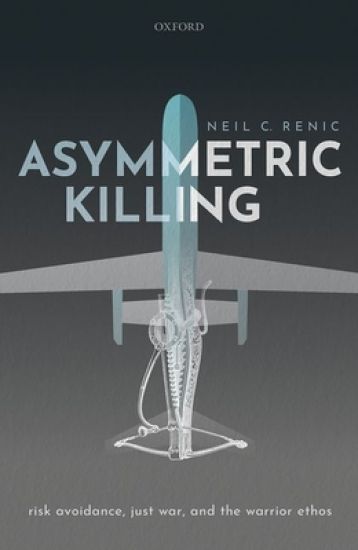
Asymmetric Killing

Asymmetric Killing

Neil C. Renic

Oxford University Press
2020
sidottu
This book offers an engaging and historically informed account of the moral challenge of radically asymmetric violence -- warfare conducted by one party in the near-complete absence of physical risk, across the full scope of a conflict zone. What role does physical risk and material threat play in the justifications for killing in war? And crucially, is there a point at which battlefield violence becomes so one-directional as to undermine the moral basis for its use? In order to answers these questions, Asymmetric Killing delves into the morally contested terrain of the warrior ethos and Just War Tradition, locating the historical and contemporary role of reciprocal risk within both. This book also engages two historical episodes of battlefield asymmetry, military sniping and manned aerial bombing. Both modes of violence generated an imbalance of risk between opponents so profound as to call into question their permissibility. These now-resolved controversies will then be contrasted with the UAV-exclusive violence of the United States, robotic killing conducted in the absence of a significant military ground presence in conflict theatres such as Pakistan, Yemen, and Somalia. As will be revealed, the radical asymmetry of this latter case is distinct, undermining reciprocal risk at the structural level of war. Beyond its more resolvable tension with the warrior ethos, UAV-exclusive violence represents a fundamental challenge to the very coherence of the moral justifications for killing in war.
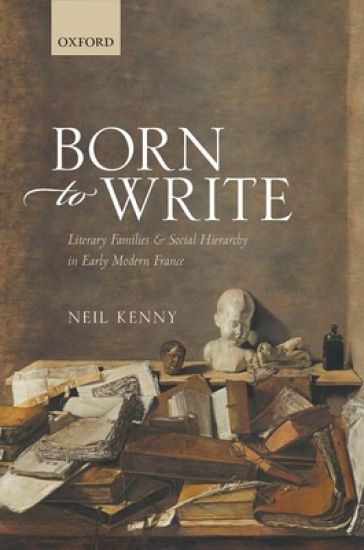
Born to Write

Born to Write

Neil Kenny

Oxford University Press
2020
sidottu
It is easy to forget how deeply embedded in social hierarchy was the literature and learning that has come down to us from the early modern European world. From fiction to philosophy, from poetry to history, works of all kinds emerged from and through the social hierarchy that was a fundamental fact of everyday life. Paying attention to it changes how we might understand and interpret the works themselves, whether canonical and familiar or largely forgotten. But a second, related fact is much overlooked too: works also often emanated from families, not just from individuals. Families were driving forces in the production--that is, in the composing, editing, translating, or publishing--of countless works. Relatives collaborated with each other, edited each other, or continued the unfinished works of deceased family members; some imitated or were inspired by the works of long-dead relatives. The reason why this second fact (about families) is connected to the first (about social hierarchy) is that families were in the period a basic social medium through which social status was claimed, maintained, threatened, or lost. So producing literary works was one of the many ways in which families claimed their place in the social world. The process was however often fraught, difficult, or disappointing. If families created works as a form of socio-cultural legacy that might continue to benefit their future members, not all members benefited equally; women sometimes produced or claimed the legacy for themselves, but they were often sidelined from it. Relatives sometimes disagreed bitterly about family history, identity (not least religious), and so about the picture of themselves and their family that they wished to project more widely in society through their written works, whether printed or manuscript. So although family was a fundamental social medium out of which so many works emerged, that process could be conflictual as well as harmonious. The intertwined role of family and social hierarchy within literary production is explored in this book through the case of France, from the late fifteenth to the mid-seventeenth century. Some families are studied here in detail, such as that of the most widely read French poet of the age, Clément Marot. But the extent of this phenomenon is quantified too: some two hundred families are identified as each containing more than one literary producer, and in the case of one family an extraordinary twenty-seven.
War in the Mountains

War in the Mountains

Neil Macmaster

Oxford University Press
2020
sidottu
The role of the peasantry during the Algerian War of Independence (1954-1962) has long been neglected by historians, in part because they have been viewed as a 'primitive' mass devoid of political consciousness. War in the Mountains: Peasant Society and Counterinsurgency in Algeria, 1918-1958 challenges this conventional understanding by tracing the ability of the peasant community to sustain an autonomous political culture through family, clan, and village assemblies. The long-established system of indirect rule by which the colonial state controlled and policed the vast mountainous interior of Algeria began to break down after the 1920s. War in the Mountains explains how competing guerrilla forces and the French military sought to harness djemâas as part of a hearts-and-minds strategy. Djemâas formed a pole of opposition to the patron-client relations of the rural élites, with clandestine urban-rural networks emerging that prepared the way for armed resistance and a system of rebel governance. Contrary to accepted historical analysis suggesting that rural society was massively uprooted and dislocated, War in the Mountains demonstrates that the peasantry demonstrated a high level of social cohesion and resistance based on powerful family and kin networks.