Kirjojen hintavertailu. Mukana 11 244 527 kirjaa ja 12 kauppaa.

Kirjahaku

Etsi kirjoja tekijän nimen, kirjan nimen tai ISBN:n perusteella.

1000 tulosta hakusanalla Octavia Butler

Problemas de fisica para la escuela secundaria-Mecanica

Problemas de fisica para la escuela secundaria-Mecanica

Octavian Radu

Createspace Independent Publishing Platform
2017
nidottu
Esta colecci n de problemas de mec nica est destinada, en particular, a los estudiantes de los institutos te ricos e industriales, as como a los estudiantes del 9 grado y a los que se preparan para ser admitidos en las facultades o las Ol mpiadas de f sica. La colecci n tambi n es til, por supuesto, de una manera espec fica, a los profesores de f sica en la educaci n preuniversitaria. Dado que la mec nica presenta para muchos estudiantes cierta dificultad para entender con respecto a otras partes de la f sica, tanto como el hecho (conocido) que la preparaci n para este dominio (en particular, para la admisi n en las facultades) debe ser iniciado por los estudiantes desde el primer momento de los estudios secundarios (el noveno grado), podemos afirmar que esta colecci n de problemas aborda un rea de gran importancia para la preparaci n de estudiantes de secundaria en F sica. El documento elaborado contiene 120 problemas de mec nica, casi todos ellos de alta originalidad. Adem s de la contribuci n del autor a resaltar nuevos aspectos en el campo de la mec nica f sica estudiada en la escuela secundaria y su transposici n en problemas, hay que se alar que los temas relacionados con la tecnolog a, y muchos de los problemas corresponden a unos aspectos observados por los alumnos en la vida cotidiana . Las soluciones presentadas son correctas. Hay que se alar que el autor encuentra soluciones accesibles para la gran mayor a de los estudiantes, y por lo tanto a los estudiantes de las escuelas secundarias industriales. El trabajo representa una colecci n de aplicaciones (problemas) del conjunto de conocimientos de mec nica adquirido por los estudiantes de 9 grado. Por esta raz n, el trabajo est especialmente indicado para la evaluaci n trimestral y anual del 9 grado, tanto como para la preparaci n de los estudiantes para las Olimpiadas de f sica. El autor de este compendio, el profesor de f sica OCTAVIAN RADU, es uno de los profesores m s activos y con m s talento de Bucarest; los estudiantes de sus clases, o preparados por l en el mbito de los c rculos de f sica dedicados a los mejores alumnos de Bucarest obteniendo a o tras a o resultados muy buenos en las Olimpiadas de f sica. La interesante tem tica, la selecci n inspirada y la originalidad de muchos de los temas propuestos, la exactitud de las soluciones ofrecidas, la accesibilidad de gran parte de los resultados para la mayor a de nuestros alumnos, aseguraran a este trabajo un amplio y merecido inter s en nuestro mbito educativo. Prof. Univ. Dr. Fis. DAN IORDACHEINSTITUTO POLITECNICO DE BUCAREST

La porcelana en el escaparate: Novela sin amor al amor

La porcelana en el escaparate: Novela sin amor al amor

Octavio de la Suaree

Createspace Independent Publishing Platform
2017
nidottu
La porcelana en el escaparate fue una novela que -al decir de Candelario Hern ndez Larrondo- traz el rumbo de la novel stica cubana, tuvo vigencia por mucho tiempo y satisfizo a la mayor a. Sin embargo, por su publicaci n clandestina en 1927, y a pesar de ser defendida por Ram n Vasconcelos, su autor estuvo encarcelado por dos meses y la obra fue decomisada por inmoral. Las siguientes palabras de Oscar Wilde tambi n defienden a La Suar e: No hay libros morales ni amorales. Los libros est n bien escritos o mal escritos.
El Arreglo: (comedia Asilvestrada)

El Arreglo: (comedia Asilvestrada)

Octavio Sanchez-Machuca

Independently Published
2018
nidottu
Novela de humor en la que se entremezclan personajes de vida pausada y gris con situaciones impensables, definidas tanto por la ubicaci n geogr fica de la historia central como por los ex ticos elementos que aparecen de forma escalonada, hasta completar una maravillosa concatenaci n de disparates que nos permiten disfrutar de una lectura amena, relajada e hilarante.
Ayuno Intermitente

Ayuno Intermitente

Octavio Moreno

Micheal Kannedy
2020
pokkari
Si te dijera que hay una dieta que te permite quemar m s grasa, ganar m sculo y disfrutar de los beneficios de una vida m s larga, saludable y m s productiva, querr as saberlo? Si es as , entonces este es el libro que has estado esperando.Descubre la forma de comer que te har bajar de peso, controlar tus niveles de insulina naturalmente y ganar m s a os. Incluso si no tienes tiempo para dietas, cambios de h bitos o tienes una alimentaci n con requerimientos especiales, descubrir s que esta forma de comer se adapta a tu estilo de vida. Recomendable para cualquier persona en edad adulta, segura y estudiada por cient ficos alrededor del mundo, el Ayuno Intermitente es la forma de alimentaci n del futuro. El ayuno intermitente es una pr ctica que la humanidad ha estado utilizando por miles de a os como un medio para lograr una supervivencia y conectar con el lado mas m stico de la vida. Hoy en d a ha estado ganando nuevos adeptos gracias a su capacidad para ayudar a las personas a perder peso, al mismo tiempo que tambi n les permite absorber una mayor cantidad de nutrientes de los alimentos que comen.
Advanced Polytopic Projects

Advanced Polytopic Projects

Octavian Iordache

Springer Nature Switzerland AG
2018
sidottu
This book focuses on new developments in polytopic projects, particularly on implementation domains and case studies, as well as high-dimensional methodology. Polytopic projects are based on a general reference architecture inspired and shared by the functional organization of organisms and enterprises as informational and cognitive systems, the scientific and engineering methodology and the operational structure of existing self-evolvable and self-sustainable systems.
Advanced Polytopic Projects

Advanced Polytopic Projects

Octavian Iordache

Springer Nature Switzerland AG
2019
nidottu
This book focuses on new developments in polytopic projects, particularly on implementation domains and case studies, as well as high-dimensional methodology. Polytopic projects are based on a general reference architecture inspired and shared by the functional organization of organisms and enterprises as informational and cognitive systems, the scientific and engineering methodology and the operational structure of existing self-evolvable and self-sustainable systems.
Polytopic Roadmaps

Polytopic Roadmaps

Octavian Iordache

Springer Nature Switzerland AG
2021
sidottu
This book is useful to engineers, researchers, entrepreneurs, and students in different branches of production, engineering, and systems sciences. The polytopic roadmaps are the guidelines inspired by the development stages of cognitive-intelligent systems, and expected to become powerful instruments releasing an abundance of new capabilities and structures for complex engineering systems implementation. The 4D approach developed in previous monographs and correlated with industry 4.0and Fourth Industrial Revolution is continued here toward higher dimensions approaches correlated with polytopic operations, equipment, technologies, industries, and societies. Methodology emphasizes the role of doubling, iteration, dimensionality, and cyclicality around the center, of periodic tables and of conservative and exploratory strategies. Partitions, permutations, classifications, and complexification, as polytopic chemistry, are the elementary operations analyzed. Multi-scale transfer, cyclicoperations, conveyors, and assembly lines are the practical examples of operations and equipment. Polytopic flow sheets, online analytical processing, polytopic engineering designs, and reality-inspired engineering are presented. Innovative concepts such as Industry 5.0, polytopic industry, Society 5.0, polytopic society, cyber physical social systems, industrial Internet, and digital twins have been discussed. The general polytopic roadmaps, (GPTR), are proposed as universal guidelines and as common methodologies to synthesize the systemic thinking and capabilities for growing complexity projects implementation.
Polytopic Roadmaps

Polytopic Roadmaps

Octavian Iordache

Springer Nature Switzerland AG
2022
nidottu
This book is useful to engineers, researchers, entrepreneurs, and students in different branches of production, engineering, and systems sciences. The polytopic roadmaps are the guidelines inspired by the development stages of cognitive-intelligent systems, and expected to become powerful instruments releasing an abundance of new capabilities and structures for complex engineering systems implementation. The 4D approach developed in previous monographs and correlated with industry 4.0and Fourth Industrial Revolution is continued here toward higher dimensions approaches correlated with polytopic operations, equipment, technologies, industries, and societies. Methodology emphasizes the role of doubling, iteration, dimensionality, and cyclicality around the center, of periodic tables and of conservative and exploratory strategies. Partitions, permutations, classifications, and complexification, as polytopic chemistry, are the elementary operations analyzed. Multi-scale transfer, cyclicoperations, conveyors, and assembly lines are the practical examples of operations and equipment. Polytopic flow sheets, online analytical processing, polytopic engineering designs, and reality-inspired engineering are presented. Innovative concepts such as Industry 5.0, polytopic industry, Society 5.0, polytopic society, cyber physical social systems, industrial Internet, and digital twins have been discussed. The general polytopic roadmaps, (GPTR), are proposed as universal guidelines and as common methodologies to synthesize the systemic thinking and capabilities for growing complexity projects implementation.
Roads to Higher Dimensional Polytopic Projects

Roads to Higher Dimensional Polytopic Projects

Octavian Iordache

Springer International Publishing AG
2022
sidottu
High dimensional reference architectures presented here allows confronting and prevailing over the growing complexity of polytopic projects implementations.Such projects should be envisaged giving that conventional systems operations, equipments, methodologies or organizations will reach their limits for self-evolvability in high complexity conditions. Self-evolvable high complexity systems are based on high dimensional polytopic reference architectures.Polytope is the general term of the sequence: point, line, polygon, polyhedron and so on.The polytopic projects are targeting the artificiality, not only for materials where it is well known and applied, but also for biological, cognitive, intelligent and mathematical systems. The book highlights the polytopic projects basic similarity despite the noticeable difference as domains of application. The roads to follow and the algebra of changing roads are emphasized.The book is divided in 9 chapters. Chapter 1 introduces the Polytopic Roadmap to 4D and beyond. The role for the dialogue of processes in duality of the non-Aristotelian Logic of Contradiction and of Included Middle is emphasized for different domains. Chapter 2 refers to chemical systems. Supramolecular chemistry, metal organic frameworks, MOF, and reaction networks, are the examples considered in the frame of polytopic chemistry. Chapter 3 refers to biological systems. Biological dynamical hierarchies and quasi-species are the considered case studies. Technological and scientific projects targeting artificiality for cells and viruses are considered. Chapter 4 refers to cognitive systems. Developmental stages, formal and relational concepts analysis, and neural coding are considered here. The roles of the 4D systems of systems of systems and of conceptual 4D-cube are emphasized. Artificiality for cognitive systems is the object of study.Chapter 5 refers to mathematical systems. Modeling levels and the 4D digital twins are discussed. Hopf monoids as tools for the study of combinations and separations, dual graded graphs and V-models are informally presented. Chapter 6 refers to application of formal concept analysis, FCA, for high dimensional separations, nesting and drug delivery. Chapter 7 refers to polytopic engineering systems as multiscale transfer, distributors-collectors, cyclic operations, middle vessel columns, mixing, assembly and designs. Equipments have been characterized using Polytopic Roadmaps and classified by Periodic Tables. Chapter 8 introduces polytopic industry, economy, society and sustainability. Chapter 9 outlines new domains of interest as arts and architecture, transdisciplinarity, complex systems and unity of sciences and engineering.Polytopic Roadmaps are proposed as Method for experts from various fields to synthesize their thinking and capabilities into new projects implementation to face and surpass high complexity. A repetitive finding of this book is that self-evolvability observed in physical systems is based on the same directed sequence of reference architectures as the self-evolvability of concepts in our mind. Continuing to develop the field of self-evolvable systems and presenting the polytopic roadmaps for 4D and beyond advances in ever growing complexity domains, the book will be useful to engineers, researchers, entrepreneurs and students in different branches of production, complex systems sciences and engineering, ecology and applied mathematics.
Roads to Higher Dimensional Polytopic Projects

Roads to Higher Dimensional Polytopic Projects

Octavian Iordache

Springer International Publishing AG
2023
nidottu
High dimensional reference architectures presented here allows confronting and prevailing over the growing complexity of polytopic projects implementations.Such projects should be envisaged giving that conventional systems operations, equipments, methodologies or organizations will reach their limits for self-evolvability in high complexity conditions. Self-evolvable high complexity systems are based on high dimensional polytopic reference architectures.Polytope is the general term of the sequence: point, line, polygon, polyhedron and so on.The polytopic projects are targeting the artificiality, not only for materials where it is well known and applied, but also for biological, cognitive, intelligent and mathematical systems. The book highlights the polytopic projects basic similarity despite the noticeable difference as domains of application. The roads to follow and the algebra of changing roads are emphasized.The book is divided in 9 chapters. Chapter 1 introduces the Polytopic Roadmap to 4D and beyond. The role for the dialogue of processes in duality of the non-Aristotelian Logic of Contradiction and of Included Middle is emphasized for different domains. Chapter 2 refers to chemical systems. Supramolecular chemistry, metal organic frameworks, MOF, and reaction networks, are the examples considered in the frame of polytopic chemistry. Chapter 3 refers to biological systems. Biological dynamical hierarchies and quasi-species are the considered case studies. Technological and scientific projects targeting artificiality for cells and viruses are considered. Chapter 4 refers to cognitive systems. Developmental stages, formal and relational concepts analysis, and neural coding are considered here. The roles of the 4D systems of systems of systems and of conceptual 4D-cube are emphasized. Artificiality for cognitive systems is the object of study.Chapter 5 refers to mathematical systems. Modeling levels and the 4D digital twins are discussed. Hopf monoids as tools for the study of combinations and separations, dual graded graphs and V-models are informally presented. Chapter 6 refers to application of formal concept analysis, FCA, for high dimensional separations, nesting and drug delivery. Chapter 7 refers to polytopic engineering systems as multiscale transfer, distributors-collectors, cyclic operations, middle vessel columns, mixing, assembly and designs. Equipments have been characterized using Polytopic Roadmaps and classified by Periodic Tables. Chapter 8 introduces polytopic industry, economy, society and sustainability. Chapter 9 outlines new domains of interest as arts and architecture, transdisciplinarity, complex systems and unity of sciences and engineering.Polytopic Roadmaps are proposed as Method for experts from various fields to synthesize their thinking and capabilities into new projects implementation to face and surpass high complexity. A repetitive finding of this book is that self-evolvability observed in physical systems is based on the same directed sequence of reference architectures as the self-evolvability of concepts in our mind. Continuing to develop the field of self-evolvable systems and presenting the polytopic roadmaps for 4D and beyond advances in ever growing complexity domains, the book will be useful to engineers, researchers, entrepreneurs and students in different branches of production, complex systems sciences and engineering, ecology and applied mathematics.
Air Navigation

Air Navigation

Octavian Thor Pleter

Springer International Publishing AG
2024
sidottu
This book takes a new approach to air navigation, extending the classic scope of positioning and guidance to efficient and safe 4D flight trajectory management. Modern air navigation aims at flight trajectories optimisation. There is an infinite number of solutions to the classic navigation problem of flying from one airport to another, but most of them are wasteful of resources and even risky. Minimising all costs and risks incurred by the 4D flight trajectory makes air navigation both efficient and safe, which are key factors in air navigation services. Beyond minimising fuel burn and CO2, efficiency addresses non-CO2 emissions and noise. This is a visually intensive book, using examples and case studies to illustrate the concepts, the physics of navigation and the mathematical models involved. Numerical examples reflect its problem-solving nature. It is useful to aerospace students, engineers, pilots, air traffic controllers, technicians, and scientists curious about aviation.
Air Navigation

Air Navigation

Octavian Thor Pleter

Springer International Publishing AG
2025
nidottu
This book takes a new approach to air navigation, extending the classic scope of positioning and guidance to efficient and safe 4D flight trajectory management. Modern air navigation aims at flight trajectories optimisation. There is an infinite number of solutions to the classic navigation problem of flying from one airport to another, but most of them are wasteful of resources and even risky. Minimising all costs and risks incurred by the 4D flight trajectory makes air navigation both efficient and safe, which are key factors in air navigation services. Beyond minimising fuel burn and CO2, efficiency addresses non-CO2 emissions and noise. This is a visually intensive book, using examples and case studies to illustrate the concepts, the physics of navigation and the mathematical models involved. Numerical examples reflect its problem-solving nature. It is useful to aerospace students, engineers, pilots, air traffic controllers, technicians, and scientists curious about aviation.
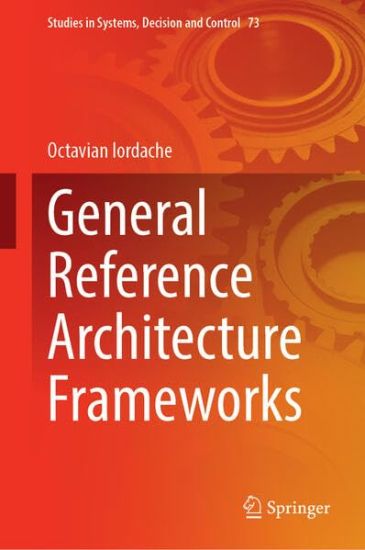
General Reference Architecture Frameworks

General Reference Architecture Frameworks

Octavian Iordache

Springer International Publishing AG
2024
sidottu
Studying high complexity projects implementation is the object of this book. Multiple interactions and emergences are the core of higher complexity and of associated models and projects. The starting point of our approach is the observed similarity or isomorphism of roadmaps toward higher complexity and of reference architectures for different domains of reality. The objective is to propose a General Polytopic Roadmaps (GPTR) and a General Reference Architecture Framework (GRAF) and use these for 8D Program implementation. The GPTR shows the stages: 0D, 1D, 2D, 4D, and 8D. The book is divided into 8 chapters. Chapter 1 introduces the GRAF as a 4D of 4D polytope. Chapter 2 emphasizes the role for the dialogue of processes in duality, of the logic of contradiction, of iteration and of included middle to face high complexity. Chapter 3 refers to operations and equipments of engineering interest as permutations, mixings and separations. Chapter 4 refers to modeling and simulation. Chapter 5 concerns creative design models. Dual process design, and processes integration are presented. Industry 4.0, future developments to Industry 8.0 and chemical engineering paradigms are evaluated in Chapter 6. Chapter 7 focuses on complex systems as production systems of systems architecture frameworks, decision models, operations processes, and cyber-physical social systems. Chapter 8 discusses implementation of high complexity projects for different levels of reality. The book is useful to engineers, researchers, entrepreneurs, and students in different branches of production, science, and engineering of high complexity.
Computational Counterpoint Worlds

Computational Counterpoint Worlds

Octavio Alberto Agustín-Aquino; Julien Junod; Guerino Mazzola

Springer International Publishing AG
2015
sidottu
The mathematical theory of counterpoint was originally aimed at simulating the composition rules described in Johann Joseph Fux’s Gradus ad Parnassum. It soon became apparent that the algebraic apparatus used in this model could also serve to define entirely new systems of rules for composition, generated by new choices of consonances and dissonances, which in turn lead to new restrictions governing the succession of intervals. This is the first book bringing together recent developments and perspectives on mathematical counterpoint theory in detail. The authors include recent theoretical results on counterpoint worlds, the extension of counterpoint to microtonal pitch systems, the singular homology of counterpoint models, and the software implementation of contrapuntal models. The book is suitable for graduates and researchers. A good command of algebra is a prerequisite for understanding the construction of the model.
Computational Counterpoint Worlds

Computational Counterpoint Worlds

Octavio Alberto Agustín-Aquino; Julien Junod; Guerino Mazzola

Springer International Publishing AG
2016
nidottu
The mathematical theory of counterpoint was originally aimed at simulating the composition rules described in Johann Joseph Fux’s Gradus ad Parnassum. It soon became apparent that the algebraic apparatus used in this model could also serve to define entirely new systems of rules for composition, generated by new choices of consonances and dissonances, which in turn lead to new restrictions governing the succession of intervals. This is the first book bringing together recent developments and perspectives on mathematical counterpoint theory in detail. The authors include recent theoretical results on counterpoint worlds, the extension of counterpoint to microtonal pitch systems, the singular homology of counterpoint models, and the software implementation of contrapuntal models. The book is suitable for graduates and researchers. A good command of algebra is a prerequisite for understanding the construction of the model.
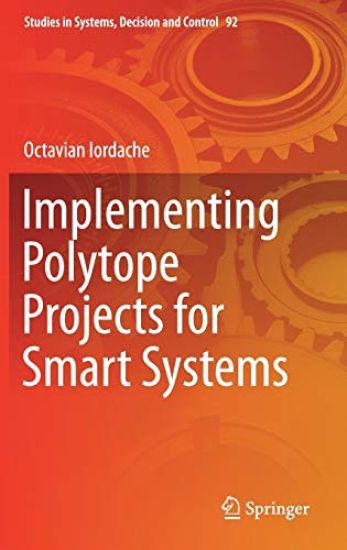
Implementing Polytope Projects for Smart Systems

Implementing Polytope Projects for Smart Systems

Octavian Iordache

Springer International Publishing AG
2017
sidottu
This book presents a domain of extreme industrial and scientific interest: the study of smart systems and structures. It presents polytope projects as comprehensive physical and cognitive architectures that support the investigation, fabrication and implementation of smart systems and structures. These systems feature multifunctional components that can perform sensing, control, and actuation. In light of the fact that devices, tools, methodologies and organizations based on electronics and information technology for automation, specific to the third industrial revolution, are increasingly reaching their limits, it is essential that smart systems be implemented in industry. Polytope projects facilitate the utilization of smart systems and structures as key elements of the fourth industrial revolution.The book begins by presenting polytope projects as a reference architecture for cyber-physical systems and smart systems, before addressing industrial process synthesis inChapter 2. Flow-sheet trees, cyclic separations and smart configurations for multi-component separations are discussed here. In turn, Chapter 3 highlights periodic features for drug delivery systems and networks of chemical reactions, while Chapter 4 applies conditioned random walks to polymers and smart materials structures. Chapter 5 examines self-assembly and self-reconfiguration at different scales from molecular to micro systems. Smart devices and technologies are the focus of chapter 6. Modular micro reactor systems and timed automata are examined in selected case studies. Chapter 7 focuses on inferential engineering designs, concept-knowledge, relational concept analysis and model driven architecture, while Chapter 8 puts the spotlight on smart manufacturing, industry 4.0, reference architectures and models for new product development and testing. Lastly, Chapter 9 highlights the polytope projects methodology and the prospects for smart systems and structures.Focusing onprocess engineering and mathematical modeling for the fourth industrial revolution, the book offers a unique resource for engineers, scientists and entrepreneurs working in chemical, biochemical, pharmaceutical, materials science or systems chemistry, students in various domains of production and engineering, and applied mathematicians.
Implementing Polytope Projects for Smart Systems

Implementing Polytope Projects for Smart Systems

Octavian Iordache

Springer International Publishing AG
2018
nidottu
This book presents a domain of extreme industrial and scientific interest: the study of smart systems and structures. It presents polytope projects as comprehensive physical and cognitive architectures that support the investigation, fabrication and implementation of smart systems and structures. These systems feature multifunctional components that can perform sensing, control, and actuation. In light of the fact that devices, tools, methodologies and organizations based on electronics and information technology for automation, specific to the third industrial revolution, are increasingly reaching their limits, it is essential that smart systems be implemented in industry. Polytope projects facilitate the utilization of smart systems and structures as key elements of the fourth industrial revolution.The book begins by presenting polytope projects as a reference architecture for cyber-physical systems and smart systems, before addressing industrial process synthesis inChapter 2. Flow-sheet trees, cyclic separations and smart configurations for multi-component separations are discussed here. In turn, Chapter 3 highlights periodic features for drug delivery systems and networks of chemical reactions, while Chapter 4 applies conditioned random walks to polymers and smart materials structures. Chapter 5 examines self-assembly and self-reconfiguration at different scales from molecular to micro systems. Smart devices and technologies are the focus of chapter 6. Modular micro reactor systems and timed automata are examined in selected case studies. Chapter 7 focuses on inferential engineering designs, concept-knowledge, relational concept analysis and model driven architecture, while Chapter 8 puts the spotlight on smart manufacturing, industry 4.0, reference architectures and models for new product development and testing. Lastly, Chapter 9 highlights the polytope projects methodology and the prospects for smart systems and structures.Focusing onprocess engineering and mathematical modeling for the fourth industrial revolution, the book offers a unique resource for engineers, scientists and entrepreneurs working in chemical, biochemical, pharmaceutical, materials science or systems chemistry, students in various domains of production and engineering, and applied mathematicians.