Kirjojen hintavertailu. Mukana 11 473 511 kirjaa ja 12 kauppaa.

Kirjahaku

Etsi kirjoja tekijän nimen, kirjan nimen tai ISBN:n perusteella.

1000 tulosta hakusanalla Philo

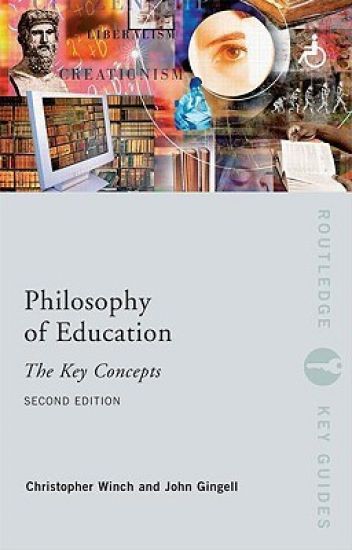
Philosophy of Education: The Key Concepts

Philosophy of Education: The Key Concepts

John Gingell; Christopher Winch

Routledge
2008
nidottu
This new edition of Philosophy of Education: The Key Concepts is an easy to use A-Z guide summarizing all the key terms, ideas and issues central to the study of educational theory today. Fully updated, the book is cross-referenced throughout and contains pointers to further reading, as well as new entries on such topics as: Citizenship and Civic Education Liberalism Capability Well-being Patriotism Globalisation Open-mindedness Creationism and Intelligent Design. Comprehensive and authoritative this highly accessible guide provides all that a student, teacher or policy-maker needs to know about the latest thinking on education in the 21st century.'
Philosophy: Mini-set D 7 vols
Originally published between 1955 and 1981 the volumes in this mini-set include works by G E von Grünebaum, Seyyed Hossein Nasr, F Rahman, and A J Wensinck. Examining the nature and growth of the cultural tradition of Islam, the volumes in this set cover Islamic life and thought, the role of the Prophet, prophecy in Islam, the Crusades and problems of the twentieth century Arab world.
Philosophy of Language
What do ‘meaning’ and ‘truth’ mean? And how are they situated in the concrete practices of linguistic communication? What is the relationship between words and the world? How—with words—can people do such varied things as marry, inaugurate a president, and declare a country’s independence? How is language able to express knowledge, belief, and other mental states? What are metaphors and how do they work? Is a mathematically rigorous account of language possible? Does language make women invisible and encode a male worldview?These are the kind of questions that have been addressed by philosophers of language since ancient times. Interest in the subject stretches back to the beginnings of western philosophy (for instance, in his Academy, Plato considered the question whether the names of things were deemed by convention or by nature). Interest in the philosophy of language has also been enduring—and has blossomed anew in the past century.This new title in the Routledge series, Critical Concepts in Philosophy, meets the need for an authoritative reference work to make sense of the subject’s vast literature and the continuing explosion in research output. Edited by A. P. Martinich, one of the subdiscipline’s leading scholars, this collection brings together in four volumes the canonical and the very best cutting-edge scholarship in the field to provide a synoptic view of all the key issues, figures, concepts, and current debates.With comprehensive introductions to each volume, newly written by the editor, which place the collected material in its historical and intellectual context, Philosophy of Language is an essential work of reference and is destined to be valued by philosophers and linguists—as well as psychologists and cognitive scientists working on language—as a vital research resource.
Philosophy of Religion
The past forty years or so have witnessed a renaissance in the philosophy of religion. New tools (modal logic, probability theory, and so on) and new historical research have prompted many thinkers to take a fresh look at old topics (God’s existence, the problem of evil, faith and reason, and the like). Moreover, sophisticated examinations of contentious new issues, such as the problem of religious diversity or the role of emotions and other non-evidential factors in shaping rationally held religious beliefs, have also emerged.Addressing the need for an authoritative reference work to make sense of this rapidly growing and ever more complex corpus of scholarly literature, Philosophy of Religion is a new title in the Routledge Major Works series, Critical Concepts in Philosophy. Edited by a leading scholar, it is a four-volume collection which brings together key examples of the most important recent work, together with carefully selected historical pieces needed to understand them. Volume I focuses on concepts of the divine while Volume II explores arguments for and against the existence of a divine reality, with special attention to the problem of evil, the problem of divine hiddenness, and the case for naturalism. Volume III and the first part of Volume IV are devoted to broadly epistemic issues: the cognitive value of religious experience; the proper role of evidence in the formation of religious belief; the nature of justified religious belief; and pragmatic arguments for religious belief. The remainder of Volume IV introduces some of the best recent work on religious diversity, tolerance, and the public role of religion in a pluralistic society.The Philosophy of Religion is fully indexed and has a comprehensive introduction, newly written by the editor, which places the material in its historical and intellectual context. It is an essential work of reference and is destined to be valued by scholars and students as a vital one-stop research resource.Available now at a special introductory price. This price is applicable until 3 months after publication. For more information, please contact us ([email protected]).
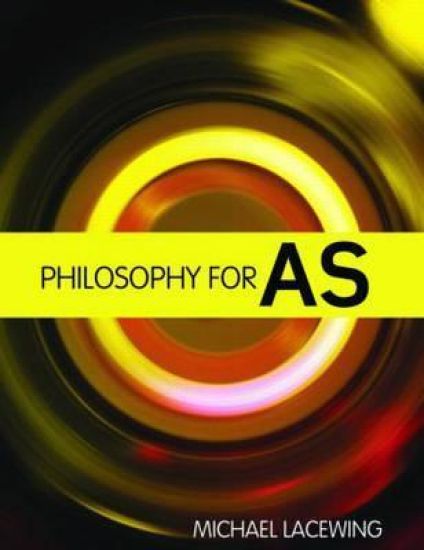
Philosophy for AS

Philosophy for AS

Michael Lacewing

Routledge
2008
nidottu
Philosophy for AS is the definitive textbook for students of the current AQA Advanced Subsidiary Level. Structured closely around the examination specifications, it covers the two units of the AS Level in an exceptionally clear and student-friendly style. As an invitation to philosophy, the book encourages and enables students to engage philosophically with the following syllabus topics: reason and experienceWhy should I be governed? Why should I be moral? the idea of Godpersonsknowledge of the external worldtolerance the value of art God and the world the debate about free will and determinism.Each chapter contains an introduction to the basic ideas, arguments and objections of the issue, and a development section, which clarifies the previous material, introduces more complex ideas, and encourages students to link up ideas and draw new implications. To aid student learning and revision, each chapter includes: comprehension questions to test core knowledge discussion questions to deepen understanding 'going further' sections for advanced study cross-references to help students make connections helpful summaries and a glossary. In addition, a chapter on exam preparation contains a wealth of helpful hints and tips on revision and exam techniques. Written by an experienced philosopher and A Level consultant, Philosophy for AS is an essential course book for all students of AS Level philosophy.
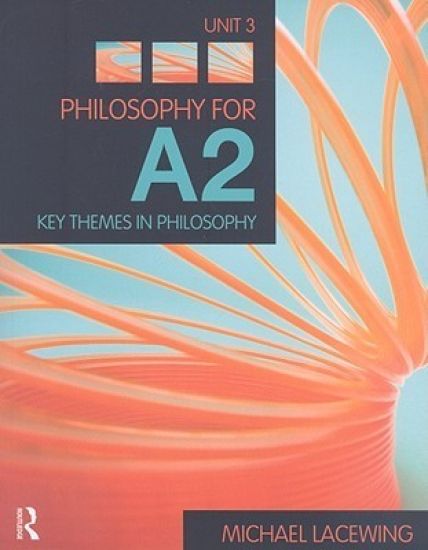
Philosophy for A2: Unit 3

Philosophy for A2: Unit 3

Michael Lacewing

Routledge
2009
nidottu
Philosophy for A2: Unit 3 is the definitive textbook for students of the current AQA Advanced Level syllabus. Structured very closely around the AQA specifications for Unit 3: Key Themes in Philosophy, it introduces the student to each of the core themes:philosophy of mind political philosophy epistemology and metaphysics moral philosophy philosophy of religion.All chapters are helpfully subdivided into short digestible passages, and include: quiz questions to test core knowledge discussion questions to deepen understanding 'going further' sections for advanced study text boxes highlighting key definitions and arguments cross-references to help students make connections lively illustrations, diagrams and a glossary. In addition, a chapter on exam preparation contains a wealth of helpful hints and tips on revision and exam techniques. Written by an experienced philosopher and A Level consultant, Philosophy for A2: Unit 3 is an essential companion for all students of A2 Level philosophy.
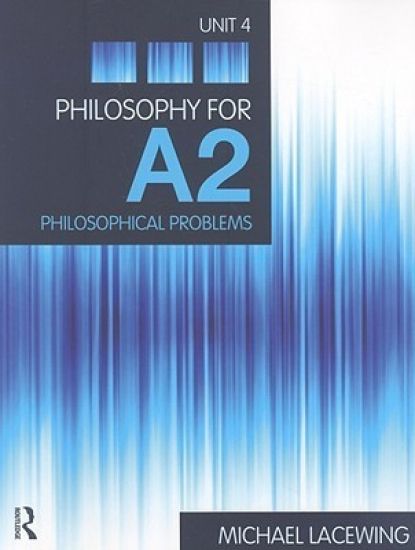
Philosophy for A2: Unit 4

Philosophy for A2: Unit 4

Michael Lacewing

Routledge
2009
nidottu
Philosophy for A2: Unit 4 is the definitive textbook for students of the current AQA Advanced Level syllabus for philosophy. Structured very closely around the AQA specifications for Unit 4: Philosophical Problems, Michael Lacewing helps students to engage with and understand the arguments of the five key texts:Hume's An Enquiry Concerning Human Understanding Plato's The Republic Mill's On Liberty Descartes' Meditations Nietzsche's Beyond Good and Evil.All chapters are helpfully subdivided into short digestible passages, and include: quiz questions to test core knowledge discussion questions to deepen understanding 'going further' sections for advanced study text boxes highlighting key definitions and arguments cross-references to help students make connections. In addition, a chapter on exam preparation contains a wealth of helpful hints and tips on revision and exam techniques. Written by an experienced philosopher and A Level consultant, Philosophy for A2: Unit 4 is an essential companion for all students of A2 Level philosophy.
Philosophies of India

Philosophies of India

Heinrich Zimmer

Routledge
2008
sidottu
Originally published in 1973. The volume is divided into four sections: The introduction places the position of the Buddhist Tantras within Mahayana Buddhism and recalls their early literary history, especially the Guhyasamahatantra; the section also covers Buddhist Genesis and the Tantric tradition. The foundations of the Buddhist Tantras are discussed and the Tantric presentation of divinity; the preparation of disciples and the meaning of initiation; symbolism of the mandala-palace Tantric ritual and the twilight language. This section explores the Tantric teachings of the inner Zodiac and the fivefold ritual symbolism of passion. The bibliographical research contains an analysis of the Tantric section of the Kanjur exegesis and a selected Western Bibliography of the Buddhist Tantras with comments.
Philosophy of Mind
Philosophy of Mind is concerned with fundamental issues about the relation between mind and body and mind and world, and with the nature of the diverse variety of mental phenomena, such as thought, self-knowledge, consciousness, perception, sensation, and emotion. Philosophers of mind explore some of the most perplexing questions about our mental lives. For instance: How exactly is the mental related to the physical? How is it that our thoughts can reach out to reality and refer to objects distant in time and space? What is consciousness? Can it be explained by science? How is thought related to language? Can animals think? Is there some one thing, some special property, that all mental phenomena share that distinguishes them from non-mental phenomena? To what extent has the computer helped us to understand the nature of mind? Does emotion play a larger role in our rationality that has previously been thought?For as long as humanity has sought an understanding of its place in the universe, philosophy of mind has been at the centre of philosophy, but it flourishes now as it has never done before. This new title in the Routledge’s Major Works series, Critical Concepts in Philosophy, meets the need for an authoritative reference work to make sense of the subject’s enormous literature and the continuing explosion in research output. Edited by Sean Crawford, a prominent scholar in the field, it is a four-volume collection of classic and contemporary contributions to all of the major debates in philosophy of mind.With comprehensive introductions to each volume, newly written by the editor, which place the collected material in its historical and intellectual context, Philosophy of Mind is an essential work of reference and is destined to be valued by philosophers of mind—as well as those working in allied areas such as metaphysics, epistemology, and philosophy of language; and cognate disciplines such as psychology—as a vital research tool.
Philosophical Essays

Philosophical Essays

Bertrand Russell

Routledge
2009
nidottu
First published in 1910, Philosophical Essays is one of Bertrand Russell’s earliest works and marks an important period in the evolution of thought of one of the world’s most influential thinkers. This selection of seven essays displays Russell's incisiveness and brilliance of exposition in the examination of ethical subjects and the nature of truth. Insightful and highly accessible, these essays are as illuminating today as they were on first publication.
Philosophy of Science and Sociology

Philosophy of Science and Sociology

Edmund Mokrzycki

Routledge
2008
sidottu
Originally published in 1983. This book concentrates on the impact of philosophy of science on sociology and other disciplines. It argues that the impact of the philosophy of science on sociology from the rise of the Vienna Circle until the mid-1980s resulted in a deep-reaching and, in the author’s view, undesirable methodological reorientation in sociology.
Philosophy and Scientific Realism
Originally published in 1963. In an introductory chapter the author argues that philosophy ought to be more than the art of clarifying thought and that it should concern itself with outlining a scientifically plausible world view. Early chapters deal with phenomenalism and the reality of theoretical entities, and with the relation between the physical and biological sciences. Free will, issues of time and space and man’s place in nature are covered in later chapters.
Philosophical Perspectives on Gender in Sport and Physical Activity
There are a broad variety of sex and gender resonances in sport, from the clash of traditional ideas of femininity and athleticism represented by female athletes, to the culture of homophobia in mainstream male sport. Despite the many sociological and cultural volumes addressing these subjects, this collection is the first to focus on the philosophical writings that they have inspired. The editors have selected twelve of the most thought-provoking philosophical articles on these subjects from the past thirty years, to create a valuable and much needed resource. Written by established experts from all over the world, the essays in this collection cover four major themes:sport and the construction of the female objectification and the sexualization of sport homophobia sex boundaries: obstruction, naturalization and opposition.The book gathers a broad range of philosophical viewpoints on gender in sport into one unique source, subjecting the philosophical origins and characteristics of some of the most controversial topics in sport to rigorous scrutiny. With a balance of male and female contributors from both sides of the Atlantic, and a comprehensive introduction and postscript to contextualize the source material, Philosophical Perspectives on Gender in Sport and Physical Activity is essential reading for all students of the philosophy of sport, sport and gender, and feminist philosophy.
Philosophical Perspectives on Gender in Sport and Physical Activity
There are a broad variety of sex and gender resonances in sport, from the clash of traditional ideas of femininity and athleticism represented by female athletes, to the culture of homophobia in mainstream male sport. Despite the many sociological and cultural volumes addressing these subjects, this collection is the first to focus on the philosophical writings that they have inspired. The editors have selected twelve of the most thought-provoking philosophical articles on these subjects from the past thirty years, to create a valuable and much needed resource. Written by established experts from all over the world, the essays in this collection cover four major themes:sport and the construction of the female objectification and the sexualization of sport homophobia sex boundaries: obstruction, naturalization and opposition.The book gathers a broad range of philosophical viewpoints on gender in sport into one unique source, subjecting the philosophical origins and characteristics of some of the most controversial topics in sport to rigorous scrutiny. With a balance of male and female contributors from both sides of the Atlantic, and a comprehensive introduction and postscript to contextualize the source material, Philosophical Perspectives on Gender in Sport and Physical Activity is essential reading for all students of the philosophy of sport, sport and gender, and feminist philosophy.
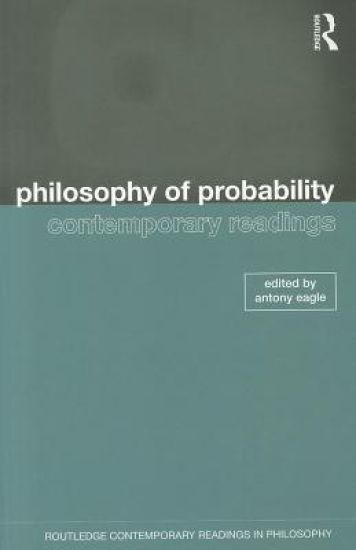
Philosophy of Probability: Contemporary Readings
Philosophy of Probability: Contemporary Readings is the first anthology to collect essential readings in this important area of philosophy. Featuring the work of leading philosophers in the field such as Carnap, Hájek, Jeffrey, Joyce, Lewis, Loewer, Popper, Ramsey, van Fraassen, von Mises, and many others, the book looks in depth at the following key topics: subjective probability and credence probability updating: conditionalization and reflection Bayesian confirmation theory classical, logical, and evidential probability frequentism physical probability: propensities and objective chances.The book features a useful primer on the mathematics of probability, and each section includes an introduction by the editor, as well as a guide to further reading. A broad-ranging and highly accessible exploration of the subject, Philosophy of Probability is ideal for any student of formal epistemology, philosophy of science, metaphysics, or philosophy of mathematics.
Philosophy of Probability: Contemporary Readings
Philosophy of Probability: Contemporary Readings is the first anthology to collect essential readings in this important area of philosophy. Featuring the work of leading philosophers in the field such as Carnap, Hájek, Jeffrey, Joyce, Lewis, Loewer, Popper, Ramsey, van Fraassen, von Mises, and many others, the book looks in depth at the following key topics: subjective probability and credence probability updating: conditionalization and reflection Bayesian confirmation theory classical, logical, and evidential probability frequentism physical probability: propensities and objective chances.The book features a useful primer on the mathematics of probability, and each section includes an introduction by the editor, as well as a guide to further reading. A broad-ranging and highly accessible exploration of the subject, Philosophy of Probability is ideal for any student of formal epistemology, philosophy of science, metaphysics, or philosophy of mathematics.
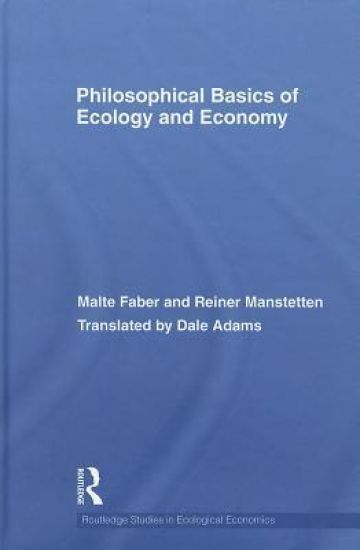
Philosophical Basics of Ecology and Economy

Philosophical Basics of Ecology and Economy

Malte Faber; Reiner Manstetten

Routledge
2009
sidottu
In today's world – despite the dramatic anthropogenic environmental changes – a proper understanding of the relationship between humanity and nature requires a certain detachment. The pressing problems in their whole extent will only be fully understood and solved with comprehensive and patient analysis. Accordingly, this book develops new perspectives on fundamental questions of biology, ecology, and the economy, integrated within a framework of a terminology specially devised by the authors. By illuminating the epistemological backgrounds of ecological-economic research, the authors lay foundations for interdisciplinary environmental research and offer guidelines for practical action. In close contact to the findings of present-day biology and economics, they demonstrate the fruitfulness as well as the shortcomings of modern science for the understanding of the proper place of humankind in nature.. Frequently, current problems in the fields of economics, ecology, politics, philosophy and biology are discussed in a kind of "dialogue" with thinkers and poets like Bacon, Quesnay, Kant, Goethe and Novalis. On the other hand, the book offers traits of the Anglo-Saxon tradition of thought: a precise, analytical approach to theory and a pragmatic approach to action. Both approaches are used by the authors complementarily. Thus the authors lay the foundations for an ecological economical and political practice which is able to tackle concrete environmental problems on an encompassing and long-term basis. This translated volume will be of great use and interest to students of ecology, economics and in particular environmental education, sustainable development and environmental ethics.
Philosophy of Medicine

Philosophy of Medicine

R. Paul Thompson; Ross Upshur

Routledge
2017
sidottu
What kind of knowledge is medical knowledge? Can medicine be explained scientifically? Is disease a scientific concept, or do explanations of disease depend on values? What is "evidence-based" medicine? Are advances in neuroscience bringing us closer to a scientific understanding of the mind? The nature of medicine raises fundamental questions about explanation, causation, knowledge and ontology – questions that are central to philosophy as well as medicine. This book introduces the fundamental issues in philosophy of medicine for those coming to the subject for the first time, including: • understanding the physician–patient relationship: the phenomenology of the medical encounter.• Models and theories in biology and medicine: what role do theories play in medicine? Are they similar to scientific theories? • Randomised controlled trials: can scientific experiments be replicated in clinical medicine? What are the philosophical criticisms levelled at RCTs? • The concept of evidence in medical research: what do we mean by "evidence-based medicine"? Should all medicine be based on evidence? • Causation in medicine.• What do advances in neuroscience reveal about the relationship between mind and body? • Defining health and disease: are explanations of disease objective or do they depend on values? • Evolutionary medicine: what is the role of evolutionary biology in understanding medicine? Is it relevant? Extensive use of empirical examples and case studies are included throughout, including debates about smoking and cancer, the use of placebos in randomised controlled trials, controversies about PSA testing and research into the causes of HIV. This is an indispensable introduction to those teaching philosophy of medicine and philosophy of science.
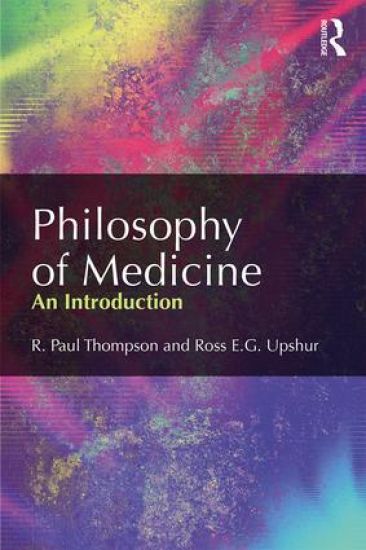
Philosophy of Medicine

Philosophy of Medicine

R. Paul Thompson; Ross Upshur

Routledge
2017
nidottu
What kind of knowledge is medical knowledge? Can medicine be explained scientifically? Is disease a scientific concept, or do explanations of disease depend on values? What is "evidence-based" medicine? Are advances in neuroscience bringing us closer to a scientific understanding of the mind? The nature of medicine raises fundamental questions about explanation, causation, knowledge and ontology – questions that are central to philosophy as well as medicine. This book introduces the fundamental issues in philosophy of medicine for those coming to the subject for the first time, including: • understanding the physician–patient relationship: the phenomenology of the medical encounter.• Models and theories in biology and medicine: what role do theories play in medicine? Are they similar to scientific theories? • Randomised controlled trials: can scientific experiments be replicated in clinical medicine? What are the philosophical criticisms levelled at RCTs? • The concept of evidence in medical research: what do we mean by "evidence-based medicine"? Should all medicine be based on evidence? • Causation in medicine.• What do advances in neuroscience reveal about the relationship between mind and body? • Defining health and disease: are explanations of disease objective or do they depend on values? • Evolutionary medicine: what is the role of evolutionary biology in understanding medicine? Is it relevant? Extensive use of empirical examples and case studies are included throughout, including debates about smoking and cancer, the use of placebos in randomised controlled trials, controversies about PSA testing and research into the causes of HIV. This is an indispensable introduction to those teaching philosophy of medicine and philosophy of science.
Philosophical Basics of Ecology and Economy

Philosophical Basics of Ecology and Economy

Malte Faber; Reiner Manstetten

Routledge
2011
nidottu
In today's world – despite the dramatic anthropogenic environmental changes – a proper understanding of the relationship between humanity and nature requires a certain detachment. The pressing problems in their whole extent will only be fully understood and solved with comprehensive and patient analysis. Accordingly, this book develops new perspectives on fundamental questions of biology, ecology, and the economy, integrated within a framework of a terminology specially devised by the authors. By illuminating the epistemological backgrounds of ecological-economic research, the authors lay foundations for interdisciplinary environmental research and offer guidelines for practical action. In close contact to the findings of present-day biology and economics, they demonstrate the fruitfulness as well as the shortcomings of modern science for the understanding of the proper place of humankind in nature.. Frequently, current problems in the fields of economics, ecology, politics, philosophy and biology are discussed in a kind of "dialogue" with thinkers and poets like Bacon, Quesnay, Kant, Goethe and Novalis. On the other hand, the book offers traits of the Anglo-Saxon tradition of thought: a precise, analytical approach to theory and a pragmatic approach to action. Both approaches are used by the authors complementarily. Thus the authors lay the foundations for an ecological economical and political practice which is able to tackle concrete environmental problems on an encompassing and long-term basis. This translated volume will be of great use and interest to students of ecology, economics and in particular environmental education, sustainable development and environmental ethics.