Kirjojen hintavertailu. Mukana 11 342 296 kirjaa ja 12 kauppaa.

Kirjahaku

Etsi kirjoja tekijän nimen, kirjan nimen tai ISBN:n perusteella.

1000 tulosta hakusanalla Pi Eriksson

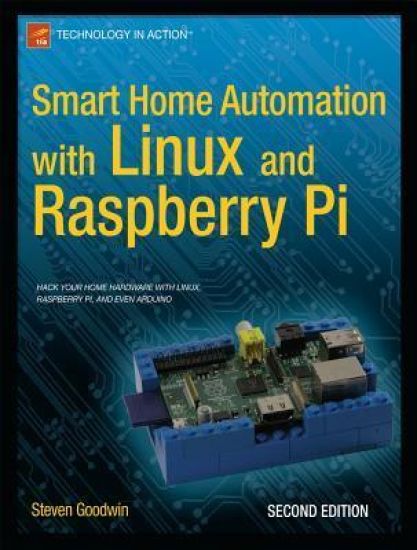
Smart Home Automation with Linux and Raspberry Pi
Smart Home Automation with Linux and Raspberry Pi shows you how to automate your lights, curtains, music, and more, and control everything via a laptop or mobile phone. You'll learn how to use Linux, including Linux on Raspberry Pi, to control appliances and everything from kettles to curtains, including how to hack game consoles and even incorporate LEGO Mindstorms into your smart home schemes. You’ll discover the practicalities on wiring a house in terms of both and power and networking, along with the selection and placement of servers. There are also explanations on handling communication to (and from) your computer with speech, SMS, email, and web. Finally, you’ll see how your automated appliances can collaborate to become a smart home. Smart Home Automation with Linux was already an excellent resource for home automation, and in this second edition, Steven Goodwin will show you how a house can be fully controlled by its occupants, all using open source software and even open source hardware like Raspberry Pi and Arduino.

KS3 Maths Progress Progression Workbook Pi 1
KS3 Maths Progression Workbooks offer extra practice of key content, along with progression checkers at the end of each Unit and plenty of dynamic student support. * Hundreds of extra practice questions at different levels of difficulty: Mastery, Strengthen and Extend * Guided questions with partially worked solutions, hints and QR codes linking to worked example videos give students crucial support * Progression checkers at the end of each Unit encourage students to take ownership of their learning, and allows them to track their progress as they work through the book. If you're an institution you can get the answers for this book as a free download. If you are a parent or tutor please contact customer services at [email protected] who will send you the download directly.
KS3 Maths Progress Progression Workbook Pi 3
KS3 Maths Progression Workbooks offer extra practice of key content, along with progression checkers at the end of each Unit and plenty of dynamic student support. Hundreds of extra practice questions at different levels of difficulty: Mastery, Strengthen and Extend Guided questions with partially worked solutions, hints and QR codes linking to worked example videos give students crucial support Progression checkers at the end of each Unit encourage students to take ownership of their learning, and allows them to track their progress as they work through the book. If you're an institution you can get the answers for this book as a free download.If you are a parent or tutor please contact customer services at [email protected] who will send you the download directly.
KS3 Maths Progress Progression Workbook Pi 1 (pack of 8)
KS3 Maths Progression Workbooks offer extra practice of key content, along with progression checkers at the end of each Unit and plenty of dynamic student support. * Hundreds of extra practice questions at different levels of difficulty: Mastery, Strengthen and Extend * Guided questions with partially worked solutions, hints and QR codes linking to worked example videos give students crucial support Progression checkers at the end of each Unit encourage students to take ownership of their learning, and allows them to track their progress as they work through the book
KS3 Maths Progress Progression Workbook Pi 2 (pack of 8)
KS3 Maths Progression Workbooks offer extra practice of key content, along with progression checkers at the end of each Unit and plenty of dynamic student support. * Hundreds of extra practice questions at different levels of difficulty: Mastery, Strengthen and Extend * Guided questions with partially worked solutions, hints and QR codes linking to worked example videos give students crucial support Progression checkers at the end of each Unit encourage students to take ownership of their learning, and allows them to track their progress as they work through the book
KS3 Maths Progress Progression Workbook Pi 3 (pack of 8)
KS3 Maths Progression Workbooks offer extra practice of key content, along with progression checkers at the end of each Unit and plenty of dynamic student support. * Hundreds of extra practice questions at different levels of difficulty: Mastery, Strengthen and Extend * Guided questions with partially worked solutions, hints and QR codes linking to worked example videos give students crucial support Progression checkers at the end of each Unit encourage students to take ownership of their learning, and allows them to track their progress as they work through the book
VLSI Placement and Routing: The PI Project

VLSI Placement and Routing: The PI Project

Alan T. Sherman

Springer-Verlag New York Inc.
2012
nidottu
This book provides a superb introduction to and overview of the MIT PI System for custom VLSI placement and routing. Alan Sher­ man has done an excellent job of collecting and clearly presenting material that was previously available only in various theses, confer­ ence papers, and memoranda. He has provided here a balanced and comprehensive presentation of the key ideas and techniques used in PI, discussing part of his own Ph. D. work (primarily on the place­ ment problem) in the context of the overall design of PI and the contributions of the many other PI team members. I began the PI Project in 1981 after learning first-hand how dif­ ficult it is to manually place modules and route interconnections in a custom VLSI chip. In 1980 Adi Shamir, Leonard Adleman, and I designed a custom VLSI chip for performing RSA encryp­ tion/decryption [226]. I became fascinated with the combinatorial and algorithmic questions arising in placement and routing, and be­ gan active research in these areas. The PI Project was started in the belief that many of the most interesting research issues would arise during an actual implementation effort, and secondarily in the hope that a practically useful tool might result. The belief was well-founded, but I had underestimated the difficulty of building a large easily-used software tool for a complex domain; the PI soft­ ware should be considered as a prototype implementation validating the design choices made.
Getting to Know the Raspberry Pi(r)

Getting to Know the Raspberry Pi(r)

Nicki Peter Petrikowski

Rosen Central
2014
nidottu
A thirty-five dollar minicomputer about the size of a credit card, the Raspberry Pi has taken the world of computing by storm. Originally intended for teaching programming in schools, the device's low price, small size, and low power consumption have given it wide appeal. This entertaining, informative book reveals the vision behind the Raspberry Pi and the history of its creation. It describes the computer's hardware and the options it offers in terms of operating systems, software, programming languages, and peripherals. Readers also get a look at the lively Raspberry Pi community of tinkerers and their creative projects making use of the minicomputer.
Fort Worth Nights: A Collection of Cody PI Stories

Fort Worth Nights: A Collection of Cody PI Stories

James Reasoner

Createspace Independent Publishing Platform
2012
nidottu
FORT WORTH NIGHTS reprints all the short fiction featuring Cody, the private eye protagonist of New York Times best-selling author James Reasoner's first novel, the cult classic TEXAS WIND. Available for the first time in one place are the acclaimed stories "Dead in Friday", "The Elephant's Graveyard", "The Spanish Blade", "The Safest Place in the World", and "In the Blood". Plus, FORT WORTH NIGHTS marks the first publication anywhere of the first new Cody story in nearly 25 years, a 10,000 word novelette entitled "Assisted Dying". Over 50,000 words in collection. Ed Gorman calls Cody's first appearance TEXAS WIND "one of the finest private eye novels I've ever read . . . a virtually perfect utterance, a story of a man, an era, and a place". If you haven't made Cody's acquaintance yet, FORT WORTH NIGHTS is the perfect introduction.
Building a Virtual Assistant for Raspberry Pi
Build a voice-controlled virtual assistant using speech-to-text engines, text-to-speech engines, and conversation modules. This book shows you how to program the virtual assistant to gather data from the internet (weather data, data from Wikipedia, data mining); play music; and take notes. Each chapter covers building a mini project/module to make the virtual assistant better. You'll develop the software on Linux or OS X before transferring it to your Raspberry Pi, ready for deploying in your own home-automation or Internet of Things applications.Building a Virtual Assistant for Raspberry Pi walks you through various STTs and TTSs and the implementation of these components with the help of Python. After that you will start implementing logic for handling user queries and commands, so that the user can have conversations with Melissa. You will then work to improve logic handling to detect what the user wants Melissa to do. You will also work on building some useful applications/modules for Melissa, which will allow you to gain interesting information from Melissa such as the time, weather information, and data from Wikipedia.You will develop a music playing application as well as a note taking application for Melissa, laying the foundations for how Melissa can be further extended. Finally, you will learn how to deploy this software to your Raspberry Pi and how you can further scale Melissa to make her more intelligent, interactive and how you can use her in other projects such as home automation as well.What You'll LearnDesign the workflow and discover the concepts of building a voice controlled assistantDevelop modules for having conversations with the assistantEnable the assistant to retrieve information from the internetBuild utilities like a music player and a note taking application for the virtual assistantIntegrate this software with a Raspberry Pi Who This Book Is ForAnyone who has built a home automation project with Raspberry Pi and now want to enhance it by making it voice-controlled. The book would also interest students from computer science or related disciplines.
Mastering Media with the Raspberry Pi
Create and maintain Raspberry Pi-based entertainment systems in a comprehensive and fun manner. Instead of front-loading a bunch of theory and minutia, this book takes a more practical approach of showing what’s needed when it’s needed. You'll first explore the possibilities and options available. Then you'll learn the hardware and software requirements based on various builds and projects. Finally, you'll be guided through building media centers, music players, recording studios, etc. Mastering Media with the Raspberry Pi presents all of this and more in an easy-to-understand-and-accomplish way, in plain English. What you'll learn: Choose the right Pi model for your project Enhance your media center with peripherals and add onsGet the most from your music and other mediaUnderstand the various major media formats out there and how to work with each Who this book is for Students and hobbyists interested in building media centers out of their Raspberry Pis.
Beginning Artificial Intelligence with the Raspberry Pi
Gain a gentle introduction to the world of Artificial Intelligence (AI) using the Raspberry Pi as the computing platform. Most of the major AI topics will be explored, including expert systems, machine learning both shallow and deep, fuzzy logic control, and more!AI in action will be demonstrated using the Python language on the Raspberry Pi. The Prolog language will also be introduced and used to demonstrate fundamental AI concepts. In addition, the Wolfram language will be used as part of the deep machine learning demonstrations.A series of projects will walk you through how to implement AI concepts with the Raspberry Pi. Minimal expense is needed for the projects as only a few sensors and actuators will be required. Beginners and hobbyists can jump right in to creating AI projects with the Raspberry PI using this book.What You'll LearnWhat AI is and—as importantly—what it is notInference and expert systemsMachine learning both shallow and deepFuzzy logic and how to apply to an actual control systemWhen AI might be appropriate to include in a systemConstraints and limitations of the Raspberry Pi AI implementationWho This Book Is ForHobbyists, makers, engineers involved in designing autonomous systems and wanting to gain an education in fundamental AI concepts, and non-technical readers who want to understand what AI is and how it might affect their lives.
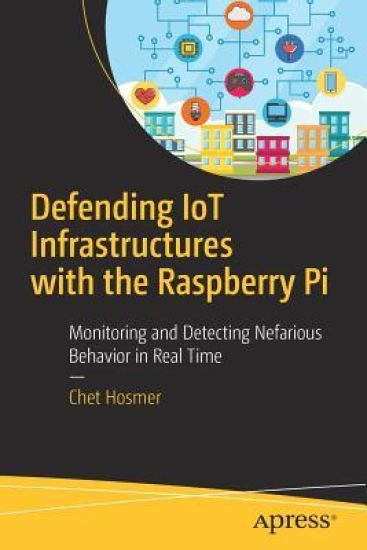
Defending IoT Infrastructures with the Raspberry Pi
Apply a methodology and practical solutions for monitoring the behavior of the Internet of Things (IoT), industrial control systems (ICS), and other critical network devices with the inexpensive Raspberry Pi. With this book, you will master passive monitoring and detection of aberrant behavior, and learn how to generate early indications and warning of attacks targeting IoT, ICS, and other critical network resources. Defending IoT Infrastructures with the Raspberry Pi provides techniques and scripts for the discovery of dangerous data leakage events emanating from IoT devices. Using Raspbian Linux and specialized Python scripts, the book walks through the steps necessary to monitor, detect, and respond to attacks targeting IoT devices. There are several books that cover IoT, IoT security, Raspberry Pi, and Python separately, but this book is the first of its kind to put them all together. It takes a practical approach, providing an entry point andlevel playing field for a wide range of individuals, small companies, researchers, academics, students, and hobbyists to participate. What You’ll Learn Create a secure, operational Raspberry Pi IoT sensorConfigure and train the sensor using “normal” IoT behaviorEstablish analytics for detecting aberrant activitiesGenerate real-time alerts to preempt attacksIdentify and report data-leakage events originating from IoT devicesDevelop custom Python applications for cybersecurity Who This Book Is For Cybersecurity specialists, professors teaching in undergraduate and graduate programs in cybersecurity, students in cybersecurity and computer science programs, software developers and engineers developing new cybersecurity defenses, incident response teams, software developers and engineers in general, and hobbyists wanting to expand the application of Raspberry Pi into both IoT and cybersecurity
Developing Games on the Raspberry Pi
Learn to set up a Pi-based game development environment, and then develop a game with Lua, a popular scripting language used in major game frameworks like Unreal Engine (BioShock Infinite), CryEngine (Far Cry series), Diesel (Payday: The Heist), Silent Storm Engine (Heroes of Might and Magic V) and many others. More importantly, learn how to dig deeper into programming languages to find and understand new functions, frameworks, and languages to utilize in your games.You’ll start by learning your way around the Raspberry Pi. Then you’ll quickly dive into learning game development with an industry-standard and scalable language. After reading this book, you'll have the ability to write your own games on a Raspberry Pi, and deliver those games to Linux, Mac, Windows, iOS, and Android. And you’ll learn how to publish your games to popular marketplaces for those desktop and mobile platforms.Whether you're new to programming or whether you've already published to marketslike Itch.io or Steam, this book showcases compelling reasons to use the Raspberry Pi for game development. Use Developing Games on the Raspberry Pi as your guide to ensure that your game plays on computers both old and new, desktop or mobile.What You'll Learn Confidently write programs in Lua and the LOVE game engine on the Raspberry PiResearch and learn new libraries, methods, and frameworks for more advanced programmingWrite, package, and sell apps for mobile platformsDeliver your games on multiple platformsWho This Book Is ForSoftware engineers, teachers, hobbyists, and development professionals looking to up-skill and develop games for mobile platforms, this book eases them into a parallel universe of lightweight, POSIX, ARM-based development.
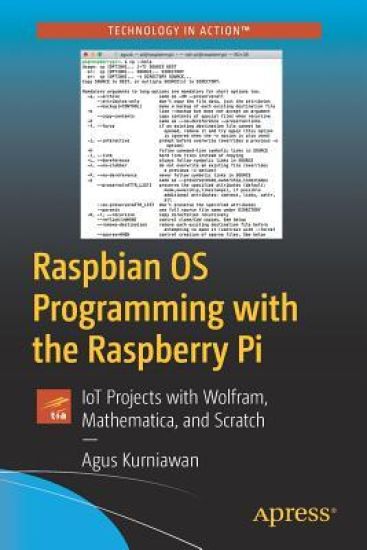
Raspbian OS Programming with the Raspberry Pi
Master the command line and Raspbian Linux as well as the physical connections of the Pi. With this book you’ll develop skills applicable to other real world applications in both hardware and software development all while working on simple and fun IoT projects that you can do yourself.You'll learn to build programs on the top of Raspbian OS in Raspberry Pi boards. Start by using Raspbian shells to develop programs.Then follow projects and samples step-by-step to get new experiences in Raspbian OS development. You'll also learn the Wolfram Language and Mathematica, Scratch, IoT programs and IoT middleware, Node-RED, Interactive Data Visualization with Jupyter Notebook, and more.There are many features in Raspbian OS and on Raspberry Pi boards perfect for building an IoT program to suite various scenarios. The GPIO pins on your Raspberry Pi allow it to scale further to accomplish all kinds of projects and tasks. Raspbian OS Programming with the Raspberry Pi is your pathway to exploring all of this.What You'll LearnDiscover the basics of programming in the Raspbian OS environment Work with the Raspbian Commandline Develop programs with the Wolfram Language and MathematicaWho This Book Is ForStudents and hobbyists interested in programming on Raspbian OS with Raspberry Pi boards.
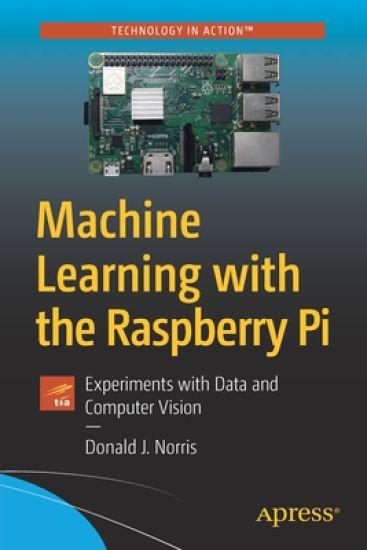
Machine Learning with the Raspberry Pi
Using the Pi Camera and a Raspberry Pi board, expand and replicate interesting machine learning (ML) experiments. This book provides a solid overview of ML and a myriad of underlying topics to further explore. Non-technical discussions temper complex technical explanations to make the hottest and most complex topic in the hobbyist world of computing understandable and approachable.Machine learning, also commonly referred to as deep learning (DL), is currently being integrated into a multitude of commercial products as well as widely being used in industrial, medical, and military applications. It is hard to find any modern human activity, which has not been "touched" by artificial intelligence (AI) applications. Building on the concepts first presented in Beginning Artificial Intelligence with the Raspberry Pi, you’ll go beyond simply understanding the concepts of AI into working with real machine learning experiments and applying practical deep learning concepts to experiments with the Pi board and computer vision. What you learn with Machine Learning with the Raspberry Pi can then be moved on to other platforms to go even further in the world of AI and ML to better your hobbyist or commercial projects.What You'll LearnAcquire a working knowledge of current ML Use the Raspberry Pi to implement ML techniques and algorithmsApply AI and ML tools and techniques to your own work projects and studiesWho This Book Is ForEngineers and scientists but also experienced makers and hobbyists. Motivated high school students who desire to learn about ML can benefit from this material with determination.