Kirjojen hintavertailu. Mukana 11 342 296 kirjaa ja 12 kauppaa.

Kirjahaku

Etsi kirjoja tekijän nimen, kirjan nimen tai ISBN:n perusteella.

1000 tulosta hakusanalla Ray Anselmo

X-Ray Multiple-Wave Diffraction

X-Ray Multiple-Wave Diffraction

Shih-Lin Chang

Springer-Verlag Berlin and Heidelberg GmbH Co. K
2004
sidottu
X-ray multiple-wave diffraction, sometimes called multiple diffraction or N-beam diffraction, results from the scattering of X-rays from periodic two­ or higher-dimensional structures, like 2-d and 3-d crystals and even quasi­ crystals. The interaction of the X-rays with the periodic arrangement of atoms usually provides structural information about the scatterer. Unlike the usual Bragg reflection, the so-called two-wave diffraction, the multiply diffracted intensities are sensitive to the phases of the structure factors in­ volved. This gives X-ray multiple-wave diffraction the chance to solve the X-ray phase problem. On the other hand, the condition for generating an X­ ray multiple-wave diffraction is much more strict than in two-wave cases. This makes X-ray multiple-wave diffraction a useful technique for precise measure­ ments of crystal lattice constants and the wavelength of radiation sources. Recent progress in the application of this particular diffraction technique to surfaces, thin films, and less ordered systems has demonstrated the diver­ sity and practicability of the technique for structural research in condensed matter physics, materials sciences, crystallography, and X-ray optics. The first book on this subject, Multiple Diffraction of X-Rays in Crystals, was published in 1984, and intended to give a contemporary review on the fundamental and application aspects of this diffraction.

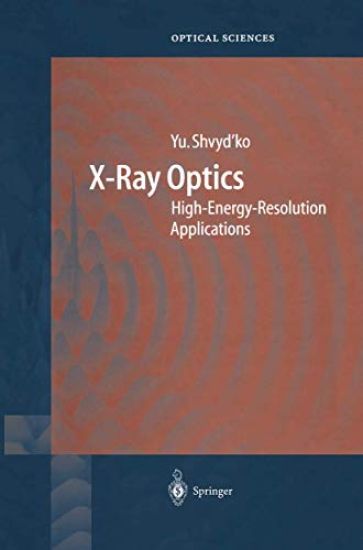
X-Ray Optics

X-Ray Optics

Yuri Shvyd'ko

Springer-Verlag Berlin and Heidelberg GmbH Co. K
2004
sidottu
The use of x rays has moved in the forefront of science and technology in the second half of the 20th century. This progress has been greatly stimulated by the advent of synchrotron x-ray sources in the 1960s. The undulator-based synchrotron radiation sources which have appeared in the last decade of the 20th century gave a new impetus to such development. The brilliance of the x-ray sources has increased by 12 orders of magnitude in 40 years and this trend does not show any signs of stagnation. The future x-ray sources of the 21th century based on free-electron lasers driven by linear accelerators will provide sub-picosecond radiation pulses with by many orders of magnitude higher brilliance and full transverse coherence. The x-ray sources of the newest generation offer a possibility to realize more than ever before the great potential of x-ray optics and, as a consequence, to elaborate new sophisticated instrumentation with unprecedented resolution and eventually to move in new directions of research in x-ray technology, materials science, fundamental physics, life sciences, etc.
Gamma-Ray Bursts

Gamma-Ray Bursts

Gilbert Vedrenne; Jean-Luc Atteia

Springer-Verlag Berlin and Heidelberg GmbH Co. K
2009
sidottu
Since their discovery was first announced in 1973, gamma-ray bursts (GRBs) have been among the most fascination objects in the universe. While the initial mystery has gone, the fascination continues, sustained by the close connection linking GRBs with some of the most fundamental topics in modern astrophysics and cosmology. Both authors have been active in GRB observations for over two decades and have produced an outstanding account on both the history and the perspectives of GRB research.
Gamma-Ray Bursts in the Afterglow Era

Gamma-Ray Bursts in the Afterglow Era

Springer-Verlag Berlin and Heidelberg GmbH Co. K
2001
sidottu
The information received from BeppoSAX, Chandra and other instruments in the last two years has more than doubled the number of samples of Gamma-Ray Bursts localized and followed up for afterglow search. This has also increased the interest of astronomers in GRBs. This book reviews the research of the last two years and covers the global properties of GRBs, GRB afterglows, GRB host galaxies, cosmology using GRBs, and theories for GRBs and their afterglows. Theoretical and observational aspects are presented as well as tools for the analysis of the data.
X-Ray Spectroscopy

X-Ray Spectroscopy

Bipin K. Agarwal

Springer-Verlag Berlin and Heidelberg GmbH Co. K
1991
nidottu
An attempt has been made in this edition of the book to retain the appeal of the first edition even after the addition of new material and the deletion of other matter which no longer appears essential. Major revisions have been made in almost all the chapters to include new developments. The material on EXAFS has been updated and put in a separate chapter. The chapter on experimental methods has been considerably expanded to include energy dispersive techniques. New topics like heavy-ion bremsstrah- lung, X-ray lasers, resonant emission, appearance potential spectroscopy, and EXAFS of high-Tc superconducting materials have been added. It is hoped that readers will find the new edition more useful and attractive. I am grateful to Professor R. H; Pratt, University of Pittsburgh, for reading the revisedversion of the first chapter, to Dr. H. Lotsch, of Springer-Verlag, for encouraging meto revisethe book,and to Prashant and Seemafor helping mein preparing the manuscript. Allahabad, B. K. Agarwal July 1989 Preface to the First Edition Rontgen's discovery of X-rays in 1895launched a subject which became central to the development of modem physics. The verification of many of the predictions of quantum theory by X-ray spectroscopy in the early part of the twentieth century stimulated great interest in this area, which has subsequently influenced fieldsas diverseas chemicalphysics, nuclear physics,and the study of the electronic properties of solids,and led to the development of techniques such as Auger, Raman, and X-ray photoelectron spectroscopy.
X-Ray Radiation of Highly Charged Ions

X-Ray Radiation of Highly Charged Ions

Heinrich F. Beyer; H.-J. Kluge; V.P. Shevelko

Springer-Verlag Berlin and Heidelberg GmbH Co. K
1997
sidottu
The physics of highly charged ions continues to be one of the most active and interesting fields of atomic physics. A large fraction of the characteristic radiation of such ions lies in the x-ray region and its spectroscopy represents an important experimental tool. The field of x-ray spectroscopy grew directly from the discovery of x radiation by Wilhelm Conrad Rontgen in 1895. The early contributions to atomic physics that arose out of x-ray spectroscopy are well documented and are the subject of many centennial events. In the past, the gross features of most x-ray spectra in the hard x-ray region have been accounted for on a hydrogenic model. In many instances the gross spectral features recorded in the early days of x-ray physics match those observed with state-of-the-art techniques today and many of the early qualitative - terpretations have remained unchanged. It is in the details of the spectra that today's results are superior to those obtained many years ago, and it is in the quantitative and accurate - scriptions that today's predictions are better. A rejuvenation of the field has occurred after the great achievements in the development of new ion sources for production of heavy ions with only one or few electrons. The new tools available to the experimenter allow the exploration of new states of m- ter and allow us to challenge new frontiers in our theoretical understanding of atoms and their interactions with other particles.
X-Ray Spectroscopy in Astrophysics

X-Ray Spectroscopy in Astrophysics

Springer-Verlag Berlin and Heidelberg GmbH Co. K
1999
sidottu
This volume contains a comprehensive treatment of X-ray spectroscopy, as applied in astrophysics. It is presented in the form of extensive notes of lectures given by seven distinguished scientists at the Tenth Summer School of the European Astrophysics Doctoral Network. The subjects covered are: basic line and continuum radiation processes in X-ray and gamma-ray astronomy; atomic physics of collision- and radiation-dominated plasmas; X-ray spectroscopic observations with ASCA and BeppoSAX; future X-ray spectroscopy missions; X-ray optics, and X-ray spectroscopy instrumentation. The book, which will appeal to both researchers and graduate students, is timely in view of the scheduled launches of the big X-ray observatories AXAF and XMM in 1999.
Cosmic Ray Astrophysics

Cosmic Ray Astrophysics

Reinhard Schlickeiser

Springer-Verlag Berlin and Heidelberg GmbH Co. K
2001
sidottu
This book provides an exhaustive account of the origin and dynamics of cosmic rays. Divided into three parts, it first gives an up-to-date summary of the observational data, then -- in the following theory section -- deals with the kinetic description of cosmic ray plasma. The underlying diffusion-convection transport equation, which governs the coupling between cosmic rays and the background plasma, is derived and analyzed in detail. In the third part, several applications of the solutions of the transport equation are presented and how key observations in cosmic ray physics can be accounted for is demonstrated. The applications include cosmic ray modulation, acceleration near shock waves and the galactic propagation of cosmic rays. While the book is primarily of interest to scientists working at the forefront of research, the very careful derivations and explanations make it suitable also as an introduction to the field of cosmic rays for graduate students.
X-Ray Scattering of Soft Matter

X-Ray Scattering of Soft Matter

Norbert Stribeck

Springer-Verlag Berlin and Heidelberg GmbH Co. K
2007
sidottu
Applications of X-ray scattering to soft matter have advanced considerably within recent years, both conceptually and technically – mature high-power X-ray sources, synchrotrons and rotating anodes, as well as high-speed detectors have become readily available. High-quality time-resolved experiments on polymer structure now can be performed with ease, a major advancement due to the genuine power of the scattering method.This manual summarizes the analytical power of modern X-ray scattering in the field of soft matter. Description of simple tools that can elucidate the mechanisms of structure evolution in the studied materials is followed by a step-by-step guide and breakdown of the more advanced methods. Data analysis based on clear, unequivocal results is rendered simple and straightforward – with a stress on the carefully planning of the experiments and adequate recording of all required data. To this end, this book serves as a useful ready-reference guide.
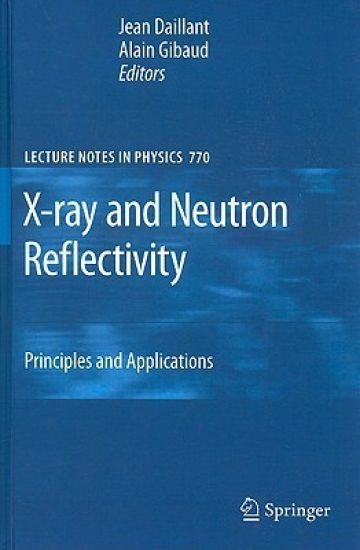
X-ray and Neutron Reflectivity

X-ray and Neutron Reflectivity

Springer-Verlag Berlin and Heidelberg GmbH Co. K
2008
sidottu
ways in which the magnetic interaction between neutrons and magnetic moments can yield information on the magnetization densities of thin ?lms and multilayers. I commend the organizers for having organized a group of expert lecturers to present this subject in a detailed but clear fashion, as the importance of the subject deserves. Argonne, IL S. K. Sinha Contents 1 The Interaction of X-Rays (and Neutrons) with Matter . . . . . . . . . . . . . . 1 F. de Bergevin 1. 1 Introduction . . . . . . . . . . . . . . . . . . . . . . . . . . . . . . . . . . . . . . . . . . . . . . 1 1. 2 Generalities and De?nitions . . . . . . . . . . . . . . . . . . . . . . . . . . . . . . . . 2 1. 3 From the Scattering by an Object to the Propagation in a Medium . 14 1. 4 X-Rays . . . . . . . . . . . . . . . . . . . . . . . . . . . . . . . . . . . . . . . . . . . . . . . . . . 26 1. 5 X-Rays: Anisotropic Scattering . . . . . . . . . . . . . . . . . . . . . . . . . . . . . . 47 1. A Appendix: the Born Approximation . . . . . . . . . . . . . . . . . . . . . . . . . . 54 References . . . . . . . . . . . . . . . . . . . . . . . . . . . . . . . . . . . . . . . . . . . . . . . . . . . . . 56 2 Statistical Aspects of Wave Scattering at Rough Surfaces . . . . . . . . . . . . 59 A. Sentenac and J. Daillant 2. 1 Introduction . . . . . . . . . . . . . . . . . . . . . . . . . . . . . . . . . . . . . . . . . . . . . . 59 2. 2 Description of Randomly Rough Surfaces . . . . . . . . . . . . . . . . . . . . . 60 2. 3 Description of a Surface Scattering Experiment, Coherence Domains . . . . . . . . . . . . . . . . . . . . . . . . . . . . . . . . . . . . . . . . . . . . . . . . . 67 2. 4 Statistical Formulation of the Diffraction Problem . . . . . . . . . . . . . . 72 2. 5 Statistical Formulation of theScattered Intensity Under the Born Approximation . . . . . . . . . . . . . . . . . . . . . . . . . . . . . . . . . . . . . . . . . . . 79 References . . . . . . . . . . . . . . . . . . . . . . . . . . . . . . . . . . . . . . . . . . . . . . . . . . . . . 84 3 Specular Re?ectivity from Smooth and Rough Surfaces . . . . . . . . . . . . . 85 A. Gibaud and G. Vignaud 3. 1 The Re?ected Intensity from an Ideally Flat Surface . . . . . . . . . . . . 85 3. 2 X-Ray Re?ectivity in Strati?ed Media . . . . . . . . . . . . . . . . . . . . . . . . 98 3. 3 From Dynamical to Kinematical Theory . . . . . . . . . . . . . . . . . . . . . . 107 3. 4 In?uence of the Roughness on the Matrix Coef?cients . . . . . . . . . . 111 3. A Appendix: The Treatment of Roughness in Specular Re?ectivity . . 113 3. B Appendix: Inversion of re?ectivity data . . . . . . . . . . . . . . . . . . . . . . .
Man Ray - Ein Kunstlerleben zwischen Surrealismus und Dadaismus
Studienarbeit aus dem Jahr 2004 im Fachbereich Kunst - Fotografie und Film, Note: 2,3, Universit t Paderborn (Fakult t f r Kulturwissenschaften), Veranstaltung: Avantgardefilm, 17 Quellen im Literaturverzeichnis, Sprache: Deutsch, Abstract: Einleitung (Auszug): Man kann Man Rays OEuvre keiner bestimmten Kunstrichtung zuordnen, seine Werke bleiben immer "Dada-Realistik oder Sur-Dada-Realismus," auch wenn in seinen fr heren Arbeiten der dadaistische Anteil sicherlich berwiegt. Man Ray expermentierte Zeit seines Lebens mit den verschiedensten k nstlerischen Techniken, er war Maler, Schriftsteller, Verleger, Photograph, Objektk nstler und Filmemacher. Er war der einzige amerikanische Dadaist, und verfolgte konsequent seine Prinzipien: Freiheit, Kreativit t, Humor, Unabh ngigkeit und Anarchismus. Er war der einzige amerikanische Avantgarde K nstler, der nicht daran interessiert war, eine moderne amerikanische Kunst zu schaffen. Er 'wollte' mit seinen Bildern nichts erreichen. Seine gro e Bedeutung f r die europ ische Kunstgeschichte liegt darin, dass er dem franz sischen Dadaismus, zu einer Zeit, als dieser gerade in sich selbst zerfiel, den entscheidenden bergang zum Surrealismus erm glichte. In dieser Hausarbeit werde ich die Entwicklung Man Rays, vom Beginn seiner Malerei in der Pre-Dada Zeit, ber seine Zeit als Photograph in Paris und seine R ckkehr nach Amerika, verfolgen. Schwerpunkte m chte ich auf die von ihm entdeckten neuen M glichkeiten der Photographie, seine Ready-mades und Filme setzen. Zudem werde ich, an kurzen Beispielen, jeweils die Einfl sse des Dadaismus und des Surrealismus in seinen bekanntesten Werken darlegen.
X-Ray Diffuse Scattering from Self-Organized Mesoscopic Semiconductor Structures

X-Ray Diffuse Scattering from Self-Organized Mesoscopic Semiconductor Structures

Martin Schmidbauer

Springer-Verlag Berlin and Heidelberg GmbH Co. K
2010
nidottu
This monograph represents a critical survey of the outstanding capabilities of X-ray diffuse scattering for the structural characterization of mesoscopic material systems. The mesoscopic regime comprises length scales ranging from a few up to some hundreds of nanometers. It is of particular relevance at semiconductor layer systems where, for example, interface roughness or low-dimensional objects such as quantum dots and quantum wires have attracted much interest. An extensive overview of the present state-of-the-art theory of X-ray diffuse scattering at mesoscopic structures is given followed by a valuable description of various experimental techniques. Selected up-to-date examples are discussed. The aim of the present book is to combine aspects of self-organized growth of mesoscopic structures with corresponding X-ray diffuse scattering experiments.
X-Ray Multiple-Wave Diffraction

X-Ray Multiple-Wave Diffraction

Shih-Lin Chang

Springer-Verlag Berlin and Heidelberg GmbH Co. K
2010
nidottu
X-ray multiple-wave diffraction, sometimes called multiple diffraction or N-beam diffraction, results from the scattering of X-rays from periodic two­ or higher-dimensional structures, like 2-d and 3-d crystals and even quasi­ crystals. The interaction of the X-rays with the periodic arrangement of atoms usually provides structural information about the scatterer. Unlike the usual Bragg reflection, the so-called two-wave diffraction, the multiply diffracted intensities are sensitive to the phases of the structure factors in­ volved. This gives X-ray multiple-wave diffraction the chance to solve the X-ray phase problem. On the other hand, the condition for generating an X­ ray multiple-wave diffraction is much more strict than in two-wave cases. This makes X-ray multiple-wave diffraction a useful technique for precise measure­ ments of crystal lattice constants and the wavelength of radiation sources. Recent progress in the application of this particular diffraction technique to surfaces, thin films, and less ordered systems has demonstrated the diver­ sity and practicability of the technique for structural research in condensed matter physics, materials sciences, crystallography, and X-ray optics. The first book on this subject, Multiple Diffraction of X-Rays in Crystals, was published in 1984, and intended to give a contemporary review on the fundamental and application aspects of this diffraction.
X-Ray Optics

X-Ray Optics

Yuri Shvyd'ko

Springer-Verlag Berlin and Heidelberg GmbH Co. K
2010
nidottu
The use of x rays has moved in the forefront of science and technology in the second half of the 20th century. This progress has been greatly stimulated by the advent of synchrotron x-ray sources in the 1960s. The undulator-based synchrotron radiation sources which have appeared in the last decade of the 20th century gave a new impetus to such development. The brilliance of the x-ray sources has increased by 12 orders of magnitude in 40 years and this trend does not show any signs of stagnation. The future x-ray sources of the 21th century based on free-electron lasers driven by linear accelerators will provide sub-picosecond radiation pulses with by many orders of magnitude higher brilliance and full transverse coherence. The x-ray sources of the newest generation offer a possibility to realize more than ever before the great potential of x-ray optics and, as a consequence, to elaborate new sophisticated instrumentation with unprecedented resolution and eventually to move in new directions of research in x-ray technology, materials science, fundamental physics, life sciences, etc.
Gamma-Ray Bursts

Gamma-Ray Bursts

Gilbert Vedrenne; Jean-Luc Atteia

Springer-Verlag Berlin and Heidelberg GmbH Co. K
2010
nidottu
Since their discovery was first announced in 1973, gamma-ray bursts (GRBs) have been among the most fascination objects in the universe. While the initial mystery has gone, the fascination continues, sustained by the close connection linking GRBs with some of the most fundamental topics in modern astrophysics and cosmology. Both authors have been active in GRB observations for over two decades and have produced an outstanding account on both the history and the perspectives of GRB research.
Gamma-Ray Bursts in the Afterglow Era

Gamma-Ray Bursts in the Afterglow Era

Springer-Verlag Berlin and Heidelberg GmbH Co. K
2010
nidottu
The information received from BeppoSAX, Chandra and other instruments in the last two years has more than doubled the number of samples of Gamma-Ray Bursts localized and followed up for afterglow search. This has also increased the interest of astronomers in GRBs. This book reviews the research of the last two years and covers the global properties of GRBs, GRB afterglows, GRB host galaxies, cosmology using GRBs, and theories for GRBs and their afterglows. Theoretical and observational aspects are presented as well as tools for the analysis of the data.
X-Ray Radiation of Highly Charged Ions

X-Ray Radiation of Highly Charged Ions

Heinrich F. Beyer; H.-J. Kluge; V.P. Shevelko

Springer-Verlag Berlin and Heidelberg GmbH Co. K
2010
nidottu
The physics of highly charged ions continues to be one of the most active and interesting fields of atomic physics. A large fraction of the characteristic radiation of such ions lies in the x-ray region and its spectroscopy represents an important experimental tool. The field of x-ray spectroscopy grew directly from the discovery of x radiation by Wilhelm Conrad Rontgen in 1895. The early contributions to atomic physics that arose out of x-ray spectroscopy are well documented and are the subject of many centennial events. In the past, the gross features of most x-ray spectra in the hard x-ray region have been accounted for on a hydrogenic model. In many instances the gross spectral features recorded in the early days of x-ray physics match those observed with state-of-the-art techniques today and many of the early qualitative - terpretations have remained unchanged. It is in the details of the spectra that today's results are superior to those obtained many years ago, and it is in the quantitative and accurate - scriptions that today's predictions are better. A rejuvenation of the field has occurred after the great achievements in the development of new ion sources for production of heavy ions with only one or few electrons. The new tools available to the experimenter allow the exploration of new states of m- ter and allow us to challenge new frontiers in our theoretical understanding of atoms and their interactions with other particles.
X-Ray Spectroscopy in Astrophysics

X-Ray Spectroscopy in Astrophysics

Springer-Verlag Berlin and Heidelberg GmbH Co. K
2010
nidottu
This volume contains a comprehensive treatment of X-ray spectroscopy, as applied in astrophysics. It is presented in the form of extensive notes of lectures given by seven distinguished scientists at the Tenth Summer School of the European Astrophysics Doctoral Network. The subjects covered are: basic line and continuum radiation processes in X-ray and gamma-ray astronomy; atomic physics of collision- and radiation-dominated plasmas; X-ray spectroscopic observations with ASCA and BeppoSAX; future X-ray spectroscopy missions; X-ray optics, and X-ray spectroscopy instrumentation. The book, which will appeal to both researchers and graduate students, is timely in view of the scheduled launches of the big X-ray observatories AXAF and XMM in 1999.
Cosmic Ray Astrophysics

Cosmic Ray Astrophysics

Reinhard Schlickeiser

Springer-Verlag Berlin and Heidelberg GmbH Co. K
2010
nidottu
In the first part, the book gives an up-to-date summary of the observational data. In the second part, it deals with the kinetic description of cosmic ray plasma. The underlying diffusion-convection transport equation, which governs the coupling between cosmic rays and the background plasma, is derived and analyzed in detail. In the third part, several applications of the solutions of the transport equation are presented and how key observations in cosmic ray physics can be accounted for is demonstrated.