Kirjojen hintavertailu. Mukana 11 699 587 kirjaa ja 12 kauppaa.

Kirjahaku

Etsi kirjoja tekijän nimen, kirjan nimen tai ISBN:n perusteella.

1000 tulosta hakusanalla Ray Leight

X-Ray Spectrometry in Electron Beam Instruments
From its early days in the 1950s, the electron microanalyzer has offered two principal ways of obtaining x-ray spectra: wavelength dispersive spectrometry (WDS), which utilizes crystal diffraction, and energy dispersive spectrometry (EDS), in which the x-ray quantum energy is measured directly. In general, WDS offers much better peak separation for complex line spectra, whereas EDS gives a higher collection efficiency and is easier and cheaper to use. Both techniques have undergone major transformations since those early days, from the simple focusing spectrometerand gas proportional counter of the 1950s to the advanced semiconductor detectors and programmable spectrometersoftoday. Becauseofthesedevelopments, thecapabilities and relative merits of EDS and WDS techniques have been a recurring feature of microprobeconferences for nearly40 years, and this volume bringstogetherthepapers presented at the Chuck Fiori Memorial Symposium, held at the Microbeam Analysis Society Meeting of 1993. Several themes are apparent in this rich and authoritative collection of papers, which have both a historical and an up-to-the-minute dimension. Light element analysis has long been a goal of microprobe analysts since Ray Dolby first detected K radiation with a gas proportional counter in 1960. WDS techniques (using carbon lead stearate films) were not used for this purpose until four years later. Now synthetic multilayers provide the best dispersive elements for quantitative light element analy­ sis-still used in conjunction with a gas counter.
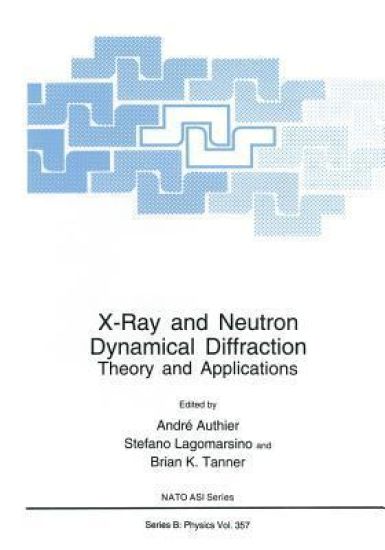
X-Ray and Neutron Dynamical Diffraction

X-Ray and Neutron Dynamical Diffraction

Springer-Verlag New York Inc.
2012
nidottu
This volume collects the proceedings of the 23rd International Course of Crystallography, entitled "X-ray and Neutron Dynamical Diffraction, Theory and Applications," which took place in the fascinating setting of Erice in Sicily, Italy. It was run as a NATO Advanced Studies Institute with A. Authier (France) and S. Lagomarsino (Italy) as codirectors, and L. Riva di Sanseverino and P. Spadon (Italy) as local organizers, R. Colella (USA) and B. K. Tanner (UK) being the two other members of the organizing committee. It was attended by about one hundred participants from twenty four different countries. Two basic theories may be used to describe the diffraction of radiation by crystalline matter. The first one, the so-called geometrical, or kinematical theory, is approximate and is applicable to small, highly imperfect crystals. It is used for the determination of crystal structures and describes the diffraction of powders and polycrystalline materials. The other one, the so-called dynamical theory, is applicable to perfect or nearly perfect crystals. For that reason, dynamical diffraction of X-rays and neutrons constitutes the theoretical basis of a great variety of applications such as: • the techniques used for the characterization of nearly perfect high technology materials, semiconductors, piezoelectric, electrooptic, ferroelectric, magnetic crystals, • the X-ray optical devices used in all modem applications of Synchrotron Radiation (EXAFS, High Resolution X-ray Diffractometry, magnetic and nuclear resonant scattering, topography, etc. ), and • X-ray and neutron interferometry.
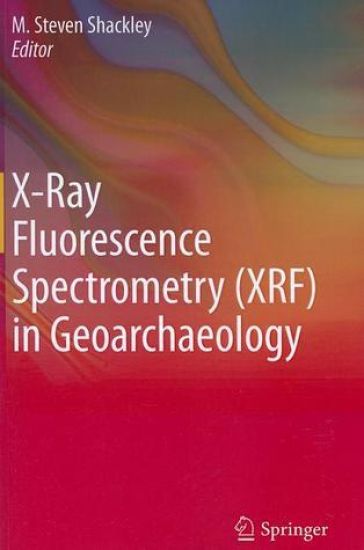
X-Ray Fluorescence Spectrometry (XRF) in Geoarchaeology
Since the 1960s, x-ray fluorescence spectrometry (XRF), both wavelength and energy-dispersive have served as the workhorse for non-destructive and destructive analyses of archaeological materials. Recently eclipsed by other instrumentation such as LA-ICP-MS, XRF remains the mainstay of non-destructive chemical analyses in archaeology, particularly for volcanic rocks, and most particularly for obsidian. In a world where heritage and repatriation issues drive archaeological method and theory, XRF remains an important tool for understanding the human past, and will remain so for decades to come.Currently, there is no comprehensive book in XRF applications in archaeology at a time when the applications of portable XRF and desktop XRF instrumentation are exploding particularly in anthropology and archaeology departments worldwide. The contributors to this volume are the experts in the field, and most are at the forefront of the newest applications of XRF to archaeological problems. It covers all relevant aspects of the field for those using the newest XRF technologies to deal with very current issues in archaeology.
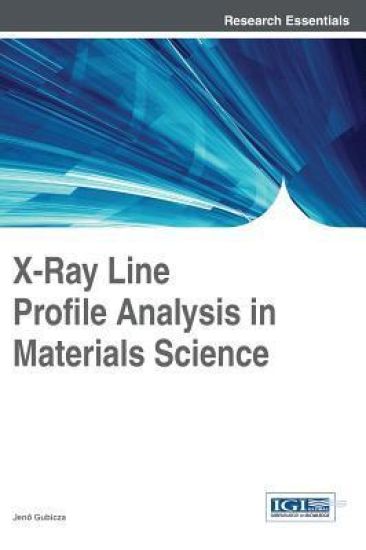
X-Ray Line Profile Analysis in Materials Science
X-ray line profile analysis is an effective and non-destructive method for the characterisation of the microstructure in crystalline materials. Supporting research in the area of x-ray line profile analysis is necessary in promoting further developments in this field.X-Ray Line Profile Analysis in Materials Science aims to synthesise the existing knowledge of the theory, methodology, and applications of x-ray line profile analysis in real-world settings. This publication presents both the theoretical background and practical implementation of x-ray line profile analysis and serves as a reference source for engineers in various disciplines as well as scholars and upper-level students.
Michael Ray Charles

Michael Ray Charles

Cherise Smith

University of Texas Press
2020
sidottu
Smithsonian American Art Museum's 2021 Charles C. Eldredge Prize for Distinguished Scholarship in American ArtMichael Ray Charles is the most comprehensive presentation yet of the work of an artist who rose to prominence in the 1990s for works that engaged American stereotypes of African Americans. With a background in advertising and an archivist’s inquisitiveness, Charles developed an artistic practice that made startling use of found images and offered critiques of the narratives they fostered. Immersing readers in the imagination of this daring painter, Michael Ray Charles celebrates and contextualizes a singular, major figure in the art world.Art historian Cherise Smith collaborated with the artist to curate nearly one hundred color plates documenting nearly thirty years of visual art. These plates are framed by an interview with the artist and by Smith’s own deep interpretive essay on Charles’s work. Smith explores topics ranging from the controversy resulting from Charles’s provocative appropriations of stereotypical racial material to his techniques of sampling from popular culture, and from his commentaries on African American men and sports to his work with director Spike Lee on Bamboozled. Both clear-eyed and complex, this retrospective demonstrates the significant role that Michael Ray Charles’s work has played in defining what art is today.
Aeternum Ray

Aeternum Ray

Tracy R Atkins

Createspace Independent Publishing Platform
2012
pokkari
"Poverty, terrorism, murder, disease, homelessness, hopelessness, hunger and death; all cease to exist in 2049."Aeternum Ray is a sweeping, yet intimate story of mankind's next renaissance that will appeal to fans of visionaries Isaac Asimov, Gene Roddenberry and Ray Kurzweil. The novel is a collection of emotional personal letters written by 240-year-old William Babington to his newborn son Benjamin. Having lived a full life, William has experienced everything from death to his rebirth into the utopian Aeternum; an advanced computer system shepherded by the omnipotent artificial intelligence Ray. William pens the highlights of his existence, love, and loss while reflecting on the centuries of wonder he has witnessed firsthand. His humble letters form a detailed memoir that is intertwined with humanity's greatest triumphs, the technological singularity, and the solemn burden of surviving Earth's darkest night of terror.Through the light and dark times of the near future, Aeternum Ray departs from dystopian themes and brings back the uplifting notion of utopian speculative ideals.
The Ray of Hope

The Ray of Hope

Janet Johnson Anderson

Archway Publishing
2020
pokkari
Forever entwined with Hurricane Katrina in the wake of a slow recovery, locals have returned to consider their dark fate. A powerful State Senator is running for a third term, though immersed in criminal elements beyond the borders of Louisiana. While a new black president, challenging the motives and interests of government's framework, is calling for social cohesion. Wynton Ellery is a security officer working customs in the port of New Orleans. Others presume they live in a world that makes sense. Wynton knows too vividly, that the rug gets pulled out from under long-held assumptions, and the narrative of a life can lose meaning. What starts out as a sunny, October day, ends with a saturation of vile smells endemic to the back seat of a police car, when he and his brother, Raymond, are innocently embroiled in a shocking murder case. The New Orleans detectives are at odds with mounting evidence and a slate of suspects, when authorization is given to pin a homicide on an innocent man. An only witness comes forward, but who can safeguard the witness and at what cost? This inspiring novel peers into the culturally unique southern city, four years after America's worst national disaster. It offers a glimpse into the human conditions of class and race, as two diametrically opposed families struggle to come together. Ultimately, The Ray of Hope is a story of healing, as readers discover despite personal setback and heartbreak, despite community loss and division, hope shines through.