Kirjojen hintavertailu. Mukana 11 426 774 kirjaa ja 12 kauppaa.

Kirjahaku

Etsi kirjoja tekijän nimen, kirjan nimen tai ISBN:n perusteella.

1000 tulosta hakusanalla Rene Beauclair

Switzerland and the European Common Market

Switzerland and the European Common Market

Rene Schwok

Praeger Publishers Inc
1991
sidottu
The first study in English on the subject, this volume explores the challenges facing Switzerland as the European Community (EC) moves toward the 1992 goal of a Europe without economic borders. The primary question addressed by the author is whether or not Switzerland can ultimately avoid becoming a full-fledged member of the EC. Rene Schwok fully explores the alternatives open to Switzerland, including marginalization and a Third Way between membership and marginalization, comparing the benefits and risks presented by each option. He examines the political and economic implications of full membership within the EC and analyzes Community rules and laws that are particularly relevant to Switzerland. Throughout, Schwok is careful to present a multifaceted approach which reflects both the economic and political issues confronted by Switzerland as the country struggles to reach a policy consensus regarding the EC.Schwok begins by exposing the source of Switzerland's current problem--the acceleration of the community integration process. He then analyzes the EC's attitude toward Switzerland and evaluates the role played by the European Free Trade Association, paying special attention to efforts to establish a European Economic Space. By comparing the situation of Austria--which has exhibited much more interest in becoming a member of the EC--with that of Switzerland, Schwok sheds new light on Switzerland's reluctance to join. In discussing the effects of the European Internal Market on Switzerland, Schwok reveals the risks of marginalization should Switzerland decide not to join. He goes on to examine the Swiss government's proposed third option, analyzing both its prospects for success and its implications for the Swiss population. Finally, Schwok treats the long-term consequences of this option, asking whether it will allow sufficient proximity to the Internal Market to enable Switzerland to avoid membership or, on the contrary, serve only to pave the way for eventual membership in the EC. Students of international relations and European economics will find Schwok's work a well-reasoned and comprehensive study of Switzerland's choices as Europe approaches 1992.
Anatomy of a Splitting Borderline

Anatomy of a Splitting Borderline

Rene Muller

Praeger Publishers Inc
1994
sidottu
Borderline personality disorder is a diagnosis often given to those who have serious problems with self-image and mood, as well as with interpersonal relations. This text presents a journal of a 15-month course of therapy with a classic splitting borderline patient, followed by an in-depth analysis of the case from three very different, but ultimately converging, perspectives. While there is a large and growing literature on borderline personality disorder, Anatomy of a Splitting Borderline is the first book-length study of a borderline patient, expressly revealing facets of this mental illness and its therapeutic challenge that could only be summarized in previous, briefer case histories. Psychiatrists, psychoanalysts, psychologists, social workers, and those in training in these professions are the audience for this ground-breaking book.
Man Adapting

Man Adapting

Rene Dubos

Yale University Press
1980
pokkari
This enlarged edition of Man Adapting includes a new chapter expanding Dr. Dubos’s discussion of the role of medicine in man’s adaptive processes. In 1965 he wrote at length of the biological and social problems of human adaptation, while treating the medical aspects of this problem only in passing. He believed that the goal of medicine was to help man function successfully with the particular circumstances of his environment and heredity. But despite advancements in the prevention and treatment of disease, skepticism has developed during the last two decades concerning the usefulness of modern medicine. Dr. Dubos turns here to readdress this question. Today physicians rely on sophisticated scientific knowledge, and no longer offer the traditional doctor-patient relationship which ministered to psychological as well as physical comfort. But it is this spiritual aspect of human medicine, Dr. Dubos argues, which distinguishes it from general biology, and it will retain its unique position among the sciences only if it accepts responsibility for the human aspects of life. Dr. Dubos demonstrates the complex interrelationship between man and his biological environment. He writes, “I have attempted to focus my attention on the individual human being . . . trying as best he can to meet the emergencies of the day and to prepare for the uncertainties of the future. He is Man Adapting.”
French, Italian, and Spanish Criticism, 1900-1950

French, Italian, and Spanish Criticism, 1900-1950

Rene Wellek

Yale University Press
1993
sidottu
The final volume of René Wellek's monumental history of modern criticism is a comprehensive survey of the main currents of twentieth-century criticism in Western Europe. In this volume, as in the preceding books of the series, Wellek expounds and analyzes the work of the most prominent critics, offering succinct appraisals of his subjects both as individuals and as participants in the broader movements of the century. ContentsI. French Criticism, 1900-1950French "Classical" Criticism in the Twentieth CenturyRetrospect: Alain, Rémy de GourmontThe Nouvelle Revue Française: André Gide, Jacques Rivière, Ramón Fernández, Benjamin Crémiuex, Albert ThibaudetMarcel ProustThe Catholic Renaissance: Charles Du Bos, Jacques Maritain and Henri Bremond, Paul ClaudelDada and SurrealismThe Geneva School: Marcel Raymond, Albert Béguin, Georges PouletAlbert CamusJean-Paul SartrePaul ValéryProspectII. Italian Criticism, 1900-1950Benedetto CroceThe Followers of Croce: Luigi Russo, Francesco Flora, Mario Fubini, Attilio MomiglianoThe Aestheticians: Giuseppe Antonio Borgese, Alfredo GargiuloCritics concerned with English and American literature: Cesare Pavese, Mario Praz, Emilio CecchiItalian Marxism: Antonio Gramesci, Giacomo DebenedettiThe Catholic Renaissance: Carlo BoThe Close Readers: Renato Serra, Giuseppe De Robertis, Cesare De Lollis, Eugenio MontaleIII. Spanish Criticism, 1900-1950Américo CastroMiguel de UnamunoMarcelino Menéndez y Pelayo and Ramón Menéndez PidalAzorínSalvador de MadariagaJorge GuillénDámaso AlonsoJosé Ortega y Gasset
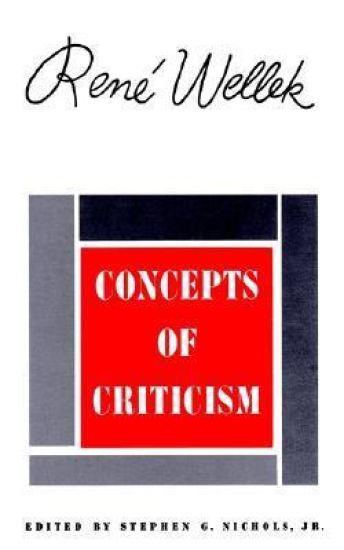
Concepts of Criticism

Concepts of Criticism

Rene Wellek

Yale University Press
2005
pokkari
Provocative and penetrating, these essays attest to Mr. Wellek’s intense concern during the past two decades with the problems besetting the disciplines of literary theory, criticism, and history. Each essay accordingly sets as its goal the development of a concept that will contribute to better understanding of the literary work. Trenchant investigation of such significant critical concepts as baroque, romanticism, and realism are complemented by illuminating surveys of the current state of literary criticism and related commentaries on contemporary literary theory and scholarship. Concepts of Criticism constitutes a valuable statement of Mr. Wellek’s theoretical position. A number of the essays are published for the first time and a bibliography of Mr. Wellek’s publications is included. René Wellek, author of A History of Modern Criticism, 1750-1950, is Sterling Professor of Comparative Literature at Yale.
Louis Pasteur

Louis Pasteur

René Dubos

Da Capo Press Inc
1986
pokkari
In the words of one of his English contemporaries, Louis Pasteur was "the most perfect man who ever entered the kingdom of science." His contributions to the development of microbiology and medicine were profound, both practically (Pasteurization and vaccination) and theoretically (the germ model of disease). He spoke out forcefully on issues of the day, especially when they concerned public health, and his research included studies on rabies, anaerobic life, childbirth fever, silkworms, and beer. René Dubos's outstanding biography examines Pasteur's manifold genius in the context of the era,Pasteur was an exemplary nineteenth-century bourgeois,and in light of recent environmental thought. His view of Pasteur as ecologist, the first to formulate in concrete terms a biological and chemical theory of global ecosystems, is only one of the many surprising insights into a man whose emblematic fame has obscured a complex and rich life.
Political Awakening in the Belgian Congo.

Political Awakening in the Belgian Congo.

Rene Lemarchand

Praeger Publishers Inc
1982
sidottu
This work examines the factors that contributed to Congolese political fragmentation encompassing the colonial administrative framework, the impact of western political and economic forces, and the transformations brought about by Christianity and western education.
A Historical Dictionary of the U.S. Merchant Marine and Shipping Industry
A foremost authority has written the first comprehensive reference about the U.S. Merchant Marine and American shipping from the introduction of steamships to today's diesel containerships--showing the impact of politics, economics, and technology on maritime history during the last two centuries. Over 500 entries describe people, private companies, business and labor groups, engineering and technological developments, government agencies, terms, key laws, landmark cases, issues, events, and ships of note. Short lists of references for further reading accompany these entries. Appendices include a chronology, diagrams of government organizations, and lists of business and labor groups by founding dates. An unusually extensive index lends itself to the varying research interests of students, teachers, and professionals in maritime and economic history, business-labor-government relations, and military studies.
The Silent Holocaust

The Silent Holocaust

Rene Spodheim

Praeger Publishers Inc
1992
sidottu
We commonly associate the term Holocaust with Nuremberg and Kristallnacht, the Warsaw and Vilna ghettos, Auschwitz and Treblinka. Appearing as they do in countless books and films, these symbols of hatred penetrate our consciousness, memory, and history. But, unfortunately, our memory is selective, and, in the case of Romania, our knowledge is scant. In 1939 the Jewish population of Romania exceeded 750,000: the third largest concentration of Jews in Europe. By 1944, some 400,000 had disappeared. Another 150,000 Ukrainian Jews died at the hands of Romanian soldiers. In the quest for a final solution Romania proved to be Hitler's most enthusiastic ally.In The Silent Holocaust, Butnaru, himself a survivor of the Romanian labor camps, provides a full account and demonstrates that anti-Semitism was a central force in Romania's history. He begins by examining the precarious status of Romanian Jewry in the years prior to World War I. He then reviews the period to the establishment in September, 1940, of the National Legionary State, a period when anti-Semitism became the unifying force in politics. The remainder of the book covers the Holocaust years, and reveals that Romania's premeditated mass murder of Jews was well underway before the Reich's gas chambers became operational. The Silent Holocaust has been called a work of epic and historical worth and it is invaluable for students of World War II, the Holocaust, and Jewish and Eastern European studies.
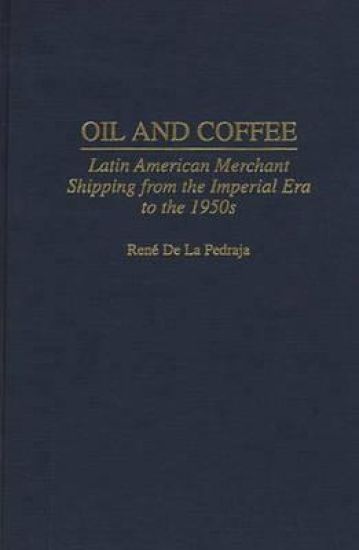
Oil and Coffee

Oil and Coffee

Rene De La Pedraja

Praeger Publishers Inc
1998
sidottu
Latin Americans as sailors? This remark caused laughter among 19th-century foreign observers, particularly British observers. Yet, Latin Americans did struggle to create important merchant fleets, an effort largely ignored outside the region. This book rescues Latin American shipping from oblivion. In a chronological narrative, it presents the most important events in the emergence of Latin American shipping. While focusing on the shipping companies, the book also roams widely into governmental policy, foreign relations, and naval affairs. Divided into two parts, the book opens with a brief summary of the age of sailing ships, then traces the history of the first steamship companies, focusing on Brazil and Chile until 1914. Part I then goes on to analyze the impact of World War I and the Great Depression. Part II considers World War II and U.S. surplus ships. New issues in Latin American shipping, arising in the 1950s, will be discussed in another volume.
Latin American Merchant Shipping in the Age of Global Competition
Although Latin America had a substantial merchant fleet by the 1950s, at the end of the century most of the major shipping companies have disappeared from the continent. Continuing to grow through protectionist efforts during the 1960s and 1970s, the industry began to decline when container technology, requiring large capital investments, shifted competition to access capital. This book shows how technology undermined and finally shattered the nationalist efforts to create a significant Latin American merchant shipping industry. Written in a clear and concise style, it provides the first authoritative survey of Latin American shipping during the second half of the century. The book opens with a discussion of cargo preference—a form of protectionism—in Chile and shows how Latin American merchant fleets expanded under cargo preference. Most countries witnessed a dramatic expansion in their national fleets. In the 1970s, the impact of containers, a new technology, began to be felt. As the book shows, the large capital outlays needed to adopt containers undermined the foundations of Latin American shipping companies, and most of the merchant shipping companies in the region gradually collapsed. The book also examines the non-commercial role of merchant shipping, particularly in international clashes such as the Cuban Revolution.
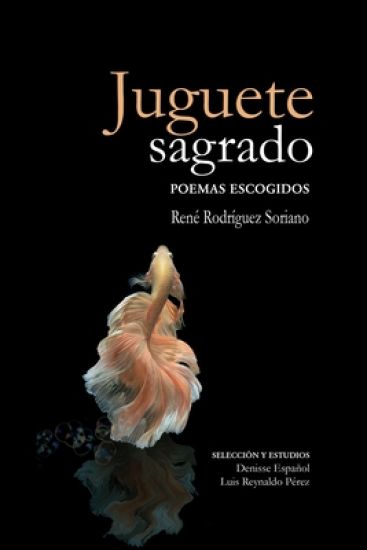
Juguete sagrado

Juguete sagrado

René Rodríguez Soriano

Lulu.com
2019
nidottu
Andar por los versos de Rene Rodriguez Soriano es deambular tambien por el paraiso de la palabra, lugar mistico al cual acudimos en nuestros momentos de necesidad para encontrar asilo. Es entrar a su mundo por la puerta grande, pisar los caminos que el mismo creo y que develan la evolucion del hombre de letras que es. Paso a paso su poesia nos lleva hasta sus posibles metas, sus posibles propositos y sus evoluciones. Digo posibles pues no es sencillo obtener la verdad por nosotros mismos, cuando el, nino travieso, escribe desde una postura de creacion tan intima con el lenguaje que da paso a la implementacion de propuestas ludicas e ironicas en su manejo. La palabra es su juguete sagrado.