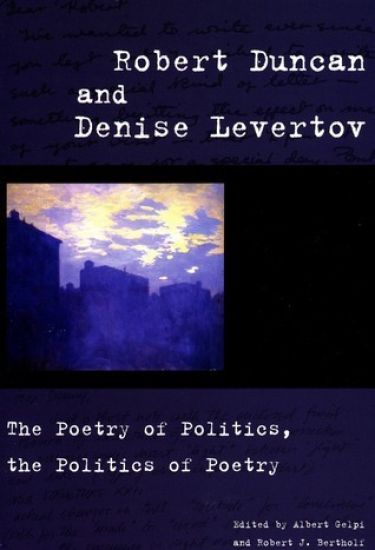
This volume presents the complete correspondence between two of the most important and influential American poets of the postwar period. The almost 500 letters range widely over the poetry scene and the issues that made the period so lively and productive. But what gives the exchange its special personal and literary resonance is the sense of spiritual affinity and shared conviction about the power of the visionary imagination. Duncan and Levertov explore these matters in rich detail until, under the stress of dealing with the Vietnam War in poetry, they discover deep-seated differences in the religious and ethical convictions underlying their politics and poetic stance. The issues that drew them together and those that drove them apart create a powerful personal drama with far-reaching historical and cultural significance. The editors have provided a critical Introduction, full notes, a chronology, and a glossary of names.
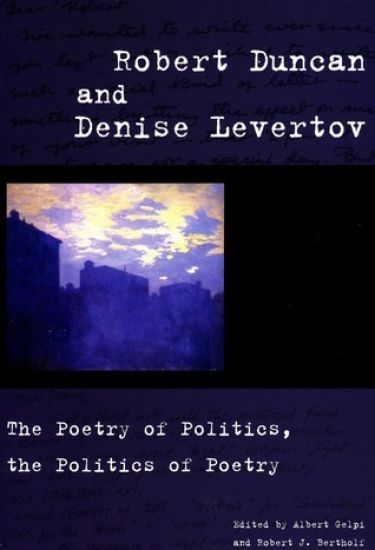
This collection of essays, written for this volume and often using unpublished and archival materials, converges around the usually close and intense relationship between Robert Duncan and Denise Levertov, two of the most important and remarkable American poets in the second half of the twentieth century. Their association, played out in their poems and in an extraordinary exchange of letters, was based on a sense of the visionary imagination informing the direction and shape of the poet. However, they had a falling out during the Vietnam crisis over the relationship between poetry and politics, between the private and public responsibilities of the poet. Such issues are vital not only to their poetry and the poetry of that period but to contemporary poetry as well. A distinguished group of critics, led by Albert Gelpi and Robert J. Bertholf, examines the issues that drew Levertov and Duncan together, and split them apart, in a book that has the openness and coherence of an urgent, contemporary dialogue about the form and meaning of poetry.
This collection of essays, written for this volume and often using unpublished and archival materials, converges around the usually close and intense relationship between Robert Duncan and Denise Levertov, two of the most important and remarkable American poets in the second half of the twentieth century. Their association, played out in their poems and in an extraordinary exchange of letters, was based on a sense of the visionary imagination informing the direction and shape of the poet. However, they had a falling out during the Vietnam crisis over the relationship between poetry and politics, between the private and public responsibilities of the poet. Such issues are vital not only to their poetry and the poetry of that period but to contemporary poetry as well. A distinguished group of critics, led by Albert Gelpi and Robert J. Bertholf, examines the issues that drew Levertov and Duncan together, and split them apart, in a book that has the openness and coherence of an urgent, contemporary dialogue about the form and meaning of poetry.
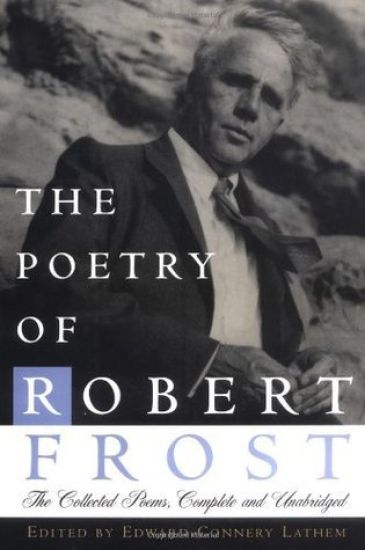
This is the only comprehensive volume of Robert Frost's published verse; in it are the contents of all eleven of his individual books of poetry-from "A Boy's Will" (1913) to" In the Clearing" (1962). The editor, Edward Connery Lathem, has scrupulously annotated the more than 350 poems in this book.
This fascinating reassessment of America's most popular and famous poet reveals a more complex and enigmatic man than many readers might expect. Jay Parini spent over twenty years interviewing friends of Frost and working in the poet's archives at Dartmouth, Amherst, and elsewhere to produce this definitive and insightful portrait of both the public and private man. While he depicts the various stages of Frost's colorful life, Parini also sensitively explores the poet's psyche, showing how he dealt with adversity, family tragedy, and depression. By taking the reader into the poetry itself, which he reads closely and brilliantly, Parini offers an insightful road map to Frost's remarkable world.
A feast for lovers of American literature-the work of our greatest poet, redesigned and relaunched for a new generation of readers No poet is more emblematically American than Robert Frost. From "The Road Not Taken" to "Stopping by Woods on a Snowy Evening," he refined and even defined our sense of what poetry is and what it can do. T. S. Eliot judged him "the most eminent, the most distinguished Anglo-American poet now living," and he is the only writer in history to have been awarded four Pulitzer Prizes. Henry Holt is proud to announce the republication of four editions of Frost's most beloved work for a new generation of poets and readers. The only comprehensive volume of Frost's verse available, comprising all eleven volumes of his poems, this collection has been the standard Frost compendium since its first publication in 1969.
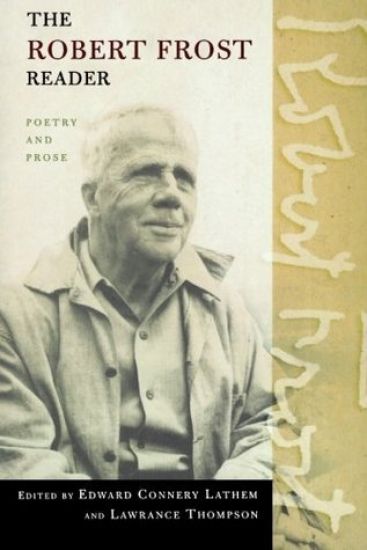
Robert Frost was the most emblematically American of poets, a forthright advocate of both the art and craft of verse who was recognized and cherished as few other poets have ever been. This reader offers students and scholars a plethora of his speeches, interviews, correspondence, one-act plays, and other materials, as well as lengthy selections from all of Frost's books of verse. Though many have been drawn to his seemingly old-fashioned simplicity, this wide-ranging reader in fact reveals that Frost's work was often dark or ironic in tone and always subtle and complex."
Robert E. Lee in Texas introduces a little known phase of the great General's career - his service in Texas during the four turbulent years just preceding the Civil War. In this account Carl Coke Rister takes us with Lee to his lonely posts on the border, and we share with him the hazardous and often fruitless chases after bands of American Indians and Mexicans. We see through the eyes of the ""Academy man"" the raw life on the frontier and hear through his own words his impressions of the country and people.
For years Robert Newton Baskin (1837–1918) may have been the most hated man in Utah. Yet his promotion of federal legislation against polygamy in the late 1800s and his work to bring the Mormon territory into a republican form of government were pivotal in Utah’s achievement of statehood. The results of his efforts also contributed to the acceptance of the Church of Jesus Christ of Latter-day Saints by the American public. In this engaging biography—the first full-length analysis of the man—author John Gary Maxwell presents Baskin as the unsung father of modern Utah. As Maxwell shows, Baskin’s life was defined by conflict and paradox.Educated at Harvard Law School, Baskin lived as a member of a minority: a “gentile” in Mormon Utah. A loner, he was highly respected but not often included in the camaraderie of contemporary non-Mormon professionals. When it came to the Saints, Baskin’s role in the legal aftermath of the Mountain Meadows massacre did not endear him to the Mormon people or their leadership. He was convinced that Brigham Young made John D. Lee the scapegoat—the planner and perpetrator of the massacre—to obscure complicity of the LDS church.Baskin was successful in Utah politics despite using polygamy as a sledgehammer against Utah’s theocratic government and despite his role as a federal prosecutor. He was twice elected mayor of Salt Lake City, served in the Utah legislature, and became chief justice of the Utah Supreme Court. He was also a visionary city planner—the force behind the construction of the Salt Lake City and County Building, which remains the architectural rival of the city’s Mormon temple.For more than a century historians have maligned Baskin or ignored him. Maxwell brings the man to life in this long-overdue exploration of a central figure in the history of Utah and of the LDS church.
Just in time for the 50th anniversary of Steven Spielberg's Jaws, an intimate and richly-told portrait of the iconic actor and writer Robert Shaw, from his portrayal of the legendary shark hunter Captain Quint and beyond, written lovingly but honestly by his nephew. "Go for the Jaws, stay for the Shaws." --Nat Segaloff, author of The Exorcist Legacy Robert Shaw unforgettably commanded attention as the weathered seaman Captain Quint in the blockbuster sensation, Jaws. But what came before and after that landmark film is as dramatic as the hunt for the great white shark itself. Capturing the many facets of the vibrant, generous, and sometimes polarizing man is his nephew, Christopher, who explores the forces that shaped a dynamic personality--including Robert's indomitable mother, his deeply troubled father, and his activist sister, Joanna, with whom Robert shared an unbreakable bond. Out of the traumatic events of their childhood in the Orkney Islands and Cornwall, Mrs. Shaw pushed her children to pursue their dreams. For Robert, that dream was acting and writing. Despite a storied career on the British and American stage--as both performer and playwright--and a string of hit films including From Russia with Love, A Man for All Seasons, The Sting, and The Taking of Pelham One Two Three, international celebrity eluded Robert . . . until he was summoned to star in "a little horror film" called Jaws. What happened on-screen was unforgettable. What happened off-screen was chaos. Now Christopher Shaw Myers reveals the true story of the making of the classic. Jaws would become both an artistic success and a worldwide triumph for Robert Shaw. Tragically, for a man shadowed by his father's demons, it would also signal the beginning of the end. Drawing on family recollections, personal letters, scrapbooks, recordings, extensive interviews, and a lifetime of his own memories, Christopher paints a unique, intimate, and honest portrait of a man he was proud to call his uncle.
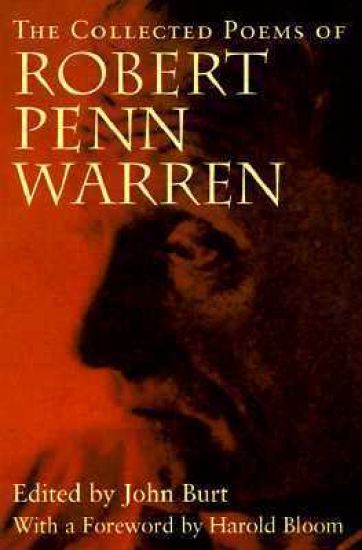
Winner of the C. Hugh Holman AwardA central figure in twentieth-century American literature, Robert Penn Warren (1905- 1989) was appointed by the Library of Congress as the first Poet Laureate of the United States in 1985. Although better known for his fiction, especially his novel All the King's Men, it is mainly his poetry- spanning sixty years, fifteen volumes of verse, and a wide range of styles- that reveals Warren to be one of America's foremost men of letters.In this indispensable volume, John Burt, Warren's literary executor, has assembled every poem Warren ever published (with the exception of Brother to Dragons), including the many poems he published in The Fugitive and other magazines, as well as those that appeared in his small press works and broadsides. Burt has also exhaustively collated all of the published versions of Warren's poems- which, in some cases, appeared as many as six different times with substantive revisions in every line- as well as his typescripts and proofs. And since Warren never seemed to reread any of his books without a pencil in his hand, Burt has referred to Warren's personal library copies. This comprehensive edition also contains textual notes, lists of emendations, and explanatory notes.Warren was born and raised in Guthrie, Kentucky, where southern agrarian values and a predilection for storytelling were ingrained in him as a young boy. By 1925, when he graduated from Vanderbilt University, he was already the most promising of that exceptional set of poets and intellectuals known as the Fugitives. Warren devoted most of the 1940s and 1950s to writing prose and literary criticism, but from the late 1950s he composed primarily poetry, with each successive volume of verse that he penned demonstrating his rigorous and growing commitment to that genre. The mature visionary power and technical virtuosity of his work in the 1970s and early 1980s emanated from his strongly held belief that ""only insofar as the work [of art] establishes and expresses a self can it engage us."" Many of Warren's later poems, which he deemed ""some of my best,"" rejoice in the possibilities of old age and the poet's ability for ""continually expanding in a vital process of definition, affirmation, revision, and growth, a process that is the image, we may say, of the life process.
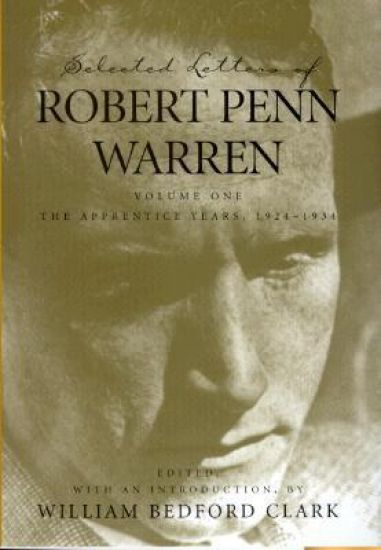
In America's twentieth century, there is no man of letters more versatile, distinguished, and influential than the poet, novelist, editor, critic, social commentator, and teacher Robert Penn Warren (1905-1989). The most intimate of Warren's ""letters,"" his personal correspondence, now join his published canon under William Bedford Clark's expert supervision. Volume One, The Apprentice Years, forms a kind of epistolary coming-of-age novel, taking Warren from the awkwardness of emerging genius during his Fugitive student years at Vanderbilt to the brink of producing great work in a newly appointed post at Louisiana State University.Warren's earliest correspondence limns a friendship in earnest with Allen Tate, a crushing heartbreak, and an attempted suicide. Eventually the author regroups, graduates with honors, and entertains a bad-boy phase at Berkeley and Yale. As he studies at Oxford, writes his first book, and decides not to complete his doctorate, Warren exhibits a deepening maturity and devotion to his literary craft, expressing ever more complex ideas about poetry and fiction. His nagging financial difficulties, growing commitment to the -Agrarian movement, controversial essay for I'll Take My Stand, marriage to Cinina Brescia, and professional uncertainty as one of the first to combine writing with college teaching lead him into the 1930s, when the bright prospect of tenure and an opportunity to remake the Southwest Review arises.Warren's letters, all but one previously unpublished, fascinate in their revelations, such as the author's surprisingly tangled relationship with his parents, his delicate health, and the gossip about major literary figures, including Tate, John Crowe Ransom, Donald Davidson, and Laura Riding. But beyond rich biographical detail, they offer a veritable self-portrait of the fledgling artist: ""When a person writes a letter it is nearly as much one to himself as to the person who takes it from the postbox."" The self-conscious, precocious, yet sensitive young Warren modulates to the sardonic, irreverent aesthete/wit ""Red"" and finally acquires a voice distinctively ""Warrenesque,"" confident and sophisticated. Thus the imaginative as well as literal aspects of these years in Warren's life are conveyed, his writing persona and historical person always an intriguing comparison.Highly accessible, unfailingly interesting, and scrupulously annotated, The Apprentice Years will satisfy scholar and lay reader alike, providing a unique window on what it means to ""profess"" the writer's calling in an era of rapid change. When complete, the Selected Letters of Robert Penn Warren will prove an indispensable addition to the author's literary oeuvre.
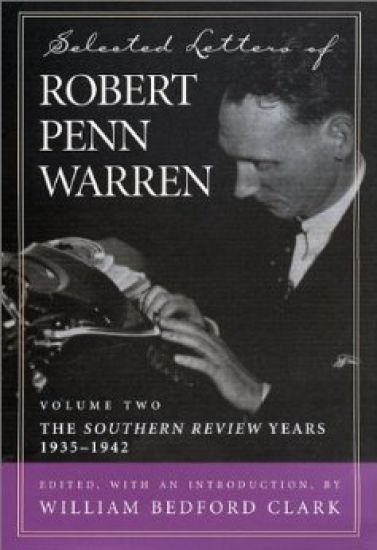
At the beginning of 1935, Robert Penn Warren was destined for arguably the most crucial period in his distinguished career. Having escaped the brink of unemployment the previous fall to join fellow Vanderbilt alumnus and Rhodes scholar Cleanth Brooks on the English faculty at Louisiana State University (which was enjoying a boom thanks to the favouritism shown by the Long regime), the young author was poised to establish himself, against the backdrop of the Great Depression and America's belated entry into World War II, as a compelling new voice, perhaps the most versatile writer of his generation.Continuing where Volume One of the Selected Letters left off, the missives from his Baton Rouge years show Warren exploring and testing the boundaries of his genius on a number of simultaneous fronts. Editing the Southern Review with Brooks was the center of his working life, and it offered him an almost immediate springboard to prominence on both sides of the Atlantic. Warren was determined to establish and maintain the stature of the quarterly even as he systematically nurtured the talent of a younger generation of writers that included Eudora Welty, Randall Jarrell, Peter Taylor, and John Berryman. He attended to his own writing as well and not only emerged as a celebrated poet but also published his first major fiction. During the same period, he and Brooks drew directly upon their classroom challenges to design and launch a series of textbooks that gradually transformed the teaching of poetry and fiction in American colleges and universities.What any number of commentators have called Warren's ""protean"" energy is in full evidence in these letters. The range and sheer diversity of his correspondence, whether with old friends, established literary figures, hopeful young writers, his beloved wife Cinina, recalcitrant academic administrators, or sometimes troublesome publishers, reveal an extraordinarily keen mind and heightened imagination operating in concert with optimum efficiency. Scrupulously edited and thoroughly annotated by William Bedford Clark with an eye toward the needs of the lay reader as well as the specialist, Warren's letters have the immediacy of skillful autobiography.
John Burt's Selected Poems of Robert Penn Warren is more broadly representative of Warren's poetry than any previous selected gathering. More than two hundred poems from every phase grace the volume, a vehicle ideal for sampling- or soaking in- the finest of Warren's rich output. With each poem, Burt has carefully located the version that constitutes Warren's final revision. His introduction gives an eloquent overview of the poet's career, touching on every published book of verse and highlighting significant lines. A ""selected"" collection in the truest sense, featuring several previously unpublished pieces, this treasure is at once new and familiar. At the heart of Warren's poetry is a celebration of man's intellect and imagination, his integral place within nature, and his relationship to time and the past; ultimately, joy coexists with the knowledge of life's many mysteries, including its tragedies. Selected Poems, a generous survey and a convenient compendium, is the shining portal to this greatly gifted poet.
Selected Letters of Robert Penn Warren, Volume three, provides an indispensable glimpse of Warren the writer and the man, covering a crucial decade in his life. Edited by Randy Hendricks and James A. Perkins, and introduced by William Bedford Clark, this collection of largely previously unpublished letters and newly discovered material documents Warren's time at the University of Minnesota, his writing and publication of the Pulitzer Prize-winning novel All the King's Men, his appointment as Consultant in Poetry at the Library of Congress, and his divorce from Emma ""Cinina"" Brescia and subsequent marriage to the writer Eleanor Clark.The period 1943-1952 also saw the publication of ""A Poem of Pure Imagination""; World Enough and Time; The Ballad of Billie Potts; At Heaven's Gate; and Selected Poems, 1923-1943. Warren's letters shed new light on those works and on his close relationship with his editors Lambert Davis and Albert Erskine. Included too is correspondence concerning Warren's collaboration with Robert Rossen on the movie production of All the King's Men, which received the Academy Award for best picture in 1949.The list of friends and colleagues with whom Warren communicated reads like a roll call of major twentieth-century literary figures and clearly shows his ever-widening influence on the world of letters. Spanning a remarkable range in both style and tone, the letters disclose Warren's attitudes toward his work as a teacher and his thoughts on the events of World War II, the Korean War, and the political conflicts in postwar Europe.Thoroughly annotated and scrupulously researched, Volume Three captures Warren in an extraordinary phase in his life and career, reaching his maturity and making many commitments at once yet pursuing them all with a seemingly boundless energy.
Volume four of the Selected Letters of Robert Penn Warren covers a crucial time of personal and professional rejuvenation in Warren's life. During the fifteen-year period spanned by this correspondence, he completed Brother to Dragons; Segregation: The Inner Conflict in the South; and Who Speaks for the Negro? As these titles suggest, these years were marked by Warren's immersion in American history and his maturing interest in race relations. They also saw his return to lyric poetry, after a ten-year hiatus, with the publication of the Pulitzer Prize-winning collection Promises. Along with seeing the completion of some of his most successful work, this period was a time of momentous change in Warren's life, including his move to Yale University; his marriage to his second wife, Eleanor; and the birth of his two children. As a chronicle of Warren's thoughts on his family, his work, his friends, the state of literary studies, and the culture at large, these letters are invaluable. Unlike many writers, Warren rarely drafted his correspondence with future readers and scholars in mind; he typically saved his prepared statements about the human condition and the state of the world for his poetry, fiction, and social commentary. His letters offer a candid and personal glimpse of Warren's relationships as well as his personal views on literature, politics, and social trends. Their recipients include Ralph Ellison, Allen Tate, Saul Bellow, Robert Lowell, Eudora Welty, and Louis Rubin, as well as Warren's editors, reviewers, collaborators, and other friends. Providing an unusually vivid and personal account of Warren's rich and fully realised life, these missives are equally revealing of his thoughts on the state of contemporary American culture during this dynamic time in American history.
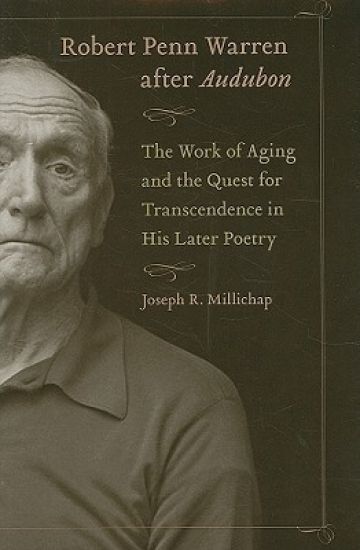
Despite nearly universal critical acclaim for Robert Penn Warren's later poetry, much about this large body of work remains unexplored, especially the psychological sources of these poems' remarkable energy. In this groundbreaking work, Warren scholar Joseph R. Millichap takes advantage of current research on developmental psychology, gerontology, and end-of-life studies to offer provocative new readings of Warren's later poems, which he defines as those published after Audubon: A Vision (1969). In these often intricate poems, Millichap sees something like an autobiographical epic focused on the process of aging, the inevitability of death, and the possibility of transcendence. Thus Warren's later poetry reviews an individual life seen whole, contemplates mortality and dissolution, and aspires to the literary sublime.Millichap locates the beginning of Warren's late period in the extraordinary collection Or Else: Poem/Poems 1968-1974, basing his contention on the book's complex, indeed obsessive sequencing of new, previously published, and previously collected poems unified by themes of time, memory, age, and death. Millichap offers innovative readings of Or Else and Warren's five other late gatherings of poems - Can I See Arcturus from Where I Stand?: Poems 1975; Now and Then: Poems 1976-1978, winner of the Pulitzer Prize; Being Here: Poetry 1977-1980; Rumor Verified: Poems 1979-1980; and Altitudes and Extensions 1980-1984.Among the autobiographical elements Millichap brings into his careful readings are Warren's loneliness in these later years, especially after the deaths of family members and friends; his alternating feelings of personal satisfaction and emptiness toward his literary achievements; and his sense of the power, and at times the impotence, of memory. Millichap's analysis explores how Warren often returned to images and themes of his earlier poems, especially those involving youth and midlife, with the new perspective given by advancing age and time's passage. Millichap also relates Warren's work to that of other poets who have dealt profoundly with memory and age, including Robert Frost, T. S. Eliot, Thomas Hardy, and, at times, John Milton, William Wordsworth, and the whole English and American nineteenth-century Romantic tradition.An epilogue traces Warren's changing reputation as a poet from the publication of his last volume in 1985 through his death in 1989 and the centennial of his birth in 2005, concluding persuasively that the finest of all of Warren's literary efforts can be found in his later poetry, concerned as it is with the work of aging and the quest for transcendence.
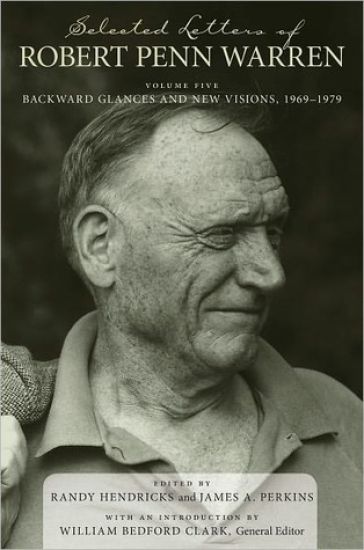
The years 1969 and 1979 bookend a volatile decade in American history. As an articulate witness to the era of the Vietnam War, Watergate, Jimmy Carter, and the national ""malaise,"" Robert Penn Warren produced a phenomenal body of work, securing his place in the canon of American poetry.Volume five of Selected Letters of Robert Penn Warren: Backward Glances and New Visions, 1969-1979 includes Warren's letters to friends, family, peers, editors, inquiring scholars, and critics - recording the details of his personal and professional life and illustrating his pivotal role in twentieth-century American literature.In these turbulent but fruitful years, Warren produced both Audubon: A Vision (1969) and the revised version of Brother to Dragons (1979). In between lay some of Warren's most searching work as poet, novelist, literary critic, and social commentator.During this era Warren's achievements included his highly experimental and complex Or Else - Poem/Poems (1974) and the Pulitzer Prize-winning Now and Then (1978). Before the end of the 1970s three more novels appeared concluding with his final book of fiction, A Place to Come To.This volume provides insight into Warren's inspiration during a remarkably productive era and will prove an essential resource on his life and work.
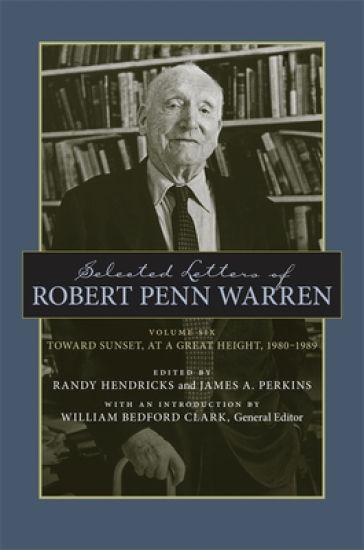
In the last decade of his life, Robert Penn Warren remained a vibrant force in American literature, producing new works of poetry and nonfiction while also dealing courageously with the gradual decline of his health and the diminishment of his poetic powers. Toward Sunset, at a Great Height, 1980-1989, the sixth and final volume of the author's selected letters, provides crucial documentation of this period, containing Warren's correspondence with friends, family, fellow writers, editors, critics, and the scholars studying his works.Warren published several volumes of poetry, including Being Here (1980), Rumor Verified (1981), and Chief Joseph of the Nez Perce (1983), and returned to nonfiction prose with Jefferson Davis Gets His Citizenship Back (1980) and the memoir Portrait of a Father (1988).His letters reveal that he tried to begin writing a novel but was unable to make substantial progress on it, and that from 1985 on he became increasingly dissatisfied with his new poems. Until his death at age eighty-four, however, Warren maintained an active correspondence filled with news about his writings and travels, accounts of the lives of his wife and children, and a stoic attitude about his own physical decline as well as a solicitousness regarding the health of others, such as his brother, Thomas, and sister, Mary. He communicated with rising young scholars and encouraged younger poets he admired.Toward Sunset, at a Great Height offers rich insights into the closing chapter of Robert Penn Warren's professional and personal life, making it an essential resource for understanding the full scope of the author's contribution to American letters.