Kirjojen hintavertailu. Mukana 11 717 486 kirjaa ja 12 kauppaa.

Kirjahaku

Etsi kirjoja tekijän nimen, kirjan nimen tai ISBN:n perusteella.

1000 tulosta hakusanalla STEWART

A Vindication of Dr. Paley's Theory of Morals from the Principal Objections of Mr. D. Stewart; Mr. Gisborne; Dr. Pearson; And Dr. T. Brown. with an Appendix, Containing Strictures on Some Remarks of Dr. Whateley.
Title: A vindication of Dr. Paley's theory of morals from the principal objections of Mr. D. Stewart; Mr. Gisborne; Dr. Pearson; and Dr. T. Brown. With an appendix, containing strictures on some remarks of Dr. Whateley.Publisher: British Library, Historical Print EditionsThe British Library is the national library of the United Kingdom. It is one of the world's largest research libraries holding over 150 million items in all known languages and formats: books, journals, newspapers, sound recordings, patents, maps, stamps, prints and much more. Its collections include around 14 million books, along with substantial additional collections of manuscripts and historical items dating back as far as 300 BC.The HISTORY OF PHILOSOPHY & ETHICS collection includes books from the British Library digitised by Microsoft. The works in this collection include expositions and scholarly analyses of philosophy and ethics for the earliest recorded Western religious and secular works. Documents concern prehistoric, medieval, and modern times, with background and historical narratives on Western thought. The collection provides insights into how philosophies have changed through history, what has driven these changes, and to what degree philosophical texts from prior eras are understood in the contemporary times of the authors. ++++The below data was compiled from various identification fields in the bibliographic record of this title. This data is provided as an additional tool in helping to insure edition identification: ++++ British Library Wainewright, Latham; Brown, Thomas; 1830. 8 . 526.i.10.
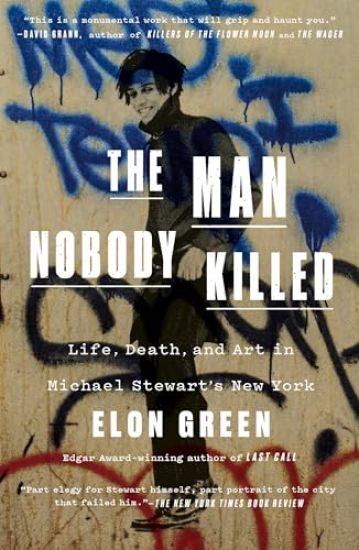
The Man Nobody Killed: Life, Death, and Art in Michael Stewart's New York
The first comprehensive book about Michael Stewart, the young Black artist and model who was the victim of a fatal assault by police in 1983, from Elon Green, the Edgar Award-winning author of Last Call. At twenty-five years old, Michael Stewart was a young Black aspiring artist, deejay, and model, looking to make a name for himself in the vibrant downtown art scene of the early 1980's New York City. On September 15, 1983, he was brutally beaten by New York City Transit Authority police for allegedly tagging a 14th Street subway station wall. Witnesses reported officers beating him with billy clubs and choking him with a nightstick. Stewart arrived at Bellevue Hospital hog-tied with no heartbeat and died after thirteen days in a coma. This was, at that point, the most widely noticed act of police brutality in the city's history. The Man Nobody Killed recounts the cultural impact of Michael Stewart's life and death. The Stewart case quickly catalyzed movements across multiple communities. It became a rallying cry, taken up by artists and singers including Madonna, Keith Haring, Spike Lee, and Jean-Michel Basquiat, tabloid legends such as Jimmy Breslin and Murray Kempton, and the pioneering local news reporter, Gabe Pressman. The Stewart family and the downtown arts community of 1980s New York demanded justice for Michael, leading to multiple investigations into the circumstances of his wrongful death. Elon Green, the Edgar Award-winning author of Last Call, presents the first comprehensive narrative account of Michael Stewart's life and killing, the subsequent court proceedings, and the artistic aftermath. In the vein of The Short and Tragic Life of Robert Peace and His Name is George Floyd, Green brings us the story of a promising life cut short and a vivid snapshot of the world surrounding this loss. A tragedy set in stark contrast against the hope, activism, and creativity of the 1980's New York City art scene, The Man Nobody Killed serves as a poignant reminder of recurring horrors in American history and explores how, and for whom, the justice system fails.
The Man Nobody Killed: Life, Death, and Art in Michael Stewart's New York
The first comprehensive book about Michael Stewart, the young Black artist and model who was the victim of a fatal assault by police in 1983, from Elon Green, the Edgar Award-winning author of Last Call. At twenty-five years old, Michael Stewart was a young Black aspiring artist, deejay, and model, looking to make a name for himself in the vibrant downtown art scene of the early 1980's New York City. On September 15, 1983, he was brutally beaten by New York City Transit Authority police for allegedly tagging a 14th Street subway station wall. Witnesses reported officers beating him with billy clubs and choking him with a nightstick. Stewart arrived at Bellevue Hospital hog-tied with no heartbeat and died after thirteen days in a coma. This was, at that point, the most widely noticed act of police brutality in the city's history. The Man Nobody Killed recounts the cultural impact of Michael Stewart's life and death. The Stewart case quickly catalyzed movements across multiple communities. It became a rallying cry, taken up by artists and singers including Madonna, Keith Haring, Spike Lee, and Jean-Michel Basquiat, tabloid legends such as Jimmy Breslin and Murray Kempton, and the pioneering local news reporter, Gabe Pressman. The Stewart family and the downtown arts community of 1980s New York demanded justice for Michael, leading to multiple investigations into the circumstances of his wrongful death. Elon Green, the Edgar Award-winning author of Last Call, presents the first comprehensive narrative account of Michael Stewart's life and killing, the subsequent court proceedings, and the artistic aftermath. In the vein of The Short and Tragic Life of Robert Peace and His Name is George Floyd, Green brings us the story of a promising life cut short and a vivid snapshot of the world surrounding this loss. A tragedy set in stark contrast against the hope, activism, and creativity of the 1980's New York City art scene, The Man Nobody Killed serves as a poignant reminder of recurring horrors in American history and explores how, and for whom, the justice system fails.

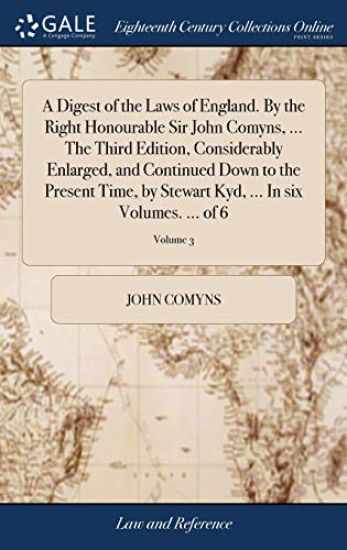
A Digest of the Laws of England. By the Right Honourable Sir John Comyns, ... The Third Edition, Considerably Enlarged, and Continued Down to the Present Time, by Stewart Kyd, ... In six Volumes. ... of 6; Volume 3
The 18th century was a wealth of knowledge, exploration and rapidly growing technology and expanding record-keeping made possible by advances in the printing press. In its determination to preserve the century of revolution, Gale initiated a revolution of its own: digitization of epic proportions to preserve these invaluable works in the largest archive of its kind. Now for the first time these high-quality digital copies of original 18th century manuscripts are available in print, making them highly accessible to libraries, undergraduate students, and independent scholars.This collection reveals the history of English common law and Empire law in a vastly changing world of British expansion. Dominating the legal field is the Commentaries of the Law of England by Sir William Blackstone, which first appeared in 1765. Reference works such as almanacs and catalogues continue to educate us by revealing the day-to-day workings of society.++++The below data was compiled from various identification fields in the bibliographic record of this title. This data is provided as an additional tool in helping to insure edition identification: ++++British LibraryT140226London: printed by A. Strahan and W. Woodfall: for T. Longman, J. Johnson, G. G. J. and J. Robinson, T. Cadell and 8 others in London], 1792. 6v.; 8
A Journey to Mequinez; the Residence of the Present Emperor of Fez and Morocco. On the Occasion of Commodore Stewart's Embassy Thither for the Redemption of the British Captives in the Year 1721
The 18th century was a wealth of knowledge, exploration and rapidly growing technology and expanding record-keeping made possible by advances in the printing press. In its determination to preserve the century of revolution, Gale initiated a revolution of its own: digitization of epic proportions to preserve these invaluable works in the largest archive of its kind. Now for the first time these high-quality digital copies of original 18th century manuscripts are available in print, making them highly accessible to libraries, undergraduate students, and independent scholars.Delve into what it was like to live during the eighteenth century by reading the first-hand accounts of everyday people, including city dwellers and farmers, businessmen and bankers, artisans and merchants, artists and their patrons, politicians and their constituents. Original texts make the American, French, and Industrial revolutions vividly contemporary.++++The below data was compiled from various identification fields in the bibliographic record of this title. This data is provided as an additional tool in helping to insure edition identification: ++++British LibraryT130560Dedication signed: John Windus. With a half-title.Dublin: printed for George Ewing, 1725. 16],129, 11]p.; 8