Kirjojen hintavertailu. Mukana 12 016 292 kirjaa ja 12 kauppaa.

Kirjahaku

Etsi kirjoja tekijän nimen, kirjan nimen tai ISBN:n perusteella.

1000 tulosta hakusanalla Sheila Simkin

The Cultural Front

The Cultural Front

Sheila Fitzpatrick

Cornell University Press
1992
pokkari
When Lenin asked, "Who will beat whom?" (Kto kogo?), he had no plan to wage revolutionary class war in culture. Many young Communists thought differently, however. Seeking in the name of the proletariat to wrest "cultural hegemony" from the intelligentsia, they turned culture into a battlefield in the 1920s. But was this, as Communist militants thought, a genuine class struggle between "proletarian" Communists and the "bourgeois" intelligentsia? Or was it, as the intelligentsia believed, an onslaught by the ruling Communist Party on the eternal principles of cultural autonomy and intellectual freedom? In this volume, one of the foremost historians of the Soviet Union chronicles the fierce battle on "the cultural front" from the October Revolution through the Stalinist 1930s. Sheila Fitzpatrick brings together ten of her essays—two previously unpublished and all revised for inclusion here—which illuminate key arenas of the prolonged struggle over cultural values and institutional control. Individual essays deal with such major issues as the Cultural Revolution, the formation of the new Stalinist elite, and socialist realism, as well as recounting colorful episodes including the uproar over Shostakovich's opera Lady Macbeth of the Mtsensk District, arguments over sexual mores, and the new consumerism of the 1930s. Closely examining the cultural elites and orthodoxies that developed under Stalin, Fitzpatrick offers a provocative reinterpretation of the struggle's final outcome in which the intelligentsia, despite its loss of autonomy and the debasement of its culture, emerged as a partial victor. The Cultural Front is essential reading for anyone interested in the formative history of the Soviet Union and the dynamic relationship between culture and politics.
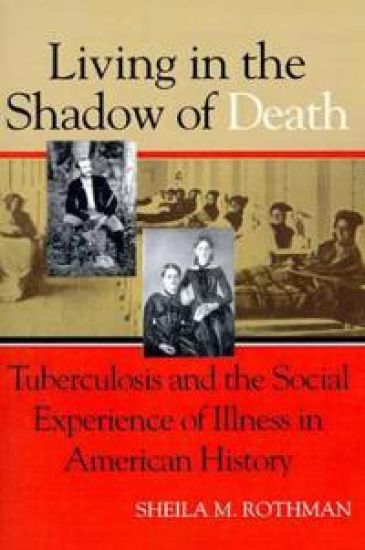
Living in the Shadow of Death

Living in the Shadow of Death

Sheila M. Rothman

Johns Hopkins University Press
1995
pokkari
For more than 150 years, until well into the twentieth century, tuberculosis was the dreaded scourge that AIDS is for us today. Based on the diaries and letters of hundreds of individuals over five generations, Living in the Shadow of Death is the first book to present an intimate and evocative portrait of what it was like for patients as well as families and communities to struggle against this dreaded disease. "Consumption", as it used to be called, is one of the oldest known diseases. But it wasn't until the beginning of the nineteenth century that it became pervasive and feared in the United States, the cause of one out of every five deaths. Consumption crossed all boundaries of geography and social class. How did people afflicted with the disease deal with their fate? How did their families? What did it mean for the community when consumption affected almost every family and every town? Sheila M. Rothman documents a fascinating story. Each generation had its own special view of the origins, transmission, and therapy for the disease, definitions that reflected not only medical knowledge but views on gender obligations, religious beliefs, and community responsibilities. In general, Rothman points out, tenacity and resolve, not passivity or resignation, marked people's response to illness and to their physicians. Convinced that the outdoor life was better for their health, young men with tuberculosis in the nineteenth century interrupted their college studies and careers to go to sea or to settle in the West, in the process shaping communities in Colorado, Arizona, and California. Women, anticipating the worst, raised their children to be welcomed as orphans in other people's homes.In the twentieth century, both men and women entered sanatoriums, sacrificing autonomy for the prospect of a cure. Poignant as biography, illuminating as social history, this book reminds us that ours is not the first generation to cope with the death of the young or with
Academic Capitalism

Academic Capitalism

Sheila Slaughter; Larry L. Leslie

Johns Hopkins University Press
2000
pokkari
The globalization of the political economy at the end of the twentieth century is destabilizing the traditional patterns of university professional work. One of the major changes that has taken place as a result of globalization is that faculty, who were previously situated between capital and labor, are now positioned squarely in the marketplace. To grasp the extent of changes taking place and to understand the forces of change, Academic Capitalism examines the current state of academic careers and institutions, with a particular focus on public research universities in the United States, Canada, the United Kingdom, and Australia. In this wide-ranging analysis, Sheila Slaughter and Larry L. Leslie examine every aspect of academic work unexplored: undergraduate and graduate education, teaching and research, student aid policies, and federal research policies.
Academic Capitalism and the New Economy

Academic Capitalism and the New Economy

Sheila Slaughter; Gary Rhoades

Johns Hopkins University Press
2009
pokkari
As colleges and universities become more entrepreneurial in a post-industrial economy, they focus on knowledge less as a public good than as a commodity to be capitalized on in profit-oriented activities. In Academic Capitalism and the New Economy, higher education scholars Sheila Slaughter and Gary Rhoades detail the aggressive engagement of U.S. higher education institutions in the knowledge-based economy and analyze the efforts of colleges and universities to develop, market, and sell research products, educational services, and consumer goods in the private marketplace. Slaughter and Rhoades track changes in policy and practice, revealing new social networks and circuits of knowledge creation and dissemination, as well as new organizational structures and expanded managerial capacity to link higher education institutions and markets. They depict an ascendant academic capitalist knowledge/learning regime expressed in faculty work, departmental activity, and administrative behavior. Clarifying the regime's internal contradictions, they note the public subsidies embedded in new revenue streams and the shift in emphasis from serving student customers to leveraging resources from them. Defining the terms of academic capitalism in the new economy, this groundbreaking study offers essential insights into the trajectory of American higher education.
In My Family Tree

In My Family Tree

Sheila Siddle; Jane Goodall

Black Cat
2003
nidottu
The cofounder of the internationally renowned African animal refuge Chimfunshi Wildlife Orphanage describes her dedication to rescuing endangered animals, her role as an animal rights activist, and the unforgettable chimpanzees she has encountered along the way. Reprint.
The Line Which Separates

The Line Which Separates

Sheila McManus

University of Nebraska Press
2005
sidottu
Nations are made and unmade at their borders, and the forty-ninth parallel separating Montana and Alberta in the late nineteenth century was a pivotal Western site for both the United States and Canada. Blackfoot country was a key site of Canadian and American efforts to shape their nations and national identities. The region’s landscape, aboriginal people, newcomers, railroads, and ongoing cross-border ties all challenged the governments’ efforts to create, colonize, and nationalize the Alberta-Montana borderlands. The Line Which Separates makes an important and useful comparison between American and Canadian government policies and attitudes regarding race, gender, and homesteading. Federal visions of the West in general and the borderlands in particular rested on overlapping sets of assumptions about space, race, and gender; those same assumptions would be used to craft the policies that were supposed to turn national visions into local realities. The growth of a white female population in the region, which should have “whitened” and “easternized” the region, merely served to complicate emerging categories. Both governments worked hard to enforce the lines that were supposed to separate "good" land from "bad," whites from aboriginals, different groups of newcomers from each other, and women's roles from men's roles. The lines and categories they depended on were used to distinguish each West, and thus each nation, from the other. Drawing on a range of sources, from government maps and reports to oral testimony and personal papers, The Line Which Separates explores the uneven way in which the borderlands were superimposed on Blackfoot country in order to divide a previously cohesive region in the late nineteenth century.
The Line Which Separates

The Line Which Separates

Sheila McManus

University of Nebraska Press
2005
pokkari
Nations are made and unmade at their borders, and the forty-ninth parallel separating Montana and Alberta in the late nineteenth century was a pivotal Western site for both the United States and Canada. Blackfoot country was a key site of Canadian and American efforts to shape their nations and national identities. The region's landscape, aboriginal people, newcomers, railroads, and ongoing cross-border ties all challenged the governments' efforts to create, colonize, and nationalize the Alberta-Montana borderlands. The Line Which Separates makes an important and useful comparison between American and Canadian government policies and attitudes regarding race, gender, and homesteading. Federal visions of the West in general and the borderlands in particular rested on overlapping sets of assumptions about space, race, and gender; those same assumptions would be used to craft the policies that were supposed to turn national visions into local realities. The growth of a white female population in the region, which should have "whitened" and "easternized" the region, merely served to complicate emerging categories. Both governments worked hard to enforce the lines that were supposed to separate "good" land from "bad," whites from aboriginals, different groups of newcomers from each other, and women's roles from men's roles. The lines and categories they depended on were used to distinguish each West, and thus each nation, from the other. Drawing on a range of sources, from government maps and reports to oral testimony and personal papers, The Line Which Separates explores the uneven way in which the borderlands were superimposed on Blackfoot country in order to divide a previously cohesive region in the late nineteenth century.
Maternal–Newborn

Maternal–Newborn

Sheila C. Whitworth; Taralyn McMullan

F.A. Davis Company
2017
nidottu
Content reviewCase studiesNCLEX(R)-style questionsToo much information? Too little time? Here's everything you need to succeed in your maternal-newborn nursing course and prepare for course exams and the NCLEX(R).Succinct content reviews in outline format focus on must-know information, while case studies and NCLEX-style questions develop your ability to apply your knowledge in simulated clinical situations. A 100-question final exam at the end of the book as well as two, 75-item comprehensive examinations online at DavisPlus.com provide the practice you need to feel confident about maternal-newborn content.You'll also find proven techniques and tips to help you study more effectively, learn how to approach different types of questions, and improve your critical-thinking skills.An access code inside new printed texts unlocks the questions online at DavisPlus, with answers and rationales for correct and incorrect responses. You can even design your own quizzes to test your knowledge and skills based on specific content areas, client need categories, cognitive level, and phases of the nursing process.
Soldier's Secret: The Story of Deborah Sampson

Soldier's Secret: The Story of Deborah Sampson

Sheila Solomon Klass

Henry Holt Company
2009
nidottu
In the 1700s, women's responsibilities were primarily child rearing and household duties. But Deborah Sampson wanted more from life. She wanted to read, to travel--and to fight for her country's independence. When the colonies went to war with the British in 1775, Deborah was intent on being part of the action. Seeing no other option, she disguised herself in a man's uniform and served in the Continental army for more than a year, her identity hidden from her fellow soldiers. Accomplished writer Sheila Solomon Klass creates a gripping firstperson account of an extraordinary woman who lived a life full of danger, adventure, and intrigue.
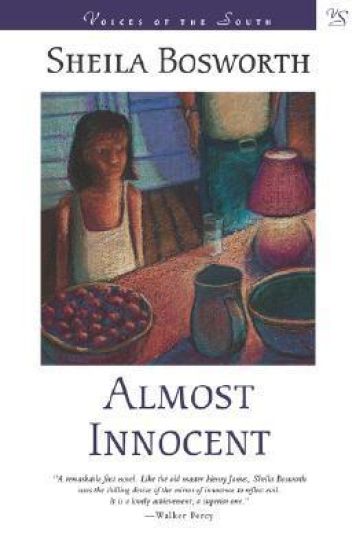
Almost Innocent

Almost Innocent

Sheila Bosworth

Louisiana State University Press
1996
nidottu
"A remarkable first novel. Like the old master Henry James, Sheila Bosworth uses the chilling device of using the mirror of innocence to reflect evil. It is a lovely achievement, a superior one."-Walker Percy Clay-Lee Calvert is the love child of two people who are as beautiful as models in a magazine but whose similarity ends there. Her father, Rand, is an artist-easygoing, dreamy, principled, and chronically jobless. Her mother, Constance, is the blue-blooded, pampered, delicate but determined daughter of a state supreme court justice. How their intense passion for each other plays out against the sumptuousness and decay of 1950s New Orleans is something to which no innocent should be privy. In Sheila Bosworth's mesmerizing first novel, the era, the place, the people, of Clay-Lee's childhood all form an air as real as our own pasts, alternately dim and indelible, where everyone bears some guilt, and all are almost innocent.
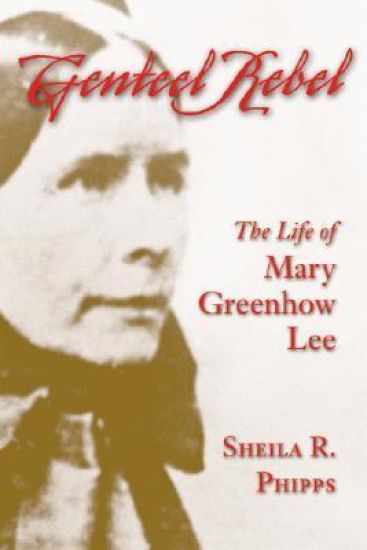
Genteel Rebel

Genteel Rebel

Sheila R. Phipps

Louisiana State University Press
2003
nidottu
This elegantly written biography depicts the combined effect of social structure, character, and national crisis on a woman's life. Mary Greenhow Lee (1819-1907) was raised in a privileged Virginia household. As a young woman, she flirted with President Van Buren's son, drank tea with Dolley Madison, and frolicked in bedsheets through the streets of Washington with her sister-in-law, future Confederate spy Rose O'Neal Greenhow. Later in life, Lee debated with senators, fed foreign emissaries and correspondents, scolded generals, and nursed soldiers. As a Confederate sympathiser in the hotly contested small border town of Winchester, Virginia, she ran an underground postal service, hid contraband under her nieces' dresses, abetted the Rebel cause, and was finally banished. Lee's personal history is an intriguing story. It is also an account of the complex social relations that characterized nineteenth-century life. She was an elite southern woman who knew the rules but who also flouted and other times flaunted the prevailing gender arrangements. Her views on status suggest that the immeasurable markers of prestige were much more important than wealth in her social stratum. She had strong ideas about who was (or was not) her ""equal,"" yet she married a man of quite modest means. Lee's biography also enlarges our view of Confederate patriotism, revealing a war within a war and divisions arising as much from politics and geography as from issues of slavery and class. Mary Greenhow Lee was a woman of her time and place , one whose youthful rebellion against her society's standards yielded to her desire to preserve that society's way of life. Genteel Rebel illustrates the value of biography as history as it narrates the eventful life of a surprisingly powerful southern lady.
Shark Scam

Shark Scam

Sheila Bair

Albert Whitman Company
2025
nidottu
A giant tortoise learns that if something sounds too good to be true, it usually is. Whitey and Cahoots, two sharks, convince giant tortoise Arlene to invest in their sure-fire, money-making scheme. Arlene takes the bait. So do all her friends, and they discover the hard way what a Ponzi scheme is.
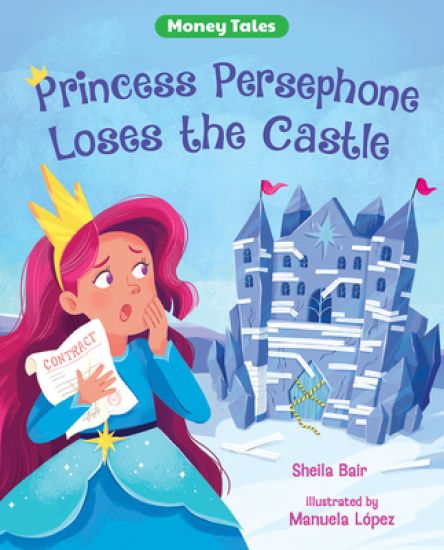
Princess Persephone Loses the Castle

Princess Persephone Loses the Castle

Sheila Bair

Albert Whitman Company
2021
sidottu
"Author Bair has serious finance credentials. She is a former chair of the Federal Deposit Insurance Corporation and current chair of Fannie Mae--and, now, an author of whimsical personal finance books for young children."--Booklist An inexperienced royal learns a valuable lesson about reading the fine print.Princess Persephone was cold in her castle on freezing Ganymede. So, when Aluminum Jim came calling to sell her tin sheets to nail onto the exterior walls to keep out the cold, Persephone was only too happy to agree to a loan and sign the contract without reading it. What could she do when the tin sheets didn't work, she couldn't repay the loan, and Jim claimed the castle?
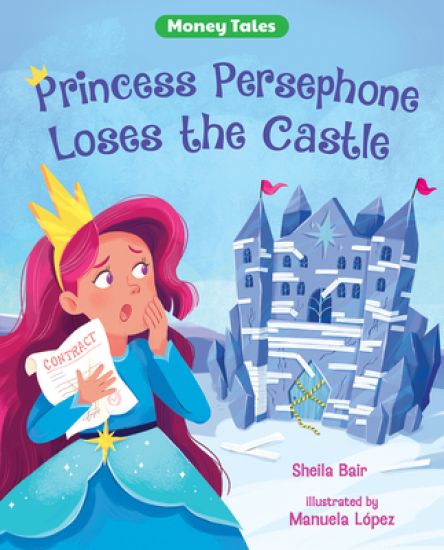
Princess Persephone Loses the Castle

Princess Persephone Loses the Castle

Sheila Bair

Albert Whitman Company
2023
nidottu
"Author Bair has serious finance credentials. She is a former chair of the Federal Deposit Insurance Corporation and current chair of Fannie Mae--and, now, an author of whimsical personal finance books for young children."--Booklist An inexperienced royal learns a valuable lesson about reading the fine print.Princess Persephone was cold in her castle on freezing Ganymede. So, when Aluminum Jim came calling to sell her tin sheets to nail onto the exterior walls to keep out the cold, Persephone was only too happy to agree to a loan and sign the contract without reading it. What could she do when the tin sheets didn't work, she couldn't repay the loan, and Jim claimed the castle?
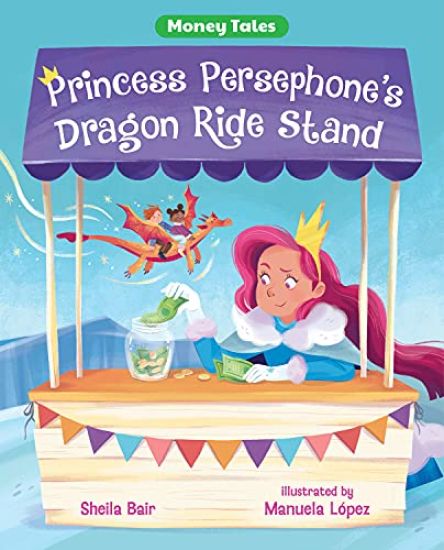
Princess Persephone's Dragon Ride Stand

Princess Persephone's Dragon Ride Stand

Sheila Bair

Albert Whitman Company
2024
nidottu
A princess and her pet discover that while making money can be difficult, keeping it can be even harder. Princess Persephone wants to travel somewhere warm and sunny in a shiny new spaceship, but her father won't give her the money she needs for her dream vacation. Persephone comes up with a great idea to earn cash: dragon rides Learn the ups and downs of entrepreneurship in this amusing story about working hard and spending wisely.