Kirjojen hintavertailu. Mukana 11 699 587 kirjaa ja 12 kauppaa.

Kirjahaku

Etsi kirjoja tekijän nimen, kirjan nimen tai ISBN:n perusteella.

1000 tulosta hakusanalla Signe Iversen

Signs

Signs

Thomas Sebeok

University of Toronto Press
2001
pokkari
The interpretive science of semiotics offers powerful analytical tools for the application of many disciplines to the study of perception. Semiotics is the study of signs, and as such, is of relevance to a wide spectrum of scholars and professionals, including social scientists, psychologists, artists, graphic designers, and students of literature. Semiosis – the production and interpretation of linguistic and visual signs – is innate to human beings of all societies. From the simplest of hand gestures to the most complex diagrams and charts, the sign is key to the communication of ideas. Thomas A. Sebeok examines, in an engaging, readable style, how the sign mediates between bodily experience and abstract thought. This updated second edition of Signs combines some of Sebeok's most important essays with a new general introduction, introductory passages at the outset of each chapter, a glossary, and brief biographies of the major semioticians. From an overview of the discipline to a more detailed exploration of sign categories, the author powerfully demonstrates the co-dependency of verbal and non-verbal communication. Aimed primarily at undergraduate and graduate students, this engaging book also has plenty to offer any general reader who is interested in exploring and analyzing the complex sign systems we so often take for granted.
Signs Amid the Rubble

Signs Amid the Rubble

Lesslie Newbigin

William B Eerdmans Publishing Co
2003
pokkari
The late Lesslie Newbigin was widely regarded as one of this generation's most significant voices on Christianity in relation to modern society. Now that he is gone, there is a call for his unpublished writings to be made available. To that end "Signs amid the Rubble" gathers some of Newbigin's finest statements on issues of continuing relevance. The first set of chapters consists of the 1941 Bangalore Lectures, in which Newbigin speaks powerfully of the kingdom of God in relation to the modern - severely deficient - idea of "progress." The second group of writings, the Henry Martyn Lectures of 1986, deals mainly with the importance of Christian mission. In the last piece, his address to the World Council of Churches conference on mission and evangelism in Brazil in 1996 - which editor Geoffrey Wainwright calls his "swan song on the ecumenical stage" - Newbigin wonders aloud how future generations will judge today's practice of abortion.
Signs and Wonders

Signs and Wonders

Robert A. Anderson

William B Eerdmans Publishing Co
1984
pokkari
Anderson's study of the Book of Daniel is a contribution to the International Theological Commentary whose goal is to bring the Old Testament alive in the worldwide church. In moving beyond the usual critical-historical approach to th Bible, the ITC offers a distinctive theological interpretation of the Hebrew text.
Signs of Paradox

Signs of Paradox

Eric Gans

Stanford University Press
1997
sidottu
Starting from the minimal principle of generative anthropology—that human culture originates as "the deferral of violence through representation"—the author proposes a new understanding of the fundamental concepts of metaphysics and an explanation of the historical problematic that underlies the postmodern "end of culture." Part I begins with the paradoxical emergence of the "vertical" sign from the "horizontal" world of appetite. Two persons reaching for the same object are a minimal model of this emergence; their "pragmatic paradox" can be resolved only by substituting the representation of the object for its appropriation. The nature of paradox and the related notion of irony, as well as the fundamental concepts of being, thinking, and signification, are rethought on the basis of this triangular model, leading to an anthropological interpretation of the origin of philosophy and semiotics in Plato's Ideas. Part I concludes with an exploration of the psychoanalytic categories of the unconscious and the erotic. Part II develops the idea that material exchange originates in the sparagmos or violent rendering of the sacrificial victim from which each participant obtains a roughly equal portion. The dependence of the process on the central victimary figure culminates in the Holocaust, the extermination of the Jews, whose crucial role in Western culture is their rejection of the central image in favor of peripheral exchange. As a result, postmodern dialogue becomes dominated by the rhetoric of victimage, and the culture of centrality gives way to an aesthetic of the marginal.
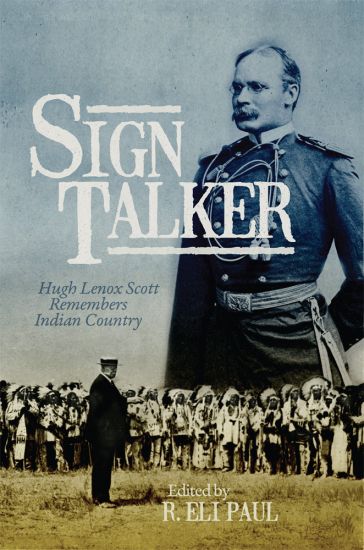
Sign Talker

Sign Talker

Hugh Lenox Scott

University of Oklahoma Press
2016
sidottu
A graduate of West Point, General Hugh Lenox Scott (1853-1934) belonged to the same regiment as George Armstrong Custer. As a member of the Seventh Cavalry, Scott actually began his career at the Little Big Horn when in 1877 he helped rebury Custer's fallen soldiers. Yet Scott was no Custer. His lifelong aversion to violence in resolving disputes and abiding respect for American Indians earned him the reputation as one of the most adept peacemakers ever to serve in the U.S. Army. Sign Talker, an annotated edition of Scott's memoirs, gives new insight into this soldier-diplomat's experiences and accomplishments. Scott's original autobiography, first published in 1928, has remained out of print for decades. In that memoir, he recounted the many phases of his distinguished military career, beginning with his education at West Point and ending with World War I, when, as army chief of staff, he gathered the U.S. forces that saw ultimate victory in Europe. Sign Talker reproduces the first - and arguably most compelling - portion of the memoir, including Scott's involvement with Plains Indians and his service at western forts. In his in-depth introduction to this volume, editor R. Eli Paul places Scott's autobiography in a larger historical context. According to Paul, Scott stood apart from his fellow officers because of his enlightened views and forward-looking actions. Through Scott's own words, we learn how he became an expert in Plains Indian Sign Language so that he could communicate directly with Indians and bypass intermediaries. Possessing deep empathy for the plight of Native peoples and concern for the wrongs they had suffered, he played an important role in helping them achieve small, yet significant victories in the aftermath of the brutal Indian wars. As historians continue to debate the details of the Indian wars, and as we critically examine our nation's current foreign policy, the unique legacy of General Scott provides a model of military leadership. Sign Talker restores an undervalued diplomat to well-deserved prominence in the story of U.S.-Indian relations.
Signs of Cherokee Culture

Signs of Cherokee Culture

Bender Margaret

The University of North Carolina Press
2002
nidottu
Based on extensive fieldwork in the community of the Eastern Band of Cherokee Indians in western North Carolina, this book uses a semiotic approach to investigate the historic and contemporary role of the Sequoyan syllabary - the written system for representing the sounds of the Cherokee language - in Eastern Cherokee life. The Cherokee syllabary was invented in the 1820s by the respected Cherokee Sequoyah. The syllabary quickly replaced alternative writing systems for Cherokee and was reportedly in widespread use by the mid-nineteenth century. After that, literacy in Cherokee declined, except in specialized religious contexts. But as Bender shows, recent interest in cultural revitalization among the Cherokees has increased the use of the syllabary in education, publications, and even signage. Bender also explores the role played by the syllabary within the ever more important context of tourism. (The Eastern Cherokee Band hosts millions of visitors each year in the Great Smoky Mountains.) English is the predominant language used in the Cherokee community, but Bender shows how the syllabary is used in special and subtle ways that help to shape a shared cultural and linguistic identity among the Cherokees. Signs of Cherokee Culture thus makes an important contribution to the ethnographic literature on culturally specific literacies.
Signs

Signs

Maurice Merleau-Ponty

Northwestern University Press
1964
nidottu
Speech is a way of tearing out a meaning from an undivided whole."Thus does Maurice Merleau-Ponty describe speech in this collection of his important writings on the philosophy of expression, composed during the last decade of his life. For him, expression is a category of human behavior and existence much broader than language alone. He maintains that man is essentially expressive, even prior to speaking: in his silence, gestures, and lived behavior.
Signs that Sing

Signs that Sing

Heather Maring

University Press of Florida
2017
sidottu
In Signs that Sing, Heather Maring argues that oral tradition, religious ritual, and literate Latin-based practices are dynamically interconnected in Old English poetry. Resisting the tendency to study these different forms of expression separately, this book contends that poets combined them in hybrid techniques that were important to the early development of English literature. Maring examines a variety of texts, including Beowulf, The Battle of Maldon, The Dream of the Rood, and the Advent Lyrics, and shows how themes from oral tradition became metaphors for sacred concepts in the hands of Christian authors and how oral performance and religious liturgy influenced written poetry. The result, she demonstrates, is richly elaborate verse filled with shared symbols and themes that a wide range of audiences could understand and find meaningful.
Signs of Dissent

Signs of Dissent

Dawn Fulton

University of Virginia Press
2008
sidottu
Maryse Conde is a Guadeloupean writer and critic whose work has challenged the categories of race, language, gender, and geography that inform contemporary literary and critical debates. In ""Signs of Dissent"", the first full-length study in English on Conde, Dawn Fulton situates this award-winning author's work in the context of current theories of cultural identity in order to foreground Conde's unique contributions to these discussions. Staging a dialogue between Conde's novels and the field of postcolonial studies, Fulton argues that Conde enacts a strategy of ""critical incorporations"" in her fiction, imitating and transforming many of the prevailing narratives of postcolonial theory so as to explore their theoretical and conceptual limits.By rejecting the facile classification of her work as ""Caribbean,"" ""African,"" or ""feminist,"" Conde has gained a reputation as an iconoclast. But Fulton proposes that behind this public image of provocation lies an incisive reflection on the burdens of representation imposed on the non-Western writer, and that Conde's novels expose the ways in which postcolonial criticism can be complicit in constructing such burdens even as it questions them. ""Signs of Dissent"" offers one of the most comprehensive assessments of Conde's literary production to date, illuminating its exceptional role in shaping a dialogue between francophone studies and the English-dominated field of postcolonialism.
Signs of Dissent

Signs of Dissent

Dawn Fulton

University of Virginia Press
2008
nidottu
Maryse Conde is a Guadeloupean writer and critic whose work has challenged the categories of race, language, gender, and geography that inform contemporary literary and critical debates. In ""Signs of Dissent"", the first full-length study in English on Conde, Dawn Fulton situates this award-winning author's work in the context of current theories of cultural identity in order to foreground Conde's unique contributions to these discussions. Staging a dialogue between Conde's novels and the field of postcolonial studies, Fulton argues that Conde enacts a strategy of ""critical incorporations"" in her fiction, imitating and transforming many of the prevailing narratives of postcolonial theory so as to explore their theoretical and conceptual limits.By rejecting the facile classification of her work as ""Caribbean,"" ""African,"" or ""feminist,"" Conde has gained a reputation as an iconoclast. But Fulton proposes that behind this public image of provocation lies an incisive reflection on the burdens of representation imposed on the non-Western writer, and that Conde's novels expose the ways in which postcolonial criticism can be complicit in constructing such burdens even as it questions them. ""Signs of Dissent"" offers one of the most comprehensive assessments of Conde's literary production to date, illuminating its exceptional role in shaping a dialogue between francophone studies and the English-dominated field of postcolonialism.
Signs of Resistance

Signs of Resistance

Susan Burch

New York University Press
2002
sidottu
Choice Outstanding Academic Title 2003 A reinterpretation of early 20th century Deaf history, with sign language at its center During the nineteenth century, American schools for deaf education regarded sign language as the "natural language" of Deaf people, using it as the principal mode of instruction and communication. These schools inadvertently became the seedbeds of an emerging Deaf community and culture. But beginning in the 1880s, an oralist movement developed that sought to suppress sign language, removing Deaf teachers and requiring deaf people to learn speech and lip reading. Historians have all assumed that in the early decades of the twentieth century oralism triumphed overwhelmingly. Susan Burch shows us that everyone has it wrong; not only did Deaf students continue to use sign language in schools, hearing teachers relied on it as well. In Signs of Resistance, Susan Burch persuasively reinterprets early twentieth century Deaf history: using community sources such as Deaf newspapers, memoirs, films, and oral (sign language) interviews, Burch shows how the Deaf community mobilized to defend sign language and Deaf teachers, in the process facilitating the formation of collective Deaf consciousness, identity and political organization.
Signs of Resistance

Signs of Resistance

Susan Burch

New York University Press
2004
pokkari
Choice Outstanding Academic Title 2003 A reinterpretation of early 20th century Deaf history, with sign language at its center During the nineteenth century, American schools for deaf education regarded sign language as the "natural language" of Deaf people, using it as the principal mode of instruction and communication. These schools inadvertently became the seedbeds of an emerging Deaf community and culture. But beginning in the 1880s, an oralist movement developed that sought to suppress sign language, removing Deaf teachers and requiring deaf people to learn speech and lip reading. Historians have all assumed that in the early decades of the twentieth century oralism triumphed overwhelmingly. Susan Burch shows us that everyone has it wrong; not only did Deaf students continue to use sign language in schools, hearing teachers relied on it as well. In Signs of Resistance, Susan Burch persuasively reinterprets early twentieth century Deaf history: using community sources such as Deaf newspapers, memoirs, films, and oral (sign language) interviews, Burch shows how the Deaf community mobilized to defend sign language and Deaf teachers, in the process facilitating the formation of collective Deaf consciousness, identity and political organization.
Signs of Change

Signs of Change

Ron Robin

CRC Press Inc
2018
sidottu
Originally published in 1990, Signs of Change assess the people of San Francisco according to their own demonstrative standards through the visual symbols. Special attention is devoted to the visual perceptions of immigrants, those whose senses were not smothered by over-familiarity or protracted compliance with American mores. Immigration history is often studied in the concentrate exclusively on narrow connections between newcomers and their urban surroundings. The city has served as a data-base for the study of specific immigrant communities; frequently it has provided mere background for cloistered studies of immigrant life.
Signs of Change

Signs of Change

Ron Robin

CRC Press Inc
2020
nidottu
Originally published in 1990, Signs of Change assess the people of San Francisco according to their own demonstrative standards through the visual symbols. Special attention is devoted to the visual perceptions of immigrants, those whose senses were not smothered by over-familiarity or protracted compliance with American mores. Immigration history is often studied in the concentrate exclusively on narrow connections between newcomers and their urban surroundings. The city has served as a data-base for the study of specific immigrant communities; frequently it has provided mere background for cloistered studies of immigrant life.
Signs of God

Signs of God

Mark Corner

CRC Press Inc
2017
sidottu
Signs of God reveals why discussion of the nature of miracles is of central rather than marginal importance where belief in God is concerned. Miracles cannot be shunted to one side as an embarrassing hangover from a 'pre-scientific age'. Miracles have played an important role in the history of all the major world religions, and many religious believers claim that they continue to do so. Yet they have also been criticized from a philosophical viewpoint as incompatible with a belief in laws of nature, and those who seek to have their religious beliefs properly attuned to the modern world often prefer to do without them. This accessible book examines the nature of miracles both in philosophical and historical terms, and concludes that, whether or not miracles happen, it is difficult to see how religious belief could survive without them.
Signed, Malraux

Signed, Malraux

Lyotard Jean-Francois

University of Minnesota Press
1999
sidottu
Traces the life and career of the French novelist, describing his participation in the Spanish Civil War, command of a World War II resistance brigade, and his position as a government minister.
Signed, Malraux

Signed, Malraux

Jean-Francois Lyotard

University of Minnesota Press
2001
nidottu
Traces the life and career of the French novelist, describing his participation in the Spanish Civil War, command of a World War II resistance brigade, and his position as a government minister
Signs Of Danger

Signs Of Danger

University of Minnesota Press
2004
sidottu
A rising ocean. A falling building. A toxic river. Species extinguished. A nuclear landscape. In a world so configured, the state of contemporary ecological thought and practice is woefully - and perilously - inadequate. Focusing on the government's nuclear waste burial program in Carlsbad, New Mexico, this book begins the urgent work of finding a new way of thinking about ecological threat in our time.