Kirjojen hintavertailu. Mukana 12 595 353 kirjaa ja 12 kauppaa.

Kirjahaku

Etsi kirjoja tekijän nimen, kirjan nimen tai ISBN:n perusteella.

1000 tulosta hakusanalla Vladimir Simosko

100 Questions and Answers About Chronic Pain

100 Questions and Answers About Chronic Pain

Vladimir Maletic; Rakesh Jain; Charles L. Raison

Jones and Bartlett Publishers, Inc
2010
nidottu
Empower Yourself!Millions of Americans suffer from chronic pain ranging from mild to excruciating. If you or a loved one experience chronic pain, Questions and Answers About Chronic Pain offers essential and practical guidance. This easy-to-read guide provides authoritative answers to common questions asked by patients and their families about chronic pain. Topics include introduction to pain disorders, neurobiology of pain, treatments, and coping strategies for thriving despite pain. Questions and Answers About Chronic Pain is an essential resource for anyone coping with the physical and emotional turmoil of this disorder.
Mechanics of Accuracy in Engineering Design of Machines and Robots

Mechanics of Accuracy in Engineering Design of Machines and Robots

Vladimir T. Portman

American Society of Mechanical Engineers,U.S.
2018
sidottu
Accuracy is one of the fundamental characteristics and one of the most important indexes of the quality of machines and robots. It significantly defines their structure and applications and, in turn, depends on their structure and applications. Accuracy provision, maintenance, and enhancement are permanently hot problems in modern manufacturing and manufacturing science.The book is being published in two volumes and comprises the Introduction and four parts including 18 chapters with consecutive numbering, and three appendices. Each part combines a theoretical chapter with applications to machines and robots with different kinematic types. The formalized consideration is accompanied with application examples, which, as a rule, are explained with numerical solutions using realistic initial values.Volume 1 includes Introduction, Parts I and II (Chapters 1-12), and hence, embraces the general accuracy definitions, nominal machine functioning models, and geometrical accuracy problems. Volume 2 includes Parts III and IV and is available separately.The book is intended for machine and robot designers and researchers, university graduate and senior undergraduate students, and may be also useful for instructors in the mechanical engineering field for teaching processes.
Mechanics of Accuracy in Engineering Design of Machines and Robots

Mechanics of Accuracy in Engineering Design of Machines and Robots

Vladimir T. Portman

American Society of Mechanical Engineers,U.S.
2020
sidottu
Accuracy is one of the fundamental characteristics and one of the most important indexes of the quality of machines and robots. It significantly defines their structure and applications and, in turn, depends on their structure and applications. Accuracy provision, maintenance, and enhancement are permanently hot problems in modern manufacturing and manufacturing science.The book is being published in two volumes and four parts. Each part combines a theoretical chapter with applications to machines and robots with different kinematic types. The formalized consideration is accompanied with application examples, which, as a rule, are explained with numerical solutions using realistic initial values.This Volume II continues consideration of the accuracy-related problem as applied to machines and robots started in Volume I. Two themes are developed in Volume II: stiffness-compliance directly associated with the machine and robot accuracy through static deformations (Part I) and computer-aided metrology aimed at final assessments of the accuracy-associated performance indexes (Part II).The problems discussed in both volumes hold the greatest interest in mechanics of machines and robot accuracy. In spite of the physical diversity of the considered problems, they are integrated by application of unique methodology in both volumes. The methodology is based on the models of the nominal functioning of the machines, whose small disturbances result in geometrical accuracy and stiffness-compliance problems. The matrix technique for engineering problem formulation and the computer software system for effective solution in parallel with overcoming mathematical and technical difficulties are applied for the considered problems.Volume II is written as a standalone book in its own right and can be used without access to Volume I. The book is intended for machine and robot designers and researchers, university graduate and senior undergraduate students, and their instructors.
Singularities of Caustics and Wave Fronts
One service mathematics has rendered the 'Et moi, ...) si j'avait su comment en revenir, human race. It has put common sense back je n'y serais point aile.' Jules Verne where it belongs, on the topmost shelf next to the dusty canister labelled 'discarded non- The series is divergent; therefore we may be sense'. ErieT. Bell able to do something with it. O. Heaviside Mathematics is a tool for thought. A highly necessary tool in a world where both feedback and non- linearities abound. Similarly, all kinds of parts of mathematics serve as tools for other parts and for other sciences. Applying a simple rewriting rule to the quote on the right above one finds such statements as: 'One service topology has rendered mathematical physics ...'; 'One service logic has rendered com- puter science ...'; 'One service category theory has rendered mathematics ...'. All arguably true. And all statements obtainable this way form part of the raison d'etre of this series.
Algorithms: Main Ideas and Applications

Algorithms: Main Ideas and Applications

Vladimir Uspensky; A.L. Semenov

Springer
1993
sidottu
Today the notion of the algorithm is familiar not only to mathematicians. It forms a conceptual base for information processing; the existence of a corresponding algorithm makes automatic information processing possible. The theory of algorithms (together with mathematical logic ) forms the the­ oretical basis for modern computer science (see [Sem Us 86]; this article is called "Mathematical Logic in Computer Science and Computing Practice" and in its title mathematical logic is understood in a broad sense including the theory of algorithms). However, not everyone realizes that the word "algorithm" includes a transformed toponym Khorezm. Algorithms were named after a great sci­ entist of medieval East, is al-Khwarizmi (where al-Khwarizmi means "from Khorezm"). He lived between c. 783 and 850 B.C. and the year 1983 was chosen to celebrate his 1200th birthday. A short biography of al-Khwarizmi compiled in the tenth century starts as follows: "al-Khwarizmi. His name is Muhammad ibn Musa, he is from Khoresm" (cited according to [Bul Rozen Ah 83, p.8]).
Mathematical Foundations of the State Lumping of Large Systems

Mathematical Foundations of the State Lumping of Large Systems

Vladimir S. Korolyuk; A.F. Turbin

Springer
1993
sidottu
During the investigation of large systems described by evolution equations, we encounter many problems. Of special interest is the problem of "high dimensionality" or, more precisely, the problem of the complexity of the phase space. The notion of the "comple­ xity of the. phase space" includes not only the high dimensionality of, say, a system of linear equations which appear in the mathematical model of the system (in the case when the phase space of the model is finite but very large), as this is usually understood, but also the structure of the phase space itself, which can be a finite, countable, continual, or, in general, arbitrary set equipped with the structure of a measurable space. Certainly, 6 6 this does not mean that, for example, the space (R 6, ( ), where 6 is a a-algebra of Borel sets in R 6, considered as a phase space of, say, a six-dimensional Wiener process (see Gikhman and Skorokhod [1]), has a "complex structure". But this will be true if the 6 same space (R 6, ( ) is regarded as a phase space of an evolution system describing, for example, the motion of a particle with small mass in a viscous liquid (see Chandrasek­ har [1]).
Mathematical Methods in Queuing Theory

Mathematical Methods in Queuing Theory

Vladimir V. Kalashnikov

Springer
1993
sidottu
The material of this book is based on several courses which have been delivered for a long time at the Moscow Institute for Physics and Technology. Some parts have formed the subject of lectures given at various universities throughout the world: Freie Universitat of Berlin, Chalmers University of Technology and the University of Goteborg, University of California at Santa Barbara and others. The subject of the book is the theory of queues. This theory, as a mathematical discipline, begins with the work of A. Erlang, who examined a model of a telephone station and obtained the famous formula for the distribution of the number of busy lines which is named after him. Queueing theory has been applied to the study of numerous models: emergency aid, road traffic, computer systems, etc. Besides, it has lead to several related disciplines such as reliability and inventory theories which deal with similar models. Nevertheless, many parts of the theory of queues were developed as a "pure science" with no practical applications. The aim of this book is to give the reader an insight into the mathematical methods which can be used in queueing theory and to present examples of solving problems with the help of these methods. Of course, the choice of the methods is quite subjective. Thus, many prominent results have not even been mentioned.
Theory of U-Statistics

Theory of U-Statistics

Vladimir S. Korolyuk; Y.V. Borovskich

Springer
1993
sidottu
The theory of U-statistics goes back to the fundamental work of Hoeffding [1], in which he proved the central limit theorem. During last forty years the interest to this class of random variables has been permanently increasing, and thus, the new intensively developing branch of probability theory has been formed. The U-statistics are one of the universal objects of the modem probability theory of summation. On the one hand, they are more complicated "algebraically" than sums of independent random variables and vectors, and on the other hand, they contain essential elements of dependence which display themselves in the martingale properties. In addition, the U -statistics as an object of mathematical statistics occupy one of the central places in statistical problems. The development of the theory of U-statistics is stipulated by the influence of the classical theory of summation of independent random variables: The law of large num­ bers, central limit theorem, invariance principle, and the law of the iterated logarithm we re proved, the estimates of convergence rate were obtained, etc.
Semi-Markov Random Evolutions

Semi-Markov Random Evolutions

Vladimir S. Korolyuk; Anatoly Swishchuk

Springer
1994
sidottu
The evolution of systems in random media is a broad and fruitful field for the applica­ tions of different mathematical methods and theories. This evolution can be character­ ized by a semigroup property. In the abstract form, this property is given by a semigroup of operators in a normed vector (Banach) space. In the practically boundless variety of mathematical models of the evolutionary systems, we have chosen the semi-Markov ran­ dom evolutions as an object of our consideration. The definition of the evolutions of this type is based on rather simple initial assumptions. The random medium is described by the Markov renewal processes or by the semi­ Markov processes. The local characteristics of the system depend on the state of the ran­ dom medium. At the same time, the evolution of the system does not affect the medium. Hence, the semi-Markov random evolutions are described by two processes, namely, by the switching Markov renewal process, which describes the changes of the state of the external random medium, and by the switched process, i.e., by the semigroup of oper­ ators describing the evolution of the system in the semi-Markov random medium.
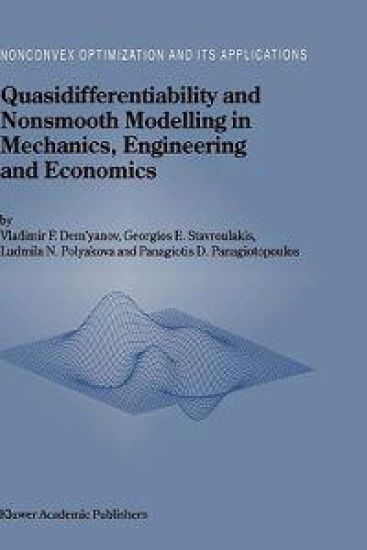
Quasidifferentiability and Nonsmooth Modelling in Mechanics, Engineering and Economics

Quasidifferentiability and Nonsmooth Modelling in Mechanics, Engineering and Economics

Vladimir F. Demyanov; Georgios E. Stavroulakis; L.N. Polyakova; P. D. Panagiotopoulos

Springer
1996
sidottu
Nonsmooth energy functions govern phenomena which occur frequently in nature and in all areas of life. They constitute a fascinating subject in mathematics and permit the rational understanding of yet unsolved or partially solved questions in mechanics, engineering and economics. This is the first book to provide a complete and rigorous presentation of the quasidifferentiability approach to nonconvex, possibly nonsmooth, energy functions, of the derivation and study of the corresponding variational expressions in mechanics, engineering and economics, and of their numerical treatment. The new variational formulations derived are illustrated by many interesting numerical problems. The techniques presented will permit the reader to check any solution obtained by other heuristic techniques for nonconvex, nonsmooth energy problems. A civil, mechanical or aeronautical engineer can find in the book the only existing mathematically sound technique for the formulation and study of nonconvex, nonsmooth energy problems. Audience: The book will be of interest to pure and applied mathematicians, physicists, researchers in mechanics, civil, mechanical and aeronautical engineers, structural analysts and software developers. It is also suitable for graduate courses in nonlinear mechanics, nonsmooth analysis, applied optimization, control, calculus of variations and computational mechanics.
Geometric Sums: Bounds for Rare Events with Applications
This book reviews problems associated with rare events arising in a wide range of circumstances, treating such topics as how to evaluate the probability an insurance company will be bankrupted, the lifetime of a redundant system, and the waiting time in a queue. Well-grounded, unique mathematical evaluation methods of basic probability characteristics concerned with rare events are presented, which can be employed in real applications, as the volume also contains relevant numerical and Monte Carlo methods. The various examples, tables, figures and algorithms will also be appreciated. Audience: This work will be useful to graduate students, researchers and specialists interested in applied probability, simulation and operations research.
Geometric Methods and Optimization Problems

Geometric Methods and Optimization Problems

Vladimir Boltyanski; Horst Martini; V. Soltan

Springer
1998
sidottu
VII Preface In many fields of mathematics, geometry has established itself as a fruitful method and common language for describing basic phenomena and problems as well as suggesting ways of solutions. Especially in pure mathematics this is ob­ vious and well-known (examples are the much discussed interplay between lin­ ear algebra and analytical geometry and several problems in multidimensional analysis). On the other hand, many specialists from applied mathematics seem to prefer more formal analytical and numerical methods and representations. Nevertheless, very often the internal development of disciplines from applied mathematics led to geometric models, and occasionally breakthroughs were b~ed on geometric insights. An excellent example is the Klee-Minty cube, solving a problem of linear programming by transforming it into a geomet­ ric problem. Also the development of convex programming in recent decades demonstrated the power of methods that evolved within the field of convex geometry. The present book focuses on three applied disciplines: control theory, location science and computational geometry. It is our aim to demonstrate how methods and topics from convex geometry in a wider sense (separation theory of convex cones, Minkowski geometry, convex partitionings, etc.) can help to solve various problems from these disciplines.
Stochastic Models of Systems

Stochastic Models of Systems

Vladimir S. Korolyuk; Vladimir V. Korolyuk

Springer
1999
sidottu
In this monograph stochastic models of systems analysis are discussed. It covers many aspects and different stages from the construction of mathematical models of real systems, through mathematical analysis of models based on simplification methods, to the interpretation of real stochastic systems. The stochastic models described here share the property that their evolutionary aspects develop under the influence of random factors. It has been assumed that the evolution takes place in a random medium, i.e. unilateral interaction between the system and the medium. As only Markovian models of random medium are considered in this book, the stochastic models described here are determined by two processes, a switching process describing the evolution of the systems and a switching process describing the changes of the random medium. Audience: This book will be of interest to postgraduate students and researchers whose work involves probability theory, stochastic processes, mathematical systems theory, ordinary differential equations, operator theory, or mathematical modelling and industrial mathematics.
Minimax Under Transportation Constrains

Minimax Under Transportation Constrains

Vladimir Tsurkov; A. Mironov

Springer
1999
sidottu
Transportation problems belong to the domains mathematical program­ ming and operations research. Transportation models are widely applied in various fields. Numerous concrete problems (for example, assignment and distribution problems, maximum-flow problem, etc. ) are formulated as trans­ portation problems. Some efficient methods have been developed for solving transportation problems of various types. This monograph is devoted to transportation problems with minimax cri­ teria. The classical (linear) transportation problem was posed several decades ago. In this problem, supply and demand points are given, and it is required to minimize the transportation cost. This statement paved the way for numerous extensions and generalizations. In contrast to the original statement of the problem, we consider a min­ imax rather than a minimum criterion. In particular, a matrix with the minimal largest element is sought in the class of nonnegative matrices with given sums of row and column elements. In this case, the idea behind the minimax criterion can be interpreted as follows. Suppose that the shipment time from a supply point to a demand point is proportional to the amount to be shipped. Then, the minimax is the minimal time required to transport the total amount. It is a common situation that the decision maker does not know the tariff coefficients. In other situations, they do not have any meaning at all, and neither do nonlinear tariff objective functions. In such cases, the minimax interpretation leads to an effective solution.
Hierarchical Optimization and Mathematical Physics
This book should be considered as an introduction to a special dass of hierarchical systems of optimal control, where subsystems are described by partial differential equations of various types. Optimization is carried out by means of a two-level scheme, where the center optimizes coordination for the upper level and subsystems find the optimal solutions for independent local problems. The main algorithm is a method of iterative aggregation. The coordinator solves the problern with macrovariables, whose number is less than the number of initial variables. This problern is often very simple. On the lower level, we have the usual optimal control problems of math­ ematical physics, which are far simpler than the initial statements. Thus, the decomposition (or reduction to problems ofless dimensions) is obtained. The algorithm constructs a sequence of so-called disaggregated solutions that are feasible for the main problern and converge to its optimal solutionunder certain assumptions ( e.g., under strict convexity of the input functions). Thus, we bridge the gap between two disciplines: optimization theory of large-scale systems and mathematical physics. The first motivation was a special model of branch planning, where the final product obeys a preset assortment relation. The ratio coefficient is maximized. Constraints are given in the form of linear inequalities with block diagonal structure of the part of a matrix that corresponds to subsystems. The central coordinator assem­ bles the final production from the components produced by the subsystems.
Large-scale Optimization

Large-scale Optimization

Vladimir Tsurkov

Springer
2001
sidottu
Decomposition methods aim to reduce large-scale problems to simpler problems. This monograph presents selected aspects of the dimension-reduction problem. Exact and approximate aggregations of multidimensional systems are developed and from a known model of input-output balance, aggregation methods are categorized. The issues of loss of accuracy, recovery of original variables (disaggregation), and compatibility conditions are analyzed in detail. The method of iterative aggregation in large-scale problems is studied. For fixed weights, successively simpler aggregated problems are solved and the convergence of their solution to that of the original problem is analyzed. An introduction to block integer programming is considered. Duality theory, which is widely used in continuous block programming, does not work for the integer problem. A survey of alternative methods is presented and special attention is given to combined methods of decomposition. Block problems in which the coupling variables do not enter the binding constraints are studied. These models are worthwhile because they permit a decomposition with respect to primal and dual variables by two-level algorithms instead of three-level algorithms. Audience: This book is addressed to specialists in operations research, optimization, and optimal control.
Electrets In Engineering

Electrets In Engineering

Vladimir N. Kestelman; Leonid S. Pinchuk; Victor A. Goldade

Springer
2000
sidottu
Recently a new sphere in materials science· has formed which subject is structure and properties of electret materials used in engineering, medicine, biotechnology and other branches. It is characterized by specific methods of experimental investigations based on recording charge transfer, polarization and depolarization of dielectrics and involves original techniques and physico-mathematical aids where notions that exist at the interface of several natural and technical sciences are concentrated. It embraces a vast area of applications mainly in engineering, instrument­ making, electronics, medical technique, biotechnology, and etc., has a specialized technological base for electric polarization of dielectrics composed of uncommon technological methods, equipment and instrumentation. Apparently, future fundamental investigations in the domain of electret materials science are to be developed at the interface of computer of dielectrics. Elaboration of a simulation, physics and physical chemistry model for electric polarization of solid media with uneven charge density distribution, complicated by surface phenomena, outer electromagnetic, heat, chemical and other effects, presents a grave methodological problem. The simulation of structures in which polarization follows diffusion mechanism of chemically active molecules or their fragments, and the development of calculation methods for polarized charge relaxation and regularities of dielectric nonlinear properties, are the most urgent objectives of current research. Success in bioelectret effect studies is anticipated to result in profound widening of natural science knowledge.
Double-Crush Syndrome

Double-Crush Syndrome

Vladimir Golovchinsky

Springer
2000
sidottu
Carpal-tunnel and other entrapment syndromes are perhaps the most common work-related injuries currently reported. With this book, Vladimir Golovchinsky presents the first evidence of double-crush syndrome as a subgroup of these. To date the existence of double-crush syndrome has been a matter of debate. Dr. Golovchinsky presents a statistical analysis of substantial clinical material, which finds a cause-and-effect relationship between cervical or lumbar radiculopathy and peripheral entrapment in corresponding nerves, thus proving the existence of double-crush syndrome. This book will be invaluable to physicians performing EMG-NCV testing and to other healthcare professionals who encounter peripheral entrapment syndromes in their practices.
Information Systems Analysis and Modeling
Informational Macrodynamics (IMD) presents the unified information systemic approach with common information language for modeling, analysis and optimization of a variety of interactive processes, such as physical, biological, economical, social, and informational, including human activities. Comparing it with thermodynamics, which deals with transformation energy and represents a theoretical foundation of physical technology, IMD deals with transformation information, and can be considered a theoretical foundation of Information Computer Technology (ICT). ICT includes but is not limited to applied computer science, computer information systems, computer and data communications, software engineering, and artificial intelligence. In ICT, information flows from different data sources, and interacts to create new information products. The information flows may interact physically or via their virtual connections, initiating an information dynamic process that can be distributed in space. As in physics, a problem is understanding general regularities of the information processes in terms of information law, for the engineering and technological design, control, optimization, and development of computer technology, operations, manipulations, and management of real information objects. Information Systems Analysis and Modeling: An Informational Macrodynamics Approach belongs to an interdisciplinary science that represents the new theoretical and computer-based methodology for system informational description and improvement, including various activities in such interdisciplinary areas as thinking, intelligent processes, management, and other nonphysical subjects with their mutual interactions, informational superimpositions, and the information transferred between interactions. Information Systems Analysis and Modeling: An Informational Macrodynamics Approach can be used as a textbook or secondary text in courses on computer science, engineering, business, management, education, and psychology and as a reference for research and industry.
Divine Sophia

Divine Sophia

Vladimir Sergeyevich Solovyov

Cornell University Press
2009
pokkari
Solovyov's wisdom writings captivated several generations of poets and philosophers during the pre- and postrevolutionary periods in Russia and abroad. In particular, his Sophiology had a profound influence on such major figures of Russia's Silver Age as Alexander Blok, Andrei Belyi, Pavel Florensky, and Sergei Bulgakov. The founder of modern Russian philosophy, Vladimir Solovyov (1853-1900) is widely considered its greatest practitioner. Together with Dostoevsky and Tolstoy, he is one of the towering intellectual figures in late-nineteenth-century Russia, and his diverse writings influenced much of the non-Marxist tradition of twentieth-century Russian thought. Philosopher, journalist, poet, and playwright, Solovyov was also a mystic who claimed to have had three visions of Divine Sophia. This personification of wisdom with golden hair and a radiant aura echoes both the eternal feminine and the world soul. Rooted in Christian and Jewish mysticism, Eastern Orthodox iconography, Greek philosophy, and European romanticism, the Sophiology that suffuses Solovyov's philosophical and artistic works is both intellectually sophisticated and profoundly inspiring. Judith Deutsch Kornblatt brings together key texts from Solovyov's writings about Sophia: poetry, fiction, drama, and philosophy, all extensively annotated and some available in English for the first time (with assistance from the translators Boris Jakim and Laury Magnus). In the comprehensive introductory essay that encompasses the book's first half, Kornblatt establishes the historical, philosophical, religious, and literary context of Solovyov's Sophiology, emphasizing its connection to contemporaneous religious and philosophical thought as well as other social and cultural trends in Europe and the United States-for example, Solovyov's reactions to his changing world ran parallel to and sometimes intersected with those of Darwin, Nietzsche, and William James. Sophiology is once again finding enthusiasts both in Russia and among seekers around the world. The definitive introduction to Solovyov's wisdom and its profound impact on Russian thought and culture, Divine Sophia makes Solovyov's mystical visions and literary "re-visions" of Sophia accessible to scholars and lay readers alike.