Kirjojen hintavertailu. Mukana 11 627 220 kirjaa ja 12 kauppaa.

Kirjahaku

Etsi kirjoja tekijän nimen, kirjan nimen tai ISBN:n perusteella.

1000 tulosta hakusanalla Albert Defant

Albert and Jakobiec's Principles and Practice of Ophthalmology
Keeping up to date with advances in comprehensive ophthalmology and in the ophthalmic sub-specialties is extremely difficult because of the accelerating rapidity with which new information and technology become available and the diminishing time and opportunity for practitioners and trainees to read and learn. The first edition of Albert and Jakobiec’s Principles and Practice (1994) was conceived with the idea of utilizing an electronic, updated version in which the chapters were revised by the chapter authors on an annual or semi-annual basis, but the technology was not sufficiently advanced to achieve this goal. Subsequent editions (2000 and 2008) were organized by Saunders and the last published by Elsevier (of which Springer has obtained the complete rights to move forward with the 4th edition, see attachment). The third edition sold 1950 copies since 2009-2012 plus 21 copies of the ebook were sold in that time. From 2012-2015, 422 copies were sold. The monthly online usage numbers up through 2016 were approximately 3300 views (includes chapter views and downloads). All of these numbers came courtesy of Dr. Albert, via his former Elsevier editor, Russell Gabbedy and Dr. Albert’s royalty statements. For more than two decades, this text has provided its readers with authoritative and comprehensive coverage of all facets of ophthalmology, written and edited by a group of authors who represented a “Who’s Who” in ophthalmology. By using Springer’s Meteor platform, with its ability to allow authors and editors access to updating their chapters online annually/semi-annually, and with the recruitment of select chapter authors, this work’s usefulness as the standard text in ophthalmology will be maintained and expanded upon by Springer. Back Cover Copy Draft text:The 4th edition of this comprehensive and authoritative text is written by hundreds of the most distinguished authorities from around the world and edited by three leaders in the field, providing today's best answers to every question that arises in ones ophthalmology practice. Richly illustrated with thousands of high quality, full color, clinically-relevant images, Albert and Jakobiec's Principles and Practice of Ophthalmology, 4th Edition covers every scientific and clinical principle in ophthalmology, ensuring that the reader will always be able to find the guidance needed to diagnose and manage patients' ocular problems and meet today's standards of care. Written for practicing ophthalmologists and trainees, this book delivers in-depth guidance on new diagnostic approaches, operative techniques, and treatment options, as well as coherent explanations of every new scientific concept and its clinical importance. The 4th edition will prove to be the source every practicing clinician needs to efficiently and confidently overcome any clinical challenge they may face. Updates include new chapters on anterior and posterior segment diseases, as well as chapters more focused on treatment, plus thousands of new, high-quality, color images and illustrations, updated references, and information on the most cutting-edge technology used by clinicians in their practices today. Additionally, readers will enjoy the same, user-friendly, full-color design they remember from the previous edition, complete with many at-a-glance summary tables, algorithms, boxes, and diagrams that allow the reader to locate the assistance needed more rapidly than ever. “I am familiar with the book and well recognized authors and Editors. The book in its current form is encyclopedic. Could be more focused on treatment. Long duration between 3rd and the 4th edition necessitates almost complete rework. The proposal hits on the key aspects for a successful textbook. The unique advantages are its name recognition (20 yrs of legacy) and established track record. Would support the proposal.” Dr. Arun Singh, Cleveland Clinic, Department of Ophthalmology (Springer’s EiO series editor and regular Springer volume editor): – I shared these comments with the VE’s and they have acknowledged that all chapters will be re-worked in one way or another (from basic, updated references to complete re-writes of chapters and updated, clinically relevant, full-color photos). “…This has always been a very authoritative and prestigious text with encyclopedic knowledge from prestigious authors and contributors. It has served, in the past, as a standard approach for all residents in training, as well as comprehensive ophthalmologists and people in allied fields. Formerly, optometrists did not purchase books, but they do now. My Retinal Atlas is a good example of how they are trying to understand the ophthalmic principles and practices to enhance their profession. One addition to the new version would be imaging…anterior and posterior segment diseases. This would be essential to allow a broad interest and comprehensive training and learning experience.” – Dr. Lawrence Yannuzzi, MD, President The Macula Foundation, Professor of Clinical Ophthalmology, Columbia University (current Springer Volume Editor). – I shared these comments with the VE’s and they agreed to add the anterior and posterior segment diseases (and had been planning on it) Reviews of the last edition: "The reference by which other ophthalmology texts are judged." - Archives of Ophthalmology "The current standard in comprehensive ophthalmology textbooks." - JAMA "A magnificent encyclopedic work...A ready source of information when getting ready to perform a seldom-done surgical procedure or when stumped with an unusual clinical problem." - Survey of Ophthalmology "This is a wonderful set of volumes with top quality in their coverage of current ophthalmology, a valuable addition to the library of all ophthalmologists." Graefe's Archive for Clinical and Experimental Ophthalmology, September 2009 "In 1994, Daniel M. Albert and Frederik A. Jakobiec produced the first edition of this award-winning and esteemed masterwork, which is used by the ophthalmic community worldwide as reference. The third edition… is a 4-volume, 5502-page update of this magnificent encyclopedic work. A highpoint of this new edition is the website access…this is a wonderful set of volumes with top quality in their coverage of current ophthalmology, a valuable addition to the library of all ophthalmologists." – Springer: Graefes Arch Clin Exp Ophthalmol (2009) 247:1437–1438

Albert and Jakobiec's Principles and Practice of Ophthalmology
Keeping up to date with advances in comprehensive ophthalmology and in the ophthalmic sub-specialties is extremely difficult because of the accelerating rapidity with which new information and technology become available and the diminishing time and opportunity for practitioners and trainees to read and learn. The first edition of Albert and Jakobiec’s Principles and Practice (1994) was conceived with the idea of utilizing an electronic, updated version in which the chapters were revised by the chapter authors on an annual or semi-annual basis, but the technology was not sufficiently advanced to achieve this goal. Subsequent editions (2000 and 2008) were organized by Saunders and the last published by Elsevier (of which Springer has obtained the complete rights to move forward with the 4th edition). For nearly three decades, this text has provided its readers with authoritative and comprehensive coverage of clinical ophthalmology, written and edited by a group of authors who represented a “Who’s Who” in ophthalmology. By using Springer’s Meteor platform, with its ability to allow authors and editors access to updating their chapters online annually/semi-annually, and with the recruitment of select chapter authors, this work’s usefulness as the standard text in ophthalmology will be maintained and expanded upon by Springer. The 4th edition of this comprehensive and authoritative text is written by hundreds of the most distinguished authorities from around the world and edited by four leaders in the field, providing today's best answers to every question that arises in ophthalmology practice. Richly illustrated with thousands of high quality, full color, clinically-relevant images, Albert and Jakobiec's Principles and Practice of Ophthalmology, 4th Edition covers every scientific and clinical principle in ophthalmology, ensuring that the reader will always be able to find the guidance needed to diagnose and manage patients' ocular problems and meet today's standards of care. Written for practicing ophthalmologists and trainees, this book delivers in-depth guidance on new diagnostic approaches, operative techniques, and treatment options, as well as coherent explanations of new scientific concept and its clinical importance. The 4th edition will prove to be the source every practicing clinician needs to efficiently and confidently overcome any clinical challenge they may face. Updates include new chapters on anterior and posterior segment diseases, as well as chapters more focused on treatment, plus thousands of new, high-quality, color images and illustrations, updated references, and information on the most cutting-edge technology used by clinicians in their practices today. Additionally, readers will enjoy the same, user-friendly, full-color design they remember from the previous edition, complete with many at-a-glance summary tables, algorithms, boxes, and diagrams that allow the reader to locate the assistance needed more rapidly than ever.
Albert and Jakobiec's Principles and Practice of Ophthalmology
Keeping up to date with advances in comprehensive ophthalmology and in the ophthalmic sub-specialties is extremely difficult because of the accelerating rapidity with which new information and technology become available and the diminishing time and opportunity for practitioners and trainees to read and learn. The first edition of Albert and Jakobiec’s Principles and Practice (1994) was conceived with the idea of utilizing an electronic, updated version in which the chapters were revised by the chapter authors on an annual or semi-annual basis, but the technology was not sufficiently advanced to achieve this goal. Subsequent editions (2000 and 2008) were organized by Saunders and the last published by Elsevier (of which Springer has obtained the complete rights to move forward with the 4th edition, see attachment). The third edition sold 1950 copies since 2009-2012 plus 21 copies of the ebook were sold in that time. From 2012-2015, 422 copies were sold. The monthly online usage numbers up through 2016 were approximately 3300 views (includes chapter views and downloads). All of these numbers came courtesy of Dr. Albert, via his former Elsevier editor, Russell Gabbedy and Dr. Albert’s royalty statements. For more than two decades, this text has provided its readers with authoritative and comprehensive coverage of all facets of ophthalmology, written and edited by a group of authors who represented a “Who’s Who” in ophthalmology. By using Springer’s Meteor platform, with its ability to allow authors and editors access to updating their chapters online annually/semi-annually, and with the recruitment of select chapter authors, this work’s usefulness as the standard text in ophthalmology will be maintained and expanded upon by Springer. Back Cover Copy Draft text:The 4th edition of this comprehensive and authoritative text is written by hundreds of the most distinguished authorities from around the world and edited by three leaders in the field, providing today's best answers to every question that arises in ones ophthalmology practice. Richly illustrated with thousands of high quality, full color, clinically-relevant images, Albert and Jakobiec's Principles and Practice of Ophthalmology, 4th Edition covers every scientific and clinical principle in ophthalmology, ensuring that the reader will always be able to find the guidance needed to diagnose and manage patients' ocular problems and meet today's standards of care. Written for practicing ophthalmologists and trainees, this book delivers in-depth guidance on new diagnostic approaches, operative techniques, and treatment options, as well as coherent explanations of every new scientific concept and its clinical importance. The 4th edition will prove to be the source every practicing clinician needs to efficiently and confidently overcome any clinical challenge they may face. Updates include new chapters on anterior and posterior segment diseases, as well as chapters more focused on treatment, plus thousands of new, high-quality, color images and illustrations, updated references, and information on the most cutting-edge technology used by clinicians in their practices today. Additionally, readers will enjoy the same, user-friendly, full-color design they remember from the previous edition, complete with many at-a-glance summary tables, algorithms, boxes, and diagrams that allow the reader to locate the assistance needed more rapidly than ever. “I am familiar with the book and well recognized authors and Editors. The book in its current form is encyclopedic. Could be more focused on treatment. Long duration between 3rd and the 4th edition necessitates almost complete rework. The proposal hits on the key aspects for a successful textbook. The unique advantages are its name recognition (20 yrs of legacy) and established track record. Would support the proposal.” Dr. Arun Singh, Cleveland Clinic, Department of Ophthalmology (Springer’s EiO series editor and regular Springer volume editor): – I shared these comments with the VE’s and they have acknowledged that all chapters will be re-worked in one way or another (from basic, updated references to complete re-writes of chapters and updated, clinically relevant, full-color photos). “…This has always been a very authoritative and prestigious text with encyclopedic knowledge from prestigious authors and contributors. It has served, in the past, as a standard approach for all residents in training, as well as comprehensive ophthalmologists and people in allied fields. Formerly, optometrists did not purchase books, but they do now. My Retinal Atlas is a good example of how they are trying to understand the ophthalmic principles and practices to enhance their profession. One addition to the new version would be imaging…anterior and posterior segment diseases. This would be essential to allow a broad interest and comprehensive training and learning experience.” – Dr. Lawrence Yannuzzi, MD, President The Macula Foundation, Professor of Clinical Ophthalmology, Columbia University (current Springer Volume Editor). – I shared these comments with the VE’s and they agreed to add the anterior and posterior segment diseases (and had been planning on it) Reviews of the last edition: "The reference by which other ophthalmology texts are judged." - Archives of Ophthalmology "The current standard in comprehensive ophthalmology textbooks." - JAMA "A magnificent encyclopedic work...A ready source of information when getting ready to perform a seldom-done surgical procedure or when stumped with an unusual clinical problem." - Survey of Ophthalmology "This is a wonderful set of volumes with top quality in their coverage of current ophthalmology, a valuable addition to the library of all ophthalmologists." Graefe's Archive for Clinical and Experimental Ophthalmology, September 2009 "In 1994, Daniel M. Albert and Frederik A. Jakobiec produced the first edition of this award-winning and esteemed masterwork, which is used by the ophthalmic community worldwide as reference. The third edition… is a 4-volume, 5502-page update of this magnificent encyclopedic work. A highpoint of this new edition is the website access…this is a wonderful set of volumes with top quality in their coverage of current ophthalmology, a valuable addition to the library of all ophthalmologists." – Springer: Graefes Arch Clin Exp Ophthalmol (2009) 247:1437–1438

Albert and Jakobiec's Principles and Practice of Ophthalmology
Keeping up to date with advances in comprehensive ophthalmology and in the ophthalmic sub-specialties is extremely difficult because of the accelerating rapidity with which new information and technology become available and the diminishing time and opportunity for practitioners and trainees to read and learn. The first edition of Albert and Jakobiec’s Principles and Practice (1994) was conceived with the idea of utilizing an electronic, updated version in which the chapters were revised by the chapter authors on an annual or semi-annual basis, but the technology was not sufficiently advanced to achieve this goal. Subsequent editions (2000 and 2008) were organized by Saunders and the last published by Elsevier (of which Springer has obtained the complete rights to move forward with the 4th edition, see attachment). The third edition sold 1950 copies since 2009-2012 plus 21 copies of the ebook were sold in that time. From 2012-2015, 422 copies were sold. The monthly online usage numbers up through 2016 were approximately 3300 views (includes chapter views and downloads). All of these numbers came courtesy of Dr. Albert, via his former Elsevier editor, Russell Gabbedy and Dr. Albert’s royalty statements. For more than two decades, this text has provided its readers with authoritative and comprehensive coverage of all facets of ophthalmology, written and edited by a group of authors who represented a “Who’s Who” in ophthalmology. By using Springer’s Meteor platform, with its ability to allow authors and editors access to updating their chapters online annually/semi-annually, and with the recruitment of select chapter authors, this work’s usefulness as the standard text in ophthalmology will be maintained and expanded upon by Springer. Back Cover Copy Draft text:The 4th edition of this comprehensive and authoritative text is written by hundreds of the most distinguished authorities from around the world and edited by three leaders in the field, providing today's best answers to every question that arises in ones ophthalmology practice. Richly illustrated with thousands of high quality, full color, clinically-relevant images, Albert and Jakobiec's Principles and Practice of Ophthalmology, 4th Edition covers every scientific and clinical principle in ophthalmology, ensuring that the reader will always be able to find the guidance needed to diagnose and manage patients' ocular problems and meet today's standards of care. Written for practicing ophthalmologists and trainees, this book delivers in-depth guidance on new diagnostic approaches, operative techniques, and treatment options, as well as coherent explanations of every new scientific concept and its clinical importance. The 4th edition will prove to be the source every practicing clinician needs to efficiently and confidently overcome any clinical challenge they may face. Updates include new chapters on anterior and posterior segment diseases, as well as chapters more focused on treatment, plus thousands of new, high-quality, color images and illustrations, updated references, and information on the most cutting-edge technology used by clinicians in their practices today. Additionally, readers will enjoy the same, user-friendly, full-color design they remember from the previous edition, complete with many at-a-glance summary tables, algorithms, boxes, and diagrams that allow the reader to locate the assistance needed more rapidly than ever. “I am familiar with the book and well recognized authors and Editors. The book in its current form is encyclopedic. Could be more focused on treatment. Long duration between 3rd and the 4th edition necessitates almost complete rework. The proposal hits on the key aspects for a successful textbook. The unique advantages are its name recognition (20 yrs of legacy) and established track record. Would support the proposal.” Dr. Arun Singh, Cleveland Clinic, Department of Ophthalmology (Springer’s EiO series editor and regular Springer volume editor): – I shared these comments with the VE’s and they have acknowledged that all chapters will be re-worked in one way or another (from basic, updated references to complete re-writes of chapters and updated, clinically relevant, full-color photos). “…This has always been a very authoritative and prestigious text with encyclopedic knowledge from prestigious authors and contributors. It has served, in the past, as a standard approach for all residents in training, as well as comprehensive ophthalmologists and people in allied fields. Formerly, optometrists did not purchase books, but they do now. My Retinal Atlas is a good example of how they are trying to understand the ophthalmic principles and practices to enhance their profession. One addition to the new version would be imaging…anterior and posterior segment diseases. This would be essential to allow a broad interest and comprehensive training and learning experience.” – Dr. Lawrence Yannuzzi, MD, President The Macula Foundation, Professor of Clinical Ophthalmology, Columbia University (current Springer Volume Editor). – I shared these comments with the VE’s and they agreed to add the anterior and posterior segment diseases (and had been planning on it) Reviews of the last edition: "The reference by which other ophthalmology texts are judged." - Archives of Ophthalmology "The current standard in comprehensive ophthalmology textbooks." - JAMA "A magnificent encyclopedic work...A ready source of information when getting ready to perform a seldom-done surgical procedure or when stumped with an unusual clinical problem." - Survey of Ophthalmology "This is a wonderful set of volumes with top quality in their coverage of current ophthalmology, a valuable addition to the library of all ophthalmologists." Graefe's Archive for Clinical and Experimental Ophthalmology, September 2009 "In 1994, Daniel M. Albert and Frederik A. Jakobiec produced the first edition of this award-winning and esteemed masterwork, which is used by the ophthalmic community worldwide as reference. The third edition… is a 4-volume, 5502-page update of this magnificent encyclopedic work. A highpoint of this new edition is the website access…this is a wonderful set of volumes with top quality in their coverage of current ophthalmology, a valuable addition to the library of all ophthalmologists." – Springer: Graefes Arch Clin Exp Ophthalmol (2009) 247:1437–1438

Albert Einstein, Boris Podolsky, Nathan Rosen
The work published by Einstein, Podolsky and Rosen (EPR) in 1935 is a classic in modern physics. It discusses, for the first time, the central feature of the quantum theory: entanglement. In general, systems are intertwined with each other in nature; that is, they have only one common, non-divisible state. This fact is responsible for all the oddities commonly associated with quantum theory, including the famous thought experiments with Schrödinger’s cat and Wigner’s friend. The entanglement of quantum mechanics plays a central role in experiments with atoms and photons (Nobel Prize 2012 for Haroche and Wineland) and the planned construction of quantum computers. This book presents EPR’s original work amplified with a detailed commentary, which examines both the historical context and all aspects of entanglement. In particular, it focuses on the interpretation of quantum theory and its consequences for a basic understanding of nature.
Albert Einstein, Boris Podolsky, Nathan Rosen
The work published by Einstein, Podolsky and Rosen (EPR) in 1935 is a classic in modern physics. It discusses, for the first time, the central feature of the quantum theory: entanglement. In general, systems are intertwined with each other in nature; that is, they have only one common, non-divisible state. This fact is responsible for all the oddities commonly associated with quantum theory, including the famous thought experiments with Schrödinger’s cat and Wigner’s friend. The entanglement of quantum mechanics plays a central role in experiments with atoms and photons (Nobel Prize 2012 for Haroche and Wineland) and the planned construction of quantum computers. This book presents EPR’s original work amplified with a detailed commentary, which examines both the historical context and all aspects of entanglement. In particular, it focuses on the interpretation of quantum theory and its consequences for a basic understanding of nature.
Albert the Great (c. 1193–1280) and the Configuration of the Embryo

Albert the Great (c. 1193–1280) and the Configuration of the Embryo

Amalia Cerrito

Springer International Publishing AG
2023
sidottu
This book provides the first comprehensive treatment of Albert the Great’s (c. 1193–1280) notion of virtus formativa, a shaping force responsible for crucial dynamics in the formation of living beings. Crossing the boundaries between theology and philosophy, the notion of virtus formativa, or formative power, was central in explaining genetic inheritance and the configuration of the embryo. By adopting an interdisciplinary approach, this book reconstructs how Albert the Great, motivated by theological open issues, reorganised the natural-philosophical and medical theories on embryonic development, creatively drawing upon Greek, Patristic, and Arabic sources. A valuable contribution to research, this book offers essential insights for those studying the history of embryology, medicine, and science in the medieval and renaissance periods.
Albert the Great (c. 1193–1280) and the Configuration of the Embryo

Albert the Great (c. 1193–1280) and the Configuration of the Embryo

Amalia Cerrito

Springer International Publishing AG
2024
nidottu
This book provides the first comprehensive treatment of Albert the Great’s (c. 1193–1280) notion of virtus formativa, a shaping force responsible for crucial dynamics in the formation of living beings. Crossing the boundaries between theology and philosophy, the notion of virtus formativa, or formative power, was central in explaining genetic inheritance and the configuration of the embryo. By adopting an interdisciplinary approach, this book reconstructs how Albert the Great, motivated by theological open issues, reorganised the natural-philosophical and medical theories on embryonic development, creatively drawing upon Greek, Patristic, and Arabic sources. A valuable contribution to research, this book offers essential insights for those studying the history of embryology, medicine, and science in the medieval and renaissance periods.
Albert Einstein—Italian Memories

Albert Einstein—Italian Memories

Sandra Linguerri; Raffaella Simili

Springer International Publishing AG
2025
sidottu
This book is dedicated to Einstein’s personal and scientific relationships with Italy, which began as early as adolescence and continued over various stages of his life. It collects together a wealth of historical documentation including the letters in which Einstein recalls having lived as a young man with his family in Lombardy, Pavia and Milan; the texts of three lectures delivered by Einstein in Italian in October 1921 in Bologna at the invitation of the mathematician Federigo Enriques, the only lectures he held in Italy; the correspondence with Enriques and other Italian intellectuals, together with the letter that Einstein sent in 1931 to the Minister of Justice Alfredo Rocco to try to avoid the infamy of the oath of allegiance to the fascist regime imposed by Mussolini on university professors. The book closes with some writings on relativity from 1907 to 1914 (Einstein, Abraham, Corbino, Castelnuovo) and the 1920s debate between pro-relativists and anti-relativists publishedin the international journal “Scientia”, founded in 1907 by Enriques.
Albert Einstein – His Life and Science

Albert Einstein – His Life and Science

Ken K. Chin

Springer International Publishing AG
2025
nidottu
This book is part biographical account, part novel, and part popular science. The basic facts are historically true, but many episodes have additionally been dramatized with plausible content that brings the personal story to life in the style of a novel or movie script. This genre of a “dramatized biography" of scientists was first created by the author 45 years ago and became a great success selling over half a million copies in China, where it has been in particular demand for teaching. But this is not the whole story: In addition, the book explains, in a serious yet accessible manner, the basics of Einstein’s scientific work, especially its impact on contemporary cosmology, astronomy, and physics. As an experienced teacher of relativity and astronomy for high-school and university students, the author knows how to make profound scientific subjects accessible, and his presentation is as fascinating as a detective story. Readers will learn not only about the historical setting but also about the challenges and frustrations faced by Einstein, about his breakthroughs and triumphs, as well as the far-reaching significance of his theory of relativity, quantum mechanics, and other scientific achievements. The reader will come to understand why, of all the billions of people living in the twentieth century, Albert Einstein was singled out as the “Person of the Century.”
Albert Camus as Philosopher and Political Thinker

Albert Camus as Philosopher and Political Thinker

Tommaso Visone

Springer International Publishing AG
2025
sidottu
This book explores the role of modesty in the thought of Albert Camus. Camusian modesty – modestie – affirms, against nihilism and absolutism, the necessity of taking care and putting passion into the relativity of human creation and recreation. The book shows how this care and passion spring from the necessity of a continually renewed tension between the self and the limits which transcend the self. From this standpoint, modesty is not a form of moderation; it goes to the root of human condition in face of the absurd. It is a radical attitude which engages human life in a daily struggle for meaning. With modesty in mind, Camus reimagined the relation between meaning and absurdity, history and nature, self and other, nation state and continent, global north and south, and war and peace. In a world of arrogance, narcissism, and fear, Camus’ philosophical and political insights are fundamental in order to re-think and re-imagine our present.
Albert Camus

Albert Camus

John Robert Maze

Peter Lang AG, Internationaler Verlag der Wissenschaften
2010
nidottu
This book provides a depth-psychological, analytic reading of all Albert Camus’s imaginative literary works including his essays and reminiscences. The chronological procedure reveals an evolution of unconscious themes underlying the conscious views and attitudes to which Camus kept returning over the course of his life. Topics discussed in this study include the analysis of Camus’s rejection of morality as the enemy of affection and self-fulfilment; his atheism; the apparent qualifications in his opposition to terrorism; and his absolute rejection of the death penalty as an instrument of state terrorism. This group of attitudes is located in the Camus family nexus, both in their external and historical reference and in their emerging internal conscious and unconscious meanings, enriched by autobiographical references in the novels to Camus’s adult character and personal and political life experiences.
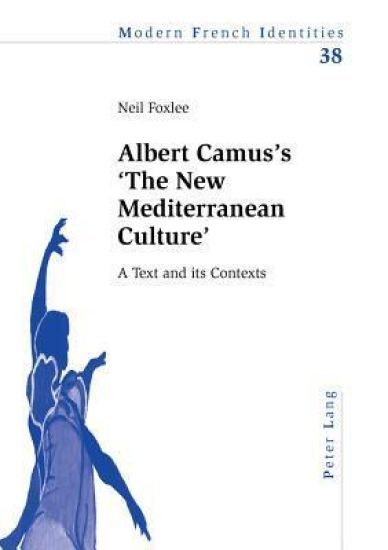
Albert Camus’s ‘The New Mediterranean Culture’

Albert Camus’s ‘The New Mediterranean Culture’

Neil Foxlee

Peter Lang AG, Internationaler Verlag der Wissenschaften
2010
nidottu
This book was shortlisted for the R.H. Gapper prize 2011. On 8 February 1937 the 23-year-old Albert Camus gave an inaugural lecture for a new Maison de la culture, or community arts centre, in Algiers. Entitled ‘La nouvelle culture méditerranéenne’ (‘The New Mediterranean Culture’), Camus’s lecture has been interpreted in radically different ways: while some critics have dismissed it as an incoherent piece of juvenilia, others see it as key to understanding his future development as a thinker, whether as the first expression of his so-called ‘Mediterranean humanism’ or as an early indication of what is seen as his essentially colonial mentality. These various interpretations are based on reading the text of ‘The New Mediterranean Culture’ in a single context, whether that of Camus’s life and work as a whole, of French discourses on the Mediterranean or of colonial Algeria (and French discourses on that country). By contrast, this study argues that Camus’s lecture – and in principle any historical text – needs to be seen in a multiplicity of contexts, discursive and otherwise, if readers are to understand properly what its author was doing in writing it. Using Camus’s lecture as a case study, the book provides a detailed theoretical and practical justification of this ‘multi-contextualist’ approach.
Albert Kahns Industriearchitektur
Albert Kahn is probably the most important industrial architect of the 20th century. With his factory for the Ford T-models, designed for mass production, he found himself at the beginning of modern industrial architecture. His industrial buildings inspired the architects of European Modernism. They were the examples by which the structural rationality of Kahn’s industrial developments became the guiding principle for the New Building movement up until today. The unrivalled monograph with its numerous photographs, plan layouts, site plans, and virtual 3D models comprehensively documents the buildings of Albert Kahn, which he was able to construct in a very short time due to his system-based working method – in the USA but also in the Soviet Union, Brazil, Sweden, France, China, Japan, and Australia.
Albert Kahn's Industrial Architecture
Albert Kahn is probably the most important industrial architect of the 20th century. With his factory for the Ford T-models, designed for mass production, he found himself at the beginning of modern industrial architecture. His industrial buildings inspired the architects of European Modernism. They were the examples by which the structural rationality of Kahn’s industrial developments became the guiding principle for the New Building movement up until today. The unrivalled monograph with its numerous photographs, plan layouts, site plans, and virtual 3D models comprehensively documents the buildings of Albert Kahn, which he was able to construct in a very short time due to his system-based working method – in the USA but also in the Soviet Union, Brazil, Sweden, France, China, Japan, and Australia.
Albert Einstein's Bright Ideas

Albert Einstein's Bright Ideas

Frederic Morlot

Diaphanes AG
2017
sidottu
At its most basic, philosophy is about learning how to think about the world around us. It should come as no surprise, then, that children make excellent philosophers! Naturally inquisitive, pint-size scholars need little prompting before being willing to consider life's "big questions," however strange or impractical. Plato & Co. introduces children and curious grown-ups to the lives and work of famous philosophers, from Socrates to Descartes, Einstein, Marx, and Wittgenstein. Each book in the series features an engaging and often funny story that presents basic tenets of philosophical thought alongside vibrant color illustrations. In Albert Einstein's Flashes of Inspiration, the young Albert Einstein has a very important job: he must deliver electricity to the big Oktoberfest celebration in Munich. As he hurries from one merry-go-round to another, nothing seems to be going as planned. With his sister, Maja, Heinrich the dog, and Niels Bohr, a qualified dwarf-thrower, can he win a battle against the laws of the universe? The key just may lie in the question of whether a dumpling can fly faster than light?
Albert Cossery, Montreur D'hommes

Albert Cossery, Montreur D'hommes

David Parris

Peter Lang AG
2008
nidottu
Cet ouvrage est consacre a l'oeuvre d'Albert Cossery, auteur de huit romans parus entre 1941 et 1999. Apres un bref descriptif des oeuvres de Cossery, sont analyses successivement les personnages, les structures de l'intrigue qui sert de pretexte a un foisonnement d'historiettes, l'evolution des idees de l'auteur et son " egyptianite ". Si les personnages des premiers recits de Cossery croient encore a la possibilite de l'action politique, allant jusqu'a esquisser des gestes revolutionnaires, ceux de la maturite, joyeux drilles et generalement marginaux, correspondant a divers archetypes qu'on retrouve sous des noms differents tout au long de son oeuvre, pratiquent l'" abstentionnisme " politique, se refusant a toute collaboration avec les hommes de pouvoir, qu'on ne peut combattre que par la derision. Il s'agit d'une " philosophie " anti-revolutionnaire et humaniste a la fois: c'est en effet dans l'amitie et dans les plaisirs du quotidien que l'on trouve une raison d'etre. L'intrigue des romans de Cossery conduit rarement a un denouement, au sens classique du terme; c'est le parcours qui prime sur l'aboutissement et c'est en cela que le recit a du charme. Age de 94 ans, il s'est eteint a Paris le 22 juin 2008, apres une vie exemplaire passee a recreer par les mots et en francais, son Egypte natale.