Kirjojen hintavertailu. Mukana 11 699 587 kirjaa ja 12 kauppaa.

Kirjahaku

Etsi kirjoja tekijän nimen, kirjan nimen tai ISBN:n perusteella.

1000 tulosta hakusanalla Alison Case

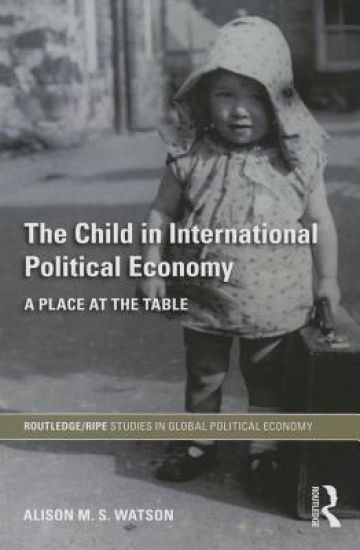
The Child in International Political Economy
This pioneering volume argues for the inclusion of children, and the structure known as ‘childhood’, as a permanent social category worthy of continued study within the discipline of international political economy (IPE). Fundamentally, and very simply, IPE is concerned with the dynamics of interaction across the economic and political domains; the relationship between the domestic and the international levels of analysis, and the role of the state. This book presents a convincing argument for the discussion of children within each of these areas. This volume:• provides the first book length examination of the child within IPE• draws on work from a variety of disciplines• brings rich analyses to debates about the role of the child in societyContributing insights that may be fundamental to the development of IPE as a discipline, The Child in International Political Economy will be vital reading to students and scholars of IPE, Childhood Studies, and International Relations.
Contagion

Contagion

Alison Bashford; Claire Hooker

Routledge
2014
nidottu
In the age of HIV, antibiotic-resistant bacteria, the Ebola Virus and BSE, metaphors and experience of contagion are a central concern of government, biomedicine and popular culture.Contagion explores cultural responses of infectious diseases and their biomedical management over the nineteenth and twentieth centuries. It also investigates the use of 'contagion' as a concept in postmodern reconceptualisations of embodied subjectivity.The essays are written from within the fields of cultural studies, biomedical history and critical sociology. The contributors examine the geographies, policies and identities which have been produced in the massive social effort to contain diseases. They explore both social responses to infectious diseases in the past, and contemporary theoretical and biomedical sites for the study of contagion.
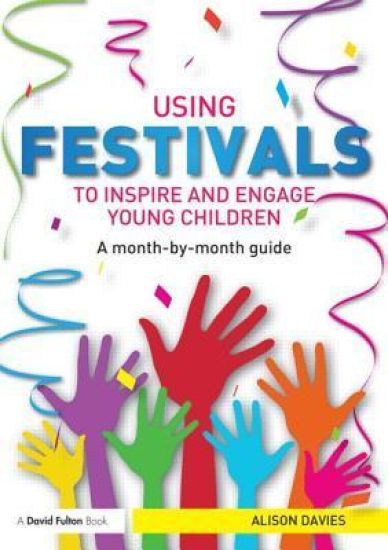
Using Festivals to Inspire and Engage Young Children
Religious events and cultural celebrations form an important part of societies throughout the world. They are key to social development and understanding, for celebrating diversity, as well as finding common ground. Covering a wide range of festivals from around the world, this book shows practitioners and teachers how they can introduce young children to some of the ideas behind these events and encourage them to have fun, get creative and work together. Aimed at those working with children aged 3 – 7, Using Festivals to Inspire and Engage Young Children covers a range of cultural celebration by each calendar month, explaining the background to these events and provides fun and imaginative activities and stories based around each one. Features include: a basic outline of each festival; a wide range of activities to suit children at different stages in their development; development and learning aims at the end of each chapter; suggestions for working with parents and links with home; top tips for creating your own activities relating to celebrations; story models that can be adapted and used to suit different events.Highly practical with an emphasis on fun and hands on learning, this book is a fantastic resource for Early Years practitioners, Primary School teachers and those that want to inspire young children and celebrate the world we live in.
Using Festivals to Inspire and Engage Young Children
Religious events and cultural celebrations form an important part of societies throughout the world. They are key to social development and understanding, for celebrating diversity, as well as finding common ground. Covering a wide range of festivals from around the world, this book shows practitioners and teachers how they can introduce young children to some of the ideas behind these events and encourage them to have fun, get creative and work together. Aimed at those working with children aged 3 – 7, Using Festivals to Inspire and Engage Young Children covers a range of cultural celebration by each calendar month, explaining the background to these events and provides fun and imaginative activities and stories based around each one. Features include: a basic outline of each festival; a wide range of activities to suit children at different stages in their development; development and learning aims at the end of each chapter; suggestions for working with parents and links with home; top tips for creating your own activities relating to celebrations; story models that can be adapted and used to suit different events.Highly practical with an emphasis on fun and hands on learning, this book is a fantastic resource for Early Years practitioners, Primary School teachers and those that want to inspire young children and celebrate the world we live in.
A Special Scar

A Special Scar

Alison Wertheimer

Routledge
2013
sidottu
Every 85 minutes someone in the UK takes their own life and the suicide rate is currently the highest since 2004. Society often reacts with unease, fear and even disapproval but what happens to those bereaved by a self-inflicted death? The reasons leading someone to take their own life are complex, and the bereavement reactions of survivors of suicide can also be complex, including shame, guilt, sadness and the effects of trauma, stigma and social isolation. It can be difficult for those personally affected by a suicide death to come to terms with their loss and seek help and support. A Special Scar looks in detail at the impact of suicide and offers practical help for survivors, relatives and friends of people who have taken their own life. Fifty bereaved people tell their stories, showing us that, by not hiding the truth from themselves and others they have been able to learn to live with the suicide, offering hope to others facing this traumatic loss.This Classic Edition includes a brand-new introduction to the work and will be an invaluable resource for survivors of suicide as well as for all those who are in contact with them, including police and coroner's officers, bereavement services, self-help organisations for survivors, mental health professionals, social workers, GPs, counsellors and therapists.
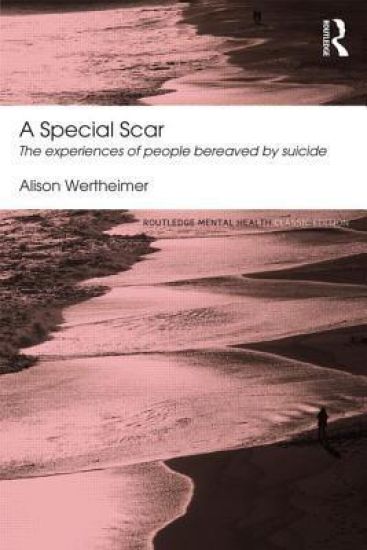
A Special Scar

A Special Scar

Alison Wertheimer

Routledge
2013
nidottu
Every 85 minutes someone in the UK takes their own life and the suicide rate is currently the highest since 2004. Society often reacts with unease, fear and even disapproval but what happens to those bereaved by a self-inflicted death? The reasons leading someone to take their own life are complex, and the bereavement reactions of survivors of suicide can also be complex, including shame, guilt, sadness and the effects of trauma, stigma and social isolation. It can be difficult for those personally affected by a suicide death to come to terms with their loss and seek help and support. A Special Scar looks in detail at the impact of suicide and offers practical help for survivors, relatives and friends of people who have taken their own life. Fifty bereaved people tell their stories, showing us that, by not hiding the truth from themselves and others they have been able to learn to live with the suicide, offering hope to others facing this traumatic loss.This Classic Edition includes a brand-new introduction to the work and will be an invaluable resource for survivors of suicide as well as for all those who are in contact with them, including police and coroner's officers, bereavement services, self-help organisations for survivors, mental health professionals, social workers, GPs, counsellors and therapists.
The Securitization of Migration and Refugee Women
Humanised accounts of restrictions on mobility are rarely the focus of debates on irregular migration. Very little is heard from refugees themselves about why they migrate, their experiences whilst entering the EU or how they navigate reception conditions upon arrival, particularly from a gendered perspective. The Securitization of Migration and Refugee Women fills this gap and explores the journey made by refugee women who have travelled from Somalia to the EU to seek asylum. This book reveals the humanised impact of the securitization of migration, the dominant policy response to irregular migration pursued by governments across the Globe. The Southern EU Member State of Malta finds itself on the frontline of policing and securing Europe’s southern external borders against transnational migrants and preventing migrants’ on-migration to other Member States within the EU. The securitization of migration has been responsible for restricting access to asylum, diluting rights and entitlements to refugee protection, and punishing those who arrive in the EU without valid passports –a visibly racialised and gendered population. The stories of the refugee women interviewed for this research detail the ways in which refugee protection is being eroded, selectively applied and in some cases specifically designed to exclude.In contrast to the majority of migration literature, which has largely focused on the male experience, this book focuses on the experiences of refugee women and aims to contribute to the volume of work dedicated to analysing borders from the perspective of those who cross them. This research strengthens existing criminological literature and has the potential to offer insights to policy makers around the world. It will be of interest to academics and students interested in International Crime and Justice, Securitisation, Refugee Law and Border Control, as well as the general reader.
The Woman's Film of the 1940s

The Woman's Film of the 1940s

Alison L. McKee

Routledge
2014
sidottu
This book explores the relationship among gender, desire, and narrative in 1940s woman’s films which negotiate the terrain between public history and private experience. The woman’s film and other form of cinematic melodrama have often been understood as positioning themselves outside history, and this book challenges and modifies that understanding, contextualizing the films it considers against the backdrop of World War II. In addition, in paying tribute to and departing from earlier feminist formulations about gendered spectatorship in cinema, McKee argues that such models emphasized a masculine-centered gaze at the inadvertent expense of understanding other possible modes of identification and gender expression in classical narrative cinema. She proposes ways of understanding gender and narrative based in part on literary narrative theory and ultimately works toward a notion of an androgynous spectatorship and mode of interpretation in the 1940s woman’s film.
Remaking Cities (Routledge Revivals)
This book, published in 1980, is an iconoclastic account of one of the pillars of the welfare state, British town and country planning, between 1945 and 1975. Always a fine balance between central control and market forces, it was challenged by strains within and between the environmental professions and protest by people dispossessed or alienated by re-shaped urban environments. Remaking Cities critiques the export of western-style planning to the developing world and reviews initiatives rooted in different understandings of ‘growth’ appearing in those years.Nearly forty years on, many of the same issues beset us, notably the depressingly familiar inner city problem, despite countless reports, funds and ‘programmes’. But now our infrastructure and services, once publicly owned, are privatised and fragmented, and local government progressively relegated. The very core of planning, development control, is being pared in a struggle to regain the ‘growth’ which led to our current crisis. This gives fresh importance to the need for new modes of creating liveable, sustainable environments, emphasised in this important work.
The Government of Space (Routledge Revivals)
Britain’s planning system began as ‘town and country planning’ to repair the ravages of unplanned industrialism and promote ideal environments for the future. Steering a course between left and right, public control and for-profit development, it survived successive booms and busts, broadening to include new concerns like ecology, conservation and community participation.By the 1986, when this book was first published, the system’s survival beyond the year 2000 was in doubt. It did endure, but it is now under serious threat from the right, which sees it as obstructing enterprise and the restoration of ‘growth’. It has been stripped of some of its core aims and mechanisms, while as yet there is no agenda distinguishing growth that will be sustainable from growth which self-evidently is not.The Government of Space was written as a concise guide for the non-specialist to the origins and evolution of British planning, its intellectual pedigree, achievements and cruxes. It is an invaluable background to the state of planning and the cases for and against it today.
Model Estate (Routledge Revivals)

Model Estate (Routledge Revivals)

Alison Ravetz

Routledge
2013
sidottu
Quarry Hill Flats, once both the pride and shame of its city of Leeds, was an iconic Modernist symbol of the 1930s. It marked the first use of a prefabricated building system for a large-scale council estate, replacing a notorious slum. But it lasted barely a generation – its complete demolition was announced as Alison Ravetz was finishing this study. First published in 1974, this book is unique in its use of all estate records from conception to destruction, as well as in its comprehensive approach, including aspects usually missing in council housing studies – notably the intimate experience of residents, and a fraught, long-drawn-out building period. Ravetz argues that the Flats’ ‘failure’ was due not to social breakdown, as repeatedly alleged, but rather to a rigidity of design and management unable to accommodate gradual, incremental change. This has continuing implications for the operation of bureaucratically designed and controlled ‘social housing’ today.
Model Estate (Routledge Revivals)

Model Estate (Routledge Revivals)

Alison Ravetz

Routledge
2014
nidottu
Quarry Hill Flats, once both the pride and shame of its city of Leeds, was an iconic Modernist symbol of the 1930s. It marked the first use of a prefabricated building system for a large-scale council estate, replacing a notorious slum. But it lasted barely a generation – its complete demolition was announced as Alison Ravetz was finishing this study. First published in 1974, this book is unique in its use of all estate records from conception to destruction, as well as in its comprehensive approach, including aspects usually missing in council housing studies – notably the intimate experience of residents, and a fraught, long-drawn-out building period. Ravetz argues that the Flats’ ‘failure’ was due not to social breakdown, as repeatedly alleged, but rather to a rigidity of design and management unable to accommodate gradual, incremental change. This has continuing implications for the operation of bureaucratically designed and controlled ‘social housing’ today.
Remaking Cities (Routledge Revivals)
This book, published in 1980, is an iconoclastic account of one of the pillars of the welfare state, British town and country planning, between 1945 and 1975. Always a fine balance between central control and market forces, it was challenged by strains within and between the environmental professions and protest by people dispossessed or alienated by re-shaped urban environments. Remaking Cities critiques the export of western-style planning to the developing world and reviews initiatives rooted in different understandings of ‘growth’ appearing in those years.Nearly forty years on, many of the same issues beset us, notably the depressingly familiar inner city problem, despite countless reports, funds and ‘programmes’. But now our infrastructure and services, once publicly owned, are privatised and fragmented, and local government progressively relegated. The very core of planning, development control, is being pared in a struggle to regain the ‘growth’ which led to our current crisis. This gives fresh importance to the need for new modes of creating liveable, sustainable environments, emphasised in this important work.
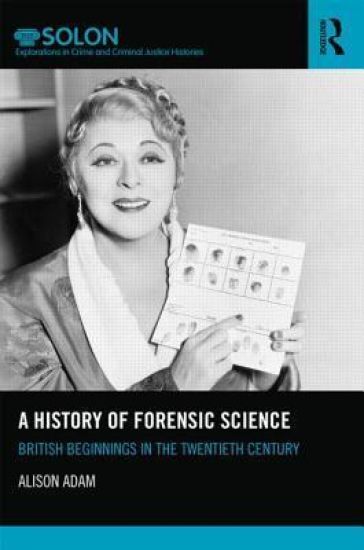
A History of Forensic Science

A History of Forensic Science

Alison Adam

Routledge
2015
sidottu
How and when did forensic science originate in the UK? This question demands our attention because our understanding of present-day forensic science is vastly enriched through gaining an appreciation of what went before. A History of Forensic Science is the first book to consider the wide spectrum of influences which went into creating the discipline in Britain in the first part of the twentieth century. This book offers a history of the development of forensic sciences, centred on the UK, but with consideration of continental and colonial influences, from around 1880 to approximately 1940. This period was central to the formation of a separate discipline of forensic science with a distinct professional identity and this book charts the strategies of the new forensic scientists to gain an authoritative voice in the courtroom and to forge a professional identity in the space between forensic medicine, scientific policing, and independent expert witnessing. In so doing, it improves our understanding of how forensic science developed as it did. This book is essential reading for academics and students engaged in the study of criminology, the history of forensic science, science and technology studies and the history of policing.
Forever England

Forever England

Alison Light

Routledge
2013
nidottu
Most studies of the interwar years have focussed upon literary elites, rendering that past and its literature in almost exclusively male terms. In Forever England Alison Light argues that we cannot make sense of Englishness in the period, or understand the changes within literary culture, unless we recognise the extent to which the female population represented the nation between the wars. From the traumatic aftermath of the First World War, Forever England traces the making of a conservative national temperament which could be defensive and protective, yet modernising in outlook. In a series of literary anaylses, the author suggests some of the tones and accents of this new version of Englishness; in particular she looks at new kinds of readership and fiction, at the historical and emotional significance of the `whodunit', the burgeoning of historical romance, and the creation of a middlebrow culture in the period. Forever England evokes a powerful sense of period and of the pleasures of reading, providing an intimate picture of interwar life from inside the English middle classes. As a feminist inquiry, it argues from a different kind of social and political history; one which makes connections between the interior structures of private life and their more public national forms. Controversially, it also urges that feminism deal with conservative, as well as radical, desires and their place in women's lives.
Madness in International Relations

Madness in International Relations

Alison Howell

Routledge
2013
nidottu
Madness in International Relations provides an important and innovative account of the role of psychology and psychiatry in global politics, showing how mental health governance has become a means of securing various populations, often with questionable effects.Through the analysis of three key case studies Howell illustrates how such therapeutic interventions can at times be coercive and sovereign, at other times disciplinary, and at still other times benevolent, though not benign. In each case a ‘diagnostic competition’ is traced, that is, a contestation over how best to diagnose and treat the population in question. The book examines the populations of Guantánamo Bay, post-conflict societies and western militaries, identifying how these diagnostic competitions ultimately rest on shared assumptions about the value of psychology and psychiatry in managing global security, about the value of achieving security through mental health governance, and ultimately about the medicalization of security.This work will be of great interest to all scholars of International relations, critical theory and security studies.
Multimodality, Cognition, and Experimental Literature
Since the turn of the millennium, there has seen an increase in the inclusion of typography, graphics and illustration in fiction. This book engages with visual and multimodal devices in twenty-first century literature, exploring canonical authors like Mark Z. Danielewski and Jonathan Safran Foer alongside experimental fringe writers such as Steve Tomasula, to uncover an embodied textual aesthetics in the information age. Bringing together multimodality and cognition in an innovative study of how readers engage with challenging literature, this book makes a significant contribution to the debates surrounding multimodal design and multimodal reading. Drawing on cognitive linguistics, cognitive psychology, neuroscience, semiotics, visual perception, visual communication, and multimodal analysis, Gibbons provides a sophisticated set of critical tools for analysing the cognitive impact of multimodal literature.
Feminism, Psychoanalysis, and Maternal Subjectivity
In this book, Alison Stone develops a feminist approach to maternal subjectivity. Stone argues that in the West the self has often been understood in opposition to the maternal body, so that one must separate oneself from the mother and maternal care-givers on whom one depended in childhood to become a self or, in modernity, an autonomous subject. These assumptions make it difficult to be a mother and a subject, an autonomous creator of meaning. Insofar as mothers nonetheless strive to regain their subjectivity when their motherhood seems to have compromised it, theirs cannot be the usual kind of subjectivity premised on separation from the maternal body. Mothers are subjects of a new kind, who generate meanings and acquire agency from their position of re-immersion in the realm of maternal body relations, of bodily intimacy and dependency. Thus Stone interprets maternal subjectivity as a specific form of subjectivity that is continuous with the maternal body. Stone analyzes this form of subjectivity in terms of how the mother typically reproduces with her child her history of bodily relations with her own mother, leading to a distinctive maternal and cyclical form of lived time.
Constructing Adolescence in Fantastic Realism
Constructing Adolescence in Fantastic Realism examines those fundamental themes which inform our understanding of "the teenager"—themes that emerge in both literary and cultural contexts. Models of adolescence do not arise solely from discourses of psychology, sociology, and education. Rather, these models—frameworks including developmentalism, identity formation, social agency, and subjectivity in cultural space—can also be found represented symbolically in fantastic tropes such as metamorphosis, time-slip, hauntings, doppelgangers, invisibility, magic gifts, and witchcraft. These are the incredible, supernatural, and magical elements that invade the everyday and diurnal world of fantastic realism.In this original study, Alison Waller proposes a new critical term to categorize a popular and established genre in literature for teenagers: young adult fantastic realism. Though fantastic realism plays a crucial part in the short history of young adult literature, up until now this genre has typically been overlooked or subsumed into the wider class of fantasy. Touching on well-known authors including Robert Cormier, Melvin Burgess, Gillian Cross, Margaret Mahy, K.M. Peyton and Robert Westall, as well as previously unexamined writers, Waller explores the themes and ideological perspectives embedded in fantastic realist novels in order to ask whether parallel realities and fantastic identities produce forms of adolescence that are dynamic and subversive. One of the first studies to deal with late twentieth-century fantastic literature for young adults, this book makes a valuable contribution to our understanding of adult attitudes toward adolescent identity.
Human Rights and Private Wrongs

Human Rights and Private Wrongs

Alison Brysk

Routledge
2004
sidottu
Human Rights and Private Wrongs breaks new ground by considering a series of fascinating issues that are normally ignored by human rights specialists because they are too "private" to consider as policy issues: children's labor migration; refugee policy towards unaccompanied minors; financial matters of investor and business responsibility; and complex questions involving access to the benefits of pharmaceutical research, transnational organ trafficking, and the control over genetic research.