

Kirjahaku
Etsi kirjoja tekijän nimen, kirjan nimen tai ISBN:n perusteella.
1000 tulosta hakusanalla Bertram Lesser

VMware vSphere 7
Bertram Wöhrmann; Florian Klotmann; Michael Schröder
Rheinwerk Verlag GmbH
2020
sidottu


"The Red Derelict" by Bertram Mitford is a captivating mystery and adventure novel centered around an abandoned ship. The story unfolds as an investigation into the derelict vessel, which is shrouded in suspense and secrecy.Set against a nautical backdrop, the novel explores the intrigue and danger associated with the mysterious ship. As characters delve into the investigation, they uncover clues and secrets related to the abandoned vessel. The maritime setting adds depth to the narrative, contributing to the overall atmosphere of suspense and adventure.The plot weaves together elements of crime and exploration, as the characters seek to unravel the mystery surrounding the ship. With its combination of thrilling detective work and the allure of maritime adventure, "The Red Derelict" keeps readers engaged as they follow the investigation and uncover the ship's hidden truths. The journey through the derelict ship and the surrounding waters is fraught with suspense, as the characters navigate both physical and psychological challenges. Mitford's portrayal of the maritime environment underscores the themes of adventure and discovery and a thrilling tale of nautical exploration and intrigue and the sense of isolation and the vastness of the ocean further intensify the mystery.

The Ruby Sword by Bertram Mitford is an enthralling adventure fiction that immerses readers in a historical novel set against the backdrop of colonial Africa. The story follows a thrilling quest for treasure, centered around a priceless ruby sword. Mitford, known for his vivid storytelling, crafts a narrative filled with action and intrigue, as characters embark on a heroic journey across exotic settings. The novel weaves together mystery and suspense with romantic elements, creating a dynamic and engaging plot. As the protagonists navigate the challenges of exploration and face various dangers, the story reflects themes of imperialism and the impact of European colonial ambitions in Africa. The Ruby Sword stands out for its richly detailed setting and character-driven plot, offering a classic adventure experience that combines excitement with a thoughtful exploration of historical and cultural themes.





The only English translation of a crucial interpretation of Nietzsche First published in 1918, Ernst Bertram's Nietzsche: Attempt at a Mythology substantially shaped the image of Nietzsche for the generation between the wars. It won the Nietzsche Society's first prize and was admired by luminous contemporaries including André Gide, Hermann Hesse, Gottfried Benn, and Thomas Mann. Although translated into French in 1932, the book was never translated into English following the decline of Nietzsche's and Bertram's reputations after 1945. Now, with Nietzsche's importance for twentieth-century thought undisputed, the work by one of his most influential interpreters can at last be read in English. Employing a perspectival technique inspired by Nietzsche himself, Bertram constructs a densely layered portrait of the thinker that shows him riven by deep and ultimately irresolvable cultural, historical, and psychological conflicts. At once lyrical and intensely probing, richly complex yet thematically coherent, Bertram's book is a masterpiece in a forgotten tradition of intellectual biography.
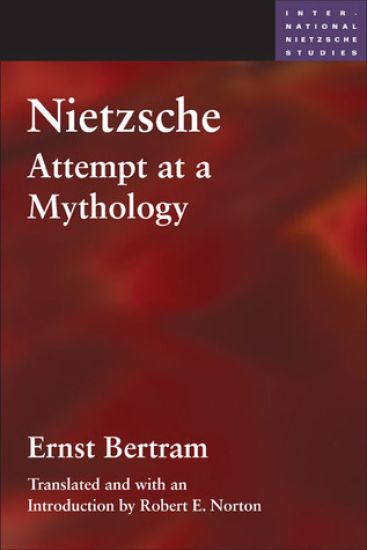
The only English translation of a crucial interpretation of Nietzsche First published in 1918, Ernst Bertram's Nietzsche: Attempt at a Mythology substantially shaped the image of Nietzsche for the generation between the wars. It won the Nietzsche Society's first prize and was admired by luminous contemporaries including André Gide, Hermann Hesse, Gottfried Benn, and Thomas Mann. Although translated into French in 1932, the book was never translated into English following the decline of Nietzsche's and Bertram's reputations after 1945. Now, with Nietzsche's importance for twentieth-century thought undisputed, the work by one of his most influential interpreters can at last be read in English. Employing a perspectival technique inspired by Nietzsche himself, Bertram constructs a densely layered portrait of the thinker that shows him riven by deep and ultimately irresolvable cultural, historical, and psychological conflicts. At once lyrical and intensely probing, richly complex yet thematically coherent, Bertram's book is a masterpiece in a forgotten tradition of intellectual biography.

"Houses can become poetic expressions of longing for a lost past, voices of a lived present, and dreams of an ideal future." Carel Bertram discovered this truth when she went to Turkey in the 1990s and began asking people about their memories of "the Turkish house." The fondness and nostalgia with which people recalled the distinctive wooden houses that were once ubiquitous throughout the Ottoman Empire made her realize that "the Turkish house" carries rich symbolic meaning. In this delightfully readable book, Bertram considers representations of the Turkish house in literature, art, and architecture to understand why the idea of the house has become such a potent signifier of Turkish identity.Bertram's exploration of the Turkish house shows how this feature of Ottoman culture took on symbolic meaning in the Turkish imagination as Turkey became more Westernized and secular in the early decades of the twentieth century. She shows how artists, writers, and architects all drew on the memory of the Turkish house as a space where changing notions of spirituality, modernity, and identity-as well as the social roles of women and the family-could be approached, contested, revised, or embraced during this period of tumultuous change.

Exploring nearly sixty years of memoir and autobiography, ""Writing Desire"" examines the changing identity of gay men writing within a historical context. Distinguished scholar and psychoanalyst Bertram J. Cohler has carefully selected a diverse group of ten men, including historians, activists, journalists, poets, performance artists, and bloggers, whose life writing evokes the evolution of gay life in twentieth-century America. By contrasting the personal experience of these disparate writers, Cohler illustrates the social transformations that these men helped shape. Among Cohler's diverse subjects is Alan Helms, whose journey from Indiana to New York's gay society represents the passage of men who came of age in the 1950s and 1960s, when homosexuality was considered a hidden ""disease."" The liberating effects of Stonewall's aftermath are chronicled in the life of Arnie Kantrowitz, the prototypical activist for gay rights in the 1970s and the founder of the Gay and Lesbian Alliance against Defamation. The artistic works of Tim Miller and Mark Doty evoke loss and shock during the early stages of the AIDS epidemic in the 1980s. Cohler rounds out this collective group portrait by looking at the newest generation of writers in the Internet age via the blog of Bryan, who did the previously unthinkable: he ""outed"" himself to millions of people. A compelling mix of social history and personal biography, ""Writing Desire"" distills the experience of three generations of gay America.

Although war is a heterogeneous assemblage of the human and nonhuman, it nevertheless builds the illusion of human autonomy and singularity. Focusing on war and ecology, a neglected topic in early modern ecocriticism, Bestial Oblivion: War, Humanism, and Ecology in Early Modern England shows how warfare unsettles ideas of the human, yet ultimately contributes to, and is then perpetuated by, anthropocentrism. Bertram’s study of early modern warfare’s impact on human-animal and human-technology relationships draws upon posthumanist theory, animal studies, and the new materialisms, focusing on responses to the Anglo-Spanish War, the Italian Wars, the Wars of Religion, the colonization of Ireland, and Jacobean “peace.” The monograph examines a wide range of texts—essays, drama, military treatises, paintings, poetry, engravings, war reports, travel narratives—and authors—Erasmus, Machiavelli, Digges, Shakespeare, Marlowe, Coryate, Bacon—to show how an intricate web of perpetual war altered the perception of the physical environment as well as the ideologies and practices establishing what it meant to be human.

A young child with a new book hunts inside and outside the house before finding the right chair for reading, in a hilarious and heartwarming tale. Reprint.


Routledge Philosophy GuideBook to Rousseau and the Social Contract
Christopher Bertram
Routledge
2003
sidottu
Rousseau's Social Contract is a benchmark in political philosophy and has influenced moral and political thought since its publication. Rousseau and the Social Contract introduces and assesses:*Rousseau's life and the background of the Social Contract*The ideas and arguments of the Social Contract*Rousseau's continuing importance to politics and philosophyRousseau and the Social Contract will be essential reading for all students of philosophy and politics, and anyone coming to Rousseau for the first time.
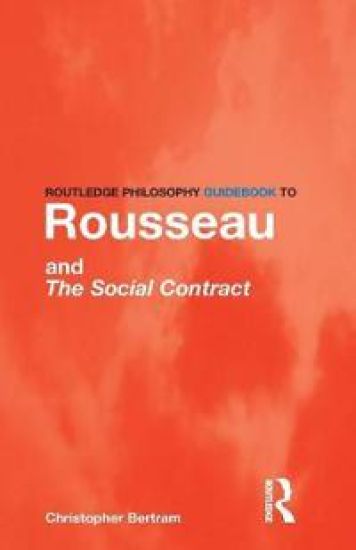
Routledge Philosophy GuideBook to Rousseau and the Social Contract
Christopher Bertram
Routledge
2003
nidottu
Rousseau's Social Contract is a benchmark in political philosophy and has influenced moral and political thought since its publication. Rousseau and the Social Contract introduces and assesses:*Rousseau's life and the background of the Social Contract*The ideas and arguments of the Social Contract*Rousseau's continuing importance to politics and philosophyRousseau and the Social Contract will be essential reading for all students of philosophy and politics, and anyone coming to Rousseau for the first time.

Drug War Politics
Eva Bertram; Morris Blachman; Kenneth Sharpe; Peter Andreas
University of California Press
1996
pokkari
Why have our drug wars failed and how might we turn things around? Ask the authors of this hard-hitting expose of U.S. efforts to fight drug trafficking and abuse. In a bold analysis of a century's worth of policy failure, "Drug War Politics" turns on its head many familiar bromides about drug politics. It demonstrates how, instead of learning from our failures, we duplicate and reinforce them in the same flawed policies. The authors examine the 'politics of denial' that has led to this catastrophic predicament and propose a basis for a realistic and desperately needed solution. Domestic and foreign drug wars have consistently fallen short because they are based on a flawed model of force and punishment, the authors show. The failure of these misguided solutions has led to harsher get-tough policies, debilitating cycles of more force and punishment, and a drug problem that continues to escalate. On the foreign policy front, billions of dollars have been wasted, corruption has mushroomed, and human rights undermined in Latin America and across the globe. Yet cheap drugs still flow abundantly across our borders. At home, more money than ever is spent on law enforcement, and an unprecedented number of people - disproportionately minorities - are incarcerated. But drug abuse and addiction persist. The authors outline the political struggles that help create and sustain the current punitive approach. They probe the workings of Washington politics, demonstrating how presidential and congressional 'out-toughing' tactics create a logic of escalation while the criticisms and alternatives of reformers are sidelined or silenced. Critical of both the punitive model and the legalization approach, "Drug War Politics" calls for a bold new public health approach, one that frames the drug problem as a public health - not a criminal - concern. The authors argue that only by situating drug issues in the context of our fundamental institutions - the family, neighborhoods, and schools - can we hope to provide viable treatment, prevention, and law enforcement. In its comprehensive investigation of our long, futile battle with drugs and its original argument for fundamental change, this book is essential for every concerned citizen.