Kirjojen hintavertailu. Mukana 11 627 220 kirjaa ja 12 kauppaa.

Kirjahaku

Etsi kirjoja tekijän nimen, kirjan nimen tai ISBN:n perusteella.

1000 tulosta hakusanalla Claire Oshetsky

Illustrated Questions in Orthodontics

Illustrated Questions in Orthodontics

Claire Nightingale; Jonathan Sandy

Oxford University Press
2014
nidottu
Illustrated Questions in Orthodontics takes a problem-based approach to orthodontics, offering a unique resource for undergraduate dentists. This book contains a comprehensive set of questions relevant to undergraduate orthodontics curricula, including chapters on examination and diagnosis, treatment planning, pathology, appliances, and anchorage. Each chapter is packed with high-quality clinical photographs and x-rays to help readers to test their skills in identifying and describing various orthodontic problems and presentations. Furthermore, every question is answered with extensive feedback, setting each topic in a clinical context in order to teach as well as test. The ideal revision resource for undergraduate dentists looking to test and consolidate their knowledge ahead of placements and exams, Illustrated Questions in Orthodontics will also form a useful tool for postgraduate dentists and orthodontic therapists.
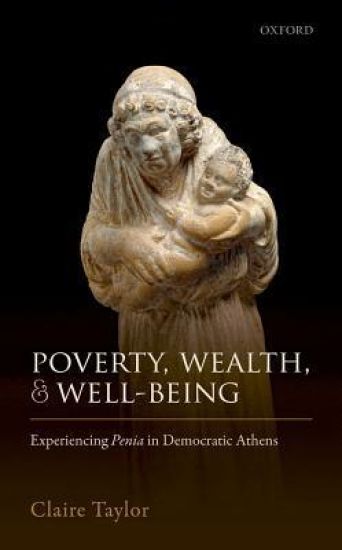
Poverty, Wealth, and Well-Being

Poverty, Wealth, and Well-Being

Claire Taylor

Oxford University Press
2017
sidottu
Poverty in fifth- and fourth-century BCE Athens was a markedly different concept to that with which we are familiar today. Reflecting contemporary ideas about labour, leisure, and good citizenship, the 'poor' were considered to be not only those who were destitute, or those who were living at the borders of subsistence, but also those who were moderately well-off but had to work for a living. Defined in this way, this group covered around 99 per cent of the population of Athens. This conception of penia (poverty) was also ideologically charged: the poor were contrasted with the rich and found, for the most part, to be both materially and morally deficient. Poverty, Wealth, and Well-Being sets out to rethink what it meant to be poor in a world where this was understood as the need to work for a living, exploring the discourses that constructed poverty as something to fear and linking them with experiences of penia among different social groups in Athens. Drawing on current research into and debates around poverty within the social sciences, it provides a critical reassessment of poverty in democratic Athens and argues that it need not necessarily be seen in terms of these elitist ideological categories, nor indeed solely as an economic condition (the state of having no wealth), but that it should also be understood in terms of social relations, capabilities, and well-being. In developing a framework to analyse the complexities of poverty so conceived and exploring the discourses that shaped it, the volume reframes poverty as being dynamic and multidimensional, and provides a valuable insight into what the poor in Athens - men and women, citizen and non-citizen, slave and free - were able to do or to be.
Children and the European Court of Human Rights

Children and the European Court of Human Rights

Claire Fenton-Glynn

Oxford University Press
2021
sidottu
The European Convention on Human Rights is one of the most influential human rights documents in existence, in terms of its scope, impact, and jurisdiction. Yet it was not drafted with children, let alone children's rights, in mind. Nevertheless, the European Court of Human Rights has developed a large body of jurisprudence regarding children, ranging from areas such as juvenile justice and immigration, to education and religion, and the protection of physical integrity. Its influence in the sphere of family law has been profound, in particular in the attribution of parenthood, and in cases concerning child abduction, child protection, and adoption. This book provides a comprehensive and detailed overview of the jurisprudence of the Court as it relates to children, highlighting its many achievements in this field, while also critiquing its ongoing weaknesses. In doing so, it tracks the evolution of the Court's treatment of children's rights, from its inauspicious and paternalistic beginnings to an emerging recognition of children's individual agency.
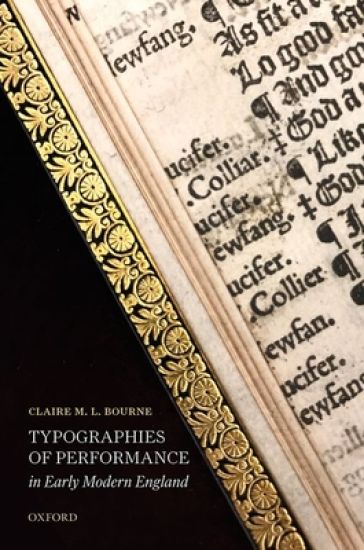
Typographies of Performance in Early Modern England

Typographies of Performance in Early Modern England

Claire M. L. Bourne

Oxford University Press
2020
sidottu
Typographies of Performance in Early Modern England is the first book-length study of early modern English playbook typography. It tells a new history of drama from the period by considering the page designs of plays by Shakespeare and others printed between the end of the fifteenth century and the beginning of the eighteenth century. It argues that typography, broadly conceived, was used creatively by printers, publishers, playwrights, and other agents of the book trade to make the effects of theatricality--from the most basic (textually articulating a change in speaker) to the more complex (registering the kinesis of bodies on stage)--intelligible on the page. The coalescence of these experiments into a uniquely dramatic typography that was constantly responsive to performance effects made it possible for 'plays' to be marketed, collected, and read in the sixteenth and seventeenth centuries as a print genre distinct from all other genres of imaginative writing. It has been said, 'If a play is a book, it is not a play.' Typographies of Performance in Early Modern England shows that 'play' and 'book' were, in fact, mutually constitutive: it was the very bookishness of plays printed in early modern England that allowed them to be recognized by their earliest readers as plays in the first place.
Reconfiguring and Appropriating Arabic, Persian, and Indic Literary Traditions in Seventeenth- and Eighteenth-Century Britain
Reconfiguring and Appropriating Arabic, Persian, and Indic Literary Traditions in Seventeenth- and Eighteenth-Century Britain investigates the reconfigurations of literary traditions coming from Islamicate regions of the world by British orientalists. Claire Gallien explores the logics of orientalist selection, reconfiguration, and appropriation of Islamicate literary canons, and focuses on the period going from the endowment of the first chairs in Arabic at Cambridge and Oxford in 1632 and 1636 respectively to the establishment of the Asiatic Society in Calcutta in 1784, presided by Sir William Jones until 1794. Contrary to the Saidian premise of an invention of the East by the West, Gallien argues that orientalists did not invent a canon but they transferred and translated texts and authors, which/who were already recognised as canonical across Islamicate literary cultures. Given the above, the question that preoccupies this book is what happens to the canon when partially re-created and re-purposed for European readers. Organised in three main parts, this book analyses first the constitution of collections of Arabic, Persian, and Indic manuscripts and their cataloguing in England in the seventeenth and eighteenth centuries. The second part investigates the variety of linguistic and literary partitioning and assemblage proposed by orientalists and discusses how their classical literary formation underpinned theories and practices of imitation, translation, and writing. The third part examines the editing and translating of Arabic, Persian, and Indic literatures in seventeenth- and eighteenth-century England as well as in British colonial India, and in particular the function of specimens and anthologies in the constitution of a corpus of Eastern literatures in English.
Wild Reads: Snakes

Wild Reads: Snakes

Claire Llewellyn

Oxford University Press
2009
nidottu
This fantastic book about snakes covers a wide range of topics. From the emerald tree boa to the orange sand viper, find out how snakes hunt, eat and survive. Did you know for instance that big snakes can eat almost any animal - even crocodiles?! Or learn how to avoid a deadly snake bite in a dessert or a steamy rainforest. For real snake enthusiasts this book also suggests websites and places to visit to find out even more! Other titles in this series: ·Big Cats ·Spiders ·Elephants ·Bees ·Dinosaurs, ·Wolves ·Sharks ·Rats ·Frogs and Toads ·Whales ·Crocodiles ·Dogs ·Horses
The Roman Noir in Post-War French Culture

The Roman Noir in Post-War French Culture

Claire Gorrara

Oxford University Press
2003
sidottu
The Roman Noir in Post-War French Culture offers a lively introduction to the post-war French roman noir from a cultural studies perspective. A populist and widely disseminated genre, the French roman noir has suffered from a reputation as a minor genre with its roots in American popular culture. In this study, Claire Gorrara challenges such preconceptions and examines how selected writers have appropriated the roman noir as a critical response to formative concerns and debates in post-war French society. Starting with the first truly French roman noir, Léo Malet's 120 rue de la gare (1943) and concluding with Maud Tabachnik's feminist thriller Un été pourri (1994), Gorrara analyses both texts and film in relation to their specific historical and cultural context. From the heritage of the Second World War and France's wars of decolonisation to the rise of consumer culture and questions of gender and sexual equality, the roman noir operates in dialogue with its times, mediating social change and transformation with stories of crime, transgression, and marginality. All the novelists studied were published initially in popular collections, such as the Série noire, but they have been chosen for the innovation of their work and the exciting ways in which they resist tired conventions and offer new ways of representing social reality. One of the first English-language studies of this popular genre, The Roman Noir in Post-War French Culture offers much more than close readings of these fascinating texts; it demonstrates the important contribution of the roman noir to the cultural histories of post-war France.
Rivers of Ink

Rivers of Ink

Claire Chambers

OUP Pakistan
2018
sidottu
In this series of illuminating essays, Claire Chambers explores global literature, with a special focus on texts from Pakistan and its diaspora. Highlighting its quality and urgency, and authors' bold treatment of hot topics like Islamophobia, racism, and the culture industry, Chambers formulates a strong case for drawing this writing into the mainstream English canon. Chambers' voice is incisive and compelling as she analyses emerging as well as established writers working in various genres. This makes Rivers of Ink a necessary, clear summons for expansion to the ?eld of contemporary global literature.
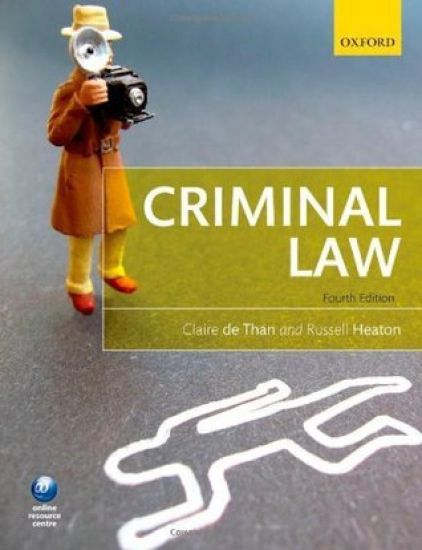
Criminal Law

Criminal Law

Claire de Than; Russell Heaton

Oxford University Press
2013
nidottu
Criminal Law introduces undergraduates to the principles of criminal law through a fresh and stimulating approach. With a reputation for providing a readable and understandable account of the law relating to criminal offences, this book allows the reader to develop a full appreciation of the fundamentals of the subject whilst highlighting and examining key areas for debate. Using a logical structure and lively writing style, the authors ensure that even the most complicated aspects of criminal law are explained in a clear and engaging manner. Running examples in each chapter provide scenarios to help clarify points of law and aid understanding, while flowcharts and diagrams offer a useful visual tool to illustrate the more complex offences and defences. Learning features throughout the chapters and additional materials on the Online Resource Centre, including the Hot 100 Cases database, help to structure study and revision. Online Resource Centre The accompanying Online Resource Centre provides additional materials to allow the reader to engage and test their knowledge across the topic areas, including a 'Hot 100 cases' database offering summaries of key criminal law cases, and an extra chapter on Vicarious and Corporate Liability.
Family Background and University Success

Family Background and University Success

Claire Crawford; Lorraine Dearden; John Micklewright; Anna Vignoles

Oxford University Press
2016
sidottu
Why do fewer teenagers in England from disadvantaged backgrounds go to university than young people from better-off families? Once at university, how well do poorer students fare compared with other students - who drops out from university and who gets the best degrees? After university - who secures better jobs and higher pay? What really has been the impact on university entry of the controversial increases in tuition fees in 2006 and 2012, especially for students from poorer families? Is there no alternative to charging for university places and what do other countries do? What should governments, universities, and schools do to reduce the gaps in university entry and success by family background? And what advice can be given to families and young people themselves deciding between the costs and benefits of university? This book answers these questions using the latest available evidence, drawing on a wealth of data from administrative records of the school and university system and sample surveys of young people and their families. The authors' analysis of the situation in England is set against a background of evidence for other countries. The book provides much needed dispassionate analysis of issues that are at the forefront of both public policy and popular debate on higher education around the world today.
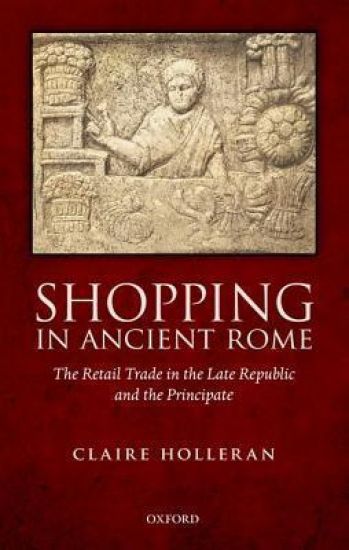
Shopping in Ancient Rome

Shopping in Ancient Rome

Claire Holleran

Oxford University Press
2012
sidottu
Shopping in Ancient Rome provides the first comprehensive account of the retail network of this ancient city, an area of commerce that has been largely neglected in previous studies. Given the remarkable concentration of consumers in ancient Rome, the vast majority of which were entirely reliant on the market for survival, a functioning retail trade was vital to the survival of Rome in the late Republic and the Principate. In this volume Holleran provides the first systematic account of Rome's retail sector through a comprehensive analysis of the literary, legal, epigraphic, and archaeological evidence together with wide-ranging and innovative comparative studies of the distributive trades. Investigating the diverse means by which goods were sold to consumers in the city, and the critical relationship between retail and broader environmental factors, Holleran places Roman retail trade firmly within the wider context of its urban economy. In considering the roles played by shops, workshops, markets, fairs, auctions, street sellers, and ambulant vendors in the distribution of goods to the inhabitants of the city, the volume sheds new light on the experience of living in the ancient city and explores the retail trade of Rome in its totality.
Relabeling in Language Genesis

Relabeling in Language Genesis

Claire Lefebvre

Oxford University Press Inc
2014
sidottu
Relabeling is a process that assigns a lexical entry of language-x a new label derived from a phonetic string drawn from language-y. This process plays a central role in the formation of contact languages such as mixed languages, pidgins and creoles, and New Englishes. In this book, Claire Lefebrve offers a coherent picture of research on relabeling over the last 15 years, and replies to the questions that have been directed at the relabeling-based theory of creole genesis presented in Lefebvre (1998) and related work. It addresses such questions as: how does relabeling apply across language contact situations and across lexicons, and what constraints act upon it? What other processes apply in language genesis and how do they interact with relabeling? Can a relabeling-based theory of creole genesis really account for all of the features that a theory of creole genesis must be able to account for? Since relabeling applies to the lexical component of the grammar, different theories of the lexicon should make different predictions as to the nature of the lexical items to which the process can apply. Lefebvre discusses the predictions of a Construction Grammar framework and how they compare to those of the Principles and Parameters framework, and how each framework accounts for data. She analyzes how word order is established within a relabeling-based account of creole genesis, and the role that relabeling plays in accounting for the differences between creoles. Other topics discussed include the contribution of the superstrate language to a creole within a relabeling-based account of creole genesis, and the predictions of relabeling in terms of the typological classification of creoles. Lefebvre ultimately demonstrates how the relabeling-based theory of creole genesis constitutes a strong alternative to the Bioprogram Hypothesis.
Relabeling in Language Genesis

Relabeling in Language Genesis

Claire Lefebvre

Oxford University Press Inc
2014
nidottu
Relabeling is a process that assigns a lexical entry of language-x a new label derived from a phonetic string drawn from language-y. This process plays a central role in the formation of contact languages such as mixed languages, pidgins and creoles, and New Englishes. In this book, Claire Lefebrve offers a coherent picture of research on relabeling over the last 15 years, and replies to the questions that have been directed at the relabeling-based theory of creole genesis presented in Lefebvre (1998) and related work. It addresses such questions as: how does relabeling apply across language contact situations and across lexicons, and what constraints act upon it? What other processes apply in language genesis and how do they interact with relabeling? Can a relabeling-based theory of creole genesis really account for all of the features that a theory of creole genesis must be able to account for? Since relabeling applies to the lexical component of the grammar, different theories of the lexicon should make different predictions as to the nature of the lexical items to which the process can apply. Lefebvre discusses the predictions of a Construction Grammar framework and how they compare to those of the Principles and Parameters framework, and how each framework accounts for data. She analyzes how word order is established within a relabeling-based account of creole genesis, and the role that relabeling plays in accounting for the differences between creoles. Other topics discussed include the contribution of the superstrate language to a creole within a relabeling-based account of creole genesis, and the predictions of relabeling in terms of the typological classification of creoles. Lefebvre ultimately demonstrates how the relabeling-based theory of creole genesis constitutes a strong alternative to the Bioprogram Hypothesis.
Violet Bakery Cookbook

Violet Bakery Cookbook

Claire Ptak

Vintage
2015
sidottu
The Violet Bakery is bustling cake shop and cafe in Hackney, east London. Famed for its exquisite baked goods and contemporary feel it has become a cult destination. In this book, structured around times of the day, she shares the flavour secrets of her delicious Violet bakes for home cooks.
Ancestors and Antiretrovirals

Ancestors and Antiretrovirals

Claire Laurier Decoteau

University of Chicago Press
2013
sidottu
In the years since the end of apartheid, South Africans have enjoyed a progressive constitution, considerable access to social services for the poor and sick, and a booming economy that has made their nation into one of the wealthiest on the continent. At the same time, South Africa experiences extremely unequal income distribution, and its citizens suffer the highest prevalence of HIV in the world. As Archbishop Desmond Tutu has noted, "AIDS is South Africa's new apartheid." In Ancestors and Antiretrovirals, Claire Laurier Decoteau backs up Tutu's assertion with powerful arguments about how this came to pass. Decoteau traces the historical shifts in health policy after apartheid and describes their effects, detailing, in particular, the changing relationship between biomedical and indigenous health care, both at the national and the local level. Decoteau tells this story from the perspective of those living with and dying from AIDS in Johannesburg's squatter camps. At the same time, she exposes the complex and often contradictory ways that the South African government has failed to balance the demands of neoliberal capital with the considerable health needs of its population.
Ancestors and Antiretrovirals

Ancestors and Antiretrovirals

Claire Laurier Decoteau

University of Chicago Press
2013
nidottu
In the years since the end of apartheid, South Africans have enjoyed a progressive constitution, considerable access to social services for the poor and sick, and a booming economy that has made their nation into one of the wealthiest on the continent. At the same time, South Africa experiences extremely unequal income distribution, and its citizens suffer the highest prevalence of HIV in the world. As Archbishop Desmond Tutu has noted, "AIDS is South Africa's new apartheid." In Ancestors and Antiretrovirals, Claire Laurier Decoteau backs up Tutu's assertion with powerful arguments about how this came to pass. Decoteau traces the historical shifts in health policy after apartheid and describes their effects, detailing, in particular, the changing relationship between biomedical and indigenous health care, both at the national and the local level. Decoteau tells this story from the perspective of those living with and dying from AIDS in Johannesburg's squatter camps. At the same time, she exposes the complex and often contradictory ways that the South African government has failed to balance the demands of neoliberal capital with the considerable health needs of its population.
Better Bankers, Better Banks

Better Bankers, Better Banks

Claire A. Hill; Richard W. Painter

University of Chicago Press
2015
sidottu
Taking financial risks is an essential part of what banks do, but there's no clear sense of what constitutes responsible risk. Taking legal risks seems to have become part of what banks do as well. Since the financial crisis, Congress has passed copious amounts of legislation aimed at curbing banks' risky behavior. Lawsuits against large banks have cost them billions. Yet bad behavior continues to plague the industry. Why isn't there more change? In Better Bankers, Better Banks, Claire A. Hill and Richard W. Painter look back at the history of banking and show how the current culture of bad behavior-dramatized by the corrupt, cocaine-snorting bankers of The Wolf of Wall Street-came to be. In the early 1980s, banks went from partnerships whose partners had personal liability to corporations whose managers had no such liability and could take risks with other people's money. A major reason bankers remain resistant to change, Hill and Painter argue, is that while banks have been faced with large fines, penalties, and legal fees-which have exceeded one hundred billion dollars since the onset of the crisis-the banks (which really means the banks'shareholders) have paid them, not the bankers themselves. The problem also extends well beyond the pursuit of profit to the issue of how success is defined within the banking industry, where highly paid bankers clamor for status and clients may regard as inevitable bankers who prioritize their own self-interest. While many solutions have been proposed, Hill and Painter show that a successful transformation of banker behavior must begin with the bankers themselves. Bankers must be personally liable from their own assets for some portion of the bank's losses from excessive risk-taking and illegal behavior. This would instill a culture that discourages such behavior and in turn influence the sorts of behavior society celebrates or condemns. Despite many sensible proposals seeking to reign in excessive risk-taking, the continuing trajectory of scandals suggests that we're far from ready to avert the next crisis. Better Bankers, Better Banks is a refreshing call for bankers to return to the idea that theirs is a noble profession.
The Western Disease

The Western Disease

Claire Laurier Decoteau

University of Chicago Press
2021
sidottu
Because autism is an increasingly common diagnosis, North Americans are familiar with its symptoms and treatments. But what we know and think about autism is shaped by our social relationship to health, disease, and the medical system. In The Western Disease Claire Laurier Decoteau explores the ways that recent immigrants from Somalia to Canada and the US make sense of their children’s diagnosis of autism. Having never heard of autism before migrating to North America, they often determine that it must be a Western disease. Given its apparent absence in Somalia, they view it as Western in nature, caused by environmental and health conditions unique to life in North America. Following Somali parents as they struggle to make sense of their children's illness and advocate for alternative care, Decoteau unfolds how complex interacting factors of immigration, race, and class affect Somalis’ relationship to the disease. Somalis’ engagement with autism challenges the prevailing presumption among Western doctors that their approach to healing is universal. Decoteau argues that centering an analysis on autism within the Somali diaspora exposes how autism has been defined and institutionalized as a white, middle-class disorder, leading to health disparities based on race, class, age, and ability. The Western Disease asks us to consider the social causes of disease and the role environmental changes and structural inequalities play in health vulnerability.
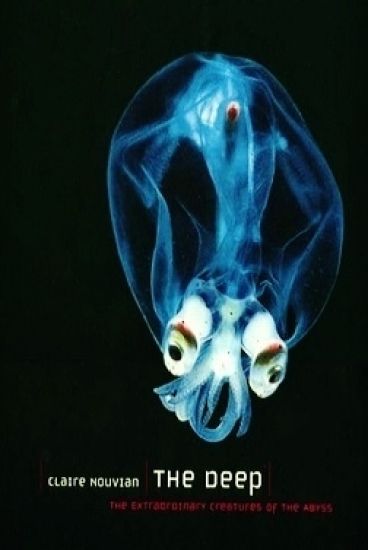
The Deep

The Deep

Claire Nouvian

THE UNIVERSITY OF CHICAGO PRESS
2007
sidottu
On dry land, most organisms are confined to the surface, or at most to altitudes of a hundred meters - the height of the tallest trees. In the oceans, though, living space has both vertical and horizontal dimensions: with an average depth of 3,800 meters, the oceans offer 99 percent of the space on Earth where life can develop. And the deep sea, which has been immersed in total darkness since the dawn of time, occupies 85 percent of ocean space, forming the planet's largest habitat. Yet, these depths abound with mystery. The deep sea is mostly uncharted - only about 5 percent of the seafloor has been mapped with any reasonable degree of detail - and we know very little about the creatures that call it home. Current estimates about the number of species yet to be found vary between ten and thirty million. The deep sea no longer has anything to prove; it is without doubt Earth's largest reservoir of life. Combining the latest scientific discoveries with astonishing color imagery, "The Deep" takes readers on a voyage into the darkest realms of the ocean. Revealing nature's oddest and most mesmerizing creatures in crystalline detail, "The Deep" features more than two hundred color photographs of terrifying sea monsters, living fossils, and ethereal bioluminescent creatures, some photographed here for the very first time. Accompanying these breathtaking photographs are contributions from some of the world's most respected researchers that examine the biology of deep-sea organisms, the ecology of deep-sea habitats, and the history of deep-sea exploration. An unforgettable visual and scientific tour of the teeming abyss, "The Deep" celebrates the incredible diversity of life on Earth and will captivate anyone intrigued by the unseen - and unimaginable - creatures of the deep sea.
America's Philosopher

America's Philosopher

Claire Rydell Arcenas

THE UNIVERSITY OF CHICAGO PRESS
2022
sidottu
America's Philosopher examines how John Locke has been interpreted, reinterpreted, and misinterpreted over three centuries of American history. The influence of polymath philosopher John Locke (1632-1704) can still be found in a dizzying range of fields, as his writings touch on issues of identity, republicanism, and the nature of knowledge itself. Claire Rydell Arcenas's new book tells the story of Americans' longstanding yet ever-mutable obsession with this English thinker's ideas, a saga whose most recent manifestations have found the so-called Father of Liberalism held up as a right-wing icon. The first book to detail Locke's trans-Atlantic influence from the eighteenth century until today, America's Philosopher shows how and why interpretations of his ideas have captivated Americans in ways few other philosophers-from any nation-ever have. As Arcenas makes clear, each generation has essentially remade Locke in its own image, drawing inspiration and transmuting his ideas to suit the needs of the particular historical moment. Drawing from a host of vernacular sources to illuminate Locke's often contradictory impact on American daily and intellectual life from before the Revolutionary War to the present, Arcenas delivers a pathbreaking work in the history of ideas.