

Kirjahaku
Etsi kirjoja tekijän nimen, kirjan nimen tai ISBN:n perusteella.
1000 tulosta hakusanalla Constance Sayers

Lady Constance Bulwer-Lytton (1869–1923), granddaughter of writer Edward Bulwer Lytton, became a passionate and militant suffragette after visiting imprisoned activists in 1905. She was arrested twice in 1909, on one occasion for throwing stones at a ministerial car, but was soon released. In 1910, to test whether the treatment of women prisoners differed depending on their class, she created a working-class alter ego, Jane Warton, for a protest in Liverpool. Under that name she was imprisoned and participated in a hunger strike that led to her being force-fed eight times, permanently damaging her health. This account of her experiences, first published in 1914, is a moving insight into the experiences of women who risked their lives and endured great suffering to secure the right to vote. For more information on this author, see http://orlando.cambridge.org/public/svPeople?person_id=lyttco
General Sketch of the History of Pantheism
Constance E. Plumptre
Cambridge University Press
2011
pokkari
A perceptive thinker and author of five scholarly tomes as well as numerous essays, the philosopher and historian of religion Constance E. Plumptre is now unfamiliar to many readers. Yet for a period of just over twenty years between 1878 and 1902 she championed some of the most fascinating philosophical and religious theories of the Victorian age. Although she won greatest acclaim for Studies in Little-Known Subjects (1898), her first work, General Sketch of the History of Pantheism, published anonymously in 1878, remains one of the most significant histories of philosophy ever written. Taking in Brahminism, the Ionian School, Pythagoras and the Neo-Platonists, as well as the work of Bruno and Vanini, the first volume provides an erudite but accessible introduction to Oriental, Greek and modern Pantheism. For more information on this author, see http://orlando.cambridge.org/public/svPeople?person_id=plumce
General Sketch of the History of Pantheism
Constance E. Plumptre
Cambridge University Press
2011
pokkari
A perceptive thinker and author of five scholarly tomes as well as numerous essays, the philosopher and historian of religion, Constance E. Plumptre is now unfamiliar to many readers. Yet for a period of just over twenty years between 1878 and 1902 she championed some of the most fascinating philosophical and religious theories of the Victorian age. Although she won greatest acclaim for Studies in Little-Known Subjects (1898), her first work, General Sketch of the History of Pantheism, published anonymously in 1878, was one of the most significant nineteenth-century studies in theological philosophy. In this second volume Plumptre continues her account of modern Pantheism and introduces the reader to the works of Spinoza, Fichte, Hegel and Schopenhauer, before concluding with a brief but insightful summary of this substantial philosophical question. For more information on this author, see http://orlando.cambridge.org/public/svPeople?person_id=plumce
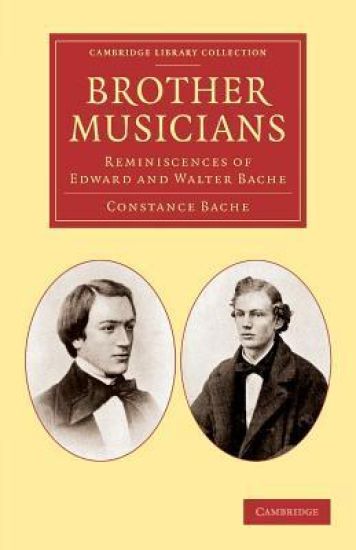
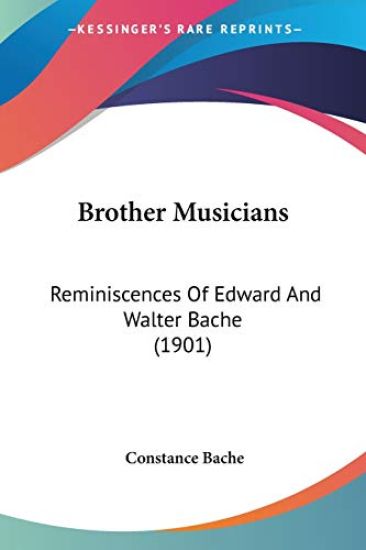
Francis Edward Bache (1833–58) and his younger brother Walter (1842–88) were active during a rich period of musical life in Britain. The Philharmonic Society and Crystal Palace concerts in London, the Hallé Orchestra in Manchester, and the Birmingham and Three Choirs festivals were all well established, while celebrated composer/conductors from Berlioz to Wagner and virtuosi including violinist Joseph Joachim and pianist Anton Rubinstein were in great demand. Edward, a pupil of Sterndale Bennett, was a promising organist and composer whose potential was tragically ended by his early death from tuberculosis. Walter, a pupil of Liszt from 1862 to 1865, became a dedicated promoter of the pianist/composer's music to the British concert-going public through annual concerts that he financed. First published in 1901, this affectionate account of the brothers' lives by their sister Constance (1846–1903) includes many letters as well as lists of Edward's compositions and Liszt's orchestral works performed at Walter's concerts.
This Element first discusses the creation of transmitted medical canons that are generally dated from early imperial times through the medieval era and then, by way of contrast, provides translations and analyses of non-transmitted texts from the pre-imperial late Shang and Zhou eras, the early imperial Qin and Han eras, and then a brief discussion covering the period through the 11th-c. CE. The Element focuses on the evolution of concepts, illness categories, and diagnostic and treatment methodologies evident in the newly discovered material and reveals a side of medical practice not reflected in the canons. It is both traditions of healing, the canons and the currents of local practice revealed by these texts, that influenced the development of East Asian medicine more broadly. The local practices show there was no real evolution from magical to non-magical medicine. This title is also available as Open Access on Cambridge Core.
The Religion Of The Luiseno Indians Of Southern California (1908)
Constance Goddard Dubois
KESSINGER PUBLISHING, LLC
2009
nidottu

The Silver Thread And Other Folk Plays For Young People (1910)
Constance D'Arcy Mackay
KESSINGER PUBLISHING, LLC
2010
pokkari

Woman's Handiwork In Modern Homes (1881)
Constance Cary Harrison
KESSINGER PUBLISHING, LLC
2010
pokkari
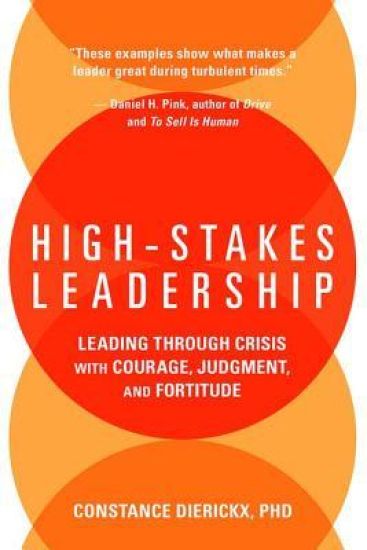
What makes some leaders so effective when the stakes are high, while others fall short? Why are some able to not only survive but to lead their organizations to new heights even in risky, fast-changing times? The answer is succinct but multi-layered: such leaders display courage, judgment, and fortitude. High-stakes leadership does not require unnatural powers, nor is it predicated on a dangerous situation. The three signature character traits can be cultivated by anyone at any level in any organization, big or small. Organizational and leadership consultant Constance Dierickx describes high-stakes leadership in a simple, three-part model that illuminates the mindsets, strategies, and tactics leaders must draw upon to make tough decisions, take an unpopular stand, or ignore convention, providing real-world examples across a range of sectors and industries. Dierickx developed her model of high-stakes leadership to help her clients—executives at organizations ranging from start-ups to nonprofits to large, global companies—better define what they need to bring strategy to life. This, she found, is the great gulf in business, the vast space between idea and results. High-Stakes Leadership helps leaders sharpen their ability to: act decisively, with clarity and focus test ideas using reason, and course correct as needed be resolute and inspire others to continue, even in the face of challenges Leading requires the courage to make conscious decisions about what to do, the judgment to separate information from short-term trends, and the fortitude to remain true to oneself and one’s mission. When leaders do these things, they also become teachers, leading their teams by example, often without realizing it. The essential aspects of good leadership endure even as the environment and tactics change. Indeed, courage, judgment, and fortitude are not merely tools for survival, they are the means by which we sculpt the future.