Kirjojen hintavertailu. Mukana 11 244 527 kirjaa ja 12 kauppaa.

Kirjahaku

Etsi kirjoja tekijän nimen, kirjan nimen tai ISBN:n perusteella.

868 tulosta hakusanalla Emerich Sumser

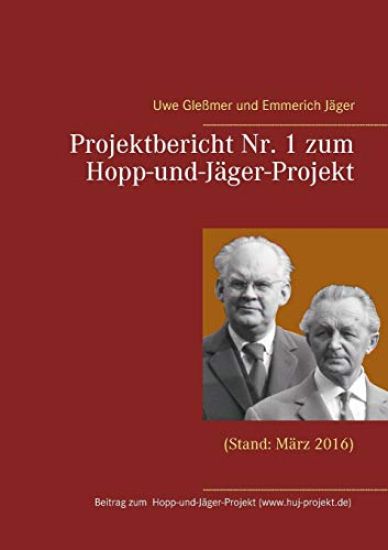
Projektbericht Nr. 1 zum Hopp-und-Jäger-Projekt

Projektbericht Nr. 1 zum Hopp-und-Jäger-Projekt

Uwe Gleßmer; Emmerich Jäger

Books on Demand
2016
pokkari
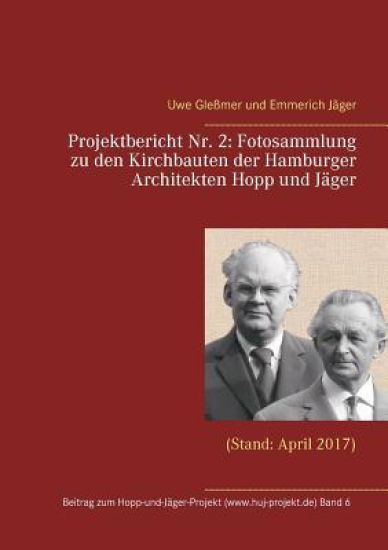
Der Projektbericht Nr. 1 versucht den gr ten Teil desjenigen Materials zusammenzustellen, das im Laufe von ca. 1 1/2 Jahren von den verschiedenen am Projekt beteiligten Mitgliedern des Teams und den weiteren Kooperationspartnern gesichtet und der Projektgruppe inzwischen f r Einzeluntersuchungen zug nglich ist. Die Zusammenarbeit beider Architekten im Blick auf gemeinsame Architektur-Entw rfe beginnt mit der Teilnahme am Wettbewerb f r das Ehrenmal an der Kleinen Alster 1930, ber dessen Erfolg mit einem zweiten Platz Fritz Schumacher in der Deutschen Bauzeitung von 1930 berichtet hat. Zu den H hepunkten der gemeinsamen Arbeit geh rt der Wiederaufbau der Hauptkirchen St. Katharinen und St. Jacobi-Kirche in der Hamburger Altstadt und die Einweihung des von ihnen entworfenen modernen St. Jacobi-Turmes 1961. Eines der wenigen Fotos, das beide Personen zeigt, ist auf dem vorderen Deckblatt abgebildet. Es wurde im Zusammenhang mit der Einweihung des Turmes vom Fotografen Walter L den aufgenommen.
Das bittere Leiden unseres Herrn Jesu Christi

Das bittere Leiden unseres Herrn Jesu Christi

Clemens Brentano; Anna Katharina Emmerich

Antigonos Verlag
2025
sidottu
Unver nderter Nachdruck der Originalausgabe von 1875. Der Verlag Antigonos spezialisiert sich auf die Herausgabe von Nachdrucken historischer B cher. Wir achten darauf, dass diese Werke der ffentlichkeit in einem guten Zustand zug nglich gemacht werden, um ihr kulturelles Erbe zu bewahren.
A Vocabulary of the Yoruba Language

A Vocabulary of the Yoruba Language

Sammuel Adjai Bp Crowther; Owen Emeric 1819-1854 Vidal

Hutson Street Press
2025
nidottu
"A Vocabulary of the Yoruba Language" by Samuel Adjai Crowther and Owen Emeric Vidal, originally published in 1852, offers a significant resource for understanding the Yoruba language during the mid-19th century. This vocabulary provides insights into the linguistic landscape and cultural context of the Yoruba people, making it a valuable historical document. The book serves as a foundational reference for scholars and students interested in African languages, linguistics, and the historical development of Yoruba. Its enduring appeal lies in its detailed compilation and its contribution to the preservation of linguistic heritage. This work has been selected by scholars as being culturally important, and is part of the knowledge base of civilization as we know it. This work was reproduced from the original artifact, and remains as true to the original work as possible. Therefore, you will see the original copyright references, library stamps (as most of these works have been housed in our most important libraries around the world), and other notations in the work. This work is in the public domain in the United States of America, and possibly other nations. Within the United States, you may freely copy and distribute this work, as no entity (individual or corporate) has a copyright on the body of the work. As a reproduction of a historical artifact, this work may contain missing or blurred pages, poor pictures, errant marks, etc. Scholars believe, and we concur, that this work is important enough to be preserved, reproduced, and made generally available to the public. We appreciate your support of the preservation process, and thank you for being an important part of keeping this knowledge alive and relevant.
will it ever go away?

will it ever go away?

Steven R Feldman; Veronica K Emmerich

Rand-Smith LLC
2020
pokkari
COVID-19 is the defining event of 2020 and possibly the decade. On March 11, 2020, the World Health Organization declared COVID-19 a global pandemic, and in the months since this declaration, the virus has shown no sign of relenting. This microscopic enemy has invaded every country and aspect of life, leading to a frantic global scramble for treatments, information, and an effective vaccine. The floodgate of scientific discoveries, public health guidelines, medical research, and misinformation has opened, creating a wealth of new and sometimes conflicting data. This book attempts to address the most urgent, immediate needs in a pandemic as well as some of the changes we are likely to see in a post-COVID-19 world through a succinct question-and-answer format. From "How do I properly wear a mask?" to "Is it safe to vacuum?" this book answers common questions about COVID-19 while offering guidance on ways to protect yourself, prepare for the future, and maintain your sanity.
A History of German Literature

A History of German Literature

Wolfgang Beutin; Klaus Ehlert; Wolfgang Emmerich; Helmut Hoffacker; Bernd Lutz; Volker Meid; Ralf Schnell; Peter Stein; Inge Stephan

Routledge
1993
sidottu
Since the appearance of its first edition in Germany in 1979, A History of German Literature has established itself as a classic work used by students and anyone interested in German literature. The volume chronologically traces the development of German literature from the Middle Ages to the present day. Throughout this chronology, literary developments are set in a social and political context. This includes a final chapter, written for this latest edition, on the consequences of the reunification of Germany in 1990. Thoroughly interdiscipinary in method, the work also reflects recent developments in literary criticism and history. Highly readable and stimulating, A History of German Literature succeeds in making the literature of the past as immediate and engaging as the works of the present. It is both a scholary study and an invaluable reference work for students.
A History of German Literature

A History of German Literature

Wolfgang Beutin; Klaus Ehlert; Wolfgang Emmerich; Helmut Hoffacker; Bernd Lutz; Volker Meid; Ralf Schnell; Peter Stein; Inge Stephan

Routledge
2014
nidottu
Since the appearance of its first edition in Germany in 1979, A History of German Literature has established itself as a classic work used by students and anyone interested in German literature. The volume chronologically traces the development of German literature from the Middle Ages to the present day. Throughout this chronology, literary developments are set in a social and political context. This includes a final chapter, written for this latest edition, on the consequences of the reunification of Germany in 1990. Thoroughly interdiscipinary in method, the work also reflects recent developments in literary criticism and history. Highly readable and stimulating, A History of German Literature succeeds in making the literature of the past as immediate and engaging as the works of the present. It is both a scholary study and an invaluable reference work for students.
Modern Portfolio Management

Modern Portfolio Management

Martin L. Leibowitz; Simon Emrich; Anthony Bova

John Wiley Sons Inc
2009
sidottu
Active 130/30 Extensions is the newest wave of disciplined investment strategies that involves asymmetric decision-making on long/short portfolio decisions, concentrated investment risk-taking in contrast to diversification, systematic portfolio risk management, and flexibility in portfolio design. This strategy is the building block for a number of 130/30 and 120/20 investment strategies offered to institutional and sophisticated high net worth individual investors who want to manage their portfolios actively and aggressively to outperform the market.
Whose Sacrifice is the Eucharist?

Whose Sacrifice is the Eucharist?

Stephen B. Sours; Edgardo Colon-Emeric

THE CATHOLIC UNIVERSITY OF AMERICA PRESS
2024
sidottu
This book explores what Catholics and Methodists believe about eucharistic sacrifice. Eucharistic sacrifice refers to the offering that Christ and his church make in the celebration of the Lord's Supper. It is, therefore, both a Christian doctrine and a church practice. The sacrificial dimension of the sacrament comes both from Christ's sacrifice on the cross and from his self-offering at the Last Supper in which Christ gives himself to the Father on behalf of his people. "This is my body, which is given for you" (Luke 22:19). The eucharist is a sacrificial meal because in the bread and cup Christians are united to the body and blood of Christ that was sacrificed for them on the cross. Moreover, the resurrected Lord is really present with his people in the eucharist, and while his historic crucifixion is an event in the past, Jesus' salvation continues and his grace is given to his people in the sacrament, "for this is my blood of the covenant, which is poured out for many for the forgiveness of sins" (Matthew 26:28). Catholics and Methodists believe that Jesus instructs his followers to repeat his words and actions from the Last Supper in their celebration of the eucharist, but a long running assumption is that Catholics and Methodists—following the historic Reformation schism—are deeply divided over eucharistic sacrifice. This book challenges that assumption by analyzing what these churches teach on eucharistic sacrifice from historical, sacramental, liturgical, and ecumenical perspectives. Key figures like Thomas Aquinas and John Wesley help define eucharistic sacrifice in each tradition. Subsequently, authoritative texts such as ecclesial statements, eucharistic prayers, and hymns further specify what Catholics and Methodists believe they are doing when they offer the eucharist to God. Sours argues that far from being divided, Catholics and Methodists have much in common regarding this controversial doctrine.