Kirjojen hintavertailu. Mukana 11 627 220 kirjaa ja 12 kauppaa.

Kirjahaku

Etsi kirjoja tekijän nimen, kirjan nimen tai ISBN:n perusteella.

1000 tulosta hakusanalla F.J. Doherty

The Evolution of Monetary Policy Strategies in Europe

The Evolution of Monetary Policy Strategies in Europe

Aerdt C.F.J. Houben

Springer-Verlag New York Inc.
2012
nidottu
Europe has a rich monetary history. Until recently, its many central banks assigned divergent priorities and pursued policy objectives via different routes. As a result, Europe's past provides fertile ground for those seeking practical guidance to the art ofcentral banking. The importance of this past gained a new dimension with the prospect of Economic and Monetary Union in 1999, as the participating countries were faced with the challenge of bridging their differences and forging a common monetary policy strategy that would apply throughout the new currency area. At the same time, these countries sought to build forth on the theretofore most successful central bank strategies, thereby maintaining a certain degree of policy continuity. Monetary policy strategy is at the core of central banking. This strategy determines how incoming information on economic developments is translated into monetary policy actions and how these policy actions are communicated to the public at large. In other words, the strategy fulfils the dual role ofimposing a structure on the internal policy-making process and ofproviding a vehicle for the external communication of this process. The design of a monetary policy strategy thus brings together key elements­ such as consistency and transparency - that together determine the effectiveness and credibility ofmonetary policy.
Operations in Persia

Operations in Persia

Brig -Gen F J Moberly

NAVAL MILITARY PRESS
2023
pokkari
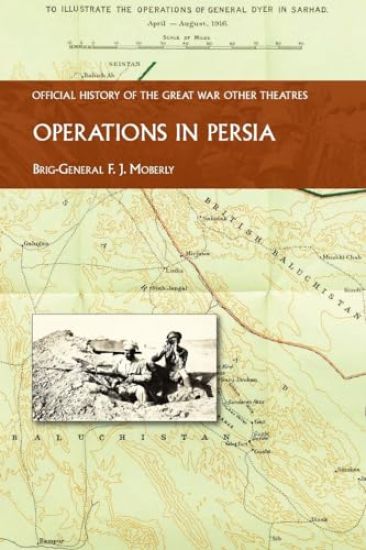
The story of Persia (today's Iran) during The Great War, when it was a major strategic player between the warring Turkish, Russian and British Empires - vital because of the oil riches in and around it. This volume tells how German attempts to stir up an Islamic Jihad were foiled, and how the situation was saved by Britain's 'Dunsterforce' after the Russian revolution.Persia (modern Iran) was a key strategic piece on the global chessboard of The Great War, placed as it was between Afghanistan and the warring Ottoman Turkish, Russian and British Empires. In 1914 Britain sent an Anglo-Indian force to Mesopotamia (modern Iraq) to deny the Turks access to the Persian oil fields. Germany retaliated by attempting to stir up an Islamic Jihad against the Allied incursion in Persia and India. This was foiled by the capture of German agents, as was a German attempt to kidnap the young Shah of Persia. Fighting between Russia and Turkey spilt over into Persia, and in the wake of the Russian collapse into revolution in 1918, Britain sent a small force - Dunsterforce - under Gen. Dunsterville into the Caucasus to encourage local resistance against the Turks and Germans. Although eventually withdrawing into Persia, Dunsterforce did succeed in denying the Turks access to the Baku oil fields until the armistice.
Operations in Persia

Operations in Persia

Brig -Gen F J Moberly

NAVAL MILITARY PRESS
2023
sidottu
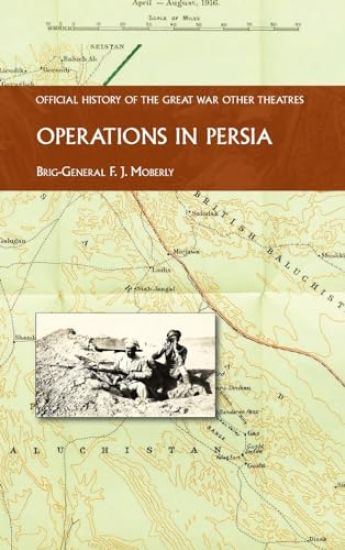
The story of Persia (today's Iran) during The Great War, when it was a major strategic player between the warring Turkish, Russian and British Empires - vital because of the oil riches in and around it. This volume tells how German attempts to stir up an Islamic Jihad were foiled, and how the situation was saved by Britain's 'Dunsterforce' after the Russian revolution.Persia (modern Iran) was a key strategic piece on the global chessboard of The Great War, placed as it was between Afghanistan and the warring Ottoman Turkish, Russian and British Empires. In 1914 Britain sent an Anglo-Indian force to Mesopotamia (modern Iraq) to deny the Turks access to the Persian oil fields. Germany retaliated by attempting to stir up an Islamic Jihad against the Allied incursion in Persia and India. This was foiled by the capture of German agents, as was a German attempt to kidnap the young Shah of Persia. Fighting between Russia and Turkey spilt over into Persia, and in the wake of the Russian collapse into revolution in 1918, Britain sent a small force - Dunsterforce - under Gen. Dunsterville into the Caucasus to encourage local resistance against the Turks and Germans. Although eventually withdrawing into Persia, Dunsterforce did succeed in denying the Turks access to the Baku oil fields until the armistice.
The Campaign in Mesopotamia

The Campaign in Mesopotamia

Brig -Gen F J Moberley

NAVAL MILITARY PRESS
2024
pokkari
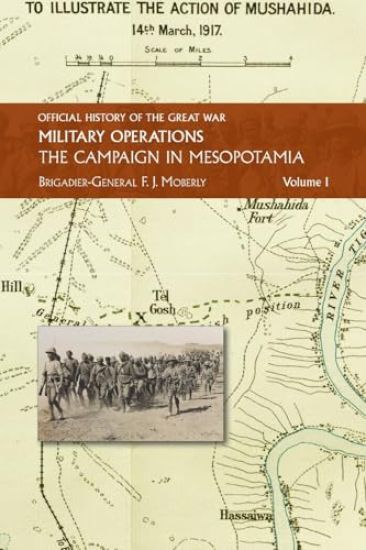
The first of four volumes covering the campaign in 'Mesop' (today's Iraq) that was fought mainly by Indian Army troops - only one British division was there, the 13th (Western) which arrived from Gallipoli in February 1916. This volume opens with background on the geography of the country, the pre-war political scene, the Turks, the Indian Army and the inception of the operations. The history of the campaign opens with the landing of Force 'D' in Mesopotamia in November 1914, the occupation of Basra and capture of Qurna. It covers the defeat of the Turkish counter-offensive, the capture of Amara in June 1915 and on to the Battle of Kut in September, concluding with the situation at the beginning of October 1915.
The Campaign in Mesopotamia

The Campaign in Mesopotamia

Brig -Gen F J Moberley

NAVAL MILITARY PRESS
2024
sidottu
The first of four volumes covering the campaign in 'Mesop' (today's Iraq) that was fought mainly by Indian Army troops - only one British division was there, the 13th (Western) which arrived from Gallipoli in February 1916. This volume opens with background on the geography of the country, the pre-war political scene, the Turks, the Indian Army and the inception of the operations. The history of the campaign opens with the landing of Force 'D' in Mesopotamia in November 1914, the occupation of Basra and capture of Qurna. It covers the defeat of the Turkish counter-offensive, the capture of Amara in June 1915 and on to the Battle of Kut in September, concluding with the situation at the beginning of October 1915.
The Campaign in Mesopotamia

The Campaign in Mesopotamia

Brig -Gen F J Moberley

NAVAL MILITARY PRESS
2024
sidottu
This volume, the second of four on the Mesoptamia (Iraq) campaign, covers October 1915 to April 1916 and begins immediately after the capture of Kut-al-Amara at the end of September by Gen. Townshend's British/Indian force, the main element of which was the 6th Indian Division. It describes the discussions that followed regarding the advisability of exploiting the capture of Kut by advancing on Baghdad. Among the doubters was Kitchener, but eventually the Cabinet decided to authorise the advance. There follows the account of operations in which the Turks halted the advance at Ctesiphon, causing Townshend to retreat to Kut where his force was besieged over the period of the next four months. The narrative describes the unsuccessful efforts of relief columns to get through (three attempts in all) and in the end Townshend was directed to open negotiations with the Turks, leading to the starving garrison's surrender on 29 April 1916. Nearly all the official records of the force in Kut dealing with the operations at Ctesiphon, the subsequent retreat and the siege were destroyed, so the author has had to rely to a great extent on private accounts which have also included the bad treatment of the garrison by the Turks. Numerous appendices give extracts from official documents, correspondence and details on order of battle and casualty figures. As the author says in his introduction: "This volume is mainly a recital of a series of British misfortunes".
The Campaign in Mesopotamia

The Campaign in Mesopotamia

Brig -Gen F J Moberley

NAVAL MILITARY PRESS
2024
pokkari
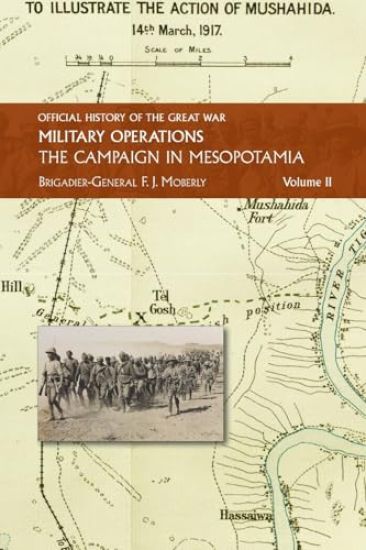
This volume, the second of four on the Mesoptamia (Iraq) campaign, covers October 1915 to April 1916 and begins immediately after the capture of Kut-al-Amara at the end of September by Gen. Townshend's British/Indian force, the main element of which was the 6th Indian Division. It describes the discussions that followed regarding the advisability of exploiting the capture of Kut by advancing on Baghdad. Among the doubters was Kitchener, but eventually the Cabinet decided to authorise the advance. There follows the account of operations in which the Turks halted the advance at Ctesiphon, causing Townshend to retreat to Kut where his force was besieged over the period of the next four months. The narrative describes the unsuccessful efforts of relief columns to get through (three attempts in all) and in the end Townshend was directed to open negotiations with the Turks, leading to the starving garrison's surrender on 29 April 1916. Nearly all the official records of the force in Kut dealing with the operations at Ctesiphon, the subsequent retreat and the siege were destroyed, so the author has had to rely to a great extent on private accounts which have also included the bad treatment of the garrison by the Turks. Numerous appendices give extracts from official documents, correspondence and details on order of battle and casualty figures. As the author says in his introduction: "This volume is mainly a recital of a series of British misfortunes".
The Campaign in Mesopotamia

The Campaign in Mesopotamia

Brig -Gen F J Moberley

NAVAL MILITARY PRESS
2024
pokkari
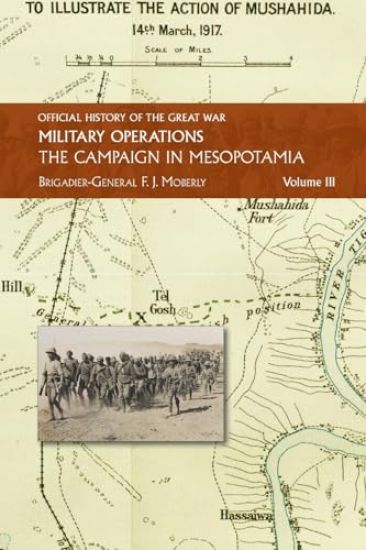
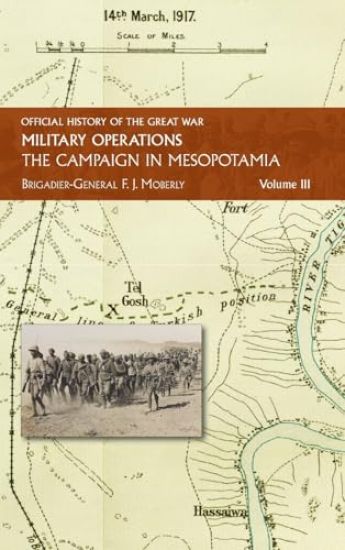
This third volume in the official four-volume history of the Mesopotamia (Iraq) campaign takes the story from May 1916 up to 30 April 1917, covering the battle of Kut-Al-Amara, the pursuit of the Turks, the occupation of Baghdad and the subsequent operations around Baghdad. During this period, command of the British forces had passed to General Maude, whose papers were made available to the author by the General's widow, Lady Maude. The Turkish troops proved to be tough opponents, especially on the River Tigris where their XVIII Corps made an heroic stand. Operations here are described in detail, since this phase in the Mesopotamian campaign is the only instance of continuous, close-trench fighting. Appendices provide detailed British and Indian Army order of battle information.
The Campaign in Mesopotamia

The Campaign in Mesopotamia

Brig -Gen F J Moberley

NAVAL MILITARY PRESS
2024
sidottu
This third volume in the official four-volume history of the Mesopotamia (Iraq) campaign takes the story from May 1916 up to 30 April 1917, covering the battle of Kut-Al-Amara, the pursuit of the Turks, the occupation of Baghdad and the subsequent operations around Baghdad. During this period, command of the British forces had passed to General Maude, whose papers were made available to the author by the General's widow, Lady Maude. The Turkish troops proved to be tough opponents, especially on the River Tigris where their XVIII Corps made an heroic stand. Operations here are described in detail, since this phase in the Mesopotamian campaign is the only instance of continuous, close-trench fighting. Appendices provide detailed British and Indian Army order of battle information.

The Campaign in Mesopotamia

The Campaign in Mesopotamia

Brig -Gen F J Moberley

NAVAL MILITARY PRESS
2024
sidottu
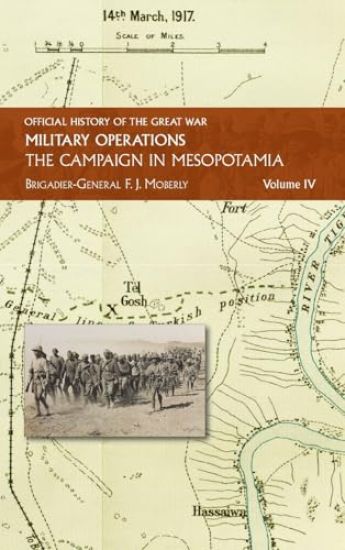
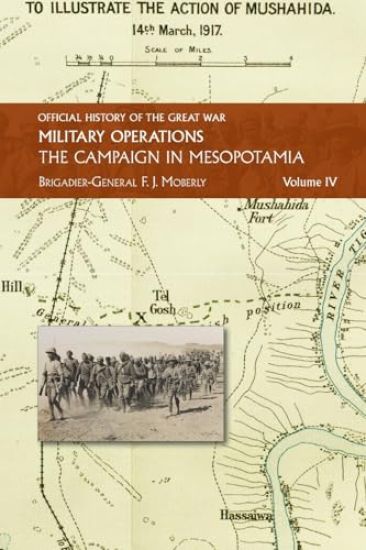
This concluding fourth volume in the Official History of the Mesopotamian campaign takes the story from May 1917 to the conclusion of hostilities and the armistice with Turkey, which came into force on 31 October 1918. It begins with a very useful chronological summary of the campaign in Mesopotamia, showing the respective periods and details of operations covered by each of the four volumes which constitute the history of the campaign. An extensive appendix gives details of the distribution of the troops of the Mesopotamia Expeditionary Force as on 27 May 1917 and, in the following appendix, compares the order of battle of the Turkish Sixth Army and its strength in rifles, sabres and machine guns on 17 August 1917. The narrative opens with the description of the River Euphrates operations and the British victory at Ramadi under General Maude, who tragically died of cholera on 18 November 1917. A very able commander, he was a great loss. Other operations described include NW Persia and the Dunsterville Force; in Kurdistan and on the shores of the Caspian Sea (occupation and defence of Baku); and the advance on Mosul. Only one British division, the 13th (Western), served in Mesopotamia compared with nine Indian divisions (including one cavalry). Total casualties amounted to 92,501, of whom 14,814 were killed in action or died of wounds while 12,807 died of disease. Appendices also give the distribution of the Mesopotamia Expeditionary Force on various dates and list the principal officers (brigadier-generals and above) in the Force on 1 December 1917 and 1 November 1918. There is a good index.
The Campaign in Mesopotamia

The Campaign in Mesopotamia

Brig -Gen F J Moberley

NAVAL MILITARY PRESS
2024
pokkari
This concluding fourth volume in the Official History of the Mesopotamian campaign takes the story from May 1917 to the conclusion of hostilities and the armistice with Turkey, which came into force on 31 October 1918. It begins with a very useful chronological summary of the campaign in Mesopotamia, showing the respective periods and details of operations covered by each of the four volumes which constitute the history of the campaign. An extensive appendix gives details of the distribution of the troops of the Mesopotamia Expeditionary Force as on 27 May 1917 and, in the following appendix, compares the order of battle of the Turkish Sixth Army and its strength in rifles, sabres and machine guns on 17 August 1917. The narrative opens with the description of the River Euphrates operations and the British victory at Ramadi under General Maude, who tragically died of cholera on 18 November 1917. A very able commander, he was a great loss. Other operations described include NW Persia and the Dunsterville Force; in Kurdistan and on the shores of the Caspian Sea (occupation and defence of Baku); and the advance on Mosul. Only one British division, the 13th (Western), served in Mesopotamia compared with nine Indian divisions (including one cavalry). Total casualties amounted to 92,501, of whom 14,814 were killed in action or died of wounds while 12,807 died of disease. Appendices also give the distribution of the Mesopotamia Expeditionary Force on various dates and list the principal officers (brigadier-generals and above) in the Force on 1 December 1917 and 1 November 1918. There is a good index.This third volume in the official four-volume history of the Mesopotamia (Iraq) campaign takes the story from May 1916 up to 30 April 1917, covering the battle of Kut-Al-Amara, the pursuit of the Turks, the occupation of Baghdad and the subsequent operations around Baghdad. During this period, command of the British forces had passed to General Maude, whose papers were made available to the author by the General's widow, Lady Maude. The Turkish troops proved to be tough opponents, especially on the River Tigris where their XVIII Corps made an heroic stand. Operations here are described in detail, since this phase in the Mesopotamian campaign is the only instance of continuous, close-trench fighting. Appendices provide detailed British and Indian Army order of battle information.

Vérité, Impartialité, Amour Du Roi, Ou Réplique À l'Auteur d'Un Pamphlet Ayant Pour Titre
Verite, impartialite, amour du roi, ou Replique a l'auteur d'un pamphlet ayant pour titre: Sur Napoleon et ses calomniateurs . Par X. F. J. Poillion-Dehanon, ...Date de l'edition originale: 1815Ce livre est la reproduction fidele d'une oeuvre publiee avant 1920 et fait partie d'une collection de livres reimprimes a la demande editee par Hachette Livre, dans le cadre d'un partenariat avec la Bibliotheque nationale de France, offrant l'opportunite d'acceder a des ouvrages anciens et souvent rares issus des fonds patrimoniaux de la BnF.Les oeuvres faisant partie de cette collection ont ete numerisees par la BnF et sont presentes sur Gallica, sa bibliotheque numerique.En entreprenant de redonner vie a ces ouvrages au travers d'une collection de livres reimprimes a la demande, nous leur donnons la possibilite de rencontrer un public elargi et participons a la transmission de connaissances et de savoirs parfois difficilement accessibles.Nous avons cherche a concilier la reproduction fidele d'un livre ancien a partir de sa version numerisee avec le souci d'un confort de lecture optimal. Nous esperons que les ouvrages de cette nouvelle collection vous apporteront entiere satisfaction.Pour plus d'informations, rendez-vous sur www.hachettebnf.fr
Des Bourbons Et Des Puissances Étrangères Au 20 Mars 1815
Des bourbons et des puissances etrangeres au 20 mars 1815Date de l'edition originale: 1815Sujet de l'ouvrage: France -- 1815 (Cent-Jours)Ce livre est la reproduction fidele d'une oeuvre publiee avant 1920 et fait partie d'une collection de livres reimprimes a la demande editee par Hachette Livre, dans le cadre d'un partenariat avec la Bibliotheque nationale de France, offrant l'opportunite d'acceder a des ouvrages anciens et souvent rares issus des fonds patrimoniaux de la BnF.Les oeuvres faisant partie de cette collection ont ete numerisees par la BnF et sont presentes sur Gallica, sa bibliotheque numerique.En entreprenant de redonner vie a ces ouvrages au travers d'une collection de livres reimprimes a la demande, nous leur donnons la possibilite de rencontrer un public elargi et participons a la transmission de connaissances et de savoirs parfois difficilement accessibles.Nous avons cherche a concilier la reproduction fidele d'un livre ancien a partir de sa version numerisee avec le souci d'un confort de lecture optimal. Nous esperons que les ouvrages de cette nouvelle collection vous apporteront entiere satisfaction.Pour plus d'informations, rendez-vous sur www.hachettebnf.fr