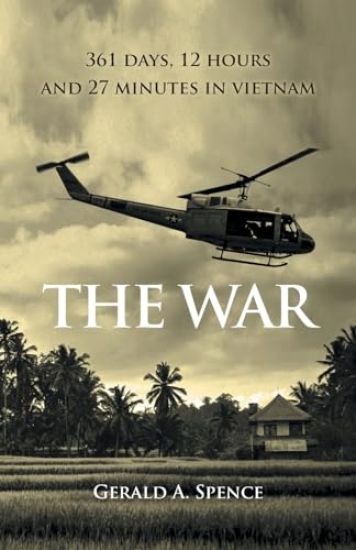
Ever wind up someplace you wish you hadn't gone?Abruptly drafted, Jerry Simpson was soon inducted into the strange and difficult ordeal of army life in Vietnam in the late sixties. Forced to leave his pregnant wife, he had a firsthand awakening to the brutality of war. A rare close-up look at the Vietnam War, The War: 361 days, 12 Hours, and 27 Minutes in Vietnam gives an eye-opening portrayal of this conflict from a young soldier's perspective. Based on one man's experience, this novel shifts from traumatic to humorous. As a soldier who came back to angry citizens calling him a criminal, Gerald A. Spence shares openly the grim reality of war and how young draftees adapted from stable civilian lives to the turmoil in Vietnam. In this moving and fascinating novel, witness the pain of separation and fear of the unknown through one transitioning from citizen to soldier before acclimating back to a hostile society. Join this soldier and see the excitement, humor, and life-changing experiences in The War: 361 Days, 12 Hours, And 27 Minutes in Vietnam.
Many women wanted to enter the men's world but it was not accessible. So they dressed as men and lived their dream. This is their story from around the world. All stories are true.
Till Time Comes to an End Impressions vague and amorphous, images liquid washing one into another, colors exchanged with shapes and tones and feel, dozing I realize I want to try to write it, why I don't know, why stop to take a snap, but that it holds a bit of truth, of reality, a moment not to lose; notebook open pen in hand, and it's gone as quick as it came, it's gone like a hobo, grabbing the next train to anywhere, that was then, was there; strange to feel it come and leave so fast, like a life I guess, like a life more or less, yes, like a glance or glimpse of things receding in the distance brings; everything grows smaller till it disappears, now a part of someone else's store, for a brief while seeming to have, forever and ever, time for more; in truth no time at all for the one or the other, abandoned in a valley, each now alone, without the other traveling on or staying, till time comes to an end 2007 October 6/7
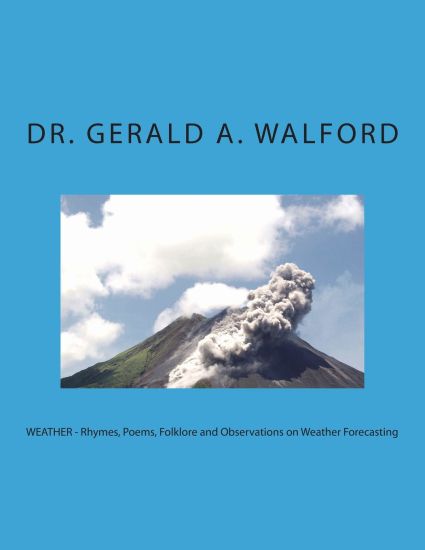
When we think of psychopaths we often think in terms of murder, violence, rape and other atrocious crimes. Many psychopaths are not physically violent but are in the everyday worlds of business, organizations, politics, religious groups, etc. In other words they are everywhere, maybe your next door neighbor or even in your own family. Being able to recognize the traits of the psychopath may save many problems in the future as psychopaths may not kill but they can destroy one's life mentally and emotionally. This book helps in recognizing the psychopath and how to cope with them. Dr. Gerald A. Walford earned his Ph.D. from the University of Maryland. He has written many books on sport sciences of skill learning and teaching. Much of his doctoral studies was on humor, its use and understanding. Dr. Walford has coached university hockey and golf and is a member of the Professional Golfers' Association of America (PGA).
Fragments Bits and pieces - motes of dust or the stuff of both dream and reality? Floating on a bit of what I hope is a little of the two I confess a certain sense of loss a kind of bereavement This was the best I could do through a life lengthening from - but to . . .
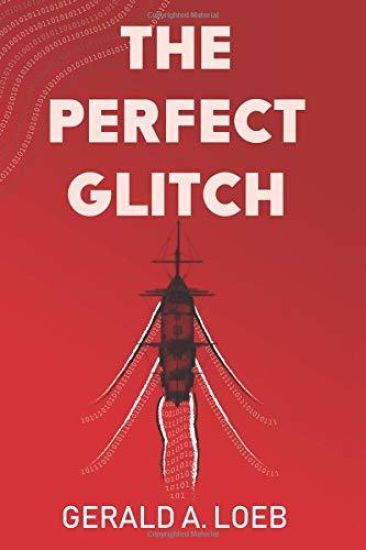
Tony Popejoy's life as an office drone changes when he starts playing Zeus, Navy-based, video-streaming on-line game. Culminating at a tournament in Harrison Creek, Kentucky, Tony and other gamers take turns being the Baddest Cyber Pirate on Planet Earth in the hopes of winning the $500,000 first prize. Two separate love stories swirl around this tourney, which makes for intrigue among the Cyber Pirates. Based on a real on-line game, "The Perfect Glitch" forms a story of corporate ambitions, back-door dealings of wily politicians, hidden Cyber viruses and the debut of a new web sensation: Roscoe the Spider.This book presents in the New Unreality of gaming into very real terms.
Will there be a time when we, as in a dream, possibly a lucid dream, come upon a book of stories and, curious, we open it, feel its heft, become aware of its many, many pages, begin to read one of them, and find it and all the others are us, our life's story? - Our lives - particles and waves. The observer might see only contradiction. We don't see. We feel. Sense, with more or less clarity, the oneness, the transitions, some smooth, others not, from the bits and the fragments to the glow and the flow. We are both. Because we too are light. Images, however remote, of The Light. - The first was life . . . drawn across the sky, the moon, the earth, mine it was, the images, so quickly did they go, then gone, from sight and eye. Now . . . now it is afterlife I see with such clarity . . . hers and mine and all the beloved, the few who chose to be, and to be so close to me. Am I going, or is it they who are growing . . . small?
I gathered a little literature, late, quite late, in life, after I had begun my lines of inquiry. It should have been the reverse, I know; it was a case of time, time running out. I had to leave some small tales about those I had loved. 2012 September 11
Primitives dashed off like this with no known craftsmanship no known lineage of master-son no known technique passed on is it any wonder doubts arise as to what it is, wishes to be but fit and free to flit here and there on the odd piece of paper to hope for more empty space than that lettered and tattooed as it were with marks vaunting their despair at ever stating the Case 2013 March 2
More Than the Eye Can SeeEvery rock and every stoneEvery tree and every limbEvery bloom and blossomEvery little field mouseAnd great hippopotamusEvery little precious childBefore and after being bornAnd every boy and girlEvery man and woman grownEvery human beingIn fine, all that has beenIs or will be: Far more than you Than I can see2014 November 25Always We prefer to start things at the beginning, finish them at the end. Nothing, or almost, seems to observe that simple canon. I just found out that a fellow student, one from Massachusetts, died this October; we trekked around Europe together, student-style, in the 50's. We had lost contact many years ago. But I imagine that when he died he was in the middle of something. An exciting new project. The anticipation of a visit from his son. A TV show. Reading a letter. Remembering. Or maybe it was just the breath he was taking in, letting out. We never seem ready; always in the middle of something2014 December 1
Adam Was Asked The linearity Of the book A necessity Of a look May be May be not Of A life The same When Adam Was asked To name Everything - was not The essence The all of it Expected to make To create the Name? All Adam did Was to hear By listening To the sound Of silence Of being Being born As letters In a line In a row No pretense They could know All the stuff - Far more than they Could ever hold 2015 March 20
Story A friend found this new "translation" of a Chinese Classic. It was in contemporary American English, very modern, up-to-date, cool, soothing too. It became a companion after which my friend modeled himself, secretly. Then he heard that someone came along, someone fluent in both (classical) Chinese and (current) English, and translated it back into Chinese. He later heard that, having somehow made it into the People's Republic, not a single Chinese person could make heads nor tails of it. My friend confessed to me that he is currently at (in) a textual sea. 2016 February 27
China and Taiwan have roughly one-eighth of the world's known species. Their approaches to biodiversity issues thus have global as well as national repercussions. Gerald McBeath and Tse-Kang Leng explore the ongoing conflicts between economic development, typically pursued by businesses and governments, and communities seeking to preserve and protect local human and ecosystem values. China and Taiwan have sharply different political and economic systems. In Taiwan, a public relatively more supportive of sustainable development, a free press, a more transparent decision-making process, and an autonomous civil society have influenced governance. Yet democratization has not guaranteed better environmental outcomes. In China, on the other hand, fragmentation of power and 'softer' forms of authoritarianism than in the Maoist era have created openings for NGOs, scientists, journalists, and officials seeking a sustainable future to participate in the environmental policy making process. The authors provide an explicit and comparative treatment of the national policies preserving rare, threatened, and endangered species and ecosystems. Considerable attention is paid to the actors involved in policy formation and implementation as well as to recent cases concerning biodiversity conservation in China and Taiwan.This comprehensive volume will appeal to students and researchers in the areas of political science, environmental science and politics, environmental activists in national and international NGOs, and members of multinational corporations working in developing countries.