Kirjahaku
Etsi kirjoja tekijän nimen, kirjan nimen tai ISBN:n perusteella.
1000 tulosta hakusanalla Gavin Edwards


Gavin Hamilton’s research shows that a toxin found in natural rubber might well have been the culprit in the 43 babies’ deaths at Toronto’s Hospital for Sick Children in 1980–81. In 1980-81, 43 babies died at Toronto’s Hospital for Sick Children from a supposed digoxin overdose. Serial murder was suspected, leading to the arrest of nurse Susan Nelles. In order to clear Nelles’s name, an investigation was launched to find an alternate explanation. No one on the Grange Royal Commission of Inquiry had expertise in diagnosis. The post-mortem diagnosis of digoxin poisoning was based on a single biochemical test without knowledge of the normal values. Gavin Hamilton’s extensive research shows that a toxin found in natural rubber, a digoxin-like substance, might well have been the culprit in the babies’ deaths. He clearly demonstrates that explanations other than serial murder account for the cluster of infant deaths at HSC. What can be learned from this black stain on Canada’s judicial system? One lesson certainly stands out: we can’t ever again allow a group of unqualified amateur diagnosticians make life-and-death decisions about such important matters as potential serial murders.

Historian Gavin K. Watt offers a fresh interpretation of the 1775 Invasion of Canada. In 1775, Governor Guy Carleton returned to Canada after a four-year absence in England to discover that political unrest in the American colonies was at a fever pitch. Soon after, open warfare erupted in Massachusetts, quickly followed by a rebel invasion.Historian Gavin K. Watt explores the first two campaigns of the American Revolution through their impact on Canada and describes how a motley group of militia, American loyalists, and British regulars managed to defend Quebec and repel the invaders.

Following a disastrous campaign in 1777, the alliance between the Six Nations and the British Crown became seriously strained. Relations were made even more difficult by the hands-off stance of Quebec’s governor, General Guy Carleton, which led to the Native leaders developing their own strategies and employing traditional tactics, leading to a ferocious series of attacks on the frontiers of Vermont, New York, and Pennsylvania, supported by Loyalist and Regular troops. Among these were two infamous actions, referred to as “massacres” by American historians — attacks on the Wyoming and Cherry Valleys. This destructive campaign prompted the Continental Congress to mount three major retributive expeditions against the territories of the Six Nations and their allies the following year.In Fire and Desolation, Gavin Watt details individual historical conflicts, illustrates the crushing tactical expertise of the Senecas and their Loyalist allies, and provides a fresh perspective on Canada’s involvement in the American Revolution and the unfolding events of 1778.
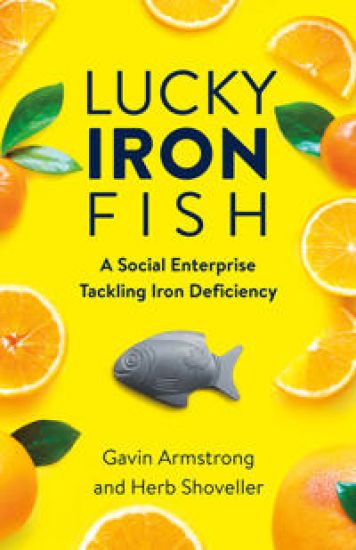
Research into iron deficiency and entrepreneurial determination brought the Lucky Iron Fish to cooking pots around the world. When Canadian researcher Dr. Christopher Charles was studying the devastation caused by iron deficiency in impoverished populations in Southeast Asia, he discovered an innovative way to help people get iron into their diets: place an iron ingot right into their cooking pots. Dr. Gavin Armstrong, a biomedical scientist and entrepreneur, built upon Charles’s findings to develop, manufacture, and distribute that ingot, which became the Lucky Iron Fish, a cost-effective solution to iron deficiency. The business thrived and the product was recognized around the world by NGOs and organizations such as World Vision, CARE International, Catholic Relief Services, and GlobalMedic. While sustaining growth through the pandemic was a challenge, Lucky Iron Fish met it head-on and now looks ahead to a bright future.




A small selection of designs for mannequins - and a visual re-imagining of the symbolism of the mannequin.

Swirling Dervish: a compilation of poems
Gavin D. McCall
Createspace Independent Publishing Platform
2011
nidottu
Non-Linear Estimation is a handbook for the practical statistician or modeller interested in fitting and interpreting non-linear models with the aid of a computer. A major theme of the book is the use of 'stable parameter systems'; these provide rapid convergence of optimization algorithms, more reliable dispersion matrices and confidence regions for parameters, and easier comparison of rival models. The book provides insights into why some models are difficult to fit, how to combine fits over different data sets, how to improve data collection to reduce prediction variance, and how to program particular models to handle a full range of data sets. The book combines an algebraic, a geometric and a computational approach, and is illustrated with practical examples. A final chapter shows how this approach is implemented in the author's Maximum Likelihood Program, MLP.


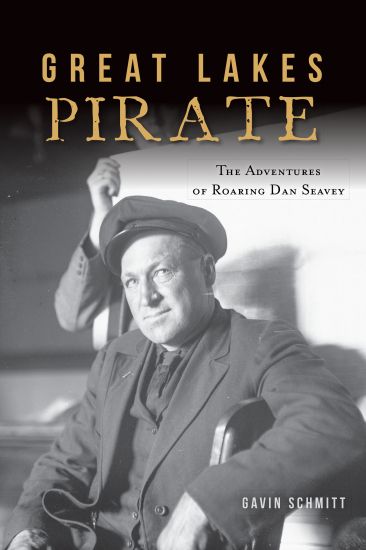
Hijacking. Arson. Buried treasure. Murder? The life and legend of "Roaring" Dan Seavey, pirate of Lake Michigan, have it all. Best known for its many natural wonders, Lake Michigan also claims the odd and dubious honor of home and stomping grounds of "Roaring" Dan Seavey, alleged to be the only pirate arrested on the Great Lakes. Aboard his ship, the Wanderer, Seavey's life at sea (or at lake) entangled him in all kinds of misadventures. The wanton sailor roamed to the wilds of Alaska, engaged in a brisk chase with the Coast Guard, and survived a raging inferno--and those are just the stories that can be confirmed. Legends of drunken brawls and grave robbing continue to follow Roaring Dan long after his death. Author Gavin Schmitt leads readers on a journey with one of Lake Michigan's most notorious sailors.
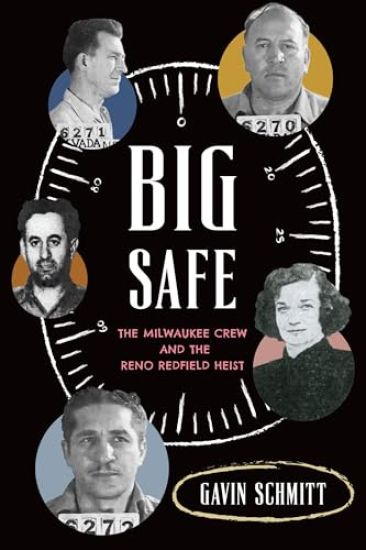
Some say it was the biggest theft in American history. Maybe it was.The multimillion-dollar burglary at eccentric gambler LaVere Redfield's Reno mansion was an endless comedy of errors. A target who hides from cameras and gets embarrassed for his dog. A failed songwriter "mastermind" who can't keep her mouth shut. A safecracker who can't pick a lock. And a convicted killer who allows his ill-gotten gains to be stolen while his pants are down. In almost every way, the 1952 Reno Heist is a study in how not to commit a crime, which is likely why the case lives on in infamy.Historian Gavin Schmitt unfolds the notorious misadventures of bumbling crooks, shady casino owners and femme fatales.