Kirjojen hintavertailu. Mukana 11 699 587 kirjaa ja 12 kauppaa.

Kirjahaku

Etsi kirjoja tekijän nimen, kirjan nimen tai ISBN:n perusteella.

1000 tulosta hakusanalla Geiger Ludwig

Perspectives on the History of Higher Education
Volume Twenty-Five of Perspectives on the History of Higher Education, the silver anniversary edition, offers three fresh contributions to the understanding of American higher education in the nineteenth century and three historical perspectives on topics of contemporary concern.The divergent paths of antebellum colleges in the North and South have long been recognized. Stephen Tomlinson and Kevin Windham discuss Alva Woods, who moved from Calvinist New England to preside over the new University of Alabama. Woods personified the commitment to evangelical Protestantism and rigid student discipline that prevailed in northern colleges of that era, but in Tuscaloosa confronted the sons of planters, raised to respect mainly independence, power, and the Southern code of honor. Adam Nelson considers geology, a crucially important science in early America that existed on the periphery of higher education but eventually exerted pressure for intellectual modernization. He portrays the small community of scientific pioneers who sought the latest scientific knowledge from Europe, surveyed the mineral wealth of American states, and advocated for science in the college curriculum.Beginning in the 1930s, the National Research Council waged an organized campaign to encourage academic patenting and centralize it within one organization. Jane Robbins explains the crosscurrents of interests that plagued and eventually scuttled that effort, but that set the stage for the contemporary practice of university patenting. Robert Hampel examines how, for more than four decades, students at Yale University took a major responsibility for learning into their own hands by publishing a Critique of courses. He analyzes these documents to determine if their aims were to identify easy or challenging offerings, and finds that this effort produced highly responsible articles. A review essay by Doris Malkmus sheds new light on the experience of co-eds in post-bellum universities and normal schools, while one by Nancy Diamond discusses the university presidency, and deftly shows that examining presidential lives can offer telling perspective on the evolution of the university.Roger L. Geiger is Distinguished Professor of Higher Education at the Pennsylvania State University. He has edited the Perspectives on the History of Higher Education Annual since 1993.

Perspectives on the History of Higher Education
The early twentieth century witnessed the rise of middle-class mass periodicals that, while offering readers congenial material, also conveyed new depictions of manliness, liberal education, and the image of business leaders. "Should Your Boy Go to College?" asked one magazine story; and for over two decades these middle-class magazines answered, in numerous permutations, with a collective "yes!" In the course of interpreting these themes they reshaped the vision of a college education, and created the ideal of a college-educated businessman.Volume 24 of the Perspectives on the History of Higher Education: 2005 provides historical studies touching on contemporary concerns--gender, high-ability students, academic freedom, and, in the case of the Barnes Foundation, the authority of donor intent. Daniel Clark discusses the nuanced changes that occurred to the image of college at the turn of the century. Michael David Cohen offers an important corrective to stereotypes about gender relations in nineteenth-century coeducational colleges. Jane Robbins traces how the young National Research Council embraced the cause of how to identify and encourage superior students as a vehicle for incorporating wartime advances in psychological testing. Susan R. Richardson considers the long Texas tradition of political interference in university affairs. Finally, Edward Epstein and Marybeth Gasman shed historical light on the recent controversy surrounding the Barnes Foundation.The volume also contains brief descriptions of twenty recent doctoral dissertations in the history of higher education. This serial publication will be of interest to historians, sociologists, and of course, educational policymakers.
Philadelphia Gentlemen

Philadelphia Gentlemen

Roger L. Geiger; E. Digby Baltzell

Routledge
2017
sidottu
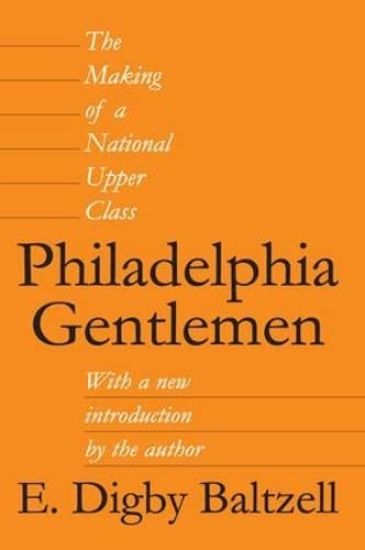
This proper Philadelphia story starts with the city's golden age at the close of the eighteenth century. It is a classic study of an American business aristocracy of colonial stock with Protestant affiliations as well as an analysis of how fabulously wealthy nineteenth-century family founders in Boston, New York, and Philadelphia, supported various exclusive institutions that in the course of the twentieth century produced a national upper-class way of life. But as that way of life became an end of itself, instead of an effort to consolidate power and control, the upper-class outlived its function; this, argues Baltzell, is precisely what took place in the Philadelphia class system.Philadelphia Gentlemen emphasizes that class is largely a matter of family, whereas an elite is largely a matter of individual achievement. The emphasis in Philadelphia on old classes, in contrast to the emphasis in New York and Boston on individual achievement and elite striving, helps to explain the dramatically different outcomes of ruling class domination in major centers of the Eastern Establishment. In emphasizing class membership or family prestige, the dynamics of industrial and urban life passed by rather than through Philadelphia. As a result in the race for urban preeminence, Philadelphia lost precious time and eventually lost the struggle for ruling preeminence as such.When the book initially appeared, it was hailed by The New York Times as "a very, very important book." Writing in the pages of the American Sociological Review, Seymour Martin Lipset noted that "Philadelphia Gentlemen says important things about class and power in America, and says them in ways that will interest and fascinate both sociologists and laymen." And in the American Historical Review, Baltzell's book was identified simply as "a gold mine of information." In short, for sociologists, historians, and those concerned with issues of culture and the economy, this is indeed a classic of modern social science.
To Advance Knowledge

To Advance Knowledge

Roger L. Geiger

Routledge
2017
sidottu
American research universities are part of the foundation for the supremacy of American science. Although they emerged as universities in the late nineteenth century, the incorporation of research as a distinct part of their mission largely occurred after 1900. To Advance Knowledge relates how these institutions, by 1940, advanced from provincial outposts in the world of knowledge to leaders in critical areas of science. This study is the first to systematically examine the preconditions for the development of a university research role. These include the formation of academic disciplines--communities that sponsored associations and journals, which defined and advanced fields of knowledge. Only a few universities were able to engage in these activities. Indeed, universities before World War I struggled to find the means to support their own research through endowments, research funds, and faculty time. To Advance Knowledge shows how these institutions developed the size and wealth to harbor a learned faculty. The book illustrates how arrangements for research changed markedly in the 1920s when the great foundations established from the Rockefeller and Carnegie fortunes embraced the advancement of knowledge as a goal. Universities emerged in this decade as the best-suited vessels to carry this mission. Foundation resources made possible the development of an American social science. In the natural sciences, this patronage allowed the United States to gain parity with Europe on scientific frontiers, of which the most important was undoubtedly nuclear physics. The research role of universities cannot be isolated from the institutions themselves. To Advance Knowledge focuses on sixteen universities that were significantly engaged with research during this era. It analyzes all facets of these institutions--collegiate life, sources of funding, treatment of faculty--since all were relevant to shaping the research role.
Life and Times of Fray Junipero Serra, V1-2: Or the Man Who Never Turned Back, 1713-1784
The book ""Life And Times Of Fray Junipero Serra, V1-2: Or The Man Who Never Turned Back, 1713-1784"" by Maynard J. Geiger is a two-volume biography of Fray Junipero Serra, a Spanish Franciscan friar who played a significant role in the establishment of missions in California during the 18th century. The first volume covers Serra's early life, from his birth in Majorca, Spain in 1713, to his arrival in Mexico in 1749. It traces his journey to becoming a Franciscan friar and his subsequent missionary work in Mexico, where he founded several missions and served as a teacher and administrator. The volume also explores Serra's involvement in the Spanish colonization of California, including his role as the president of the missions in the region.The second volume delves deeper into Serra's work in California, including the establishment of nine missions along the California coast. It also explores his relationships with the indigenous people of California and the challenges he faced in converting them to Christianity. The volume concludes with Serra's death in 1784 and his legacy in California and beyond.Throughout the book, Geiger provides a detailed and comprehensive account of Serra's life and work, drawing on primary sources such as Serra's letters and journals. The book is a valuable resource for anyone interested in the history of California, the Spanish colonization of the Americas, or the history of the Catholic Church.Two Volumes In One.This scarce antiquarian book is a facsimile reprint of the old original and may contain some imperfections such as library marks and notations. Because we believe this work is culturally important, we have made it available as part of our commitment for protecting, preserving, and promoting the world's literature in affordable, high quality, modern editions, that are true to their original work.
Souveranitatstraining

Souveranitatstraining

Gunar Musik; Iris Geiger-Musik

Lulu Press Inc
2015
nidottu
Konjekturen der Souveranitat: Beziehungsarbeit und Lustpolitik - Bedurfnis- und Illusionslosigkeit - Intellektuelles Jiu-jitsu und Humor - Netze des Signifikanten: Die Gunst der Stunde und der rechte Augenblick - Technik, Kunst und Magie: Die Praxis des Findens.
Perspectives on the History of Higher Education

Perspectives on the History of Higher Education

Roger L. Geiger

AldineTransaction
2005
nidottu
The early twentieth century witnessed the rise of middle-class mass periodicals that, while offering readers congenial material, also conveyed new depictions of manliness, liberal education, and the image of business leaders. "Should Your Boy Go to College?" asked one magazine story; and for over two decades these middle-class magazines answered, in numerous permutations, with a collective "yes!" In the course of interpreting these themes they reshaped the vision of a college education, and created the ideal of a college-educated businessman.Volume 24 of the Perspectives on the History of Higher Education: 2005 provides historical studies touching on contemporary concerns--gender, high-ability students, academic freedom, and, in the case of the Barnes Foundation, the authority of donor intent. Daniel Clark discusses the nuanced changes that occurred to the image of college at the turn of the century. Michael David Cohen offers an important corrective to stereotypes about gender relations in nineteenth-century coeducational colleges. Jane Robbins traces how the young National Research Council embraced the cause of how to identify and encourage superior students as a vehicle for incorporating wartime advances in psychological testing. Susan R. Richardson considers the long Texas tradition of political interference in university affairs. Finally, Edward Epstein and Marybeth Gasman shed historical light on the recent controversy surrounding the Barnes Foundation.The volume also contains brief descriptions of twenty recent doctoral dissertations in the history of higher education. This serial publication will be of interest to historians, sociologists, and of course, educational policymakers.
Perspectives on the History of Higher Education

Perspectives on the History of Higher Education

Roger L. Geiger

AldineTransaction
2006
nidottu
Volume Twenty-Five of Perspectives on the History of Higher Education, the silver anniversary edition, offers three fresh contributions to the understanding of American higher education in the nineteenth century and three historical perspectives on topics of contemporary concern.The divergent paths of antebellum colleges in the North and South have long been recognized. Stephen Tomlinson and Kevin Windham discuss Alva Woods, who moved from Calvinist New England to preside over the new University of Alabama. Woods personified the commitment to evangelical Protestantism and rigid student discipline that prevailed in northern colleges of that era, but in Tuscaloosa confronted the sons of planters, raised to respect mainly independence, power, and the Southern code of honor. Adam Nelson considers geology, a crucially important science in early America that existed on the periphery of higher education but eventually exerted pressure for intellectual modernization. He portrays the small community of scientific pioneers who sought the latest scientific knowledge from Europe, surveyed the mineral wealth of American states, and advocated for science in the college curriculum.Beginning in the 1930s, the National Research Council waged an organized campaign to encourage academic patenting and centralize it within one organization. Jane Robbins explains the crosscurrents of interests that plagued and eventually scuttled that effort, but that set the stage for the contemporary practice of university patenting. Robert Hampel examines how, for more than four decades, students at Yale University took a major responsibility for learning into their own hands by publishing a Critique of courses. He analyzes these documents to determine if their aims were to identify easy or challenging offerings, and finds that this effort produced highly responsible articles. A review essay by Doris Malkmus sheds new light on the experience of co-eds in post-bellum universities and normal schools, while one by Nancy Diamond discusses the university presidency, and deftly shows that examining presidential lives can offer telling perspective on the evolution of the university.Roger L. Geiger is Distinguished Professor of Higher Education at the Pennsylvania State University. He has edited the Perspectives on the History of Higher Education Annual since 1993.
Iconic Leaders in Higher Education

Iconic Leaders in Higher Education

Roger L. Geiger

AldineTransaction
2011
nidottu
Iconic leaders are those who have become symbols of their institutions. This volume of historical studies portrays a collection of college and university presidents who acquired iconic qualities that transcend mere identification with their institution.The volume begins with Roger L. Geiger's observation that creating and controlling one's image requires managing publicity. Andrea Turpin describes how Mount Holyoke Seminar's evolution into a modern women's college required reshaping the image of Mary Lyon, its founder. Roger L. Geiger and Nathan M. Sorber show how College of Philadelphia provost William Smith's partisan politics and patronage tainted the college he symbolized. Joby Topper reveals how presidents Seth Low of Columbia and Francis Patton of Princeton mastered the modern art of publicity.Katherine Chaddock explains how John Erskine—the Columbia University English professor responsible for the first Great Books program—and his unusual career inverted the normal route to iconic status. In contrast, Christian Anderson's analysis of John G. Bowman, chancellor of the University of Pittsburgh, shows how he substituted architectural vision for academic leadership. James Capshew explores the background that made Herman Wells a revered leader of Indiana University. Nancy Diamond details how building Brandeis University involved a challenging series of decisions successfully navigated by founding president Abram Sachar. Finally, Ethan Schrum depicts how Clark Kerr's controversial understanding of the role of contemporary universities was formed by his earlier career in industrial relations. This study of iconic leaders probes new dimensions of leadership and the construction of institutional images.
The Wisconsin Farm They Built: Tales of Family & Fortitude
The Next Generation Indie Book Awards Winner 2024Corey Geiger, international agricultural journalist and author of On a Wisconsin Family Farm, pairs his rural roots and lively storytelling talents to capture six generations of life in America's Dairyland.After his mother Anna was killed by a train, Elmer Pritzl was thrown into adulthood at the tender age of sixteen. A clever and crafty fellow, Elmer quickly found work at the local foundry. Promoted to foreman by age eighteen, he began supervising men double and even triple his age during the depths of the Great Depression. However, that professional career track ended abruptly five years later when Elmer fell in love with a farmer's daughter, Julia Burich. Six months after their wedding, Julia's father passed away, and with no living male relatives left in her life, Julia's mother, Anna Burich, asked, "Elmer, will you run my farm?" So, Elmer, born a city boy, transformed his life and began a love affair with a Wisconsin family farm.
500 Words To Know In Spanish (Library Edition)

500 Words To Know In Spanish (Library Edition)

Bradley C. Geiger

Createspace Independent Publishing Platform
2012
nidottu
Master 500 of the most important words and phrases you can use every day while speaking Spanish. Examples for business, dining, travel and more encourage rapid comprehension of vital topics. 500 Words To Know In Spanish is a streamlined guide to learning the basics of Spanish.
Dreaming of Other Realities

Dreaming of Other Realities

Matthew J. Geiger

Createspace Independent Publishing Platform
2013
nidottu
"When we, as a nation, are faced with a threat, we must unite our strengths against our common enemy. Our greatest city is a monument to our strength, so I believe it is no coincidence that it should be the place where that strength is tested most often. When we are faced with a threat that is so insidious and reclusive, as the one we are faced with today, we are obligated to sacrifice the few for the many, to isolate a small portion of our nation so this threat may be contained and not allowed to spread. This despicable creature, monster that we have uncovered in our greatest city must be hunted down before it is allowed to end the life of another man, woman, or child Although we are obligated to ask those trapped within this city's boundaries to sacrifice for the freedom of all, we must pray that their lives are not lost." From City Sanctions, Men and Their Galaxies, and Mind Games to Games of Immortal Men, the Strike of the Caduceus, and Inside the Wiccan Room explore an adventurous, inspiring collection of short stories.
Wildman

Wildman

J.C. Geiger

Hyperion
2018
nidottu
"How can a total stranger understand you better than the people you've known your entire life?"When Lance's '93 Buick breaks down in the middle of nowhere, he tells himself Don't panic. After all, he's valedictorian of his class. First-chair trumpet player. Scholarship winner. Nothing can stop Lance Hendricks. But the locals don't know that. They don't even know his name. Stuck in a small town, Lance could be anyone: a delinquent, a traveler, a maniac. One of the townies calls him Wildman, and a new world opens up. He's ordering drinks at a roadhouse. Jumping a train. Talking to an intriguing older girl who is asking about his future. And what he really wants. As one day blurs into the next, Lance finds himself drifting farther from home and closer to a girl who makes him feel a way he's never felt before-like himself. This debut novel by a remarkable new talent explores the relationship between identity and place, the power of being seen, and the speed at which a well-planned life can change forever.
A candle shrouded in darkness

A candle shrouded in darkness

Matthew J. Geiger

Createspace Independent Publishing Platform
2013
nidottu
Sin To be born under dim stars is to sin A sin greater than murder or rape, As thieves and assassins live more free, Takers of innocence hold less burden In a world where law values salt greater Paladins may throw copper in the streets But they keep charity for their own ranks Even at the cost of beauty lost, They chance not the anger of their gods, To be poor is the greatest sin of all Experience a poetic life story that explores human emotion from child-like wonder to love and despair as the reader progresses through the original chapters "The birth of beauty in the mind," "Living on the Edge," "Falling forever into the great destiny of life," "To the end of grace and the fall from a beautiful day," and "Descending deeper and deeper into the American nightmare," plus the all new "Lost Chapter."