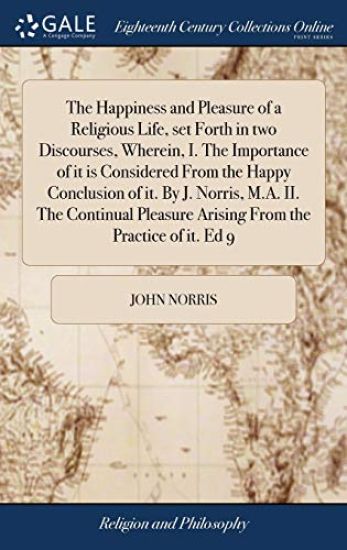
The 18th century was a wealth of knowledge, exploration and rapidly growing technology and expanding record-keeping made possible by advances in the printing press. In its determination to preserve the century of revolution, Gale initiated a revolution of its own: digitization of epic proportions to preserve these invaluable works in the largest archive of its kind. Now for the first time these high-quality digital copies of original 18th century manuscripts are available in print, making them highly accessible to libraries, undergraduate students, and independent scholars.Rich in titles on English life and social history, this collection spans the world as it was known to eighteenth-century historians and explorers. Titles include a wealth of travel accounts and diaries, histories of nations from throughout the world, and maps and charts of a world that was still being discovered. Students of the War of American Independence will find fascinating accounts from the British side of conflict. ++++The below data was compiled from various identification fields in the bibliographic record of this title. This data is provided as an additional tool in helping to insure edition identification: ++++British LibraryT121933Edinburgh: printed for G. Mudie and Son, 1797. 2], iii, 3],281, 1]p.; 8
The 18th century was a wealth of knowledge, exploration and rapidly growing technology and expanding record-keeping made possible by advances in the printing press. In its determination to preserve the century of revolution, Gale initiated a revolution of its own: digitization of epic proportions to preserve these invaluable works in the largest archive of its kind. Now for the first time these high-quality digital copies of original 18th century manuscripts are available in print, making them highly accessible to libraries, undergraduate students, and independent scholars.The Age of Enlightenment profoundly enriched religious and philosophical understanding and continues to influence present-day thinking. Works collected here include masterpieces by David Hume, Immanuel Kant, and Jean-Jacques Rousseau, as well as religious sermons and moral debates on the issues of the day, such as the slave trade. The Age of Reason saw conflict between Protestantism and Catholicism transformed into one between faith and logic -- a debate that continues in the twenty-first century.++++The below data was compiled from various identification fields in the bibliographic record of this title. This data is provided as an additional tool in helping to insure edition identification: ++++Cambridge University LibraryN032827London: printed for Edmund Parker, 1735. 48p.; 12
This book has been considered by academicians and scholars of great significance and value to literature. This forms a part of the knowledge base for future generations. So that the book is never forgotten we have represented this book in a print format as the same form as it was originally first published. Hence any marks or annotations seen are left intentionally to preserve its true nature.
Since the mid-1820s, a series of lectures has been delivered each year over the Christmas period in the world-famous Faraday Lecture Theatre at The Royal Institution of Great Britain by prominent scientists, addressed specifically to an audience of children. Initially made accessible in book form, the lectures have been nationally televised throughout the UK and distributed worldwide since the 1960s, making them accessible to an even larger audience. The importance of these lectures in promoting science to a broad audience is perhaps best gauged by the fact that an image of one of Faraday's lectures appeared on the Bank of England £20 note in the 1990s.This anthology brings together, for the first time, a carefully chosen selection of 11 lectures from the 1860s to the 1990s. The selection includes lectures by Michael Faraday, arguably the most important and influential 19th-century physicist, and Lawrence Bragg, the youngest ever winner of the Nobel Prize. Through this work, readers will come to grips with the changing nature of popular science lectures over the past 140 years.
Since the mid-1820s, a series of lectures has been delivered each year over the Christmas period in the world-famous Faraday Lecture Theatre at The Royal Institution of Great Britain by prominent scientists, addressed specifically to an audience of children. Initially made accessible in book form, the lectures have been nationally televised throughout the UK and distributed worldwide since the 1960s, making them accessible to an even larger audience. The importance of these lectures in promoting science to a broad audience is perhaps best gauged by the fact that an image of one of Faraday's lectures appeared on the Bank of England £20 note in the 1990s.This anthology brings together, for the first time, a carefully chosen selection of 11 lectures from the 1860s to the 1990s. The selection includes lectures by Michael Faraday, arguably the most important and influential 19th-century physicist, and Lawrence Bragg, the youngest ever winner of the Nobel Prize. Through this work, readers will come to grips with the changing nature of popular science lectures over the past 140 years.
Title: The Works of John Locke, etc. (The Remains of John Locke ... Published from his original manuscripts.-An account of the life and writings of John Locke by J. Le Clerc]. The third edition, etc.) With a portrait.]Publisher: British Library, Historical Print EditionsThe British Library is the national library of the United Kingdom. It is one of the world's largest research libraries holding over 150 million items in all known languages and formats: books, journals, newspapers, sound recordings, patents, maps, stamps, prints and much more. Its collections include around 14 million books, along with substantial additional collections of manuscripts and historical items dating back as far as 300 BC.The HISTORY OF PHILOSOPHY & ETHICS collection includes books from the British Library digitised by Microsoft. The works in this collection include expositions and scholarly analyses of philosophy and ethics for the earliest recorded Western religious and secular works. Documents concern prehistoric, medieval, and modern times, with background and historical narratives on Western thought. The collection provides insights into how philosophies have changed through history, what has driven these changes, and to what degree philosophical texts from prior eras are understood in the contemporary times of the authors. ++++The below data was compiled from various identification fields in the bibliographic record of this title. This data is provided as an additional tool in helping to insure edition identification: ++++ British Library Locke, John; 1722. 3 vol.; fol. 12268.i.7.

![Life in the South; From the Commencement of the War. by a Blockaded British Subject [S. L. J., i.e. Catharine Cooper Hopley]. Being a Social History of Those Who Took Part in the Battles, ... from the Spring of 1860 to August 1862. Vol. I. - War College Se](/covers/9781296476304.jpg)




![MS 23 Judeo-Spanish Traditional Ballads from Jerusalem. an Ethnomusicological Study. [Vol. I: Text.] by Israel J. Katz.: Volume 23](/covers/9780912024967.jpg)
![Such a Good Man! a Tale Written for Christmas by the Authors of Ready-Money-Mortiboy, This Son of Vulcan, Etc. [I.E. W. Besant and J. Rice].](/covers/9781240883943.jpg)
![The Magpie, or the Maid? a Melo Drame, in Three Acts. Translated and Altered from the French, by I. Pocock ... Second Edition. [An Adaptation of "La Pie Voleuse," by L. C. Caigniez and J. M. T. Baudouin D'Aubigny.]](/covers/9781241051983.jpg)
![The Magpie or the Maid? a Melo Drame, in Three Acts. Translated and Altered from the French, by I. Pocock, Etc. [an Adaptation of La Pie Voleuse, by L. C. Caigniez and J. M. T. Baudouin d'Aubigny.]](/covers/9781241061128.jpg)
![The Pleader's Guide. a Didactic Poem ... by the Late J. S. Esq. ... the Fifth Edition. [Edited, or Rather Written, by J. A., i.e. John Anstey.]](/covers/9781241074524.jpg)
![Mahomet the Impostor. a Tragedy. [In Verse. Adapted from the French of Voltaire, Acts I.-IV. by James Miller, ACT V. by J. Hoadly. with a Dedicatory Epistle by Dorothy Miller.]](/covers/9781241101831.jpg)
![Greenes Groatsworth of Witte, Bought with a Million of Repentance, Describing the Folly of Youth, and Falshood of Makeshift Flatterers, Etc. [Edited by J. H., i.e. John Hind?] B.L.](/covers/9781241143510.jpg)
![The Works of John Locke, etc. (The Remains of John Locke ... Published from his original manuscripts.-An account of the life and writings of John Locke [by J. Le Clerc]. The second edition, etc.) [With a portrait.] Vol. I.](/covers/9781241164287.jpg)