Kirjojen hintavertailu. Mukana 11 699 587 kirjaa ja 12 kauppaa.

Kirjahaku

Etsi kirjoja tekijän nimen, kirjan nimen tai ISBN:n perusteella.

1000 tulosta hakusanalla Jeremy Halstead

Modern NMR Spectroscopy

Modern NMR Spectroscopy

Jeremy K. M. Sanders; Brian K. Hunter

Oxford University Press
1993
nidottu
Nuclear magnetic resonsance (NMR) spectrocopy is the most powerful research tool used in chemistry today, but many chemists have yet to realize its true potential. Recent advances in NMR have led to a formidable array of new techniques - and acronyms - which leaves even the professional spectroscopist bewildered. How, then, can chemists decide which approach will solve their particular structural or mechanistic problem? This book provides a non-mathematical, descriptive approach to modern NMR spectroscopy, taking examples from organic, inorganic, and biological chemistry. It also contains much practical advice about the acquisition and use of spectra. Starting from the simple 'one pulse' sequence, the text employs a 'building block' approach to lead naturally to multiple pulse and two-dimensional NMR. Spectra of readily available compounds illustrate each technique. One- and two- dimensional methods are integrated in three chapters which show how to solve problems by making connections between spins through bonds, through space, or through exchange. There are also chapters on spectrum editing and solids. The final chapter contains a case history which attempts to weave the many strands of the text into a coherent strategy. This second edition reflects the progress made by NMR in the past few years; there is a greater emphasis on inorganic nuclei; some two-colour spectra are used; the treatment of heteronuclear experiments has moved from direct to 'inverse' detection; many new examples and spectra have been included; and the literature to early 1992 has been covered. An accompanying text, Modern NMR spectroscopy: A workbook of chemical problems, by Jeremy Sanders, Edwin Constable, and Brian Hunter, is available from OUP. Using a combination of worked examples and set problems, this workbook provides a practical guide to the accurate interpretation of NMR spectra, which will be of value to students and professional scientists alike.

Modern NMR Spectroscopy: A Workbook of Chemical Problems

Modern NMR Spectroscopy: A Workbook of Chemical Problems

Jeremy K. M. Sanders; Edwin C. Constable; Brian K. Hunter; Clive M. Pearce

Oxford University Press
1993
nidottu
Nuclear magnetic resonance techniques have advanced dramatically in recent years, and are now more powerful and more versatile than ever before. To exploit these techniques efficiently, the chemist must have both an understanding of their theoretical basis and the ability to interpret the spectra accurately. The new edition of this established workbook develops the latter skill to an advanced level by a combination of worked examples and set problems that cover one- and two-dimensional NMR techniques applied to organic and inorganic systems. Most of the problems are genuine research examples, and this new edition contains eight pages of problems drawn from very recent research work. This second edition is fully compatible with the second edition of Modern NMR Spectroscopy: a guide for chemists, and the two books are thoroughly cross referenced throughout.
Who Killed the Great Auk?

Who Killed the Great Auk?

Jeremy Gaskell

Oxford University Press
2000
sidottu
The Great Auk is one of the world's most famous extinct birds. It was undoubtedly a most curious creature: a flightless bird with tiny wings, it stood upright like a human, and sported an enormous beak. On land, the Great Auk was clumsy and awkward, but it was perfectly adapted for swift and efficient movement in the sea, where it spent the large part of the year. In its heyday, it populated the North Atlantic, from Western Europe across to North America, and was a familiar sight to islanders and coastal dwellers when, each May, it would climb ashore for the short breeding season. Yet by the mid-nineteenth century sightings of the bird were but rare occurrences, and just a few decades later even the most assiduous Victorian explorers could not find it. So what happened to the Great Auk? What - or who - caused it to disappear from the northern oceans? Jeremy A. Gaskell draws on eyewitness accounts spanning some four centuries to relate the tale of the Great Auk's extinction. He tells how the Great Auk was hunted by sailors, coastal dwellers, and merchants for its ample flesh, its eggs, and its soft down. He shows how the fate of the Great Auk was inextricably bound up with the prevailing social, economic, and political conditions of the late 18th century. It was also a result of widespread scientific misapprehensions about the nature and geographical range of this mysterious seabird. The disappearance of the Great Auk had a considerable impact on the public imagination of the late 19th Century. Specimens of the birds or their eggs soon began to fetch astronomical prices among collectors. Charles Kingsley used the last Great Auk as a character in The Water Babies. It became the stuff of legend. More importantly, its plight keenly interested a number of great Victorian ornithologists, men like John Wolley, Alfred Newton, and John James Audubon. Later, these self-same men were to cause some of the very first legislation on seabird protection to come into place. As a result this is also the story of the beginnings of bird conservation. This intriguing book takes the reader on a tour of some of the wildest and coldest places on earth, in its attempt to uncover the history of the last days of the Great Auk. We travel with Audubon to Labrador, sail to the remote Scottish island of St Kilda, experience the hardship of life in the colonies of Newfoundland, and follow the peregrinations of intrepid naturalists as they put to sea in search of the very last of the Great Auks. The text is enhanced by numerous maps, photographs, and line drawings, and includes a fine original colour frontispiece by Jan Wilczur.
Newspaper Power

Newspaper Power

Jeremy Tunstall

Oxford University Press
1996
nidottu
Based on 200 interviews with senior newspaper reporters and executives, this study examines the fate of Britain's national newspapers in the 1990s. The author makes illuminating comparisons between the Fleet Street of the 1960s and the 1990s, and defines the power and influence of the media.
The Book of Fallacies

The Book of Fallacies

Jeremy Bentham

Oxford University Press
2015
sidottu
The present edition of The Book of Fallacies is the first that follows Bentham's own structure for the work, and includes a great deal of material, both in terms of the fallacies themselves and the illustrative matter, that previous versions of the work have omitted. The fallacies that concerned Bentham were not logical errors of the sort identified by Aristotle, or commonplace misunderstandings of matters of fact, but arguments deployed in political debate, in particular in the British Parliament, in order to prevent reform. Bentham not only identified, described, and criticized the fallacious arguments in question, which were all characterized by their irrelevancy, but explained the sinister interests that led politicians to employ them and their supporters to accept them. By exposing these political fallacies, Bentham hoped to prevent their employment in future, and thereby to place political debate on its only proper ground, namely considerations drawn from the principle of utility.
Media Occupations and Professions

Media Occupations and Professions

Jeremy Tunstall

Oxford University Press
2000
nidottu
Journalists, television producers, and other media workers are members of newly powerful occupations, yet no broad study of media workers has until now been attempted. Media Occupations and Professions is the first major attempt to consider a broad range of media occupations and their historical development. This collection of essays confronts numerous occupational controversies and dilemmas: can a valid distinction be made between media 'crafts' and media 'professions'? What are the differences between media moguls, media barons, and media stars? Are media workers becoming not only more powerful, but also more insecure? How predictable are media careers and why do media occupations have such chaotic entry patterns? Media occupations are strongly influenced by national politics and culture; so this book includes pieces about media occupations not only in the USA and UK, but also in Africa, Australia, China, France, Germany, Japan, and Russia.
Music, Modernity, and God

Music, Modernity, and God

Jeremy Begbie

Oxford University Press
2015
nidottu
When the story of modernity is told from a theological perspective, music is routinely ignored—despite its pervasiveness in modern culture and the manifold ways it has been intertwined with modernity's ambivalent relation to the Christian God. In conversation with musicologists and music theorists, this collection of essays shows that the practices of music and the discourses it has generated bear their own kind of witness to some of the pivotal theological currents and counter-currents shaping modernity. Music has been deeply affected by these currents and in some cases may have played a part in generating them. In addition, Jeremy Begbie argues that music is capable of yielding highly effective ways of addressing and moving beyond some of the more intractable theological problems and dilemmas which modernity has bequeathed to us. Music, Modernity, and God includes studies of Calvin, Luther, and Bach, an exposition of the intriguing tussle between Rousseau and the composer Rameau, and an account of the heady exaltation of music to be found in the early German Romantics. Particular attention is paid to the complex relations between music and language, and the ways in which theology, a discipline involving language at its heart, can come to terms with practices like music, practices which are coherent and meaningful but which in many respects do not operate in language-like ways.
Computational Chemistry

Computational Chemistry

Jeremy Harvey

Oxford University Press
2018
nidottu
The renowned Oxford Chemistry Primers series, which provides focused introductions to a range of important topics in chemistry, has been refreshed and updated to suit the needs of today's students, lecturers, and postgraduate researchers. The rigorous, yet accessible, treatment of each subject area is ideal for those wanting a primer in a given topic to prepare them for more advanced study or research. The learning features provided, including exercises at the end of every chapter and online multiple-choice questions, encourage active learning and promote understanding. Moreover, cutting-edge examples and applications throughout the texts show the relevance to current research and industry of the chemistry being described. Computational Chemistry provides a user-friendly introduction to this powerful way of characterizing and modelling chemical systems. This primer provides the perfect introduction to the subject, leading the reader through the basic principles before showing the variety of ways in which computational chemistry is applied in practice to study real molecules, all illustrated by frequent examples. Online Resource Centre The Online Resource Centre to accompany Computational Chemistry features: For registered adopters of the text: · Figures from the book available to download For students: · Multiple-choice questions for self-directed learning
Writings on Political Economy

Writings on Political Economy

Jeremy Bentham

Oxford University Press
2016
sidottu
In the mid-1780s Bentham drafted his first sustained discussions of political economy and public finance for Projet Matière (itself part of Projet d'un corps de loix complet). Those discussions are now lost, but the corresponding marginal contents open this volume, followed by three closely related appendices. The volume continues with Defence of Usury, first published 1787, which was well received, quickly translated, and established some reputation for Bentham in political economy. In 1790, whilst preparing a second edition, Bentham drafted the raft of additional materials included here in five appendices. At the same time he began Manual of Political Economy, an introductory handbook which he never finished, while the surviving text appears here, supplemented by seven appendices. In March 1793 Bentham reacted to press reports of the Irish Budget by composing A Protest against Law Taxes, a trenchant critique of the taxation of legal proceedings, and the denial of justice to the poor, which was printed in 1793, published in 1795, and extended in 1816, and which completes the volume.
Ashworth's Principles of Criminal Law

Ashworth's Principles of Criminal Law

Jeremy Horder

Oxford University Press
2019
nidottu
Ashworth's Principles of Criminal Law, now in its ninth edition, takes a distinctive approach to the subject of criminal law, whilst still covering all of the vital topics found on criminal law courses. Uniquely theoretical, it seeks to enlighten the reader as to the underlying principles and theoretical foundations of the criminal law, critically engaging readers by contextualizing and analysing the law. This is essential reading for students seeking a sophisticated and critically engaging exploration of the subject. Online Resources The text is accompanied by online resources housing a full bibliography as well as a selection of useful web links.
Preparatory Principles

Preparatory Principles

Jeremy Bentham

Oxford University Press
2016
sidottu
Preparatory Principles is not a linear text in the conventional sense, but consists of a series of short passages on a variety of topics, whose themes are summarised in marginal headings. The material constitutes a philosophical commonplace book, compiled by Bentham in the mid-1770s, in which he worked out the foundational ideas for his new science of legislation. He then drew on this material when composing such works as A Fragment on Government and An Introduction to the Principles of Morals and Legislation. Inspired by such figures as John Locke and Claude Adrien Helvétius, Bentham developed an original ontological and epistemological basis for legal terminology, with the aim of replacing the traditional terminology of English law with that of universal jurisprudence. The work that dominates the text, in that Bentham returns to it time and time again in order to offer criticism of it, is William Blackstone's Commentaries on the Laws of England. While unorganized and fragmentary, the material in Preparatory Principles constitutes a remarkable record of the evolving ideas of a major legal philosopher at a formative stage of his career.
Whistleblowing

Whistleblowing

Jeremy Lewis; John Bowers QC; Martin Fodder; Jack Mitchell

Oxford University Press
2017
sidottu
First cumulative supplement to the 3rd Edition now available: http://bit.ly/2t1OxGO This book provides a detailed survey of the law relating to public interest disclosure. It examines how the system has developed since the coming into force of the Public Interest Disclosure Act 1998 (PIDA), and provides up-to-date practical guidance on the key issues that arise in practice. Analysing the legal framework in the area, both under PIDA and the disparate sources of law that can apply, it provides in-depth commentary on case law and legislative developments. It examines the structure of PIDA, litigation procedure and remedies under the Act, data protection, confidentiality, copyright, defamation issues, and the Human Rights Act 1998, as well as the contractual and fiduciary duties of employees, statutory obligations (both regulatory and criminal), and the Corporate Governance Codes. Since the publication of the second edition, there have been many developments in the area, including substantial procedural amendments for Employment Tribunals, major legislative changes brought in by the Enterprise and Regulatory Reform Act 2013 (ERRA) (the first major legislative change since the Public Interest Disclosure Act 1998), and the introduction of The Public Interest Disclosure (Prescribed Persons) Order 2014 SI 2014/2148 which now lists over 60 prescribed persons to whom a disclosure may be made. Written by an author team with extensive experience in the area, and making use of checklists and worked examples, this book is an essential reference work for employment practitioners dealing with cases involving public interest disclosure issues. It will also be of interest to private and public sector employers seeking guidance on whistleblowing procedures and policies.
The Limitations of the Open Mind

The Limitations of the Open Mind

Jeremy Fantl

Oxford University Press
2018
sidottu
When should you engage with difficult arguments against your cherished controversial beliefs? The primary conclusion of this book is that your obligations to engage with counterarguments are more limited than is often thought. In some standard situations, you shouldn't engage with difficult counterarguments and, if you do, you shouldn't engage with them open-mindedly. This conclusion runs counter to aspects of the Millian political tradition and political liberalism, as well as what people working in informal logic tend to say about argumentation. Not all misleading arguments wear their flaws on their sleeve. Each step of a misleading argument might seem compelling and you might not be able to figure out what's wrong with it. Still, even if you can't figure out what's wrong with an argument, you can know that it's misleading. One way to know that an argument is misleading is, counterintuitively, to lack expertise in the methods and evidence-types employed by the argument. When you know that a counterargument is misleading, you shouldn't engage with it open-mindedly and sometimes shouldn't engage with it at all. You shouldn't engage open-mindedly because you shouldn't be willing to reduce your confidence in response to arguments you know are misleading. And you sometimes shouldn't engage closed-mindedly, because to do so can be manipulative or ineffective. In making this case, Jeremy Fantl discusses echo chambers and group polarization, the importance in academic writing of a sympathetic case for the opposition, the epistemology of disagreement, the account of open-mindedness, and invitations to problematic academic speakers.
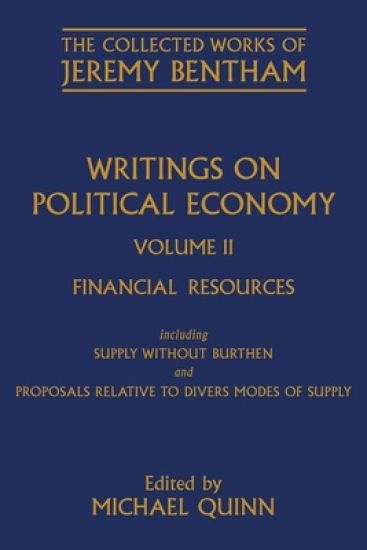
Writings on Political Economy

Writings on Political Economy

Jeremy Bentham

Oxford University Press
2019
sidottu
The works contained in this volume, 'Supply without Burthen' and 'Proposals relative to divers modes of Supply', were drafted by Bentham in 1794, during an intense period of activity in which he set out systematically to review possible sources of public revenue. Bentham had long believed that the appropriation of a proportion of the estates of those dying without near relations offered a painless method of raising public revenue, and now developed the proposal in detail, before sending a précis to Charles Long, Secretary to the Treasury. Fifteen months later that précis, with some additions, was published as 'Supply without Burthen', and opens the present volume. Bentham drafted considerable additional material for 'Supply without Burthen' which was neither sent to Long nor published, and which is the source for four Appendices in the present volume. By late September 1794, Bentham envisaged 'Supply without Burthen' as the first of a related series of proposals for generating public revenue. The remaining proposals ranged from further painless expedients, through taxation with compensatory benefit, to taxation pure and simple. Since Bentham viewed all these proposals as connected elements of a single generic enterprise, the fruits of his labours (excepting the proposal which he did publish, namely 'Supply without Burthen') are published together for the first time in the present volume as 'Proposals relative to divers modes of Supply'. This work is followed by six Appendices which shed further light on Bentham's approach to raising public revenue, including his first articulation of what would reappear five years later as his Annuity Note Scheme.
Global Health Governance in International Society

Global Health Governance in International Society

Jeremy R. Youde

Oxford University Press
2018
sidottu
In the 1980s, health was a marginal issue on the international political agenda, and it barely figured into donor states' foreign aid allocation. Within a generation, health had developed a robust set of governance structures that drive significant global political action, incorporate a wide range of actors, and receive increasing levels of funding. What explains this dramatic change over such a short period of time? Drawing on the English School of international relations theory, this book argues that global health has emerged as a secondary institution within international society. Rather than being a side issue, global health now occupies an important role. Addressing global health issues-financially, organizationally, and politically-is part of how actors demonstrate their willingness and ability to help realize their moral responsibility and obligation to others. In this way, it demonstrates how global health governance has emerged, grown, and persisted-even in the face of global economic challenges and inadequate responses to particular health crises. The book also shows how English School conceptions of international society would benefit from expanding their analytical gaze to address international economic issues and incorporate non-state actors. The book begins by building a case for using the English School to understand the role of global health governance before looking at global health governance's place in international society through case studies about the growth of development assistance for health, the international response to the Ebola outbreak, and China's role within the global health governance framework. .
Criminal Misconduct in Office

Criminal Misconduct in Office

Jeremy Horder

Oxford University Press
2018
sidottu
Should the criminal law be used to deter and punish corruption in politics: from employing family members at public expense to improper spending on elections, lobbying, and cronyism? How did so many MPs avoid facing charges after the 2009 government expenses scandal? In this book, Jeremy Horder tackles these questions and more. As well as offering the first treatment of the history, philosophy, and politics of the application of the offence of misconduct in office to Members of Parliament in England and Wales, Horder explains how political corruption might be dealt with in future, and how politicians could be held accountable for their actions so that they are deterred from betraying the public's trust. Use of the criminal law should not be the sole or even the main way to remedy all corruption in politics. Nevertheless, for too long the offence of misconduct in a public office has had an ambiguous status in the political realm. If we are to preserve the good health of government it must be seen as a constitutional fundamental. A charge of misconduct provides a way in which corrupt conduct on the part of legislators can be punished with an appropriate label, holding them to account for the misuse of power by reference to the standards of ordinary people. When other - civil law or regulatory - means prove insufficient, it should be possible for ordinary members of a jury, and not for Parliamentarians or other officials, to decide whether, for example, the expenditure of public money on legislators' private income and benefits amounts to a criminal abuse of the public's trust. This book offers an authoritative and accessible account of a 'bottom-up' (jury standards-led), as opposed to a 'top-down' (officials applying their own standards), approach to the role of the criminal law in constitutional contexts.
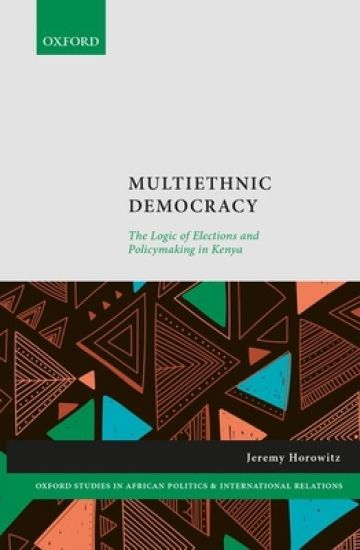
Multiethnic Democracy

Multiethnic Democracy

Jeremy Horowitz

Oxford University Press
2022
sidottu
Who are the swing voters in multiethnic democracies? How much effort do parties invest in courting the swing relative to mobilizing supporters in their core ethnic bases? And how does this balance affect the policies leaders propose - and implement - if elected? This book examines the logic of electoral competition and policymaking in the context of Kenya's emerging multiparty democracy. Using data on voters, campaigns, and policy outcomes, it shows that the pursuit of the swing encourages presidential candidates to offer broad, inclusive promises and for election winners to opt for universal policies that share benefits widely. In doing so, it challenges the view - common to both popular accounts and scholarly work - that where ethnicity is politically salient, multiparty competition inevitably leads parties to focus their electoral efforts on mobilizing narrow ethnic factions and to concentrate rewards on ethnic clientele. Oxford Studies in African Politics and International Relations is a series for scholars and students working on African politics and International Relations and related disciplines. Volumes concentrate on contemporary developments in African political science, political economy, and International Relations, such as electoral politics, democratization, decentralization, gender and political representation, the political impact of natural resources, the dynamics and consequences of conflict, comparative political thought, and the nature of the continent's engagement with the East and West. Comparative and mixed methods work is particularly encouraged, as is interdisciplinary research and work that considers ethical issues relating to the study of Africa. Case studies are welcomed but should demonstrate the broader theoretical and empirical implications of the study and its wider relevance to contemporary debates. The focus of the series is on sub-Saharan Africa, although proposals that explain how the region engages with North Africa and other parts of the world are of interest. Series Editors: Nic Cheeseman, Professor of Democracy and International Development, University of Birmingham; Peace Medie, Senior Lecturer in Gender and International Politics, University of Bristol; and Ricardo Soares de Oliveira, Professor of the International Politics of Africa, University of Oxford.
Birds in the Ancient World

Birds in the Ancient World

Jeremy Mynott

Oxford University Press
2020
nidottu
Birds pervaded the ancient world. They impressed their physical presence on the daily experience and imaginations of ordinary people in town and country alike, and figured prominently in literature and art. They also provided a fertile source of symbols and stories in their myths and folklore, and were central to the ancient rituals of augury and divination. Jeremy Mynott's Birds in the Ancient World: Winged Words brings together all this rich and fascinating material for the modern reader. Using quotations from well over a hundred classical Greek and Roman authors, all of them translated freshly into English, and nearly a hundred illustrations from ancient wall-paintings, pottery, and mosaics, Birds in the Ancient World illustrates the many different roles birds played in popular culture: as indicators of time, weather, and the seasons; as a resource for hunting, eating, medicine, and farming; as domestic pets and entertainments; and as omens and intermediaries between the gods and humankind. There are also selections from early scientific writings about birds, as well as many anecdotes and descriptions from works of history, geography, and travel. Jeremy Mynott acts as a stimulating guide to this varied material, using birds as a prism through which to explore both the similarities and the often surprising differences between ancient conceptions of the natural world and our own. His book is an original contribution to the flourishing interest in the cultural history of birds and to our understanding of the ancient cultures in which birds played such a prominent part.
Family-Run Universities in Japan

Family-Run Universities in Japan

Jeremy Breaden; Roger Goodman

Oxford University Press
2020
sidottu
Globally, private universities enrol one in three of all higher education students. In Japan, which has the second largest higher education system in the world in terms of overall expenditure, almost 80% of all university students attend private institutions. According to some estimates up to 40% of these institutions are family businesses in the sense that members of a single family have substantive ownership or control over their operation. This book offers a detailed historical, sociological, and ethnographic analysis of this important, but largely under-studied, category of private universities as family business. It examines how such universities in Japan have negotiated a period of major demographic decline since the 1990s: their experiments in restructuring and reform, the diverse experiences of those who worked and studied within them and, above all, their unexpected resilience. It argues that this resilience derives from a number of 'inbuilt' strengths of family business which are often overlooked in conventional descriptions of higher education systems and in predictions regarding the capacity of universities to cope with dramatic changes in their operating environment. This book offers a new perspective on recent changes in the Japanese higher education sector and contributes to an emerging literature on private higher education and family business across the world.
Family-Run Universities in Japan

Family-Run Universities in Japan

Jeremy Breaden; Roger Goodman

Oxford University Press
2023
nidottu
Globally, private universities enrol one in three of all higher education students. In Japan, which has the second largest higher education system in the world in terms of overall expenditure, almost 80% of all university students attend private institutions. According to some estimates up to 40% of these institutions are family businesses in the sense that members of a single family have substantive ownership or control over their operation. This updated edition of Family-Run Universities in Japan offers a detailed historical, sociological, and ethnographic analysis of this important, but largely under-studied, category of private universities as family business. It examines how such universities in Japan have negotiated a period of major demographic decline since the 1990s: their experiments in restructuring and reform, the diverse experiences of those who worked and studied within them and, above all, their unexpected resilience. It argues that this resilience derives from a number of 'inbuilt' strengths of family business which are often overlooked in conventional descriptions of higher education systems and in predictions regarding the capacity of universities to cope with dramatic changes in their operating environment. This book offers a new perspective on recent changes in the Japanese higher education sector and contributes to an emerging literature on private higher education and family business across the world.