Most qualitative researchers work on teams at some point. Qualitative Research and Complex Teams charts new methodological territory by providing hands-on help for qualitative researchers working on team projects. Useful to those working with a purely qualitative research design or mixed methods, the text provides a unique focus on writing and communications, offering strategies for all stages of the process from research design to final product. This volume provides an overview of the research related to team-based work, as well as a discussion of relevant changes in approaches to writing in the field. Readers will learn how to initiate team-based work through a digital tool kit approach, organize systems to insure efficiency, and undertake the process of bringing together and training diverse teams. Jargon-free, this book provides strong guidance for thinking about the joint arenas of methodological and substantive writing, and it develops ways to further the aims of both as the project proceeds.
This manual guides macro practitioners as they bring service users into the community planning process. The authors have developed the Community Development Planning Model (CDPM)-a cohesive eight step planning framework anchored in the concept of empowerment. This framework changes the relationship between service users and providers by structuring defined parallel and joint planning tracks that encourage not only service user participation but leadership, and promotes democratic decision-making. Using this model to engage service users encourages transparency, allows for the inclusion of minority voices, and increases planning and program effectiveness. This approach will be a significant asset in community planning and development courses. The author's manual helps students understand both the complexity of managing stakeholder relationships and the necessity of a rigorous evidence-informed approach to planning.
In Motion and the English Verb, a study of the expression of motion in medieval English, Judith Huber provides extensive inventories of verbs used in intransitive motion meanings in Old and Middle English, and discusses these in terms of the manner-salience of early English. Huber demonstrates how several non-motion verbs receive contextual motion meanings through their use in the intransitive motion construction. In addition, she analyzes which verbs and structures are employed most frequently in talking about motion in select Old and Middle English texts, demonstrating that while satellite-framing is stable, the extent of manner-conflation is influenced by text type and style. Huber further investigates how in the intertypological contact with medieval French, a range of French path verbs (entrer, issir, descendre, etc.) were incorporated into Middle English, in whose system of motion encoding they are semantically unusual. Their integration into Middle English is studied in an innovative approach which analyzes their usage contexts in autonomous Middle English texts as opposed to translations from French and Latin. Huber explains how these verbs were initially borrowed not for expressing general literal motion, but in more specific, often metaphorical and abstract contexts. Her study is a diachronic contribution to the typology of motion encoding, and advances research on the process of borrowing and loanword integration.
This specially-designed, practical, easy-to-use handbook presents reference data for health professionals, especially clinical geneticists, evaluating children and adults with abnormal features or syndromes. Using a mixture of graphs, tables, and charts, it presents information clinicians require to define 'normal' patterns of growth for various parts of the body, and provides the standards against which to compare possible congenital abnormalities. Numerous illustrations help to explain exactly how standardized measurements should be taken to ensure accurate and comparable documentation of growth patterns.
In this book, Judith Bennett addresses the gap in our knowledge of medieval country women by examining how their lives differed from those of rural men. Drawing on her study of an English manor in the early-fourteenth century, she finds that rural women were severely restricted in their public roles and rights primarily because of their household status as dependents of their husbands, rather than because of a notion of female inferiority. Adolescent women and widows, by virtue of their unmarried status, enjoyed greater legal and public freedom than did their married counterparts.
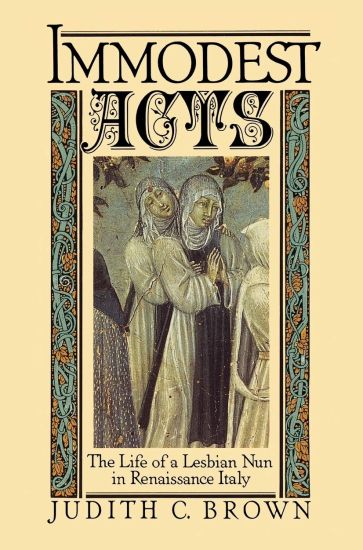
The discovery of the fascinating and richly documented story of Sister Benedetta Carlini, Abbess of the Convent of the Mother of God, by Judith C. Brown was an event of major historical importance. Not only is the story revealed in Immodest Acts that of the rise and fall of a powerful woman in a church community and a record of the life of a religious visionary, it is also the earliest documentation of lesbianism in modern Western history. Born of well-to-do parents, Benedetta Carlini entered the convent at the age of nine. At twenty-three, she began to have visions of both a religious and erotic nature. Benedetta was elected abbess due largely to these visions, but later aroused suspicions by claiming to have had supernatural contacts with Christ. During the course of an investigation, church authorities not only found that she had faked her visions and stigmata, but uncovered evidence of a lesbian affair with another nun, Bartolomeo. The story of the relationship between the two nuns and of Benedetta's fall from an abbess to an outcast is revealed in surprisingly candid archival documents and retold here with a fine sense of drama.
Based on personal accounts by birthing women and their medical attendants, Brought to Bed reveals how childbirth has changed from colonial times to the present. Judith Walzer Leavitt's study focuses on the traditional woman-centered home-birthing practices, their replacement by male doctors, and the movement from the home to the hospital. She explains that childbearing women and their physicians gradually changed birth places because they believed the increased medicalization would make giving birth safer and more comfortable. Ironically, because of infection, infant and maternal mortality did not immediately decline. She concludes that birthing women held considerable power in determining labor and delivery events as long as childbirth remained in the home. The move to the hospital in the twentieth century gave the medical profession the upper hand. Leavitt also discusses recent events in American obstetrics that illustrate how women have attempted to retrieve some of the traditional women--and family--centered aspects of childbirth.
Women brewed and sold most of the ale drunk in medieval England, but after 1350, men slowly took over the trade. By 1600, most brewers in London--as well as in many towns and villages--were male, not female. Drawing on a wide variety of sources--such as literary and artistic materials, court records, accounts, and administrative orders--Judith Bennett vividly describes how brewsters (that is, female brewers) slowly left the trade. She tells a story of commercial growth, gild formation, changing technologies, innovative regulations, and finally, enduring ideas that linked brewsters with drunkenness and disorder. Examining this instance of seemingly dramatic change in women's status, Bennett argues that it included significant elements of continuity. Women might not have brewed in 1600 as often as they had in 1300, but they still worked predominantly in low-status, low-skilled, and poorly remunerated tasks. Using the experiences of brewsters to rewrite the history of women's work during the rise of capitalism, Ale, Beer, and Brewsters in England offers a telling story of the endurance of patriarchy in a time of dramatic economic change.
The Mishnah is a book of legal rules produced by Jewish sages in second-century Palestine and is to a great extent still binding upon Orthodox Jews. In this pioneering work, Judith Wegner scrutinizes the mishnaic laws governing women, in an attempt to determine the image and status of women in the patriarchy the Mishnah portrays. She focuses on a specific question: did the Mishnah's creators regard women as persons, entities possessing legal rights, powers, and duties, or mere chattels, the property of some person or other? Considering a wide range of issues including women's ability to give legal testimony and enter into religious vows, the penalties for rape and seduction and the rules pertaining to betrothal, marriage, and divorce, Wegner discovers a curious paradox. In some circumstances the Mishnah clearly regards women as full legal persons, with the same rights and responsibilities as the adult Israelite male. At other times, however, the system treats women as virtual chattels of the men who control their lives. Through close analysis of individual cases, Wegner isolates the factors that generate differences in the treatment of women. She finds that these differences hinge on whether a woman is legally independent, or subject to some man's jurisdiction. The crucial point, she demonstrates, is the locus of ownership of the woman's sexual and reproductive function. Whoever owns a woman's sexuality exercises a degree of control over that function - and hence over the woman in question - that greatly resembles an owner's control of a chattel. For this reason the personhood of minor daughters, wives, and certain widows is circumscribed, whereas "emancipated" women such as adult daughters, divorcees, and most widows are virtually autonomous. Going beyond any previous study of the status of women in Jewish law, Chattel or Person? sheds new light on the almost indelible marks left by archaic socio-legal systems on attitudes toward women in modern western cultures. By enlarging our understanding of women in antiquity, it serves not only to illuminate the workings of one particular ancient system, but also to highlight some of the problems facing feminism in our time.
Minnie Fisher Cunningham was Texas's most important female political activist. After directing Texas's womans suffrage campaign, she helped establish the National League of Women Voters and the Woman's National Democratic Club. After an unsuccessful attempt to gain election to the US Senate, Cunningham evolved into a left feminist, increasingly aware that women could be oppressed by class and race as well as by gender. A leader of the post-1945 Texas liberal movement, she inspired a generation of young women, including Liz Carpenter and Billie Carr. This is the first biography of the lifelong politician affectionately known as Minnie Fish.
Women brewed and sold most of the ale drunk in medieval England, but after 1350, men slowly took over the trade. By 1600, most brewers in London--as well as in many towns and villages--were male, not female. Drawing on a wide variety of sources--such as literary and artistic materials, court records, accounts, and administrative orders--Judith Bennett vividly describes how brewsters (that is, female brewers) slowly left the trade. She tells a story of commercial growth, gild formation, changing technologies, innovative regulations, and finally, enduring ideas that linked brewsters with drunkenness and disorder. Examining this instance of seemingly dramatic change in women's status, Bennett argues that it included significant elements of continuity. Women might not have brewed in 1600 as often as they had in 1300, but they still worked predominantly in low-status, low-skilled, and poorly remunerated tasks. Using the experiences of brewsters to rewrite the history of women's work during the rise of capitalism, Ale, Beer, and Brewsters in England offers a telling story of the endurance of patriarchy in a time of dramatic economic change.
Change is constant in everyday life. Infants crawl and then walk, children learn to read and write, teenagers mature in myriad ways, the elderly become frail and forgetful. In addition to these natural changes, targeted interventions may cause change: cholesterol levels may decline as a result of a new medication, exam grades may rise following completion of a coaching class. By measuring and charting changes like these - both naturalistic and experimentally induced - researchers uncover the temporal nature of development. The investigation of change has fascinated empirical researchers for generations, and to do it well, they must have longitudinal data. Applied Longitudinal Data Analysis is a much-needed professional book that will instruct readers in the many new methodologies now at their disposal to make the best use of longitudinal data, including both individual growth modelling and survival analysis. Throughout the chapters, the authors employ many cases and examples from a variety of disciplines, covering multilevel models, curvilinear and discontinuous change, in addition to discrete-time hazard models, continuous-time event occurrence, and Cox regression models. Applied Longitudinal Data Analysis is a unique contribution to the literature on research methods and will be useful to a wide range of behavioural and social science researchers.
Agrippina the Younger ranks as one of the most powerful women in the history of the Roman empire. Judith Ginsburg's book provides a fresh look at both the literary and material representations of Agrippina. Her incisive study exposes both the contrivances of the commissioned artists whose idealized portraits served to buttress the image of the regime and the contrasting designs of the historians whose rhetorical stereotypes and negative depictions aimed to undermine it.
The principal orchestrator of the passage of women's suffrage in Texas, a founder and national officer of the League of Women Voters, the first woman to run for a U.S. Senate seat from Texas, and a candidate for that state's governor, Minnie Fisher Cunningham was one of the first American women to pursue a career in party politics. Cunningham's professional life spanned a half century, thus illuminating our understanding of women in public life between the Progressive Era and the 1960s feminist movement. Cunningham entered politics through the suffrage movement and women's voluntary association work for health and sanitation in Galveston, Texas. She quickly became one of the most effective state suffrage leaders, helping to pass the bill in a region where opposition to women voters was strongest. In Washington, Cunningham was one of the core group of suffragists who lobbied the Nineteenth Amendment through Congress and then traveled the country campaigning for ratification. After women gained the right to vote across the nation, she helped found the nonpartisan National League of Women Voters and organized training schools to teach women the skills of grassroots organizing, creating publicity campaigns, and lobbying and monitoring legislative bodies. Through the League, she became acquainted with Eleanor Roosevelt, who credited one of her speeches with stimulating her own political activity. Cunningham then turned to the Democratic Party, serving as an officer of the Woman's National Democratic Club and the Women's Division of the Democratic National Committee. In 1928 Cunningham became a candidate herself, making an unsuccessful bid for the U.S. Senate. An advocate of New Deal reforms, Cunningham was part of the movement in the 1930s to transform the Democratic Party into the women's party, and in 1944 she ran for governor on a pro-New Deal platform. Cunningham's upbringing in rural Texas made her particularly aware of the political needs of farmers, women, union labor, and minorities, and she fought gender, class, and racial discrimination within a conservative power structure. In the postwar years, she was called the "very heart and soul of Texas liberalism" as she helped build an electoral coalition of women, minorities, and male reformers that could sustain liberal politics in the state and bring to office candidates including Ralph Yarborough and Bob Eckhardt. A leader and role model for the post-suffrage generation, Cunningham was not satisfied with simply achieving the vote, but agitated throughout her career to use it to better the lives of others. Her legacy has been carried on by the many women to whom she taught successful grassroots strategies for political organizing.
The late thirteenth-century manuscript, Oxford, Bodleian Library Digby 86, contains a personal anthology of nearly 100 texts in French, English and Latin, including secular literature, devotional material, and texts with practical applications, ranging from medical care for humans and birds to games and party tricks. Many of the texts are unique to this manuscript. It contains 18 English texts, including lyrics, the earliest English Fabliau (Dame Sirith), and the beast-epic, `The Fox and the Wolf'. The manuscript, which was assembled by a layman associated with Redmarley d'Abitot (Gloucestershire), provides and important witness to the context in which these texts were preserved and read.
The Petra tombstones in Jordan are famed for their "baroque" architecture carved out of pink sandstone by the Nabataeans. This comprehensive survey, the first volume in the new British Academy Monographs in Archaeology series, dates many of the famous Petra monuments against similar rock-cut tombs at Medain Saleh in Saudi Arabia. Through close examination of the monuments as well as the little known remains of Ptolemaic Alexandria, the Hellenistic city founded by Alexander the Great, Murphy reveals that the earliest baroque architecture was that of Ptolemaic Alexandria. The style was then transmitted to Petra and Pompeii. Lavishly illustrated with over 700 photographs and figures, including a detailed catalog of the monuments, the volume uncovers Petra as a city, rather than merely a necropolis.
Union Booms and Busts takes a bird's eye view of the shifting fortunes of U.S. workers and their unions on the one hand, and employers and their organizations on the other. Using detailed data, this book analyses union density across 11 industries and 115 years, contrasting the organizing and union building successes and failures across decades. With attention to historical developments and the economic, political, and legal contexts of each period, it highlights workers' and their unions' actions, including strikes, union elections, and organizing strategies as well those of employers, who aimed to disrupt union organizing using legal maneuvers, workforce-based strategies, and race and gender divisions. By demonstrating how workers used strikes, elections, and other strategies to win power and employers used legal maneuvers, workforce-based strategies, and race and gender divisions to disrupt unions, the authors reveal data-driven truths about the ongoing history of unionization. Chapters follow time periods: the early unregulated period where unions took hold in only a handful of industries; the mid-century regulated period where strikes, elections, and union density grew across industries; and the later dis-regulated period where union trajectories diverged, with some industries seeing drastic decline and others holding steady. The book concludes by turning toward what might come next for workers and unions in America and provides access to on-line data for readers who want to take a closer look
The Music Professor Online is a practical volume that provides a window into online music instruction in higher education. Author Judith Bowman highlights commonalities between online and face-to-face teaching, presents a theoretical framework for online learning, and provides practical models and techniques based on interviews with professors teaching online in various music disciplines. This book offers keys for thinking about music education in a post-COVID world, when the importance and interest of online education is of central concern. Part I reviews the growth and significance of online learning and online learning in music, identifies similarities and differences between face-to-face and online teaching, and presents standards and principles for online instruction. It explores development of an online teaching persona, explains teaching presence, and emphasizes the central role of the instructor as director of learning, always in relation to specific disciplines and their signature pedagogies. Part II focuses on the lived online curriculum, featuring online teaching experiences in key fields by professors teaching them online. Bowman explores specific disciplines and their signature pedagogies together with practitioner profiles that provide insights into the thinking and techniques of excellent online music instructors, together with recommendations for prospective online instructors and lessons drawn from the field. Part III summarizes recommendations and lessons from online practitioners, presents an action plan for moving forward with online music instruction, and looks to the future of online instruction in music. Educators will find great use in this comprehensive, thoughtful compendium of reflections from a leading, longtime online music educator.