

Kirjahaku
Etsi kirjoja tekijän nimen, kirjan nimen tai ISBN:n perusteella.
1000 tulosta hakusanalla Kay Jackson
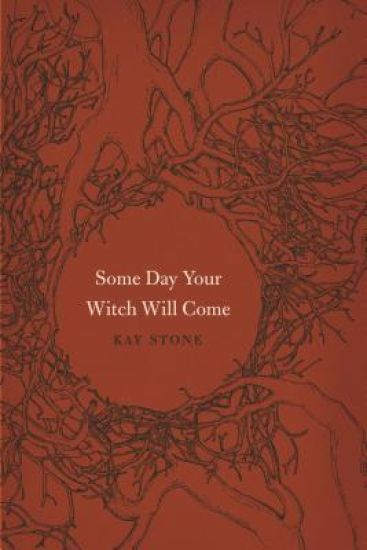
This book collects nearly thirty years of major work by noted writer and folklore scholar Kay Stone. In this enjoyable volume, Kay Stone has selected writings from her scholarly articles and books spanning 1975-2004 that contain reflections on the value of fairy tales as adult literature. The title ""Some Day Your Witch Will Come"" twists a Walt Disney lyric to challenge the typical fairy-tale framework and is a nod to Stone's innovative and sometimes unconventional perspective. As a whole, this collection is a fascinating look at both the evolution of a career and the recent history of fairy-tale scholarship.The volume is organized in three chronological sections, beginning with Stone's influential early work on women in fairy tales. The second section explores her developing interest in traditional tales told by contemporary tellers, and the final section focuses on Stone's more recent comparisons of dreams and folktales as artistic expressions. In addition to challenging the genres of folktales and storytelling, a distinctive feature of this work is the wealth of material from interviews, which bring readers' responses into conversation with the scholar's work. A preface by the author, a foreword by series editor Donald Haase, and brief introductions to each piece are also included.""Some Day Your Witch Will Come"" is an invaluable resource for anyone interested in Stone's writings. As such, it will be informative and entertaining for both general readers and scholars in a variety of fields, including folklore and fairy-tale studies, women's studies, psychology, cultural studies, and literature.

This book examines the relationship between competitive strategies and the use of temporary employees.

"Churchwide discussions on structure and growth tend to focus on the importance of increasing “butts in the pews and bucks in the plates.” Suggestions have been made on merging smaller dioceses to create larger ones and closing the doors of congregations which do not have Sunday attendance of at least 200. This is a model of scarcity without consideration of the value and abundance to be found in small churches. Discover the roles, possibilities, promise, and potential of being a small church! Travel with Kay Collier McLauglin as she takes the back roads and byways of the United States, visiting small churches that are making a difference in their community. Each chapter tells a story about an example of faithfulness in the life of a small congregation and relates that story to the essentials of faithful living and being church. The book challenges the decision-makers in the Episcopal Church to think beyond traditional measures and shortterm economic fixes to discover the life-giving opportunities and models presented by the smallest congregations.

From the inception of slavery as a pillar of the Atlantic World economy, both Europeans and Africans feared their mass extermination by the other in a race war. In the United States, says Kay Wright Lewis, this ingrained dread nourished a preoccupation with slave rebellions and would later help fuel the Civil War, thwart the aims of Reconstruction, justify Jim Crow, and even inform civil rights movement strategy. And yet, says Lewis, the historiography of slavery is all but silent on extermination as a category of analysis. Moreover, little of the existing sparse scholarship interrogates the black perspective on extermination. A Curse upon the Nation addresses both of these issues.To explain how this belief in an impending race war shaped eighteenth- and nineteenth-century American politics, culture, and commerce, Lewis examines a wide range of texts including letters, newspapers, pamphlets, travel accounts, slave narratives, government documents, and abolitionist tracts. She foregrounds her readings in the long record of exterminatory warfare in Europe and its colonies, placing lopsided reprisals against African slave revolts—or even rumors of revolts—in a continuum with past brutal incursions against the Irish, Scots, Native Americans, and other groups out of favor with the empire. Lewis also shows how extermination became entwined with ideas about race and freedom from early in the process of enslavement, making survival an important form of resistance for African peoples in America.For African Americans, enslaved and free, the potential for one-sided violence was always present and deeply traumatic. This groundbreaking study reevaluates how extermination shaped black understanding of the Atlantic slave trade and the political, social, and economic worlds in which it thrived.
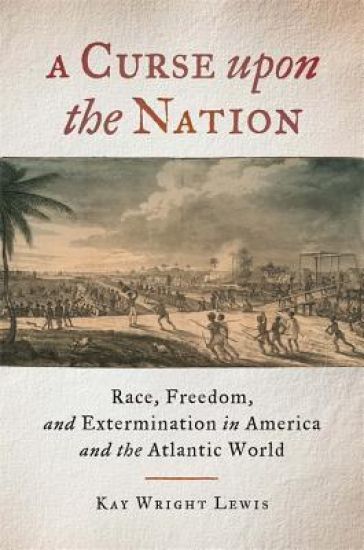
From the inception of slavery as a pillar of the Atlantic World economy, both Europeans and Africans feared their mass extermination by the other in a race war. In the United States, says Kay Wright Lewis, this ingrained dread nourished a preoccupation with slave rebellions and would later help fuel the Civil War, thwart the aims of Reconstruction, justify Jim Crow, and even inform civil rights movement strategy. And yet, says Lewis, the historiography of slavery is all but silent on extermination as a category of analysis. Moreover, little of the existing sparse scholarship interrogates the black perspective on extermination. A Curse upon the Nation addresses both of these issues.To explain how this belief in an impending race war shaped eighteenth- and nineteenth-century American politics, culture, and commerce, Lewis examines a wide range of texts including letters, newspapers, pamphlets, travel accounts, slave narratives, government documents, and abolitionist tracts. She foregrounds her readings in the long record of exterminatory warfare in Europe and its colonies, placing lopsided reprisals against African slave revolts—or even rumors of revolts—in a continuum with past brutal incursions against the Irish, Scots, Native Americans, and other groups out of favor with the empire. Lewis also shows how extermination became entwined with ideas about race and freedom from early in the process of enslavement, making survival an important form of resistance for African peoples in America.For African Americans, enslaved and free, the potential for one-sided violence was always present and deeply traumatic. This groundbreaking study reevaluates how extermination shaped black understanding of the Atlantic slave trade and the political, social, and economic worlds in which it thrived.
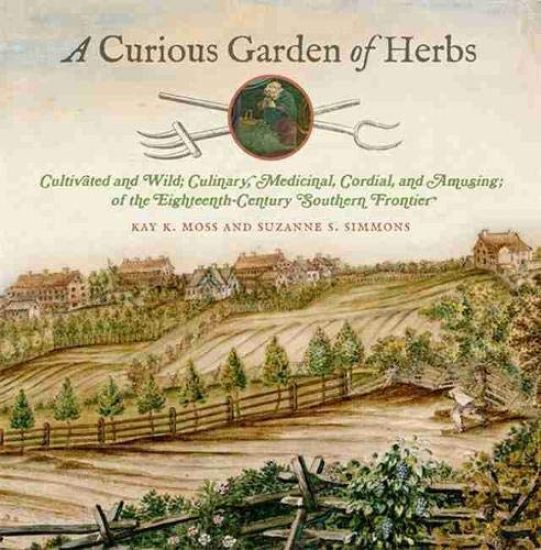
A Curious Garden of Herbs is a richly illustrated collection of herbal fact and lore that illuminates the "why" rather than the "how" of the historical kitchen garden. Rather than offering a how-to of gardening methods, Kay K. Moss and Suzanne S. Simmons trace herbs and their uses back to earlier times and places. A Curious Garden of Herbs is peppered with reflections and observations from manuscripts and published herbals that detail the historical uses and fascinating stories surrounding plants of documented interest in the early American South and mid-Atlantic.Practicality and necessity were the guiding theses for gardening in eighteenth- and early nineteenth-century rural and frontier settlements in the Southeast. There were plants for food, for seasoning, for medicine, for dye, for insect repellency, and for scent. While many of these plants were also decorative, utility dominated the rationale of backcountry gardeners. Unlike the experimental and exotic collections of Thomas Jefferson and other wealthy gentleman botanists, the gardens detailed in these pages are generally of the "middling sort"—of townspeople and farmers, of "housewives," merchants, and artisans. A Curious Garden of Herbs brings these everyday herbs to life with sixty historical illustrations. In addition to including the well-known varieties such as parsley, lavender, cucumber, and asparagus, this wonderfully illustrated catalog of more than a hundred plants also reveals new ways to enjoy violet, rose, and nasturtium. Moss and Simmons also encourage readers to invite lesser-known plants, such as wild purslane, mullein, and wood sorrel into their gardens and conversations.

Security Investments (Littlefield, Adams Quality Paperback Series)
Kay L. Scott
Rowman Littlefield
1981
nidottu
To find more information about Rowman and Littlefield titles, please visit www.rowmanlittlefield.com.
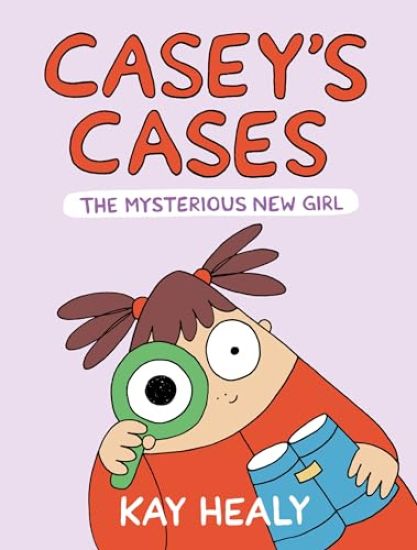
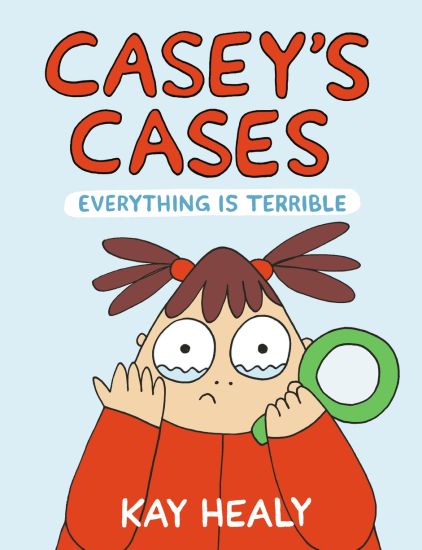
Diary of a Wimpy Kid meets Nancy Drew meets Amelia Bedelia in this hilarious young graphic novel series featuring an aspiring detective who will solve any case . . . usually accidentally. Casey wants nothing more than to be a detective. No mystery is too big or small for her to tackle OK, so she doesn't see everything coming--mean girl Dina always has the last word, and Casey is constantly falling into embarrassing disasters in front of cute boy AJ. But now, it's Casey's eleventh birthday, and she's just been given a magnifying glass and a pair of binoculars--perfect gifts for today's mystery: Mr. Muffin, a cat Casey's parents insist is too big to be a hungry stray. Will Casey manage to convince them he belongs with her? More importantly, could that new girl in school be the perfect contender for a new best friend? Casey's on the job, and she won't stop till all cases are closed. Fresh talent Kay Healy's winsome heroine, crackling wit, and charmingly geometric characters alchemize to comedy gold. Voracious young comics fans won't want to miss Casey's laugh-out-loud debut. A Junior Library Guild Gold Standard Selection


Teacher's Guide to Protecting Children
Kay Janet
Continuum International Publishing Group Ltd.
2003
nidottu
This book is intended to provide teachers with an accessible guide to their responsibilities to children who may have been abused, clarifying their role within the child protection system.The layout has been designed to ensure information can be found quickly, without teachers having to wade through excessive prose. It should also be an appropriate introductory text for a range of courses relating to teacher training.
This book examines mathematical discourse from the perspective of Michael Halliday's social semiotic theory. In this approach, mathematics is conceptualized as a multisemiotic discourse involving language, visual images and symbolism. The book discusses the evolution of the semiotics of mathematical discourse, and then, proceeds to examine the grammar of mathematical symbolism, the grammar of mathematical visual images, intersemiosis between language, visual images and symbolism and the subsequent ways in which mathematics orders reality. The focus of this investigation is written mathematical texts. The aims of the book are to understand the semantic realm of mathematics and to appreciate the metaphorical expansions and simultaneous limitations of meaning in mathematical discourse. The book is intended for linguists, semioticians, social scientists and those interested in mathematics and science education. In addition, the close study of the multisemiotic mature of mathematics has implications for other studies adopting a social semiotic approach to multimodality.
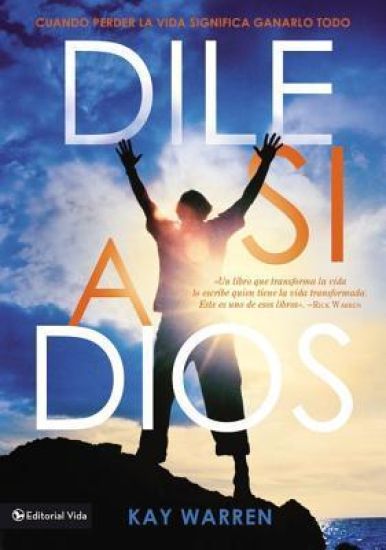
You have a plan for the rest of your life. God has a plan for the rest of your life. Are they the same? Say Yes to God---formerly titled Dangerous Surrender---will help you find the answer. You have expectations for how your life will play out, and you hope those plans will become realities. But what if God's plan for your life is far different from what you had in mind? Can you accept that? Will you surrender your goals for God's? Kay Warren had a plan. Together with her husband, Rick Warren, author of the megaseller The Purpose Driven Life, she planned that after her kids were grown, she'd travel the world, teaching and encouraging couples in ministry. It was a good plan. But it wasn't what God had in mind for her. In her own startling wake-up call, Kay discovered the shocking realities of the AIDS pandemic in Africa while reading a magazine. 'I want to use you ' she heard God say. That began the struggle---first to avoid God's call and then to surrender herself to God. She cried out to God, 'Why are you bothering me with this? There's nothing I can do about it. I'm just an ordinary person. What could one person do about such a gigantic problem' But God had grabbed her attention and wouldn't let go. If you've ever struggled with knowing and doing God's will, this book is for you. With raw honesty, Kay goes straight to the heart of the matter: the bottom line is surrender. Will you say yes to God? Along the way she'll introduce you to others---people like you---who have said yes to God and have made a difference in the world. Using their skills, energy, faith, and a willingness to take risks, they became powerful instruments of change and tools in God's hands. Giving in to God isn't easy. It's not for cowards. It's the boldest, riskiest step you'll ever take. This dangerous surrender can bring both joy and pain, both heartache and ecstasy, but it enables you to know God in a far deeper way than ever before. 'I had to make a conscious decision. Would I retreat to my comfortable life and to my settled plans? Or would I surrender to God's call and let my heart engage with the cause to which he called me one that I was pretty sure would include buckets of pain and sorrow? I felt like I was standing on the edge of a giant precipice; I couldn't go back, and yet the way forward looked like stepping into a void.' Kay Warren took that step, choosing to say yes to God. That decision transformed her life and reshaped her future. She invites you to do the same.
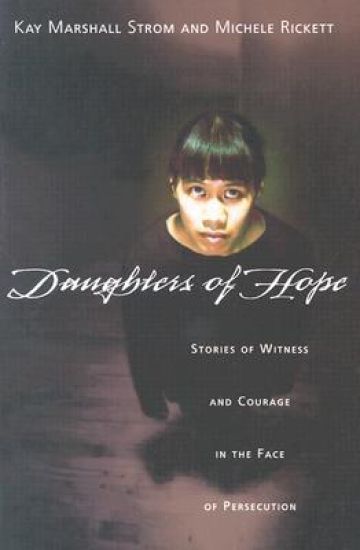
Daughters of Hope – Stories of Witness Courage in the Face of Persecution
Kay Marshall Strom; Michele Rickett
INTERVARSITY PRESS
2003
nidottu
Throughout the world today, Christians continue to face intense persecution, and Christian women are often the most vulnerable. In Pakistan, Christian girls are systematically kidnapped, tortured and raped. In China, underground church leaders are sent to labor camps for hosting illegal home meetings. In Sudan, Christian women are captured and sold into slavery or mutilated and left to die. And in many Muslim countries, a woman can be killed by her husband or father for converting to Christianity. In this deeply moving book, Kay Marshall Strom and Michele Rickett tell the stories of persecuted Christian women from around the world. From Africa to the Middle East to Asia, they give voice to our sisters persevering under the yoke of oppression and injustice. Each section provides specific prayer points and practical action steps to equip us to respond to the issues at hand. Above all, these stories remind us that suffering is part of the call of followers of Jesus. The challenges do not mean that God has abandoned us. Rather, God is active and present with his suffering people. Do not be discouraged. Take heart from these daughters of hope.
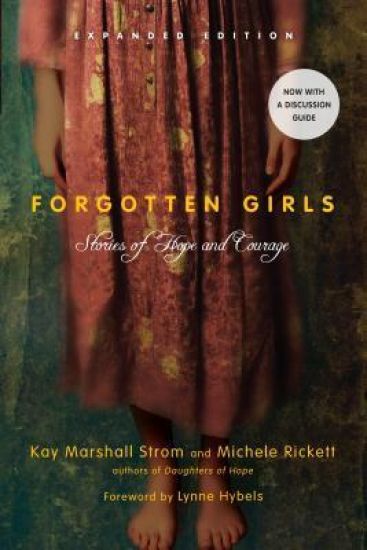
Forgotten Girls – Stories of Hope and Courage
Kay Marshall Strom; Michele Rickett; Lynne Hybels
Inter-Varsity Press,US
2014
nidottu
Readers' Choice Award Winner Think of the little girls you know: your daughter, a niece, a friend's child. Then think about this: little girls are tossed away every day. All over the world, women and girls face troubles such as starvation, displacement, illiteracy, sexual exploitation and abuse. In fact, statistics show that the world's most oppressed people are overwhelmingly female. Moved by the plight of these neglected girls, advocates Kay Marshall Strom and Michele Rickett took a trip across continents to interview girls and to partner with ministries working to help females in some of the most difficult places in the world. These pages hold those girls' stories: stories of deep pain and suffering, inspiring courage, and incredible hope. They are the stories of girls who have discovered their value in God's eyes, in the midst of cultures that have rejected them. They are stories of rescue and redemption by God working through compassionate people—people like you. These pages might hold pieces of your story as well, as the authors invite you to pray and speak on behalf of the millions of women and girls who still need to know how much they're worth. For each of the five sections of the book—physical suffering, education, sexual protection, prison and war, and spiritual life—the authors provide specific, practical action steps and prayer points that allow you to get involved as God leads. This expanded edition includes updated statistics throughout and a discussion guide to accompany each section of the book, as well as a new preface.

What's the key to improving the relationships in your life?You have cancer. . . now what?Everyone has advice: Eat more of this or less of that. Take chemo and she died. What should you believe? Faced with fear and an unknown future, you ask Where are you, God? Do you even hear me?Your battle with cancer will be physical, but first and foremost, it will be spiritual. Your Life with Cancer connects you with God and His faithfulness to you in this circumstance. You will find strength to trust Him with what you cannot understand.Your Life with Cancer doesn't promise a cure. But it will deliver hope, spiritual encouragement, and practical ways to cope. God will enable you to endure the fear and the treatment and come through with peace and joy.

Designed to complement every introductory library reference course, this is the perfect text for students and librarians looking to expand their personal reference knowledge, teaching failsafe methods for identifying important materials by matching specific types of questions to the best available sources, regardless of format. Guided by a national advisory board of educators and practitioners, this thoroughly updated text expertly keeps up with new technologies and practices while remaining grounded in the basics of reference work. Chapters on fundamental concepts, major reference sources, and special topics provide a solid foundation; the text also offers fresh insight on core issues, including:ethics, readers’ advisory, information literacy, and other key aspects of reference librarianship;selecting and evaluating reference materials, with strategies for keeping up to date;assessing and improving reference services;guidance on conducting reference interviews with a range of different library users, including children and young adults;a new discussion of reference as programming;important special reference topics such as Google search, 24/7 reference, and virtual reference; anddelivering reference services across multiple platformsAs librarians experience a changing climate for all information services professionals, in this book Cassell and Hiremath provide the tools needed to manage the ebb and flow of changing reference services in today’s libraries.